
A Market Divided
Signals are split evenly between offense and defense, pointing to a market at an inflection point.

SIGNAL SUMMARY
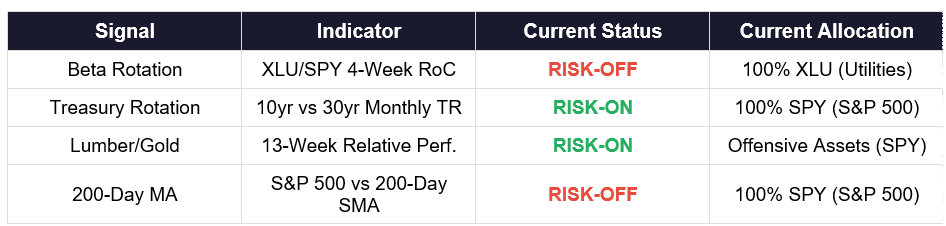
Key Takeaways:
• The Beta Rotation signal (XLU/SPY 4-week RoC of +1.65%) remains Risk-Off for the sixth consecutive week. Despite the S&P 500’s 3.4% weekly rally, utilities maintained their relative edge. XLU at $46.34 continues to attract defensive flows, reflecting persistent uncertainty even as equity markets bounced from oversold conditions.
• Signal 2 has flipped to Risk-On for the first time since February. With March monthly data now in, TLT returned -4.55% versus IEF at -2.60%. The 30-year bond’s underperformance versus the 10-year signals improving risk appetite on the long end of the curve — the exact flip we flagged in last week’s report. This rotation back to equities from long-duration Treasuries marks a meaningful shift.
• The Lumber/Gold signal remains Risk-On with lumber’s 13-week return of +11.91% outpacing gold’s +7.96%. Lumber’s 12% gain over the trailing quarter reflects housing resilience, while gold’s more modest advance signals less panic demand than in prior weeks. Unlike the previous forced-liquidation dynamics, this week’s reading carries more genuine economic signal.
• The S&P 500 at 6,582.68 sits -0.9% below its 200-day SMA of 6,644.6. Last week’s powerful 3.4% rally — the biggest weekly gain since May — has narrowed the gap from -3.9% to under 1%. The index is testing its 200-day from below, setting up a pivotal week. A decisive close above could flip Signal 4, bringing three of four signals to Risk-On for the first time since January. Trump’s Iran ultimatum expires today (April 6), creating a binary catalyst.
MARKET COMMENTARY
For the first time since February, the intermarket framework is evenly split: 2 signals read Risk-Off and 2 read Risk-On. The composition has shifted meaningfully from last week’s 3-1 defensive tilt. The Treasury Rotation signal flipped to Risk-On as March monthly data confirmed what we previewed: TLT’s -4.55% return underperformed IEF’s -2.60%, signaling the long end of the curve is under more stress than the intermediate. Combined with the persistent Lumber/Gold Risk-On, the framework has moved from defensive conviction to genuine ambiguity. The S&P 500 rallied 3.4% on the week — its biggest weekly gain since May — but at 6,583, it remains just below the 200-day moving average. Trump’s Iran ultimatum expires today, creating a binary catalyst that could break the deadlock in either direction.
The week of March 31–April 3 delivered a powerful relief rally. The S&P 500 surged 3.4%, snapping a five-week losing streak with the biggest daily gain since May on Tuesday. Goldman Sachs noted the sell-off had improved the near-term technical setup, with Q1 earnings season (12% growth expected) providing a potential fundamental floor. The index clawed back from 6,369 to close at 6,583, erasing roughly half of March’s decline. But the rally came on falling volume and narrowing breadth — hallmarks of a bear market bounce rather than a durable trend reversal. The S&P 500 remains 4.6% below its year-end close and roughly 5.7% below its January peak of 6,978.
The 200-Day Moving Average is the critical level to watch this week. The S&P 500 at 6,582.68 sits just -0.9% below its 200-day SMA of 6,644.6 — a dramatic improvement from -3.9% last week. This convergence sets up one of the most consequential technical tests of the year: a decisive close above the 200-day would flip Signal 4 to Risk-On, potentially bringing three of four signals to Risk-On for the first time since January. April is historically the second-best month for the S&P 500, and Q1 earnings provide a potential catalyst. But the index has failed at its 200-day twice already in 2026, and the Iran resolution (or escalation) could overwhelm any technical setup.
The Beta Rotation signal (XLU/SPY 4-week RoC of +1.65%) remains Risk-Off for the sixth consecutive week. Despite the broad market rally, XLU at $46.34 maintained relative strength. The 4-week RoC has moderated from +3.33% last week to +1.65%, suggesting the defensive tide may be receding — but has not yet turned. The ratio has been positive since late February, one of the longest sustained defensive streaks in recent memory. If the S&P 500 clears its 200-day and the rally broadens, we would expect this signal to be the next to flip, potentially by mid-April.
The Treasury Rotation signal has flipped to Risk-On — exactly as we flagged in last week’s report. March monthly data shows TLT at -4.55% versus IEF at -2.60%. Both lost ground, but the 30-year bond’s steeper decline signals that long-duration is being sold more aggressively than intermediate. This is not a “safe haven” signal — it’s a yield curve signal. The 30-year yield remains elevated near 5% as the market prices in persistent inflation from $111+ Brent crude and the possibility that the Fed may not cut rates this cycle. The signal’s rotation from Treasuries back to equities (SPY) reflects the market’s judgment that stocks offer better risk-adjusted exposure than long-duration bonds in an inflationary regime.
The Lumber/Gold signal remains Risk-On with lumber’s 13-week return at +11.91% versus gold’s +7.96%. Unlike prior weeks when this reading was dismissed as a forced-liquidation artifact, the signal is now carrying more genuine economic information. Lumber’s 12% gain reflects resilience in housing demand despite higher mortgage rates, while gold’s more modest 5% gain — while still positive — suggests the panic bid has subsided from the $5,000+ levels of early March. All seven Lumber/Gold sub-strategies remain in offensive positioning, and for the first time in several weeks, that positioning feels more aligned with underlying economic reality.
The framework’s shift from 3-1 defensive to 2-2 split is the week’s most significant development. The Treasury flip was anticipated, but its timing coincides with the most consequential geopolitical deadline of the crisis: Trump’s Iran ultimatum expires April 6 (today). Israel struck dozens of targets across Iran over Easter weekend, with Brent crude surging above $140 on the Dated Brent benchmark before settling near $111. A diplomatic resolution would be a massive risk-on catalyst — potentially flipping the 200-day MA signal and pushing the framework to 3-1 offensive. Continued escalation would likely reverse the Treasury signal as investors flee back to long-duration safety. Warren Buffett’s comment that stocks “haven’t reached low enough” for him to invest adds a cautionary note from the most respected voice in value investing. The 2-2 split is the framework’s way of saying: this is a coin flip.
SIGNAL 1: BETA ROTATION
Based on: “Opposing Behavioral Forces: Beta Rotation” (SSRN 2417974)
Target Investor: Self-directed investors who want to capture relative strength between equity market segments. This signal uses the 4-week rate of change of the Utilities-to-S&P 500 price ratio to determine whether the market favors offense (broad equity) or defense (Utilities).
CURRENT INDICATOR: RISK-OFF
XLU/SPY 4-Week Rate of Change: 1.65%
Current Allocation: 100% XLU (Utilities Select Sector SPDR)
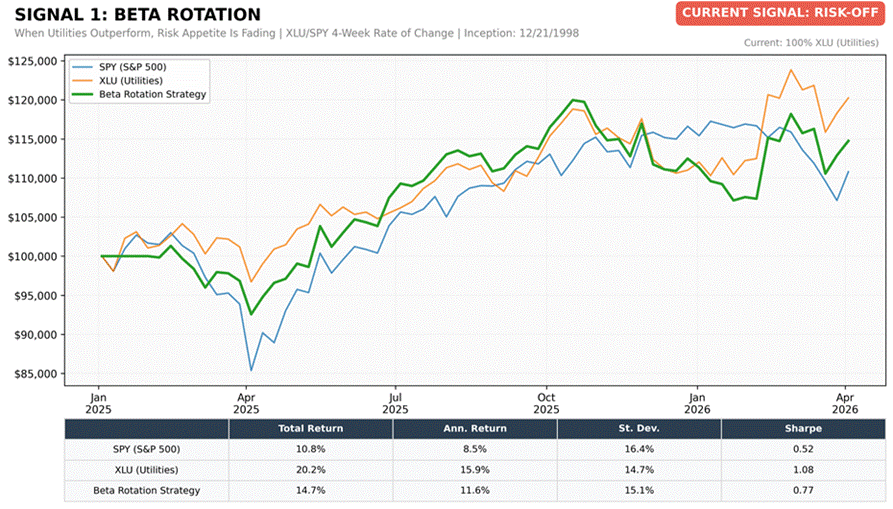
Growth of $100,000 | YTD from January 3, 2025 | Data: Lead-Lag Publishing, LLC
SIGNAL 2: TACTICAL RISK ROTATION
Based on: “A Quantitative Approach to Tactical Asset Allocation” (SSRN 2431022)
Target Investor: Conservative to moderate investors seeking a tactical overlay between equities and long-duration Treasuries. This signal compares the prior month total return of 10-year versus 30-year Treasury bonds to identify shifts in the yield curve’s risk appetite signal.
CURRENT INDICATOR: RISK-ON
