
A Market Divided (2)
Signals are split evenly between offense and defense, pointing to a market at an inflection point.

SPECIAL ANNOUNCEMENT — SPONSORED BY GRANITESHARES
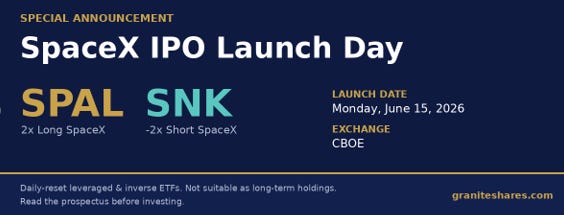
SpaceX IPO is here. Two new tools for the day-one tape.
GraniteShares is launching two single-stock leveraged ETFs designed for traders with a directional view on the SpaceX IPO.
SPAL seeks daily investment results, before fees and expenses, of 200% of the daily performance of SpaceX common stock.
SNK seeks daily investment results, before fees and expenses, of -200% (-2x) of the daily performance of SpaceX common stock.
Both are designed for short-term, daily-reset use by knowledgeable investors who understand the risks of using leverage. Daily rebalancing, compounding effects, and the volatility of a newly-public underlying mean these are not buy-and-hold instruments. For periods longer than a single day, the Funds will lose money if SpaceX performance is flat.
Read the prospectus before you invest.
REQUIRED DISCLOSURE FOOTER
Risk Factors and Important disclosures
This material must be preceded or accompanied by a Prospectus. Carefully consider the Fund’s investment objectives, risk factors, charges and expenses before investing. Please read the prospectus before investing.
The Fund is not suitable for all investors. The investment program of the Fund is speculative, entails substantial risks and includes asset classes and investment techniques not employed by most ETFs and mutual funds. Investments in the ETF are not bank deposits and are not insured or guaranteed by the Federal Deposit Insurance Corporation or any other government agency. The Fund is designed to be utilized only by knowledgeable investors who understand the potential consequences of seeking daily leveraged (2X) investment results, understand the risks associated with the use of leverage and are willing to monitor their portfolios frequently. For periods longer than a single day, the Fund will lose money if the Underlying Stock’s performance is flat, and it is possible that the Fund will lose money even if the Underlying Stock’s performance increases over a period longer than a single day. An investor could lose the full principal value of his/her investment within a single day.
The Fund seeks daily leveraged investment results and is intended to be used as a short-term trading vehicle. SPAL attempts to provide daily investment results that correspond to 200% of the daily performance of SpaceX common stock (a Leverage Long Fund). SNK attempts to provide daily investment results that correspond to -200% of the daily performance of SpaceX common stock (a Leverage Short Fund).
Investors should note that such Leverage Long Funds and Leverage Short Funds pursue daily leveraged investment objectives, which means that the Funds are riskier than alternatives that do not use leverage because the Funds magnify the performance of their underlying stock. The volatility of the underlying security may affect a Fund’s return as much as, or more than, the return of the underlying security.
Because of daily rebalancing and the compounding of each day’s return over time, the return of the Fund for periods longer than a single day will be the result of each day’s returns compounded over the period, which will very likely differ from 200% (or -200%) of the return of the Underlying Stock over the same period. The Fund will lose money if the Underlying Stock’s performance is flat over time, and as a result of daily rebalancing, the Underlying Stock volatility and the effects of compounding, it is even possible that the Fund will lose money over time while the Underlying Stock’s performance increases over a period longer than a single day.
Shares are bought and sold at market price (not NAV) and are not individually redeemed from the ETF. There can be no guarantee that an active trading market for ETF shares will develop or be maintained, or that their listing will continue or remain unchanged.
An investment in the Fund involves risk, including the possible loss of principal. Risks include Effects of Compounding and Market Volatility Risk, Leverage Risk, Market Risk, Counterparty Risk, Rebalancing Risk, Intra-Day Investment Risk, Other Investment Companies Risk, IPO Risk (newly-public underlying issuer), and risks specific to the securities of the Underlying Stock and the sector in which it operates. These and other risks can be found in the prospectus.
An investor should consider the investment objectives, risks, charges and expenses of the Funds carefully before investing. To obtain a prospectus containing this and other information, please call 1-844-476-8747. Read the prospectus carefully before you invest.
THE FUND IS DISTRIBUTED BY ALPS DISTRIBUTORS, INC. GRANITESHARES IS NOT AFFILIATED WITH ALPS DISTRIBUTORS, INC.
Sponsorship disclosure: This is a paid sponsored placement by GraniteShares. Lead-Lag Media has received compensation from GraniteShares for the inclusion of this Special Announcement.
A Market Divided (2)
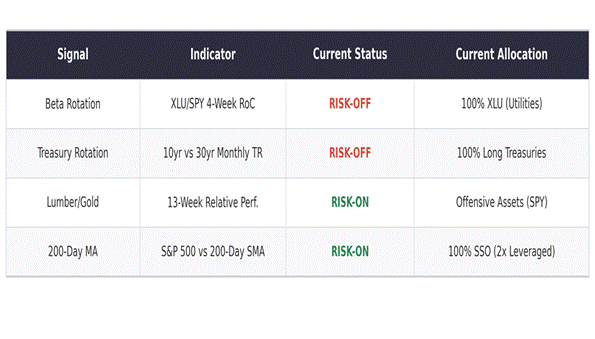
SIGNAL SUMMARY
Key Takeaways:
• Signal 1 (Beta Rotation) now Risk-Off with the XLU/SPY 4-week RoC at 1.15%. Utilities are outperforming the S&P 500 over the past four weeks, a defensive rotation signature. The allocation remains 100% XLU (Utilities).
• Signal 2 (Treasury Rotation) is RISK-OFF on the latest May month-end reading. TLT returned 0.16% in May versus IEF at -0.35%. Long-duration bonds outperformed intermediate maturities, a defensive risk-appetite indicator. The signal will hold this reading through the end of June. The current allocation tilts toward long-duration Treasuries (VLGSX/TLT).
• Signal 3 (Lumber/Gold) is RISK-ON on the latest 13-week relative-performance reading. Lumber’s 13-week return of 1.30% exceeds gold’s -11.72%. All seven sub-strategies are positioned offensively, with cyclical exposures favored over defensive bond pairs.
• The S&P 500 at 7,431.45 sits +8.0% above its 200-day SMA of 6,881.99. Signal 4 remains Risk-On, with the allocation set to SSO (2x leveraged S&P 500). Trend remains intact even after Friday’s broad equity selloff.
MARKET COMMENTARY
The framework reads 2-2 Risk-On this week. 2 of four signals favor risk-on positioning and 2 signals flag defense. The S&P 500 closed at 7,431.45 on June 12, 2026, +8.0% above its 200-day moving average of 6,881.99.
The week ending June 12, 2026 closed with the S&P 500 at 7,431.45. The index continues to sit above its 200-day moving average, keeping the trend structure intact that has framed the year to date. Beneath the headline price action, defensive equity leadership has emerged — utilities are outperforming the broad market over the trailing four weeks, a rotation signature that often precedes broader risk-off behavior, and long-duration Treasury bids picked up versus intermediate maturities — a pattern consistent with this week’s Treasury Rotation reading. Earnings season has wound down with broadly stable forward guidance, and macro data continues to trace a soft-landing path, but valuations, positioning, and concentration risk all argue for tactical respect of the framework’s defensive readings.
At 7,431.45, the index sits +8.0% above its 200-day SMA of 6,881.99. That spread is comfortable enough to keep Signal 4 on the offensive 2x leveraged allocation. The technical setup remains constructive in the aggregate — price above a rising 200-day — but the divergence between the trend signal and the Beta Rotation and Treasury Rotation signals is the kind of split that historically precedes either a pause in the trend or a stronger rotation into defense.
The Beta Rotation signal is RISK-OFF with the XLU/SPY 4-week Rate of Change at 1.15%. Utilities are outperforming the broad market over the trailing four weeks, with the positive RoC reflecting persistent flows into defensive equity sectors. This rotation signature often emerges ahead of broader risk-off behavior and warrants attention. The framework’s allocation shifts to XLU (Utilities).
The Treasury Rotation signal is RISK-OFF on the latest May month-end reading. TLT returned 0.16% in May versus IEF at -0.35%, with the long bond outperforming the intermediate — a classic defensive risk-appetite signature. The signal will hold this May reading through the end of June. Long-duration outperformance during a backdrop of generally rising equity tells a story of yield-curve flattening pressure and creeping recessionary positioning at the long end. Combined with Signal 1’s utilities-led rotation, defensive positioning is broadening across multiple corners of the framework. A persistent Risk-Off Treasury signal alongside a Risk-On 200-day reading is the kind of divergence that historically signals an inflection point: either the equity trend resolves the divergence by following Treasuries lower, or Treasuries reconverge upward.
The Lumber/Gold signal is RISK-ON on the latest 13-week reading. Lumber’s 13-week return of 1.30% exceeds gold’s -11.72%. All seven Lumber/Gold sub-strategies are positioned offensively, with cyclical and growth-tilted pairs favored over defensive bond pairs. Lumber has held its bid as housing demand expectations firm, while gold has paused its rally near record levels. The relative dynamic stays Risk-On but the spread has narrowed week-over-week, and a re-acceleration in gold would flip the signal quickly.
The 2-2 Risk-On reading sits evenly split, an inflection-point posture where the framework offers neither full offense nor full defense. Mixed readings often precede broader pivots in either direction — either the defensive signals reconverge to risk-on, or the risk-on signals follow defense lower. The current setup demands tactical respect: maintain offensive allocations where signals call for them, recognize defensive allocations where they apply, and treat the disagreement among indicators as meaningful. The risks worth watching are an acceleration of the long-Treasury bid, further utilities outperformance that deepens the Beta Rotation defensive reading, equity selloffs that compress the cushion above the 200-day, or a flip of the Lumber/Gold spread back to gold-favored.
SIGNAL 1: BETA ROTATION
Based on: “Opposing Behavioral Forces: Beta Rotation” (SSRN 2417974)
Target Investor: Self-directed investors who want to capture relative strength between equity market segments. This signal uses the 4-week rate of change of the Utilities-to-S&P 500 price ratio to determine whether the market favors offense (broad equity) or defense (Utilities).
CURRENT INDICATOR: RISK-OFF
XLU/SPY 4-Week Rate of Change: 1.15%
Current Allocation: 100% SPY (S&P 500)
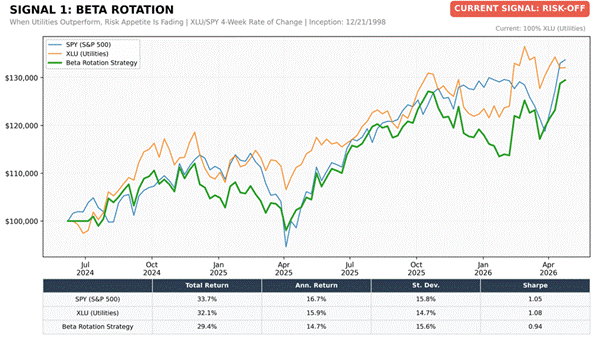
Growth of $100,000 | YTD from January 3, 2025 | Data: Lead-Lag Publishing, LLC
SIGNAL 2: TACTICAL RISK ROTATION
Based on: “A Quantitative Approach to Tactical Asset Allocation” (SSRN 2431022)
Target Investor: Conservative to moderate investors seeking a tactical overlay between equities and long-duration Treasuries. This signal compares the prior month total return of 10-year versus 30-year Treasury bonds to identify shifts in the yield curve’s risk appetite signal.
CURRENT INDICATOR: RISK-OFF
30yr Treasury (TLT) May Return: 0.16%
10yr Treasury (IEF) May Return: -0.35%
Current Allocation: 100% Long-Duration Treasuries (VLGSX/TLT)
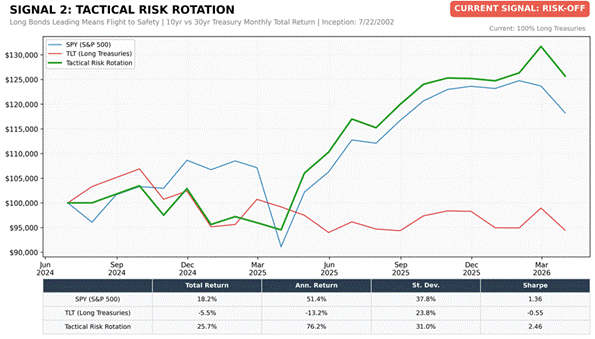
Growth of $100,000 | Monthly Data from January 2025 | Data: Lead-Lag Publishing, LLC
SIGNAL 3: LUMBER/GOLD RATIO
Based on: “Lumber: Worth Its Weight in Gold” (SSRN 2604248)
Target Investor: Active investors seeking to rotate between offensive and defensive exposures across multiple asset class pairings. This signal uses the 13-week relative performance of Lumber futures versus Gold spot to determine the market’s risk appetite. When Lumber outperforms Gold, the economy is likely strengthening (Risk-On). When Gold outperforms, investors should favor defensive positioning (Risk-Off).
CURRENT INDICATOR: RISK-ON
