
Accelerant to Extinguisher
Has last year’s AI fervor become this year’s cautionary tale?

Key Highlights
Investor enthusiasm around artificial intelligence spending faced a sharp reality check as Big Tech outlined unprecedented capital outlays with uncertain near-term payoffs.¹
Market leadership rotated abruptly away from high-growth technology stocks and toward value-oriented, dividend-paying, and economically sensitive sectors.²
Global central banks largely held steady on policy, while geopolitical risks added volatility to commodities, reinforcing a broader shift toward caution and balance.³
Tech Euphoria Meets the Cost of Reality
The first week of February delivered a jarring contrast in market performance, as optimism around artificial intelligence collided with concerns about its mounting cost. What had been a defining source of equity leadership over the past year suddenly became a source of unease. Investors, long willing to overlook near-term earnings in exchange for sweeping visions of AI-driven growth, began asking harder questions about timing, scale, and return on investment.¹
Those questions surfaced quickly after several technology giants laid out aggressive capital spending plans tied to AI infrastructure. Alphabet disclosed that it expects to invest as much as $185 billion in AI-related projects during 2026, a figure that underscored how central artificial intelligence has become to corporate strategy but also highlighted the magnitude of the financial commitment involved.¹ Amazon followed with similarly ambitious projections, signaling a sharp acceleration in spending tied to data centers, cloud capacity, and AI services.¹ Instead of rewarding these announcements, markets reacted with visible discomfort. Amazon’s shares fell sharply, and the broader technology complex moved lower as investors reassessed whether the economics of AI adoption would justify such heavy upfront costs.¹
The reaction marked a notable shift in sentiment. Throughout much of last year, companies associated with artificial intelligence enjoyed valuation premiums and relatively forgiving scrutiny. That tolerance now appears to be thinning. Software and services stocks bore the brunt of the pullback, with the S&P 500 software and services index falling sharply and extending a multi-day losing streak.¹ Even companies widely viewed as best-positioned to monetize AI were not spared, as investors weighed the possibility that profitability could be deferred far longer than previously assumed.¹
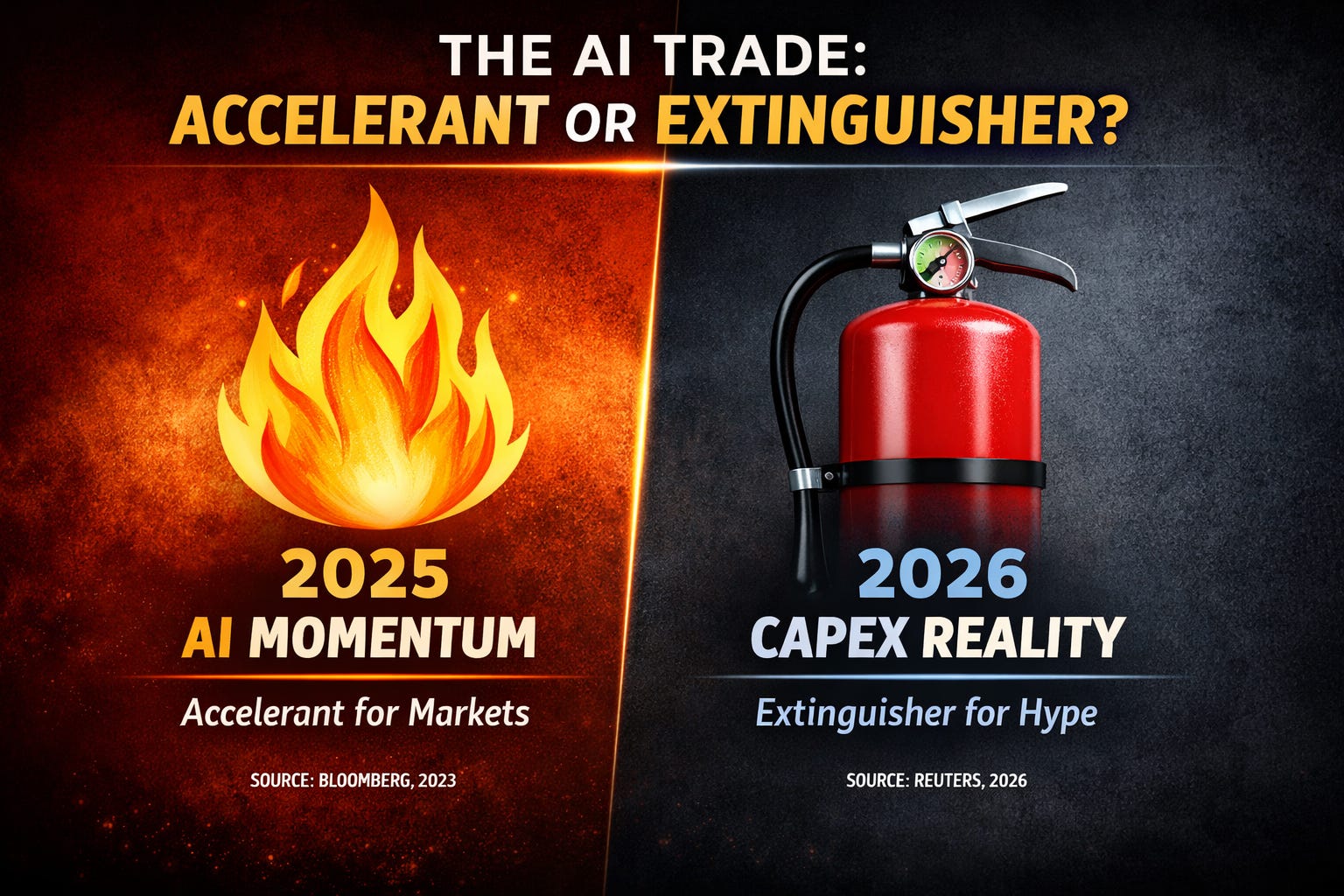
Strategists increasingly framed the moment as a turning point. One market observer remarked that the same AI narrative that acted as an accelerant for equities last year may now be functioning as an extinguisher, dampening risk appetite rather than fueling it.¹ With Alphabet, Amazon, and other large technology firms collectively planning to deploy hundreds of billions of dollars toward AI initiatives, skepticism has grown over whether the resulting revenue streams will materialize quickly enough to satisfy shareholders.¹ The concern is not that AI lacks transformative potential, but that its financial payoff may arrive unevenly and on a longer timeline than markets had priced in.¹
Rotation Rewrites the Market Narrative
As technology stocks retreated, capital did not leave equities altogether. Instead, it rotated decisively into areas of the market long overshadowed by growth and momentum trades. Industrials, consumer staples, and energy stocks attracted renewed interest, benefiting from perceptions of stable cash flows, pricing power, and more immediate earnings visibility.² This shift in leadership was evident in index performance. While the Nasdaq Composite declined notably over the week, the Dow Jones Industrial Average surged, gaining roughly 2.5 percent and closing above the 50,000 level for the first time in its history.²
The contrast between growth and value styles was equally striking. Growth-oriented stocks declined meaningfully over the week, while value stocks held their ground and, in some cases, advanced modestly.¹ Small-capitalization stocks also participated in the rebound, suggesting that investors were not simply retreating to safety but were reallocating toward segments perceived as better aligned with the prevailing economic environment.² Elevated interest rates, tighter financial conditions, and rising scrutiny of capital discipline all appear to favor companies with tangible earnings and manageable balance sheets.²
This rotation reflects more than short-term positioning. It signals a broader recalibration of expectations. For much of the past year, market leadership was driven by narratives about future dominance, platform economics, and technological inevitability. The past week suggested a renewed focus on fundamentals. Investors appeared increasingly inclined to reward businesses that can deliver returns today rather than promise transformative breakthroughs tomorrow.¹
At the same time, the shift underscores how fragile consensus trades can become once their assumptions are challenged. Artificial intelligence remains a powerful secular theme, but its investment implications are no longer being treated as one-directional. The market’s response to AI spending announcements suggests that investors are beginning to differentiate between strategic vision and financial execution. That distinction may prove decisive in determining which companies ultimately benefit from the AI build-out and which struggle under its weight.¹
