
AllianceBernstein's Global High-Yield CEF Yields 7.5%. The 8% Discount Is the Story.
When tariffs stress EM credit and domestic HY in the same move, a diversified global income fund at a decade-wide discount deserves a look.

Every week, we’ll profile a high yield investment fund that typically offers an annualized distribution of 6-10% or more. With the S&P 500 yielding less than 2%, many investors find it difficult to achieve the portfolio income necessary to meet their needs and goals. This report is designed to help address those concerns.
Macro Context
The global credit backdrop in April 2026 is not comfortable. US tariff escalation — particularly the re-escalation of US-China trade tensions — has rattled risk assets in ways that spread well beyond equities. US investment-grade and high-yield spreads, which began the year near post-2007 cycle tights, have widened meaningfully. Global high-yield spreads sit at approximately 343 basis points. US HY is tighter at roughly 285 bps, but the widening has been sharp enough to remind investors of how quickly carry can get eaten by price. Emerging market spreads have taken the worst of it: JPM EMBI hard-currency sovereign spreads are up over 35 basis points since early April alone, and EM HY spreads have widened 36–42 bps in Q1 2026. The IMF’s April 2026 Global Financial Stability Report flagged EM assets as “strongly impacted, especially in commodity-importing and more vulnerable countries.” That’s the macro wall.
This creates a real dilemma for income investors. You want global diversification — concentrating entirely in US HY at 285 bps when spreads could easily widen another 100–150 bps in a hard landing is not a comfortable position. But adding EM exposure right now, with dollar strength and tariff pressure, feels like walking into a minefield. You want the return; you don’t want the currency blow-up.
That tension is precisely the environment AllianceBernstein Global High Income Fund (NYSE: AWF) has been designed to navigate. This fund has been operating since 1993 — through the ‘94 bond crash, the Russian default, the dot-com blow-up, the GFC, COVID, and the 2022 rate spike. When credit fear peaks, CEF discounts tend to gap wider than NAV warrants. That’s the setup today.
Fund Background
Ticker: AWF | Market Price: $10.49 | NAV: $11.42 | Discount: -8.16%
Total Net Assets: ~$985 million | Inception: July 28, 1993
Monthly Distribution: $0.0655/share | Annualized Yield: ~7.5% at market
Effective Leverage: ~13.7% | Expense Ratio: 1.03% | Duration: 2.97 years
AWF is one of the oldest continuously operating global high-yield closed-end funds in existence. Managed by AllianceBernstein LP — a firm with over $750 billion in AUM — the portfolio management team includes Gershon Distenfeld (Director of Income), Matthew Sheridan, Nish Malik, Robert DiClementi, and Scott Smith. This is not a recent crew. AB’s fixed income platform runs global sector specialists across credit cycles; the team knows what they own.
The fund’s mandate is genuinely multi-sector. It can invest across US high-yield corporate bonds, EM sovereign debt (both hard and local currency), EM corporate bonds, European high-yield, bank loans, investment-grade corporates as an opportunistic sleeve, and credit default swap indices. That’s not a pitch — it’s what the portfolio actually holds, as you’ll see in the composition section.
One administrative note worth flagging: Equitable Holdings and Corebridge Financial announced a merger in March 2026, expected to close by year-end. Because AllianceBernstein is owned through that ownership chain, the Investment Company Act of 1940 treats this as a “change of control” event for the advisory agreement — meaning AWF’s Board and shareholders must approve a replacement advisory agreement before closing. This is procedural. The AllianceBernstein LP entity continues unchanged; the management team isn’t going anywhere. But it adds a shareholder vote process to the calendar that some institutional holders may be watching. Minor uncertainty, not a red flag.
Portfolio Composition
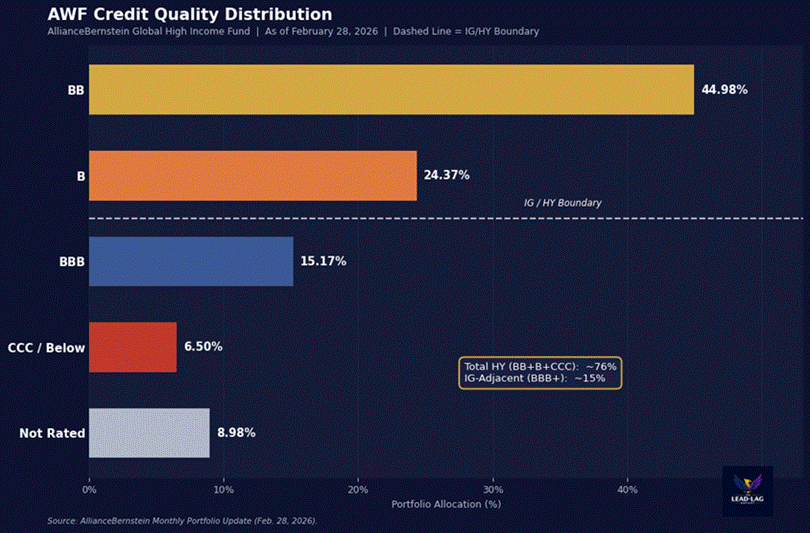
The credit quality breakdown tells you a lot about what AWF actually is — and what it isn’t. BB-rated bonds represent 44.98% of the portfolio. Single-B is 24.37%. CCC and below is roughly 8%. That makes AWF a genuine high-yield fund. But 15.17% of the portfolio is investment-grade (BBB), with additional AAA and A exposure bringing the total IG-adjacent slice to roughly 17.7%. This is not pure junk. The IG sleeve provides ballast when lower-rated credits widen — it’s a deliberate part of AB’s cycle-aware risk management.
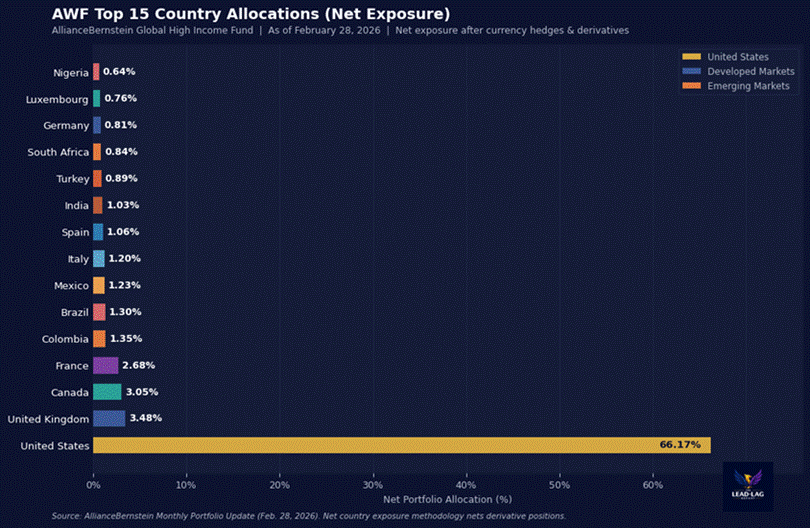
The geographic picture is important to understand correctly. The US is the largest single-country allocation at roughly 66% of net exposure. But “net” is the operative word — the portfolio spans 50+ countries including Brazil, Mexico, Colombia, Turkey, Indonesia, India, and Argentina on the EM side, plus the UK, France, Italy, and Spain in Europe. EM exposure at the gross level is meaningful (approximately 10–12% in EM sovereign and corporate bonds). What you’re getting is genuine global credit diversification in a single wrapper.
Two structural features deserve more attention than they typically get. First, approximately 13% of the portfolio runs through credit default swap indices — specifically CDX.NA.HY (US HY CDS index, ~7.2%) and iTraxx Crossover (European HY CDS, ~6.1%). These are not exotic instruments; they’re liquid, centrally cleared, and AB uses them to manage systematic credit risk dynamically. When spreads widen, the CDS positions allow rapid de-risking without having to sell illiquid cash bonds. No passive ETF does this. Second, the effective duration is only 2.97 years — substantially shorter than the portfolio’s nominal average maturity of 4.24 years. AB actively runs short Treasury futures to compress duration. In a world where rates may stay “higher for longer” due to geopolitical inflation, a 2.97-year duration is an important defensive attribute.
Historical Performance
The track record here warrants an honest walk-through, not just cherry-picking the good years.
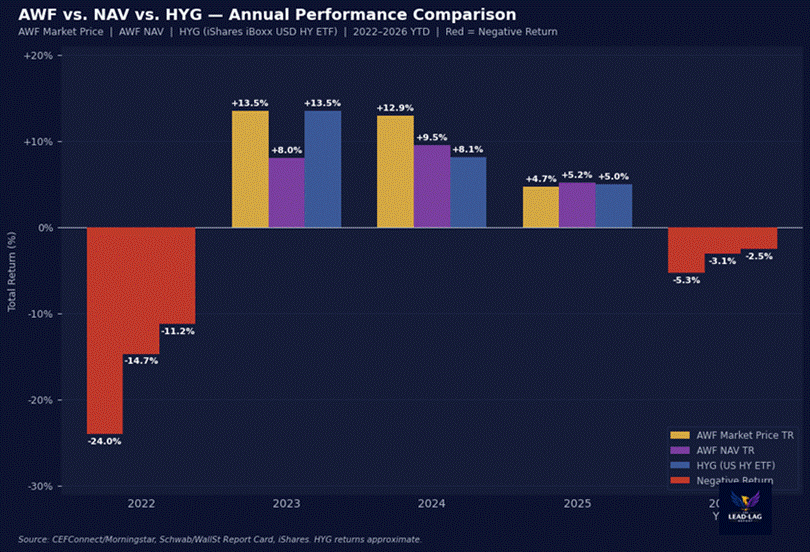
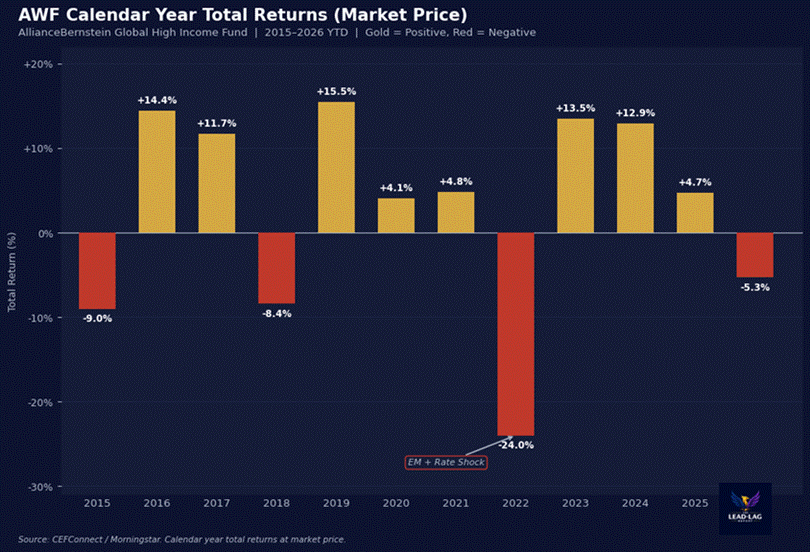
2022 was painful. AWF’s price fell -16.61% and NAV fell -12.04% — slightly worse than the CEF high-yield category averages of -15.67% price and -10.18% NAV. US HY spreads blew out from near-all-time tights (~300 bps) to ~550 bps. EM credit stress collided with rising rates. European HY got hit by the ECB tightening and energy crisis. The fund’s global diversification actually added stress that year versus pure-US HY funds — EM and European exposure underperformed. That’s the honest version.
Then 2023 happened: +18.34% price return / +15.51% NAV. Both outperformed the category. HY spreads tightened, EM rebounded, and the discount compressed from approximately -11% to -7%. The entry point mattered enormously. 2024 continued the recovery: +14.29% price / +9.14% NAV. 2025 was a mixed picture: +7.55% price return, significantly lagging the +13.64% category average — primarily because the fund’s conservative duration positioning limited gains as rates fell, and a short EUR position detracted as the dollar weakened.
Longer-term, the numbers hold up. Over the 10 years through September 2025, AWF delivered 7.9% annualized at market price — ahead of the 6.2% for the HY bond category. Since inception through the same date, AWF returned 9.7% annualized at market price, vs. 9.4% at NAV. A hypothetical $10,000 invested at inception grew to $17,630 (at market) versus $11,998 in the Bloomberg US Aggregate. That’s the income compounding story: 33 years of 6–9% distributions, reinvested through multiple credit cycles.
The Discount Opportunity
This is the section that matters most right now.
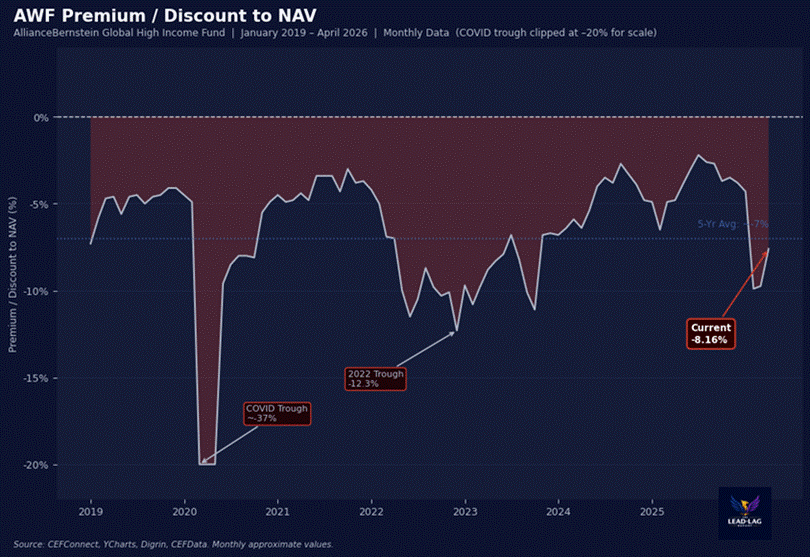
AWF’s current discount to NAV is approximately -8.16% (price $10.49, NAV $11.42). In March 2026, it briefly touched -9.74%, near the widest level of the past 52 weeks (-10.42% was the 52-week trough). The 52-week average discount has been -4.92%. The 1-year average is -5.19%. The fund traded as tight as -1.30% discount a year ago.
Let’s do the math explicitly, because this is the investment case.
If you buy AWF today at $10.49 and the discount reverts from the current approximately -8% back to the 5-year average of roughly -5.5%, that’s a 2.5 percentage-point NAV-to-price tailwind. On top of the 7.5% annualized distribution yield you’re collecting while you wait, that’s a potential total return in the high single to low double digits without requiring any improvement in the underlying portfolio’s NAV.
The historical pattern supports this. In the 2022 credit stress, the discount widened to approximately -12% to -14%. AWF then recovered +18.34% in price terms in 2023, significantly outpacing the NAV return of +15.51% precisely because the discount compressed. The price return exceeded the NAV return by 2.8 percentage points — exactly the discount compression mechanism playing out.
At the COVID extreme (March 2020), the discount reached -37% as forced selling overwhelmed the market for illiquid income CEFs. That was an outlier driven by margin calls and panic redemptions in structures adjacent to AWF. We are not close to that scenario today. The current -8% discount reflects genuine fear about EM credit and tariff uncertainty — but it is not a forced-selling event.
The discount doesn’t compress on a schedule. It could widen further if global credit fear escalates, and at -15%, an investor would be sitting on additional price pain even if NAV holds. That risk is real and I’ll address it in the disadvantages. But the base case — credit markets stabilize over the next 6–12 months, EM spreads normalize, and CEF sentiment recovers — has historically delivered double-digit price returns from this entry level.
Macro Environment and EM Exposure
AWF’s EM exposure (~10–12% in EM sovereign and corporate bonds at the gross level) makes it genuinely sensitive to the current macro environment. Brazil (1.30% net), Colombia (1.35%), Mexico (1.23%), Turkey (0.89%), India (1.03%), Argentina (0.43%), Indonesia (0.33%), and Nigeria (0.64%) are all in the portfolio. In a world where dollar strength and tariff escalation are squeezing EM capital flows and widening sovereign spreads, this is not a comfortable list.
But here is the critical structural distinction that most readers miss: AB hedges approximately 99.84% of its currency exposure back to US dollars. Net USD exposure is 99.84% of the portfolio as of February 28, 2026. The residual foreign currency positions are marginal: long Colombian peso (0.25%), Canadian dollar (0.19%), sterling (0.16%), short euro (-0.47%). What this means is that AWF is not a leveraged FX bet on EM currencies. You are getting EM credit spread exposure — the yield premium that EM sovereign and corporate borrowers pay over US Treasuries — without the peso/rupiah/lira risk that can destroy returns when EM currencies move sharply.
That’s an important distinction. EM credit spread risk is real and the widening of 35–42 bps in Q1 2026 is a headwind to NAV. But it is manageable, diversifiable risk. An unhedged direct EM currency position during the same period would have been far more damaging.
With effective duration of 2.97 years, a 100 bps rate move changes NAV by approximately 3%. In a scenario where geopolitical-driven inflation keeps rates elevated, the short-duration positioning is meaningful protection. It also limits upside if rates fall, but given the uncertainty about the rate path, AB’s choice to run short seems defensible.
Distribution Policy
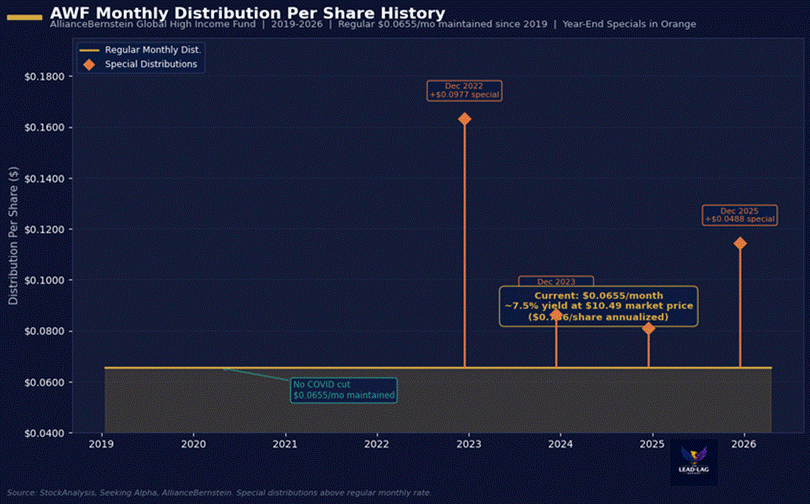
The current monthly distribution is $0.0655 per share, annualizing to $0.786 per share — approximately 7.5% yield at the current market price of $10.49. The distribution rate at NAV is approximately 6.9%.
The consistency here is notable. The $0.0655 monthly rate has held without interruption since at least 2019 — through the COVID crash, the 2022 rate spike, and the current tariff volatility. That is not typical for high-yield CEFs. Many funds in this space cut distributions in 2020 and again in 2022. AWF held the line.
The distribution history includes annual special payments: December 2022 saw a large special of $0.0977 per share (realized gains), December 2023 a $0.0209 special, December 2024 a $0.0156 special, and December 2025 a $0.0488 special (an advance of the January 2026 payment for IRC minimum distribution compliance). These specials reflect AB’s commitment to distributing realized gains when they occur.
On coverage: based on the September 30, 2025 semi-annual report, annualized NII runs approximately $0.70–$0.74 per share against an annual distribution pace of $0.786. Coverage is approximately 89–94% — not perfect 100%, but the gap has historically been covered by modest realized gains from the portfolio’s 68% annual turnover. Through Q3 fiscal 2026, NII came in at $15.06 million for the quarter ($0.17/share), annualizing to approximately $0.70/share. The fund generates enough income to support the distribution in all but severe credit environments.
Advantages
Deep discount with mean-reversion potential. AWF is trading approximately 8% below NAV when the 5-year average discount has been closer to -5.5%. That’s nearly 2.5 percentage points of potential price return embedded in entry price alone, independent of portfolio performance. For a fund collecting 7.5% annually, that discount reversion is the difference between good and excellent realized returns.
Genuine global diversification. AWF spans 50+ countries, four major credit sectors (US HY, EM sovereign, EM corporate, European HY), bank loans, IG corporates, and CDS indices. It is not a US HY clone with an EM marketing sleeve. The portfolio construction is diversified across credit cycles in a way that single-market funds cannot replicate. When US HY is expensive (285 bps spreads), having access to EM sovereign yield is structurally valuable.
Active CDS management as dynamic risk tool. The ~13% allocation to CDX.NA.HY and iTraxx Crossover gives AB a liquid, low-friction mechanism to adjust aggregate credit risk without touching the illiquid cash bond positions. This is a significant operational advantage over passive funds. When credit stress accelerates, AB can tighten the CDS shorts or unwind them quickly. Most CEF investors don’t realize they’re getting this active risk management capability.
33-year track record. AWF launched in July 1993 and has operated continuously through every major credit cycle since: the 1994 bond market crash, the 1997-98 EM crisis and LTCM, the dot-com credit blow-up, the GFC, COVID, and the 2022 rate spike. The since-inception market return of 9.7% annualized speaks to the compounding power of consistent high-yield income through cycles.
Short duration for a credit cycle inflection. At 2.97 years effective duration, AWF has limited sensitivity to rate moves. This is a meaningful protective attribute in a world where the rate path is genuinely uncertain.
Disadvantages
EM credit exposure in a tariff-stress world. Even with near-full currency hedging, EM credit spreads can widen severely during risk-off episodes. The +35–42 bps Q1 2026 widening is a preview, not necessarily the full move. Countries like Turkey, Argentina, and Nigeria carry elevated credit risk regardless of macro backdrop. AWF’s diversification limits single-issuer impact, but systematic EM spread widening hits all positions simultaneously.
Leverage amplifies drawdowns. The 13.7% total leverage (primarily through derivatives and investment operations) amplifies both returns and losses. The 2022 price return of -16.61% — worse than the -15.67% category average — was a direct consequence of leveraged credit exposure getting hit by both rates and EM stress simultaneously. In the next credit stress event, leverage will again magnify downside.
Discount can widen further. At -8%, we are not at crisis-level discounts. The 2022 trough was -12% to -14%, and COVID brought -37%. If macro conditions deteriorate from here — deeper trade war escalation, EM defaults, global recession — the discount can and will widen before it compresses. An investor entering at -8% could be sitting at -13% six months later even if NAV is flat.
Advisory agreement uncertainty. The pending Equitable/Corebridge merger requires a shareholder vote on the new advisory agreement before closing. The management team isn’t changing, and AllianceBernstein LP is not being restructured. But procedural uncertainty exists, and if the shareholder vote were somehow contested or delayed, it would create headline risk.
Distribution coverage is not bulletproof. At approximately 90–94% NII coverage, the $0.0655 monthly distribution does not have a large margin of safety. A sustained deterioration in portfolio income — driven by credit spread widening, defaults, or financing cost increases — could eventually pressure the distribution. AWF has held the $0.0655 rate since at least 2019, but the precedent for cuts exists in the industry broadly, and investors should not treat the current rate as permanent.
Final Thoughts
AWF is compelling for income investors who want genuine global credit diversification and are comfortable with EM credit risk. The 33-year track record, the active CDS management, the near-full currency hedge, and the 2.97-year duration all point to a fund that has been thoughtfully constructed for exactly the kind of multi-front credit stress we’re seeing in April 2026.
The discount is the story. Buying $1.00 of AllianceBernstein’s multi-decade global credit management expertise for $0.92 is not a frequent opportunity. The 52-week average discount is -4.92%. The current discount is -8.16%. That gap is the embedded return that patient holders are being paid to wait for.
The risk is straightforward: EM credit stress deepens, tariff escalation turns into a full global recession, and the discount widens from -8% to -13% before it ever compresses. That scenario is possible. It is not my base case, but I won’t pretend it’s off the table.
For an investor who can hold through a potential further widening, collect 7.5% annually, and wait for the inevitable credit cycle stabilization, AWF at this discount has historically been a reasonable entry point. The 2023 experience — where entry at a similar discount level preceded +18% price returns — is the template. Whether that template repeats depends on the macro path, not on anything wrong with the fund itself.
The Lead-Lag Report is provided by Lead-Lag Publishing, LLC. All opinions and views mentioned in this report constitute our judgments as of the date of writing and are subject to change at any time. Information within this material is not intended to be used as a primary basis for investment decisions and should also not be construed as advice meeting the particular investment needs of any individual investor. Trading signals produced by the Lead-Lag Report are independent of other services provided by Lead-Lag Publishing, LLC or its affiliates, and positioning of accounts under their management may differ. Please remember that investing involves risk, including loss of principal, and past performance may not be indicative of future results. Lead-Lag Publishing, LLC, its members, officers, directors and employees expressly disclaim all liability in respect to