$ATACX: What Rising Volatility Means for Tactical Funds vs. Static Portfolios

Key Highlights
- Volatility has re-emerged as a defining feature of the current market cycle, reshaping how investors think about risk and portfolio construction.¹
- Traditional static allocations, including the classic 60/40 portfolio, face challenges when stock and bond correlations rise during periods of macro stress.²
- Tactical allocation strategies, including the ATAC Rotation Fund (ATACX), seek to adapt to changing market conditions by shifting exposure between risk assets and defensive holdings.³
The Return of Volatility and a Changing Market Backdrop
For much of the past decade, investors operated in a market environment that felt unusually forgiving. Equity volatility was episodic, monetary policy was broadly supportive, and diversification across stocks and bonds often delivered smoother outcomes. That backdrop has changed. As markets have moved deeper into the current cycle, volatility has returned as a persistent feature rather than an occasional disruption.
Since 2024, a combination of slowing economic momentum, persistent inflation pressures, and heightened policy uncertainty has increased market sensitivity to new information. Measures of expected volatility, including the VIX, have surged during periods of policy surprise and geopolitical stress. The VIX (CBOE Volatility Index) measures the market’s expectation of 30-day forward-looking volatility in the S&P 500, derived from the prices of near-term S&P 500 index options. In early 2025, abrupt tariff announcements in Washington contributed to a sharp rise in volatility, reminding investors how quickly sentiment can shift.¹
These developments reflect a broader late-cycle dynamic. Yield curves have remained inverted, leading indicators have softened, and growth expectations have become more fragile.² Markets now respond more forcefully to incremental changes in data or policy direction, creating an environment defined by sudden drawdowns and rapid reversals rather than steady trends.
Unlike earlier expansionary periods, today’s market landscape is marked by competing narratives. Optimism around innovation and productivity gains coexists with concern about tightening financial conditions and slowing demand.³ This tension has increased the likelihood of sharp market reactions, particularly when expectations become crowded.
For investors, volatility is more than a psychological challenge. Large drawdowns can disrupt long-term compounding and increase the risk of poorly timed decisions. As uncertainty rises, the limitations of traditional portfolio construction become more apparent, prompting a reassessment of how risk is managed.
Static Portfolios and the Limits of Traditional Diversification
The traditional static portfolio, most commonly represented by the 60% equity and 40% bond allocation, was built for a different macroeconomic era. Its premise relied on the historical tendency for bonds to offset equity losses during periods of market stress. For decades, declining inflation and falling interest rates reinforced this relationship, allowing balanced portfolios to weather downturns with relative resilience.⁴
Recent experience has challenged that assumption. During the inflation shock of the early 2020s, both stocks and bonds declined simultaneously as central banks raised interest rates aggressively. In 2022, this convergence resulted in one of the most difficult environments for balanced portfolios in modern history. Equity valuations compressed while bond prices fell sharply as yields rose, undermining the diversification benefits investors had long relied upon.⁴
This breakdown is not merely a historical anomaly. It highlights a structural vulnerability of static allocations when macro forces push asset classes in the same direction. Research from major asset managers has noted that elevated volatility combined with unstable stock-bond relationships complicates traditional portfolio construction frameworks.⁵
Beyond the 60/40 model, static allocations share a common limitation: they do not adjust exposure as market conditions evolve. A portfolio that remains fully invested in risk assets during periods of rising volatility absorbs the full impact of drawdowns. Over time, repeated losses can erode investor confidence and increase the likelihood of emotionally driven decisions.
None of this suggests that static portfolios are obsolete. Long-term investing still benefits from discipline and patience. However, in environments characterized by frequent volatility spikes and uncertain correlations, static strategies may offer less preservation than investors expect. This reality has renewed interest in approaches that emphasize flexibility rather than permanence.
Tactical Allocation and the Role of ATACX
Tactical allocation strategies seek to address these challenges by introducing adaptability into portfolio management. Rather than maintaining fixed exposures through all market environments, tactical funds adjust allocations in response to changing market conditions. The objective is not to forecast short-term market movements, but to manage exposure as risk conditions evolve.
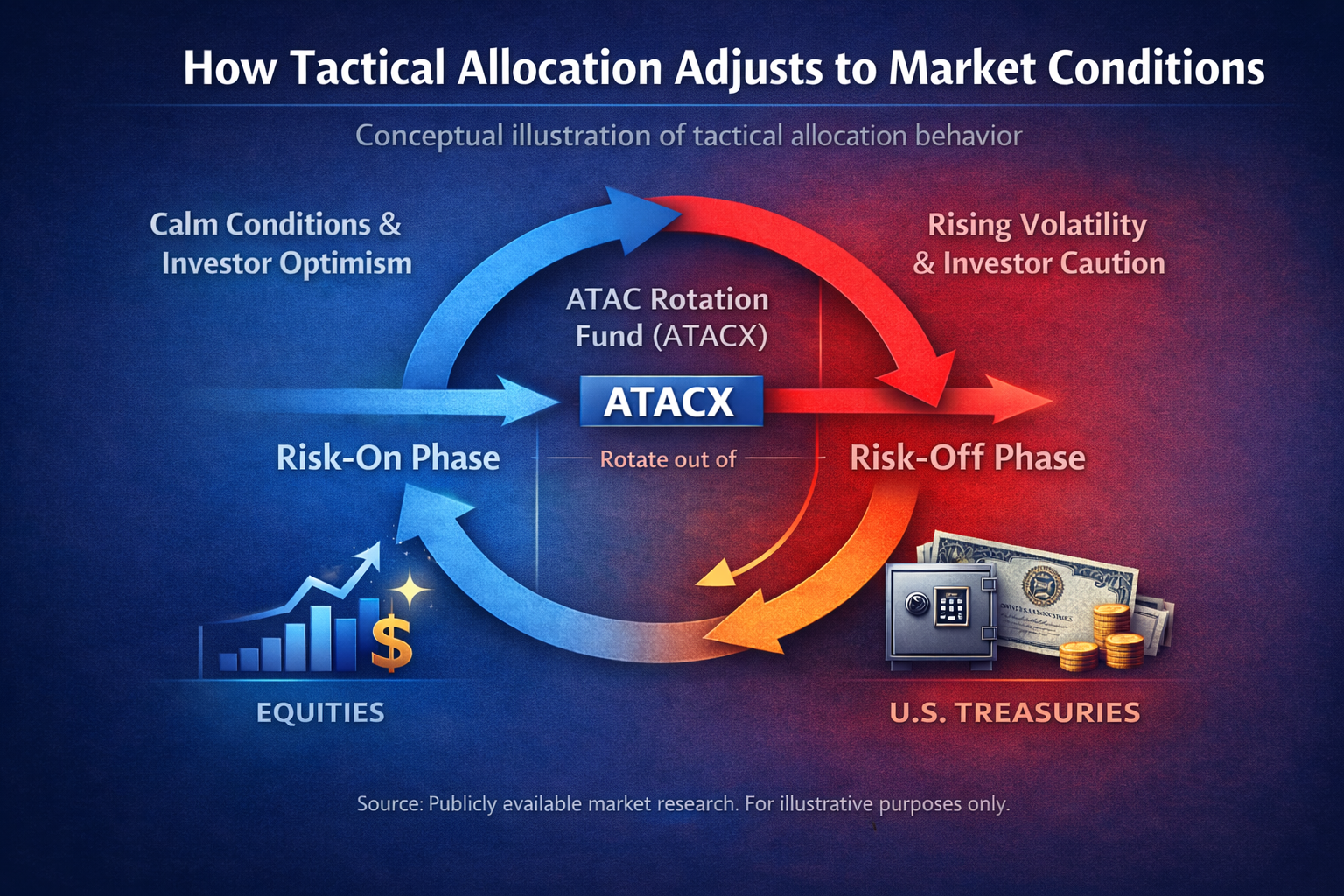
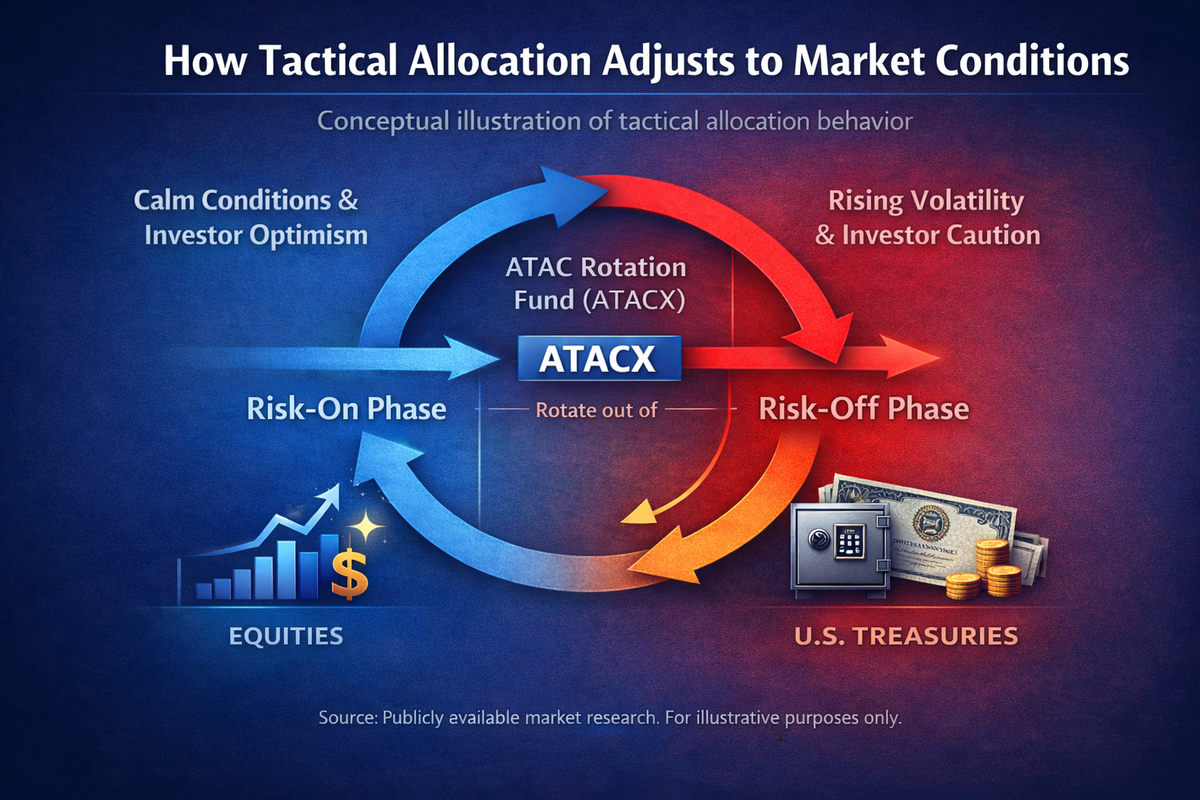
The ATAC Rotation Fund (ATACX) provides a clear example of this approach. The fund employs a tactical risk-on and risk-off framework that rotates between equity exposure and U.S. Treasury holdings depending on broader market conditions associated with stress or confidence.³ When conditions appear supportive of risk-taking, the fund allocates toward equities across various segments of the market. When signs of market stress increase, the strategy shifts defensively into Treasuries.
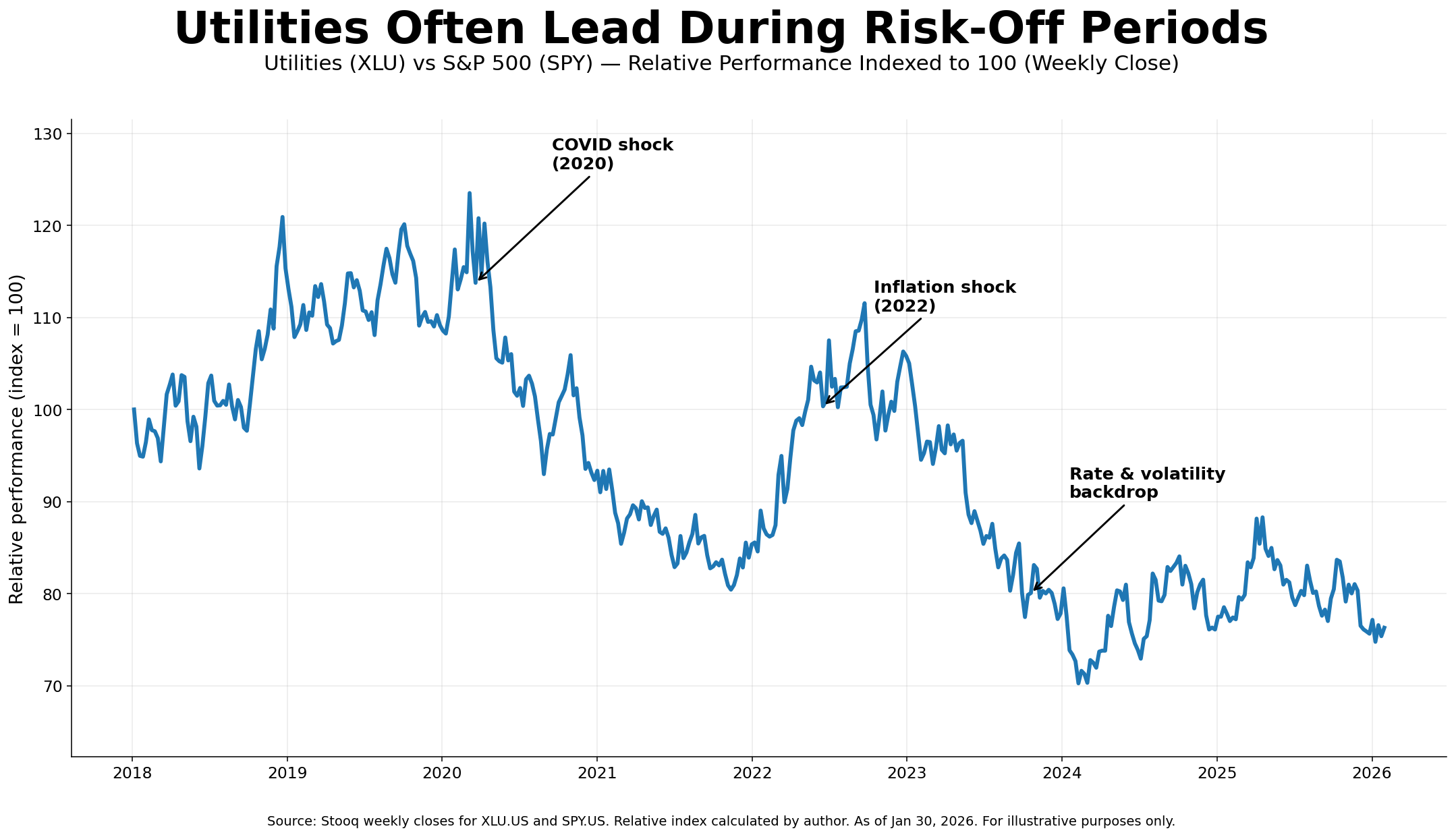
The indicators informing these shifts are grounded in long-observed market relationships that tend to emerge during periods of rising volatility. Certain asset classes, such as utility stocks and U.S. Treasuries, have historically reflected changes in investor risk appetite. When utilities begin to outperform the broader equity market and Treasury yields decline, it often signals growing caution among investors.⁶ ATACX incorporates these dynamics into its allocation decisions with the goal of adjusting exposure as market conditions evolve.
A defining characteristic of this approach is its emphasis on adaptability. Rather than remaining fully exposed to risk assets through all phases of the cycle, the fund seeks to respond to shifts in market conditions over time. This flexibility is intended to help manage downside exposure during periods of heightened uncertainty while remaining positioned to participate when conditions improve.⁷
That objective comes with trade-offs. Tactical strategies may lag during extended bull markets, particularly when volatility remains subdued. Shifts in positioning can also occur during periods when markets reverse quickly, which may result in missed upside. Additionally, active allocation strategies can involve higher expenses and tax considerations compared with fully passive approaches.⁸
Even so, the appeal of tactical allocation becomes clearer in environments characterized by uncertainty rather than steady growth. When markets frequently transition between risk-on and risk-off phases, the ability to adjust exposure may enhance risk-adjusted outcomes. For many investors and advisors, funds such as ATACX are best viewed not as replacements for core holdings, but as complementary tools within a broader portfolio framework.
In the current environment, where volatility has become a defining feature rather than an exception, adaptability itself has emerged as a form of risk management. ATACX positions itself as a tactical allocation option designed to navigate late-cycle conditions by adjusting exposure as market dynamics shift. While no strategy eliminates risk, flexibility can offer an important advantage when uncertainty dominates.
Conclusion: Rethinking Portfolio Construction in a Volatile World
Rising volatility has altered the investment landscape in ways that challenge long-standing assumptions about diversification and portfolio stability. Static allocations that performed well during periods of low inflation and predictable policy may struggle when correlations rise and market conditions change rapidly.
Tactical allocation strategies offer an alternative framework grounded in adaptability. By adjusting exposure as conditions evolve, these strategies seek to manage downside risk while remaining engaged with growth opportunities. The ATAC Rotation Fund (ATACX) exemplifies this approach through its ability to shift between equities and Treasuries in response to changing market dynamics.
For investors navigating today’s environment, the key question is no longer whether volatility will persist, but how portfolios are positioned to respond when it does. Incorporating tactical elements alongside traditional allocations may help align portfolios more closely with the realities of the current cycle. In a market defined by uncertainty, flexibility has become an increasingly valuable portfolio attribute.
Footnotes
- Reuters, “US Recession Risk Provides Tinder for Smoldering Market Volatility,” March 11, 2025.
- LPL Financial, “Is the 60/40 Portfolio Still Relevant? Exploring Alternatives,” December 11, 2025.
- ATAC Funds, “ATAC Rotation Fund Overview,” accessed December 29, 2025.
- Resonanz Capital, “The 60/40 Illusion: Rethinking Portfolio Resilience in a Changed World,” October 2023.
- BlackRock Investment Institute, “2025 Spring Investment Directions: Exposures for Volatile Markets,” April 28, 2025.
- Wellington Management, “Top of Mind: The Long and Short of Markets,” May 2025.
- The Lead-Lag Report, “Why Tactical Allocation Matters Now,” January 24, 2026.
- ATAC Funds, “Frequently Asked Questions: ATAC Rotation Fund,” accessed December 29, 2025.
The Russell 2000 Index is a stock market index that tracks the performance of 2,000 small-cap US companies, serving as a key benchmark for small-cap stocks and a barometer for the US economy
The Nasdaq 100 is a stock market index comprising the 100 largest non-financial companies listed on the Nasdaq stock exchange, weighted by modified market capitalization
The Standard and Poor’s 500, or simply the S&P 500, is a stock market index tracking the stock performance of 500 of the largest companies listed on stock exchanges in the United States.
Past performance is no guarantee of future results.
The Fund’s investment objectives, risks, charges, expenses and other information are described in the statutory or summary prospectus, which must be read and considered carefully before investing. You may download the statutory or summary prospectus or obtain a hard copy by calling 855-ATACFUND or visiting www.atacfunds.com. Please read the Prospectuses carefully before you invest.
Fund Risks: An investment in the Fund is subject to numerous risks including the possible loss of principal. There can be no assurance that the Fund will achieve its investment objective. Equity securities, such as common stocks, are subject to market, economic and business risks that may cause their prices to fluctuate. As with all ETFs, Fund shares may be bought and sold in the secondary market at market prices. The market price normally should approximate the Fund’s net asset value per share (NAV), but the market price sometimes may be higher or lower than the NAV. There are a limited number of financial institutions authorized to buy and sell shares directly with the Fund, and there may be a limited number of other liquidity providers in the marketplace. There is no assurance that Fund shares will trade at any volume, or at all, on any stock exchange. Low trading activity may result in shares trading at a material discount to NAV. Please see the prospectus and summary prospectus for a complete description of principal risks.
The Fund’s investments will be concentrated in an industry or group of industries to the extent the portfolio manager deems it appropriate to be so concentrated. In such event, the value of Shares may rise and fall more than the value of shares that invest in securities of companies in a broader range of industries.
Investing involves risk including the possible loss of principal.
ATACX is distributed by Quasar Distributors, LLC.