Defensive Sweep: XLV +4.6σ Best Sector Signal in Years, Tech Crushed -2σ, Framework Flips Risk-Off, Credit Confirms
XLV +7.8% Best Week Since 2022; XLK -5.3%; XLU +3.9%; Russell Holds; WTI -9.6%; JNK/GOVT -1.5σ CONFIRMING

Today’s Lead-Lag Report post is sponsored by TrendSpider

Markets move across multiple dimensions: flows, sector rotation, breadth, momentum, fundamentals, positioning, and risk.
The challenge is not just getting more data. It is turning that data into a repeatable research workflow.
That is where TrendSpider Sidekick excels.
Sidekick is TrendSpider’s AI-powered market analyst and trading assistant designed to help active investors research markets, analyze holdings, review charts, compare fundamentals, and monitor positions from one connected platform.
Sidekick Portfolio Agent allows users to connect supported brokerage accounts and ask Sidekick to analyze their live holdings in real time. That means Sidekick can help review open positions, portfolio weights, current PnL, and exposure across one or multiple accounts.
You can use Sidekick to:
● Analyze your current holdings from a single prompt
● Identify portfolio themes and potential exposure gaps
● Review sector concentration and position-level risk
● Compare fundamentals, technicals, and market context
● Set alerts across active positions without opening every chart manually
● Scan for names that match specific market, technical, or fundamental criteria
● Build a more structured market research and monitoring process
Sidekick helps turn market information into a more actionable research workflow.
Sign up for TrendSpider and experience the power of Sidekick at a steep discount.
Save up to 45% off plus $355 in free bonus upgrades: https://trendspider.com?_go=leadlagreport
Sign up by June 30 to secure the best deal.
Disclosure: This is a partner offer. Lead-Lag Media may receive compensation if you sign up through this link.
Defensive Sweep: XLV +4.6σ Best Sector Signal in Years, Tech Crushed -2σ, Framework Flips Risk-Off, Credit Confirms
Below is an assessment of the performance of some of the most important sectors and asset classes relative to each other with an interpretation of what underlying market dynamics may be signaling about the future direction of risk-taking by investors. The below charts are all price ratios which show the underlying trend of the numerator relative to the denominator. A rising price ratio means the numerator is outperforming (up more/down less) the denominator. A falling price ratio means underperformance.

THIS WEEK’S DOMINANT THESIS
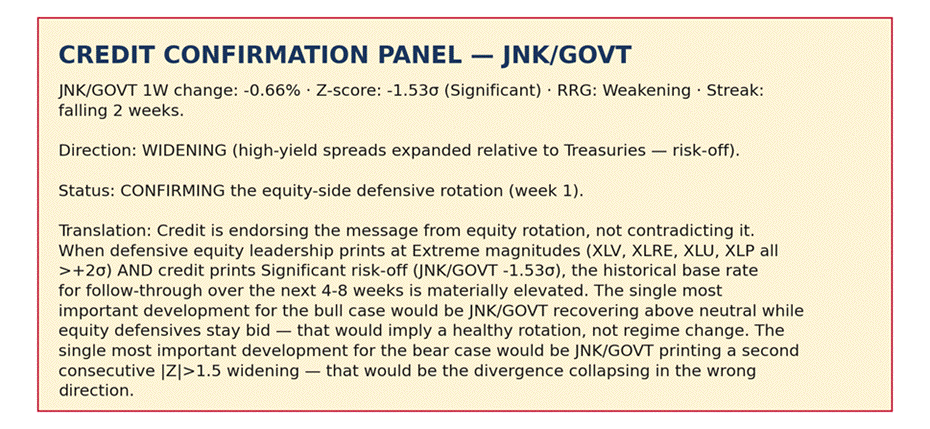
Defensive rotation is the trade. Health care, utilities, staples, REITs, and long-duration Treasuries all printed Extreme (|Z|>2.0) positive signals while technology printed an Extreme negative signal — and credit confirmed it.
The cleanest read is that the market has stopped paying for AI growth at any price and started repricing for a Fed-on-hold-with-no-cuts regime under Chair Warsh, with breadth narrowing in exactly the way that historically precedes a tradable correction in the cap-weighted index.
Weekly Snapshot
S&P 500 -2.38% · Nasdaq -4.6% (worst week since 2022) · Russell 2000 +1.01% · 10Y yield 4.40% (-12 bp WoW) · Dollar Index 101.36 · Gold -3.48% to $388.86 · WTI Crude -9.62% to $69.23 (Iran de-escalation continues) · VIX +12.26% to 18.83 · Lumber -2.37% to $621 · Best sector XLV +7.80% (best week since June 2022) · Worst sector XLK -5.28% (Nvidia -8.6% worst week since April 2025).
24-Asset Master Summary Table
Sorted by Status (Leaders → Neutral → Laggards), then by signal strength.
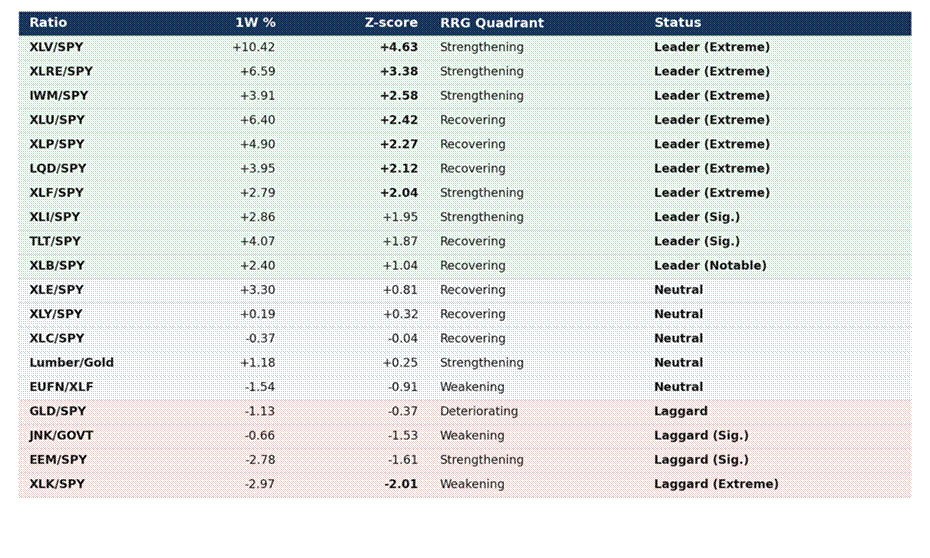
Z-score legend: |Z|<0.5 Background · 0.5-1.0 Weak · 1.0-1.5 Notable · 1.5-2.0 Significant · >2.0 Extreme. RRG: Strengthening (rising+accelerating) · Weakening (rising+slowing) · Recovering (falling+improving) · Deteriorating (falling+declining).
LEADERS: DEFENSIVE ROTATION GOES EXTREME — FIVE SECTORS HIT |Z|>2σ
Health Care (XLV) — Strengthening · The Single Largest Sector Signal In Over A Year
XLV/SPY ratio: +10.42% 1W · +11.14% 1M · Z-score: +4.63σ (Extreme) · Streak: rising 1 week · Seasonal: XLV has historically been the best-performing sector in July of midterm years.
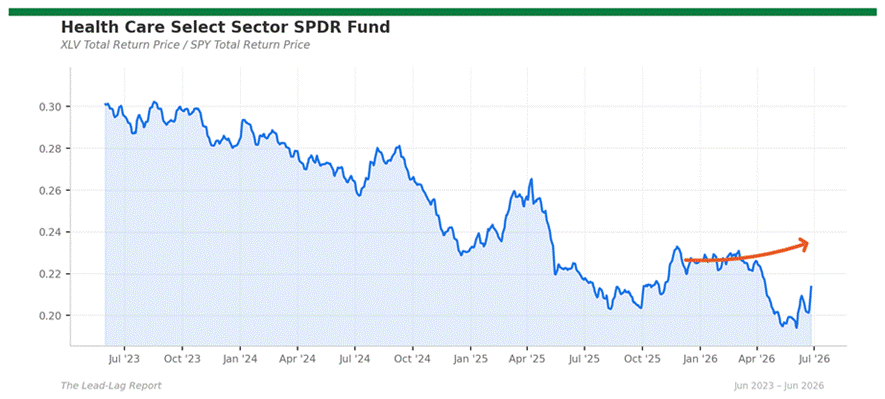
Health care is the headline. XLV gained 7.80% on the week — the best single-week sector performance since June 2022 — and the XLV/SPY ratio printed a +4.63σ reading, an ‘Extreme’ signal at a magnitude this framework has not generated in either direction in over twelve months. Eli Lilly led with an 11.6% weekly gain on renewed obesity-drug pipeline confidence and a broader sector bid that included biotech, large-cap pharma, and managed care simultaneously. The structural drag I have flagged for months — GLP-1 saturation, drug pricing pressure, mega-cap tech sucking flow — was overwhelmed in a single week by a defensive rotation impulse that was as broad as it was violent. The RRG quadrant is Strengthening because the ratio is rising and accelerating versus its prior 4-week pace, and the seasonal tailwind into midterm-year July adds confluence. The risk to the call: a +4.63σ reading is, by definition, statistically improbable to repeat next week — mean reversion in the magnitude is likely, but a Z above 1.0 even after a partial unwind would still confirm regime change.
Real Estate (XLRE) — Strengthening · From Forgotten Sector To Extreme Leader In One Week
XLRE/SPY ratio: +6.59% 1W · +5.00% 1M · Z-score: +3.38σ (Extreme) · Streak: rising 1 week.

Real estate ripped. XLRE/SPY printed +3.38σ — the second-largest signal in the report — driven by a 12 bp decline in the 10-year yield, REITs catching a bond-proxy defensive bid, and Welltower leading individual names with +7.70% on the week. The same setup that hurt REITs for the past nine months — higher-for-longer rates, work-from-home overhang on offices, financing-cost pressure on commercial — partially reversed: rates fell on the de-escalation in Iran, the defensive bid arrived after the tech rout, and real estate suddenly had the cleanest set of supports it has had since 2024. The RRG is Strengthening but the prior week’s RRG was Deteriorating, so this is a fresh quadrant flip, not continuation. Treat the signal as confirmed but watch for the 10-year yield to reverse — REIT leadership is yield-sensitive and a single hawkish Warsh comment can unwind it.
Small Caps (IWM) — Strengthening · Third Consecutive Week Of Leadership While Mega-Cap Tech Bled
IWM/SPY ratio: +3.91% 1W · +6.28% 1M · Z-score: +2.58σ (Extreme) · Streak: rising 3 weeks · Seasonal: small-cap July seasonality is mixed but post-July strong.
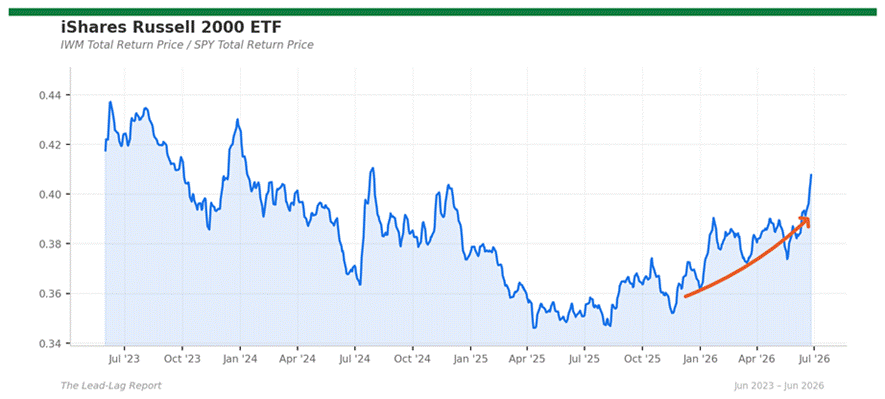
The Russell ground higher for a third straight week while the S&P fell 2.38%. The dispersion is the story: cap-weighted indices are dominated by names that just got crushed (Nvidia -8.6%, Broadcom heavy, software exodus), while the equal-weight S&P 500 rose 1.6% on the week — the widest gap in favor of equal-weight since June 2020. IWM/SPY printed +2.58σ Extreme on a 3-week rising streak with RRG accelerating into Strengthening. The lower 10-year yield helps small-cap balance sheets (Russell components carry far more floating-rate debt than S&P components), the defensive rotation lifts small-cap defensives that are nontrivial in the index, and the relative valuation gap continues to compress from extreme lows. The risk: if the Nasdaq selloff broadens into a full risk-off, small caps historically participate to the downside even though they led during the rotation.
Utilities (XLU) — Recovering · Bond-Proxy Defensive Catches Bid Even As Yields Stay Elevated
XLU/SPY ratio: +6.40% 1W · +5.76% 1M · Z-score: +2.42σ (Extreme) · Streak: rising 1 week.

Utilities printed +2.42σ — the third Extreme defensive signal of the week — confirming the framework check flip. The trade is straightforward: when investors stop paying for AI growth and start hunting for income and stability, utilities are the cleanest sector expression. XLU rallied 2.91% absolute while SPY fell, and the data-center AI power demand narrative that has supported the sector for two years is now layering on top of a fresh defensive bid. The RRG is Recovering — the ratio is below its 20-week moving average but the 4-week ROC is now accelerating positive, meaning the early innings of what could become a sustained leadership move. Watch the 10-year yield: utilities live and die on duration sensitivity. A yield breakout above 4.50% takes air out of this trade fast.
Consumer Staples (XLP) — Recovering · Defensive Rotation Hits Every Sector In The Cohort
XLP/SPY ratio: +4.90% 1W · +3.55% 1M · Z-score: +2.27σ (Extreme) · Streak: rising 1 week.

Staples completed the defensive sweep. XLP/SPY printed +2.27σ Extreme while the sector itself gained 2.4% on the week. The pattern is unmistakable: every defensive sector — health care, real estate, utilities, staples — is printing a |Z|>2.0 in the same week, which is the kind of clustered rotation signal that historically marks a regime change rather than a one-week tactical bounce. Nestle led individual names (+7.39%) on a combination of pricing power confirmation and EM consumer normalization. RRG is Recovering because the longer-term trend is still down, but the 4-week ROC is now accelerating positive — the same setup as utilities, with the same yield-sensitivity risk.
Investment-Grade Credit (LQD) — Recovering · Quality Credit Catches A Bid
LQD/SPY ratio: +3.95% 1W · +3.61% 1M · Z-score: +2.12σ (Extreme) · Streak: rising 1 week.

LQD/SPY printed +2.12σ — quality credit outperformed equities by nearly 4% on the week — confirming the risk-off rotation across asset classes, not just within equities. Investment-grade spreads tightened modestly while the 10-year yield fell 12 bp, giving LQD a double-tailwind (lower duration component and tighter spread). The setup matters because investment-grade credit is the rare asset class where retail allocators and pension funds both add at the same time during defensive rotations — there is structural demand whenever quality fixed income looks attractive relative to equities. Continued leadership here would be the cleanest single confirmation that institutional flows are following the rotation.
Financials (XLF) — Strengthening · Banks Stay Up Even As Yield Curve Compressed
XLF/SPY ratio: +2.79% 1W · +7.35% 1M · Z-score: +2.04σ (Extreme) · Streak: rising 1 week.
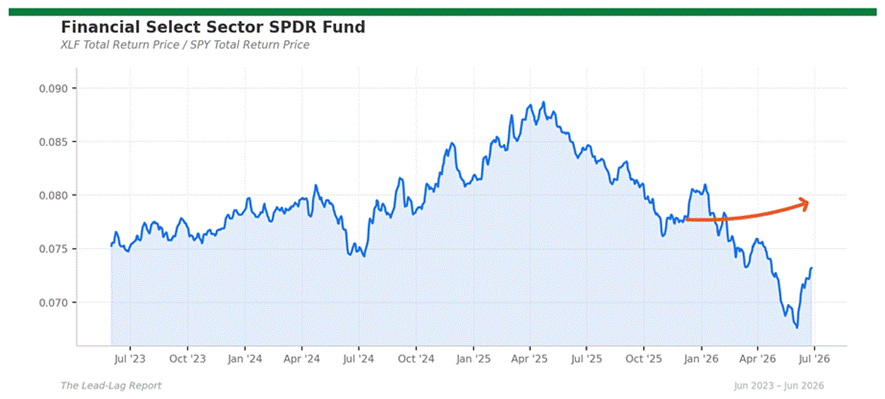
Financials are the one cyclical that held on through the defensive rotation, printing +2.04σ Extreme with RRG accelerating into Strengthening. The 10-year yield fell 12 bp while the 2-year stayed anchored, which technically compressed the curve — but XLF still gained relative to SPY because the rotation away from tech freed up enormous capital that needed a home in something with both growth optionality and defensive quality. Banks remain the cleanest expression of a no-recession, Fed-on-hold, deregulation-tailwind macro: deposit base intact, net interest margin still wide enough, capital markets active enough. The risk is the same as every cycle: if the bond market starts pricing actual recession instead of just slowdown, XLF deflates with everything else.
Industrials (XLI) — Strengthening · Four Weeks Of Rising Ratio, Cyclical-In-Defensive-Clothing
XLI/SPY ratio: +2.86% 1W · +7.01% 1M · Z-score: +1.95σ (Significant) · Streak: rising 4 weeks.

Industrials are the most counter-narrative leader this week. While the macro tape rotated defensive, XLI/SPY extended its rising streak to four weeks and printed +1.95σ Significant. The reading is consistent with the ‘soft landing without cuts’ thesis — the economy is still expanding (May retail sales surprised at +0.9%), reshoring capex is real, and industrial automation orders are firming even as the AI software equity narrative cracks. The XLB/XLI spread that I flagged earlier in the quarter is now resolving in industrials’ favor because the inflation impulse is being expressed in services and defensives rather than raw materials. The 4-week streak makes this the most durable trend on the leader board after Lumber/Gold.
Long-Duration Treasuries (TLT) — Recovering · Bond-Proxy Defensives All At Once
TLT/SPY ratio: +4.07% 1W · +5.57% 1M · Z-score: +1.87σ (Significant) · Streak: rising 4 weeks.
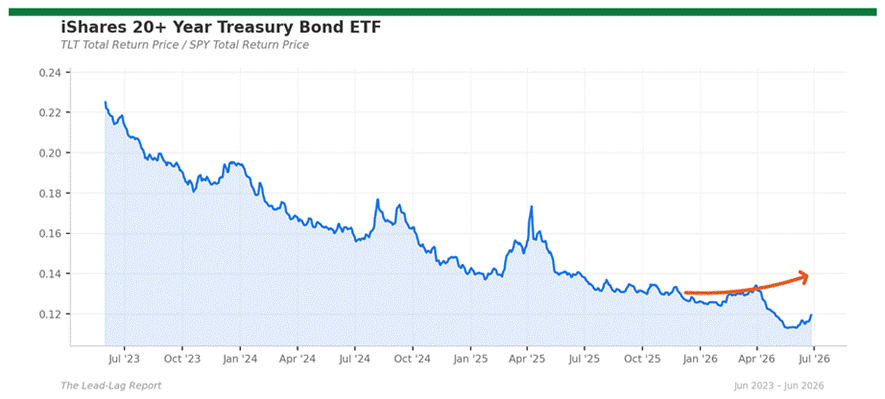
TLT/SPY printed +1.87σ Significant — the long bond outperformed equities by 4% on the week even as the 10-year only fell 12 bp. The pattern matches LQD, XLU, and XLRE: every duration-sensitive asset is catching a defensive bid simultaneously, which is what happens when allocators reach simultaneously for both income and lower volatility. RRG is Recovering on a 4-week rising streak — the streak duration matches XLI and is the second-longest among leaders. The interpretation: bond investors are positioning for either a growth scare that forces Warsh dovish or for a flight-to-quality bid from continued equity rotation. Either way, treasuries finally have a tailwind after three months of pain.
Materials (XLB) — Recovering · The Quiet Cyclical Holdout
XLB/SPY ratio: +2.40% 1W · +3.91% 1M · Z-score: +1.04σ (Notable) · Streak: rising 1 week.
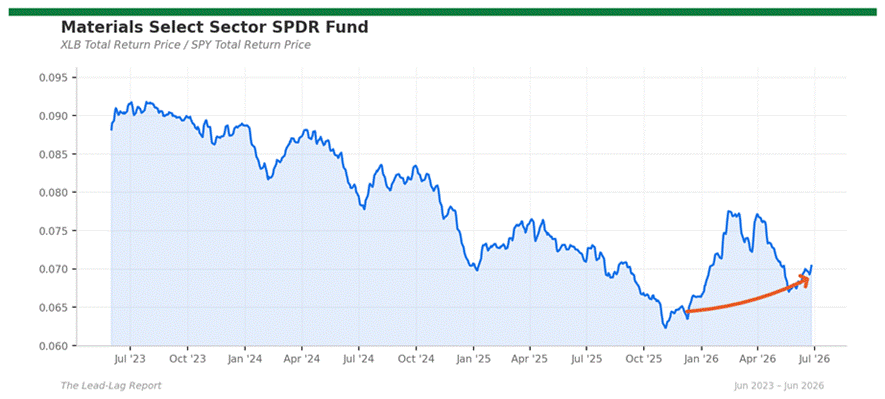
Materials threaded the needle. XLB/SPY held leader status with +1.04σ Notable even as the broader cyclical complex outside Industrials and Financials lost ground. Copper and aluminum names participated; chemicals lagged. The reading is consistent with a structurally tight commodities market combined with deregulation-friendly fiscal policy, but the weakness in lumber this week (-2.37%) is a warning sign that the broader cyclical pulse may be losing some velocity. RRG Recovering — the ratio is still below its 20-week MA but the 4-week ROC is now positive and accelerating. If next week brings continued positive Z, materials confirms the broader inflation-asset bid; if not, this becomes a Neutral within two weeks.
LAGGARDS: TECH CRUSHED, EM BREAKS DOWN, CREDIT TURNS
Technology (XLK) — Weakening · The First Sustained Tech Selloff Since April 2025
XLK/SPY ratio: -2.97% 1W · +0.95% 1M · Z-score: -2.01σ (Extreme) · Streak: falling 1 week.
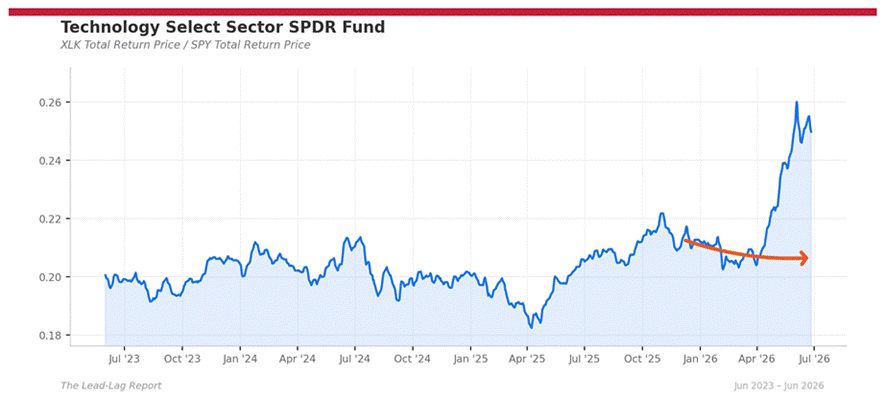
Technology cracked. XLK/SPY printed -2.01σ Extreme, the only Extreme negative reading on the board, and Nvidia fell 8.6% on the week — its worst weekly performance since April 2025. The Roundhill Magnificent Seven ETF is down 12.9% month-to-date. The proximate triggers were a consensus pivot away from ‘AI capex at any price’ toward concerns about return-on-AI-spending and weakening enterprise software signals (semiconductors -7.95% segment, software -2.98%, hardware -6.24%). XLC fell 8.46% as the mega-cap internet cohort got hit by the same flow. RRG flipped from Strengthening to Weakening — the ratio is still above its 20-week MA so this is not a full breakdown yet, but the 4-week ROC has clearly turned. The risk to a more cautious tech call: dip-buyers have shown up reliably for 18 months and one strong earnings beat (Microsoft, Apple report late July) can unwind half the damage in a single session. Stay short tech vs. defensives until either the JNK/GOVT confirmation reverses or XLK absorbs a hot earnings catalyst.
Emerging Markets (EEM) — Strengthening · The Counter-Trend Quadrant Breaks Down On Headline
EEM/SPY ratio: -2.78% 1W · +1.40% 1M · Z-score: -1.61σ (Significant) · Streak: falling 1 week.
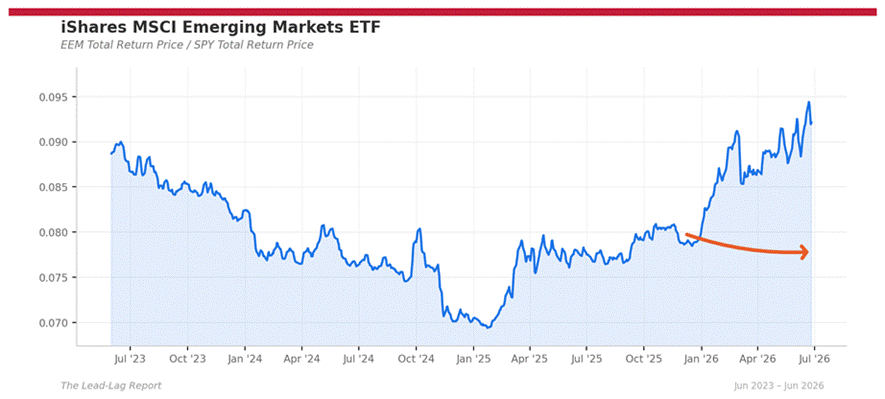
EM gave back the gains it built over the past month. EEM/SPY printed -1.61σ Significant — the third-largest negative reading — even though the RRG technically still says Strengthening (because the longer-term trend remains intact). The driver was a combination of dollar resilience into the defensive rotation, China-specific tape weakness on tech and material names, and Brazil/India taking idiosyncratic hits. The story to watch is whether this is a single-week capitulation in a still-intact uptrend or the first crack. The dollar held 101.36 even as the Iran de-escalation continued, which is itself a tell: when DXY refuses to fall on objectively bullish-for-EM news, it means the defensive bid in the dollar is stickier than the geopolitical setup would suggest. If DXY breaks 102, EM unwinds harder. If DXY breaks 100, EM mean-reverts up.
Gold (GLD) — Deteriorating · Eight-Week Falling Streak Extended To Nine
GLD/SPY ratio: -1.13% 1W · -6.08% 1M · Z-score: -0.37σ (Background) · Streak: falling 9 weeks.

Gold extended its losing streak to nine consecutive weeks of falling vs SPY — one of the longest stretches in the past three years. GLD itself fell 3.48% on the week to $388.86, a fourth consecutive weekly decline, and is now -10.43% on a 4-week basis. The drivers compound on each other: Fed-on-hold-or-hiking under Warsh removes the falling-real-rates tailwind; the Iran de-escalation continues to bleed the safe-haven premium; and now the defensive rotation chose health care, utilities, staples, and Treasuries over precious metals — meaning even within the defensive trade, gold is being skipped over. The Z-score is only -0.37 because the magnitude of any individual week has been modest while the streak has been brutal — death by a thousand cuts. The level the trade needs to break this: a Warsh dovish surprise, a sustained dollar break under 100, or geopolitical re-escalation. Until then, the trend is the trade.
Communication Services (XLC) — Recovering · Eight-Week Falling Streak Despite Tactical Bounce
XLC/SPY ratio: -0.37% 1W · -5.98% 1M · Z-score: -0.04σ (Background) · Streak: falling 8 weeks.

XLC is the slow-motion bleed. The ratio has fallen for eight consecutive weeks and is -5.98% on a 1-month basis, but the individual weekly moves have been modest enough to print only Background Z-scores. The sector is dominated by mega-cap internet (Meta, Alphabet, Netflix) which has been the cleanest victim of the rotation away from secular growth. Communication Services itself fell 8.46% on the week per third-party segment data — among the worst-performing S&P groups. The technical RRG quadrant flipped to Recovering this week (ratio falling but 4-week ROC improving) which historically marks the early innings of a relief bounce, but with the broader defensive rotation accelerating, expect any XLC bounce to be sold.
Consumer Discretionary (XLY) — Recovering · Tesla Drag Plus Consumer Fatigue
XLY/SPY ratio: +0.19% 1W · -3.19% 1M · Z-score: +0.32σ (Background) · Streak: rising 2 weeks.

Discretionary is the laggard with a quiet tailwind. The 1-week reading flipped slightly positive (+0.19%) on a 2-week rising streak, but the 1-month picture is still -3.19% and Tesla’s +8.46% Monday rebound is doing real work to flatter the index relative to fundamentals. The consumer signal underneath is weakening: credit card delinquencies elevated, services-spending categories softening, and Amazon-specific risk into the Q2 print. The RRG Recovering classification suggests the bounce has another week or two of room, but the deeper trend remains down until either rates structurally fall or the labor market visibly loosens. Treat this as a tactical neutral, not a leader.
European Banks vs U.S. Banks (EUFN/XLF) — Weakening · The Best Bank Trade Quietly Reversed
EUFN/XLF ratio: -1.54% 1W · -2.84% 1M · Z-score: -0.91σ (Weak) · Streak: falling 1 week.
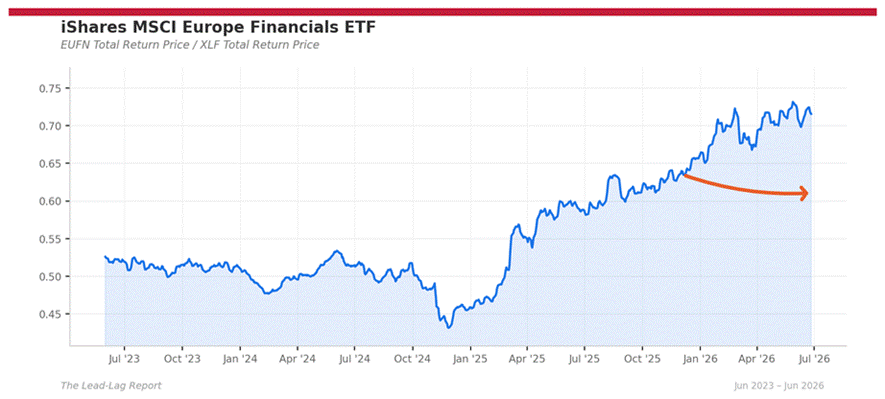
EUFN/XLF turned for the first time in months. With U.S. banks printing +2.04σ Extreme this week, EUFN’s relative leadership eroded — EUFN fell 1.19% while XLF gained 0.35%, and the ratio printed -0.91σ Weak with RRG flipped to Weakening. The ECB-Fed policy divergence trade still exists conceptually but is being overwhelmed by the U.S. defensive rotation flow that prefers domestic balance-sheet quality. The cleanest read: this is a tactical pause in a still-intact structural EUFN/XLF uptrend, but if next week prints another |Z|>0.5 negative, the structural call comes under review.
Energy (XLE) — Recovering · Surprising Strength Inside An Otherwise Bearish Week For Crude
XLE/SPY ratio: +3.30% 1W · -2.30% 1M · Z-score: +0.81σ (Weak) · Streak: rising 1 week.

Energy is the puzzle. WTI crude fell 9.62% on the week as Iran de-escalation continued, yet XLE/SPY rose 3.30% — printing +0.81σ Weak with RRG flipped to Recovering. The disconnect is partly mechanical (energy equity got too oversold relative to the move in spot) and partly because the broader defensive rotation lifted everything that was not tech or commodity-pure. Do not read too much into this — the underlying fundamental for XLE (oil price level) just confirmed a structurally lower regime, and the equity catch-up is a relief rally rather than leadership confirmation. Treat as Neutral with a downward bias until oil stabilizes above $75.
Lumber / Gold — Strengthening Statistically But Losing Velocity
Lumber/Gold ratio: +1.18% 1W · +14.91% 1M · Z-score: +0.25σ (Background) · Streak: rising 4 weeks.

The Lumber/Gold ratio still technically prints Strengthening on a 4-week rising streak, but the underlying components both deteriorated this week: lumber fell 2.37% (LBR=F $621) and gold fell 3.48% — meaning the ratio rose only because gold fell harder. This is the lowest-quality version of the leader signal: the lumber-vertical, gold-falling pro-cyclical regime is still mathematically intact on a 4-week basis (Lumber +5.19%, Gold -10.43%), but the lumber component itself is cracking, which is the pre-condition for either a stagflation pivot (BothDown) or a defensive-favoring pivot (Lumber↓ Gold↑). Watch lumber: a break below $600 in the next two weeks would mark a meaningful regime change in the macro framework.
Lumber/Gold Scenario Translation
Scenario this week: Lumber↑ Gold↓ (cyclical-favoring). Lumber 4W ROC +5.19%, Gold 4W ROC -10.43%. The mathematical reading still says cyclical-pro-growth, which is the historical confirmation pattern for materials and small-cap leadership. But this week’s individual components both fell, meaning the ratio improved on relative momentum rather than absolute strength — a degraded version of the signal. The implication: the cyclical regime is fading, even if it has not yet flipped. If lumber breaks $600 in the next two weeks while gold stabilizes or rebounds, the scenario flips to Lumber↓ Gold↑ (defensive-favoring) which would CONFIRM the equity defensive rotation across the cross-asset framework. That is the single highest-confluence setup to watch.
Previously On Leaders-Laggards
Last week (Jun 23 issue, Run #20) — Warsh’s First Strike: Hawkish Hold Sends EEM and Russell To Extremes, Energy Goes From Hero To Worst Performer. The leader board was EEM, IWM, XLK, XLI, EUFN, TLT, XLF, XLB; the laggards were XLE, XLV, XLC, XLRE, GLD, XLU, XLY, XLP. How it held up: the call on the hawkish Warsh pivot is intact and arguably the proximate driver of this week’s full defensive rotation — the FOMC’s higher-for-longer messaging is what gave permission to the rotation out of growth and into income. The XLE-to-laggard call held perfectly (WTI down another 9.6% this week). The XLK leadership call inverted hard — XLK/SPY went from +0.19σ last week to -2.01σ this week, a -2.20σ one-week swing that is itself an Extreme magnitude. The XLV-as-laggard call inverted from Weakening RRG to Strengthening RRG and printed the largest sector flip in the report. The IWM/EEM/TLT/XLF calls extended cleanly. Net: 5 of 8 leaders held or strengthened, 6 of 8 laggards held or weakened, the XLK/XLV pair was the principal miss.

What Would Change My View
The defensive rotation call is the highest-conviction read in this report. It would weaken materially if: (1) JNK/GOVT recovers above its 20-week moving average within two weeks, breaking the credit-side confirmation; (2) XLK/SPY prints |Z|>1.0 positive on a fresh weekly read, indicating dip-buyers absorbed the AI rotation; (3) the 10-year yield breaks above 4.50% on a sustained basis, removing the duration-defensive tailwind; (4) lumber breaks above $660 while gold stays soft, reinstating the BothDown-to-cyclical pivot; or (5) Warsh delivers an unexpectedly dovish FOMC statement in late July. The call would be invalidated if all five conditions print simultaneously. The call would be CONFIRMED with higher conviction if: (a) defensive sectors print another |Z|>1.0 positive next week (continuation, not single-week spike); (b) lumber breaks under $600 confirming the cross-asset cyclical regime change; (c) JNK/GOVT extends to a second consecutive |Z|>1.5 widening; or (d) DXY breaks above 102 forcing further EM and risk-asset unwind.
The Week In Context
The cleanest signal from this report in over a year is that five defensive sectors all printed Extreme positive readings (|Z|>2.0) in the same week — XLV +4.63σ, XLRE +3.38σ, XLU +2.42σ, XLP +2.27σ, LQD +2.12σ — while technology printed -2.01σ Extreme on the other side and credit confirmed risk-off with JNK/GOVT -1.53σ Significant widening. The cross-asset confluence is unusually high: defensive equities, long-duration bonds, investment-grade credit, and the framework’s own XLU/SPY 4W ROC all moved together. The single most important question for the next two weeks is whether the JNK/GOVT widening extends or reverses — that is the cleanest test of whether this rotation becomes a regime change or remains a sharp internal correction inside an intact bull market.
“Five defensive sectors at |Z|>2σ in the same week, with credit confirming. That is not a rotation — that is the breadth setup that precedes regime change.”
Data Sources
Yahoo Finance — Daily ETF & equity prices:
https://finance.yahoo.com
MarketWatch — Tale of Two S&P 500s, Equal-Weight Rotation: https://finance.yahoo.com/markets/stocks/articles/tale-two-p-500s-rotation-113000983.html
ValuEngine via The Globe and Mail — Week ending Jun 26, 2026: https://www.theglobeandmail.com/investing/markets/stocks/AMAT/pressreleases/3042235/06292026-valuengine-weekly-market-summary-commentary/
The Market Pulse — Healthcare Replaces Technology as Investors Rotate Into Defensives:

Cardinal Insights — Weekly Market Update Jun 28, 2026:

Stock Titan — 1-Week Sector Performance Jun 27, 2026: https://www.stocktitan.net/sector-performance
FRED — 10-Year Treasury Yield: https://fred.stlouisfed.org/series/DGS10
Intellectia.ai — Fed June 2026 Hawkish Pause Analysis: https://intellectia.ai/blog/fed-interest-rate-decision-june-2026-analysis
Opus Asset — Warsh Doctrine Era Special Report: https://www.opusasset.com/knowledge-centre/special-report-june-fomc-meeting-warsh-doctrine-era/
CIBC — June 2026 FOMC Update: https://private-wealth.us.cibc.com/insights/articles/june-2026-fomc-update
Disclosure
The Lead-Lag Report is provided by Lead-Lag Publishing, LLC. All opinions and views mentioned in this report constitute our judgments as of the date of writing and are subject to change at any time. Information within this material is not intended to be used as a primary basis for investment decisions and should also not be construed as advice meeting the particular investment needs of any individual investor. Trading signals produced by the Lead-Lag Report are independent of other services provided by Lead-Lag Publishing, LLC or its affiliates, and positioning of accounts under their management may differ. Please remember that investing involves risk, including loss of principal, and past performance may not be indicative of future results. Lead-Lag Publishing, LLC, its members, officers, directors and employees expressly disclaim all liability in respect to actions taken based on any or all of the information on this writing.