
Defensive Tide Rising
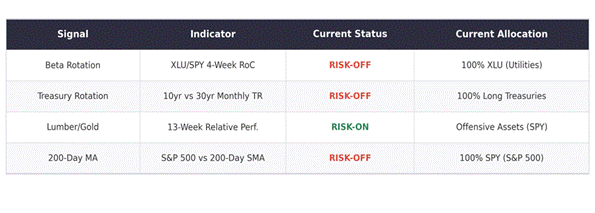
Three of four signals favor safety. The S&P 500 has broken its 200-day moving average — and the lone Risk-On reading is gold's crash, not improving fundamentals.

Signal Summary
Key Takeaways
• The Beta Rotation signal (XLU/SPY 4-week RoC of +5.03%) remains Risk-Off. Utilities continue to outperform the S&P 500, reflecting persistent flight to defensive sectors. The war-driven oil shock and the Fed’s hawkish hold have kept investors favoring lower-beta exposure.
• Treasuries remain firmly Risk-Off. The February monthly data (TLT +4.24% vs IEF +2.14%) maintains the signal, though the bond market is now caught between competing forces: safe-haven flows into duration and inflation fears from $119 oil. TLT edged higher Thursday even as equities sold off, suggesting the flight-to-safety bid is winning for now.
• The Lumber/Gold signal has flipped to Risk-On — but not for the reason you might expect. Gold crashed from above $5,000 to $4,607, a dramatic reversal likely driven by forced liquidation and margin calls across commodities as the oil shock rippled through futures markets. Lumber’s 13-week return of +9.34% now exceeds Gold’s +4.74%. This is a technical flip, not an improvement in economic fundamentals.
• The S&P 500 has breached its 200-day moving average. At 6,578.77, the index now trades -0.5% below its 200-day SMA of 6,609.56. This is the critical technical level we flagged last week — the last line of defense has been broken. Signal 4 has flipped to Risk-Off, replacing SSO (2x leverage) with SPY.
Market Commentary
Three weeks into the US-Iran conflict, 3 of four intermarket signals now read Risk-Off. This week marks a significant reshuffling of the signal framework: the S&P 500 has finally broken below its 200-day moving average, flipping Signal 4 to Risk-Off for the first time since the April 2025 correction. Meanwhile, gold’s violent crash from above $5,000 to $4,607 — a 9% decline in days — has paradoxically flipped the Lumber/Gold signal to Risk-On. The net result remains strongly defensive, but the composition has changed materially.
The catalyst for this week’s selloff was twofold. On Wednesday, the Federal Reserve held rates at 3.5-3.75% with an 11-1 vote, and Chair Powell struck a hawkish tone, stating inflation was “not coming down as much as hoped.” Then on Thursday, Israel and the United States struck Iran’s South Pars gas field — the world’s largest natural gas reserve — sending Brent crude surging above $119 per barrel. The S&P 500 dropped from 6,716 on Monday to 6,579 by Thursday’s close, a 2% decline in four sessions.
