
Digital Assets Within a Deregulation ETF: FMKT’s Bitcoin and Ethereum Exposure
Key Highlights
The Free Markets ETF (FMKT) applies the concept of deregulation broadly, extending beyond traditional industries to include digital assets.¹
Bitcoin and Ethereum are included indirectly through U.S.-listed exchange-traded products, maintaining regulatory compliance while reflecting financial innovation.²
Digital asset exposure is capped and framed as a thematic complement rather than a primary return driver.³
Bitcoin and Ethereum introduce diversification by adding return drivers distinct from equities and conventional macro factors.⁴
FMKT’s structure reflects an effort to balance policy-driven opportunity, innovation, and portfolio risk.⁵
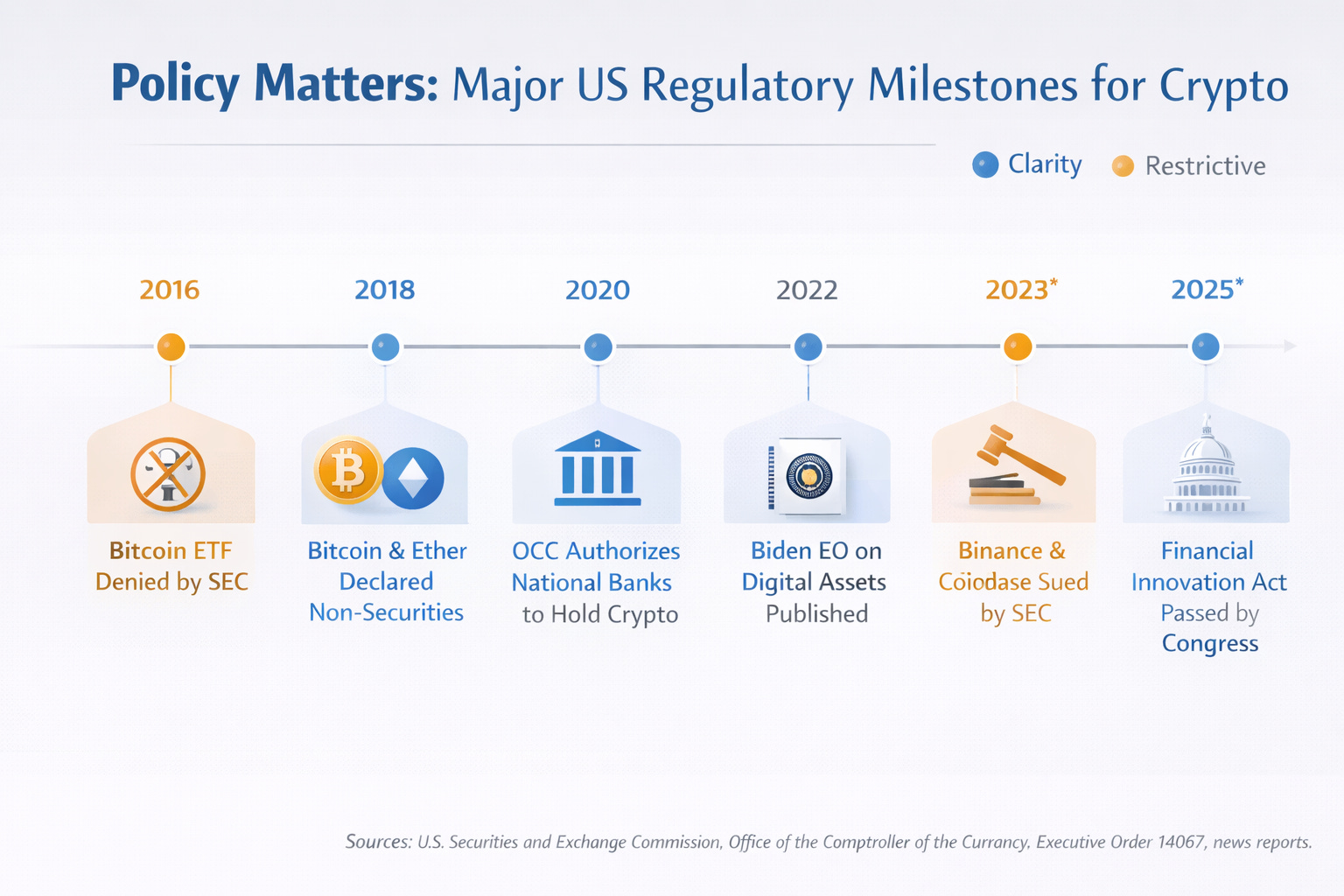
A retail investor scrolling through crypto prices on a smartphone might not expect to find Bitcoin or Ethereum inside a deregulation-themed exchange-traded fund. Yet that is precisely what distinguishes the Free Markets ETF (FMKT). Designed to invest in companies positioned to benefit from reduced regulatory burdens, the fund quietly incorporates digital assets as part of its broader thematic framework. This combination may seem unconventional, but it reflects a deliberate interpretation of what deregulation can mean in a modern financial system.
A Broader View of Deregulation
FMKT was launched with a clear premise: regulatory rollbacks can unlock value across sectors historically constrained by government oversight. Financial institutions, energy producers, and healthcare companies often dominate this narrative, as changes in policy can directly affect profitability, capital allocation, and competitive dynamics. What sets FMKT apart is its decision to extend this logic beyond traditional industries and into the digital asset ecosystem.¹
Bitcoin and Ethereum enter the portfolio not as speculative side bets, but as reflections of how financial deregulation may evolve. Policymakers have increasingly acknowledged that digital assets and blockchain-based financial infrastructure sit at the intersection of innovation and regulation. Shifts toward clearer or lighter oversight can influence how capital flows into crypto-related markets, how institutions participate, and how broadly these technologies are adopted. FMKT’s strategy incorporates this perspective by allocating a limited portion of the portfolio to U.S.-listed exchange-traded products linked to Bitcoin and Ethereum, rather than holding digital tokens directly.²
This structure allows the fund to maintain regulatory compliance while still participating in potential upside associated with digital assets. The allocation remains capped, reinforcing that crypto is intended to complement, not redefine, the fund’s identity. FMKT remains first and foremost a diversified equity ETF centered on deregulation, with digital assets functioning as an extension of that theme rather than a replacement for it.³
Thematic Diversification, Not Gimmickry
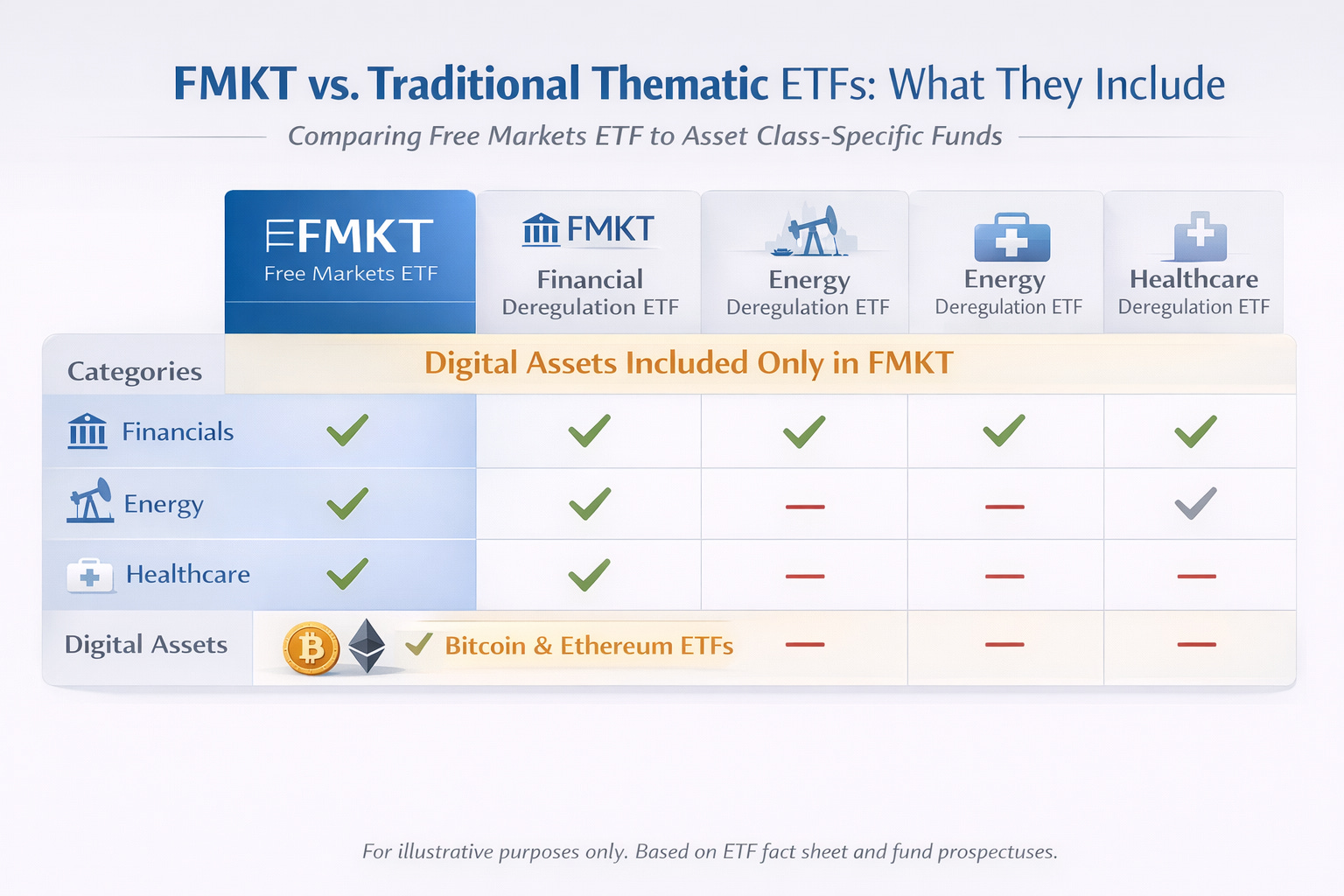
Including Bitcoin and Ethereum within a deregulation ETF serves a thematic purpose beyond novelty. Deregulation in finance does not exclusively apply to banks or insurers; it also affects payment systems, capital markets infrastructure, and emerging financial technologies. Digital assets occupy a unique position within this landscape, operating outside traditional intermediaries while still being shaped by government policy.
By incorporating crypto-linked instruments, FMKT broadens its exposure to policy-driven change. Investors are not only gaining access to companies that may benefit from relaxed permitting rules or modified capital requirements, but also to a financial system experimenting with decentralization, tokenization, and alternative settlement mechanisms. This approach recognizes that “free markets” are no longer confined to legacy institutions.
The diversification benefit extends beyond theme and into portfolio construction. Bitcoin and Ethereum have historically exhibited return patterns that differ from those of equities and fixed income. While correlations can rise during periods of market stress, digital assets have often responded to distinct drivers such as network adoption, technological upgrades, and global liquidity conditions.⁴ Including a small allocation to these assets introduces an additional return stream that does not rely on the same economic variables as traditional stocks.
Research examining diversified portfolios has suggested that modest allocations to digital assets can, at times, improve overall risk-adjusted characteristics. FMKT reflects this thinking without overcommitting capital, keeping its crypto exposure aligned with the broader investment thesis rather than allowing it to dominate portfolio behavior.⁴
Risk Awareness and Portfolio Discipline
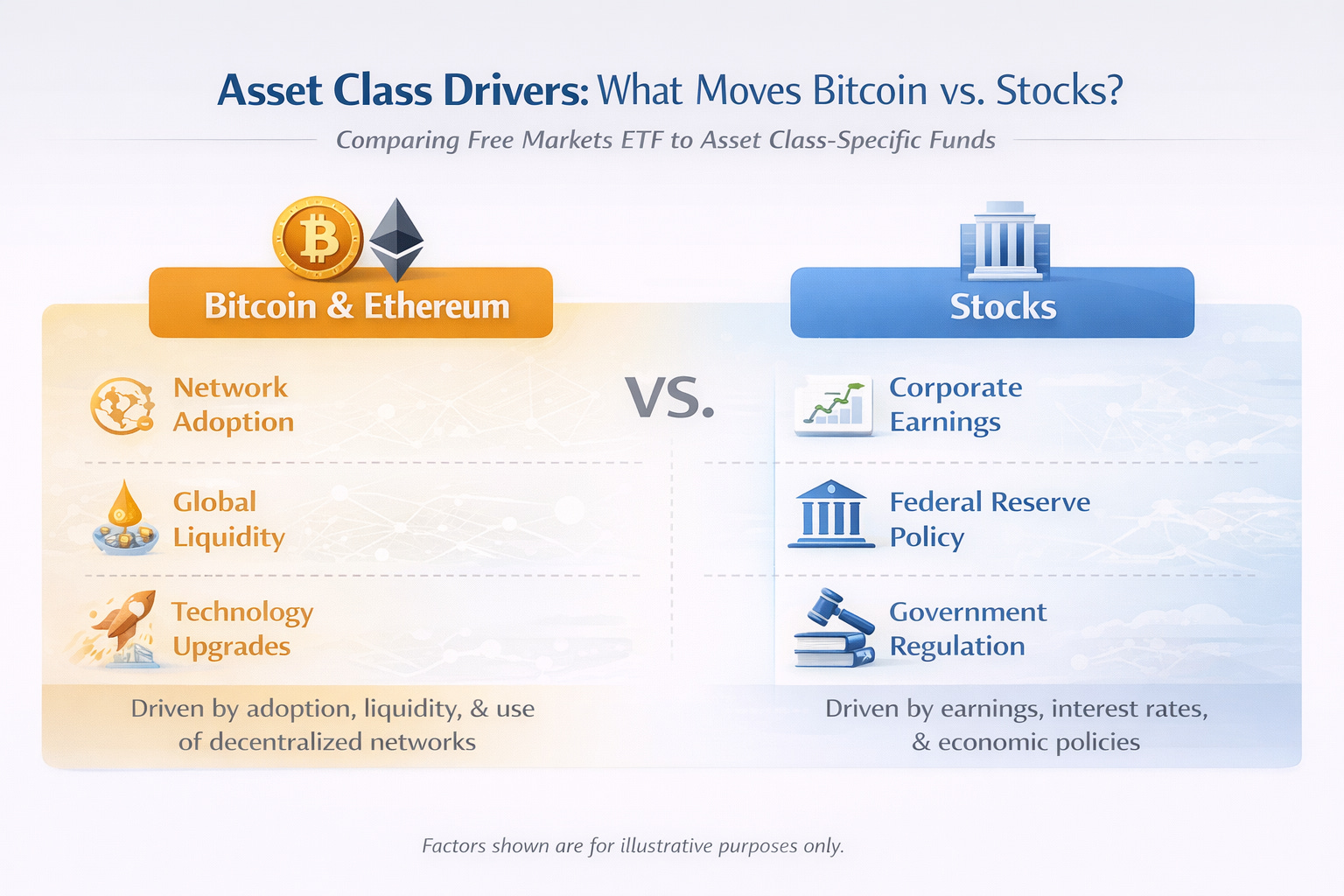
The inclusion of Bitcoin and Ethereum does not eliminate risk; it reshapes it. Digital assets are known for volatility, and even indirect exposure through exchange-traded products can introduce price swings unrelated to equity fundamentals. FMKT addresses this by constraining the size of the allocation and embedding it within a portfolio that spans multiple sectors and asset types.³
Regulatory uncertainty also cuts both ways. The same policy environment that could encourage digital asset adoption could shift rapidly, especially as political priorities change. A renewed emphasis on enforcement or restrictive legislation could dampen enthusiasm for crypto markets. FMKT’s actively managed structure provides some flexibility, but it cannot fully insulate investors from macro-level policy reversals.⁵
That said, the fund’s design suggests an awareness of these trade-offs. Bitcoin and Ethereum are treated as satellite exposures rather than core holdings. Their role is to enhance diversification and reflect evolving market structures, not to dominate performance outcomes. This restraint is particularly relevant for investors seeking thematic exposure without assuming concentrated crypto risk.
Innovation Within a Familiar Framework
What makes FMKT notable is not simply that it holds digital assets, but how it integrates them into a familiar ETF framework. Investors do not need to manage wallets, navigate crypto exchanges, or evaluate custody arrangements. Exposure is obtained through regulated instruments, embedded within a diversified portfolio that also includes established industries.
This structure lowers the barrier to entry for investors curious about digital assets but hesitant to allocate capital directly. It also reinforces the fund’s educational value by placing Bitcoin and Ethereum alongside banks, energy firms, and healthcare companies, encouraging a more holistic view of deregulation as a multi-dimensional economic force.
A Measured Bet on Policy and Markets
FMKT remains a relatively new entrant, and its strategy has yet to be tested across a full market cycle. Both deregulation trends and digital asset markets are subject to rapid shifts, and there are no guarantees that policy momentum will remain supportive.⁶ Still, the fund’s investment thesis is internally consistent.
For investors who believe that free-market policies will continue to influence economic outcomes, FMKT offers a consolidated way to express that view. The inclusion of Bitcoin and Ethereum broadens the fund’s reach without redefining its core purpose. It acknowledges that deregulation may affect not only established corporations, but also emerging financial systems.
Ultimately, FMKT’s crypto exposure illustrates how thematic investing is adapting to a changing landscape. The fund blends conventional deregulation beneficiaries with selective participation in digital assets, creating a portfolio that reflects both policy trends and technological shifts.
Footnotes
Tidal Investments LLC, “Launches The Free Markets ETF (FMKT), First-of-Its-Kind Fund Targeting Companies Benefiting from Deregulation,” Business Wire, June 10, 2025.
Tidal Investments LLC, “The Free Markets ETF (FMKT) Completes Dual Listing, Begins Trading on NYSE Texas,” Business Wire, August 20, 2025.
DJ Shaw, “New ETF Targets Companies Poised for Deregulation Relief,” ETF.com, June 11, 2025.
21Shares Research, “Primer: Cryptoassets Included in a Diversified Portfolio,” October 2023.
The Free Markets ETF, Summary Prospectus, U.S. Securities and Exchange Commission filing, February 7, 2025.
Free Markets ETF, Fund Details, FreeMarketsETF.com, accessed January 2026.
Past performance is no guarantee of future results.
The Fund’s investment objectives, risks, charges, expenses and other information are described in the statutory or summary prospectus, which must be read and considered carefully before investing. You may download the statutory or summary prospectus or obtain a hard copy by calling 855-994-4004 or visiting www.freemarketsetf.com. Please read the Prospectuses carefully before you invest.
Investing involves risk including the possible loss of principal.
FMKT is distributed by Foreside Fund Services, LLC.
Find full holding details and learn more about FMKT at
http://www.freemarketsetf.com.
Holdings are subject to change.
Deregulation Strategy Risks.The Fund’s strategy of investing in companies that may benefit from deregulatory measures entails significant risks, including those stemming from the unpredictable nature of regulatory trends. Deregulation is influenced by political, economic, and social factors, which can shift rapidly and in unforeseen directions. Changes in government priorities, political leadership, or public sentiment may result in the reversal of existing deregulatory policies or the introduction of new regulations that could adversely affect certain industries or companies. Further, while the Fund invests in companies expected to benefit from deregulatory initiatives, not all of these companies may achieve the expected advantages, whether fully, partially, or at all. The actual impact of deregulatory measures may vary widely depending on a company’s specific operational, financial, and competitive circumstances. Companies may also face challenges adapting to new regulatory environments, or their competitive positioning may be undermined by other market factors unrelated to deregulation. These risks could negatively affect the performance of the Fund’s portfolio.
Underlying Digital Assets ETP Risks. The Fund’s investment strategy, involving indirect exposure to Bitcoin, Ether, or any other Digital Assets through one or more Underlying ETPs, is subject to the risks associated with these Digital Assets and their markets. These risks include market volatility, regulatory changes, technological uncertainties, and potential financial losses. As with all investments, there is no assurance of profit, and investors should be cognizant of these specific risks associated with digital asset markets.
● Underlying Bitcoin and Ether ETP Risks: Investing in an Underlying ETP that focuses on Bitcoin, Ether, and/or other Digital Assets, either through direct holdings or indirectly via derivatives like futures contracts, carries significant risks. These include high market volatility influenced by technological advancements, regulatory changes, and broader economic factors. For derivatives, liquidity risks and counterparty risks are substantial. Managing futures contracts tied to either asset may affect an Underlying ETP’s performance. Each Underlying ETP, and consequently the Fund, depends on blockchain technologies that present unique technological and cybersecurity risks, along with custodial challenges in securely storing digital assets. The evolving regulatory landscape further complicates compliance and valuation efforts. Additionally, risks related to market concentration, network issues, and operational complexities in managing Digital Assets can lead to losses. For Ether specifically, risks associated with its transition to a proof-of-stake consensus mechanism, including network upgrades and validator centralization, may add additional uncertainties.
●Bitcoin and Ether Investment Risk: The Fund’s indirect investments in Bitcoin and Ether through holdings in one or more Underlying ETPs expose it to the unique risks of these digital assets. Bitcoin’s price is highly volatile, driven by fluctuating network adoption, acceptance levels, and usage trends. Ether faces similar volatility, compounded by its reliance on decentralized applications (dApps) and smart contract usage, which are subject to innovation cycles and adoption rates. Neither asset operates as legal tender or within central authority systems, exposing them to potential government restrictions. Regulatory actions in various jurisdictions could negatively impact their market values. Both Bitcoin and Ether are susceptible to fraud, theft, market manipulation, and security breaches at trading platforms. Large holders of these assets (”whales”) can influence their prices significantly. Forks in the blockchain networks—such as Ethereum’s earlier split into Ether Classic—can affect demand and performance. Both assets’ prices can be influenced by speculative trading, unrelated to fundamental utility or adoption.
● Digital Assets Risk: Digital Assets like Bitcoin and Ether, designed as mediums of exchange or for utility purposes, are an emerging asset class. Operating independently of any central authority or government backing, they face extreme price volatility and regulatory scrutiny. Trading platforms for Digital Assets remain largely unregulated and prone to fraud and operational failures compared to traditional exchanges. Platform shutdowns, whether due to fraud, technical issues, or security breaches, can significantly impact prices and market stability.
● Digital Asset Markets Risk: The Digital Asset market, particularly for Bitcoin and Ether, has experienced considerable volatility, leading to market disruptions and erosion of confidence among participants. Negative publicity surrounding these disruptions could adversely affect the Fund’s reputation and share trading prices. Ongoing market turbulence could significantly impact the Fund’s value.
● Blockchain Technology Risk: Blockchain technology underpins Bitcoin, Ether, and other digital assets, yet it remains a relatively new and largely untested innovation. Competing platforms, changes in adoption rates, and technological advancements in blockchain infrastructure can affect their functionality and relevance. For Ether, the dependence on its proof-of-stake mechanism and smart contract capabilities introduces risks tied to network performance and scalability. Investments in blockchain-dependent companies or vehicles may experience market volatility and lower trading volumes. Furthermore, regulatory changes, cybersecurity incidents, and intellectual property disputes could undermine the adoption and stability of blockchain technologies.
Recent Market Events Risk. U.S. and international markets have experienced and may continue to experience significant periods of volatility in recent years and months due to a number of economic, political and global macro factors including uncertainty regarding inflation and central banks’ interest rate changes, the possibility of a national or global recession, trade tensions and tariffs, political events, war and geopolitical conflict. These developments, as well as other events, could result in further market volatility and negatively affect financial asset prices, the liquidity of certain securities and the normal operations of securities exchanges and other markets, despite government efforts to address market disruptions.
New Fund Risk. The Fund is a recently organized management investment company with no operating history. As a result, prospective investors do not have a track record or history on which to base their investment decisions.
. Lead-Lag Publishing, LLC is not an affiliate of Tidal/Toroso, Tactical Rotation Management, LLC, SYKON Asset Management, Point Bridge Capital, or ACA/Foreside.