
$FMKT: Why Regulators Are Pausing or Pulling Back AI Oversight Efforts
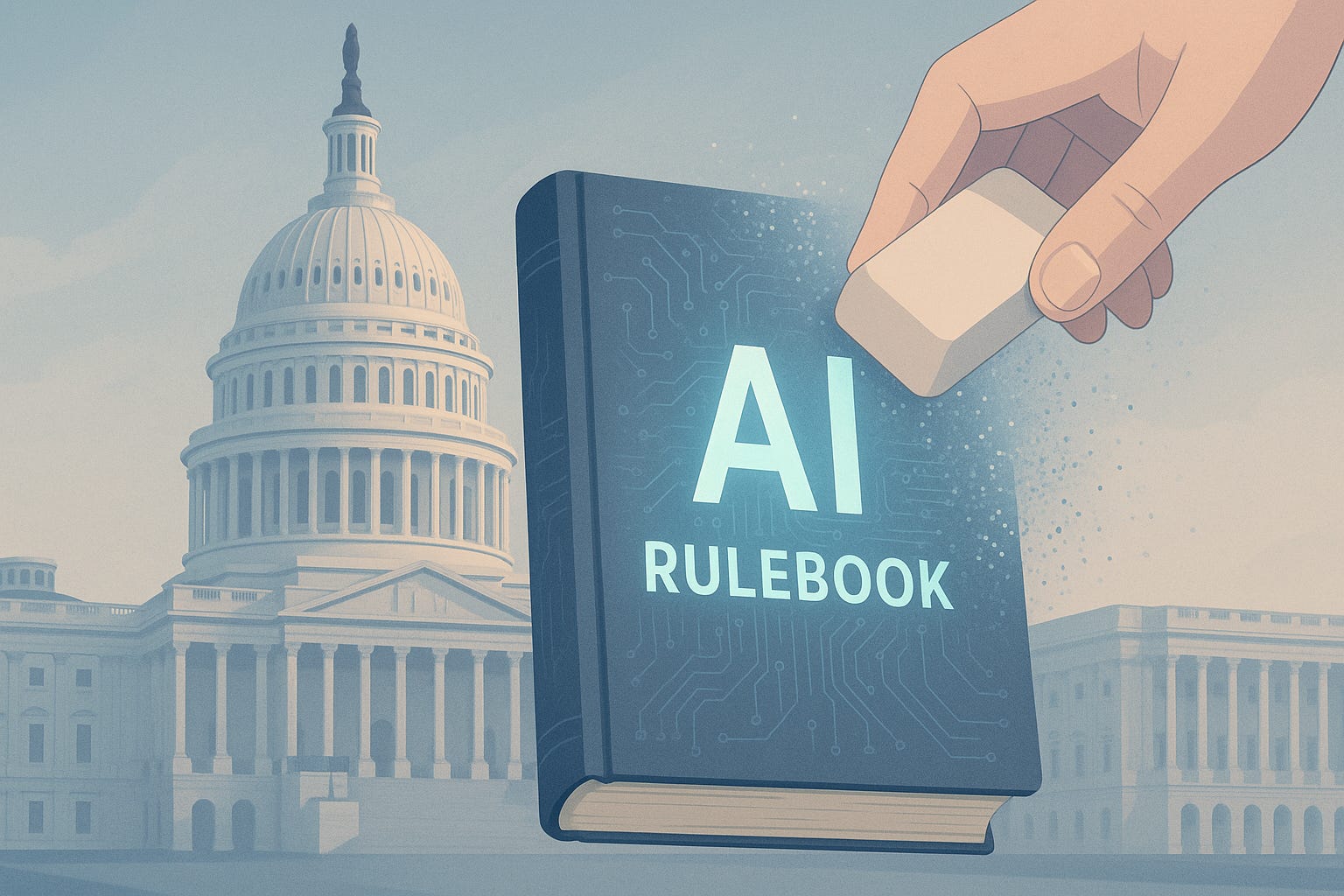
It wasn’t long ago that Washington appeared ready to tighten controls on artificial intelligence. Lawmakers held headline-grabbing hearings, agencies floated new guardrails, and the policy world seemed braced for a sweeping federal framework. That momentum has shifted. Instead of pushing ahead, regulators across the federal landscape are slowing down, scaling back, or shelving proposals altogether. What once looked like an assertive regulatory cycle has become a deliberate pause — and, in many cases, a reversal.
This pivot matters. It shapes how companies build AI systems, how states attempt to fill the vacuum, and how investors position around the next phase of AI-driven growth.
A Sudden Pivot in Washington
The turning point came in January 2025, when President Donald Trump rescinded the prior administration’s “Safe, Secure, and Trustworthy AI” executive order and replaced it with a directive focused on “Removing Barriers to American Leadership in AI.”¹ The move didn’t just change tone; it eliminated the federal guidance on fairness, transparency, and risk management that had guided agencies since 2023. The “AI Bill of Rights,” a centerpiece of the Biden administration’s approach, disappeared from government websites.¹
Other proposed requirements — including third-party audits for advanced models and certain disclosures — were halted.² The administration’s July 2025 “America’s AI Action Plan” cemented the shift: agencies were instructed to reduce regulatory friction, fast-track permits for data-center and compute infrastructure, and avoid policies that could be viewed as “unnecessary government control.”³ References to ethics, diversity, and climate considerations in federal AI standards were pared back.³
Controversy erupted when reports surfaced that the White House was preparing an executive order to preempt state AI rules, authorize federal lawsuits against states, and potentially restrict funding for states that enacted their own safeguards.⁴ Bipartisan backlash followed quickly. Lawmakers called it government overreach; consumer advocates called it “unfathomable” given real-world AI harms.⁴ Within weeks, the administration paused the plan.⁴ Even for a White House intent on deregulation, the optics of overriding states proved too difficult.
The State–Federal Standoff

This regulatory pause is rooted in a growing power struggle. While federal agencies have stepped back, states have moved assertively. By mid-2025, more than 1,000 AI-related bills had been introduced across state legislatures, covering everything from hiring algorithms to deepfake protections.⁵ States such as California, Colorado, and New York were no longer waiting for federal leadership — they were creating their own rulebooks.
Tech companies, worried about a patchwork of compliance standards, lobbied aggressively for federal preemption.⁴ Congress responded. In May 2025, the House passed the “One Big Beautiful Bill Act,” which included a sweeping ten-year moratorium on state and local AI regulation.⁶ If enacted, it would have voided dozens of existing state laws and blocked new ones through the mid-2030s.⁶
Opposition was immediate. Forty state attorneys general signed letters condemning the move as unconstitutional federal overreach.⁷ Republican senators raised concerns about states’ rights and the Tenth Amendment. Legal scholars warned that courts might strike down such an expansive preemption.⁷ By summer, the Senate stripped the provision from the final legislation.⁸
Nevertheless, the administration continued searching for legislative vehicles — including the annual defense authorization bill — to revive parts of the proposal.⁴ The result is a fragmented landscape: states have proposed rules, federal agencies have stepped back, and enforcement deadlines stretch well into 2026. California’s hiring-related AI law, for instance, does not begin meaningful enforcement until the following year, leaving an extended period in which companies face minimal new constraints.³
Innovation, Competitiveness, and the Politics of Restraint
Why such a dramatic federal pause? Policymakers increasingly frame AI oversight through the lens of global competition. Officials argue that heavy-handed rules would slow innovation, undermine U.S. competitiveness, and cede advantage to China.³ Vice President J.D. Vance underscored the message by criticizing the European Union’s AI Act as evidence that strict frameworks risk stifling progress.²
Europe provides a clear contrast. Its upcoming AI Act — likely the most comprehensive AI law in the world — is set to impose stringent requirements by 2026. Many European businesses are lobbying to delay it. U.S. policymakers view that as an opportunity: a chance to position the United States as a more attractive hub for AI investment.
Industry influence also plays a role. Large AI developers argue that strict compliance regimes would slow release cycles, deepen legal exposure, and push capital abroad.² Their argument has resonated in Washington, where officials see AI not only through a risk lens but as a major economic catalyst. Deregulation, in this view, is a competitive necessity.
Still, critics warn that the absence of clear rules creates its own vulnerabilities. Advocacy groups point to algorithmic bias, fraud, and safety failures as evidence that voluntary self-governance is insufficient.⁴ Even some supporters of a lighter touch acknowledge the possibility of a future backlash if AI failures erode public trust.
The Economic Consequences of Hitting Pause
For now, the regulatory retreat strengthens incentives for companies adopting AI. With no imminent federal mandates — and many state rules delayed or in limbo — firms can deploy AI without the weight of new compliance costs. Banks exploring AI-driven credit models face minimal additional oversight.⁹ Healthcare, manufacturing, and logistics firms are integrating AI systems faster, reallocating budgets once reserved for potential compliance to research, hiring, and infrastructure.
This resembles earlier American deregulation cycles. When restrictions were relaxed in telecommunications in the 1980s or the early internet era of the 1990s, investment surged. A lighter regulatory touch gave innovators room to experiment, build, and scale.
The risks are real. An AI-related failure causing significant harm could provoke a swift regulatory reaction. Smaller firms may cut corners, creating systemic vulnerabilities that damage public confidence. Divergent rules across borders could complicate trade, as American AI exporters may need to comply with stricter European or Asian standards even if domestic requirements remain loose.³
Still, businesses appear confident that the benefits outweigh the risks. Capital continues flowing into AI startups, and enterprise adoption keeps accelerating. In boardrooms, the prevailing view is that the regulatory climate will remain favorable — or at least not become restrictive — for the foreseeable future.
The Investor Angle

For investors, the shift is more than a political story. A regulatory pause can function like a tailwind: reducing costs, widening margins, and accelerating product cycles. Companies building compute infrastructure, developing models, enabling data analytics, or embedding AI in financial and industrial workflows all benefit from a freer environment. Market enthusiasm reflects this momentum.
A practical way to position for this shift is through the Free Markets ETF (FMKT), which targets U.S. companies poised to benefit from deregulation across sectors.¹⁰ The fund is built on a straightforward thesis: when government steps back, innovation and market forces tend to expand economic opportunity.
None of this eliminates risk. Politics can change quickly, public opinion can sour, and AI failures can alter the landscape overnight. But for now, the direction of travel is clear. Regulators are not rewriting the AI rulebook — they’re setting it aside. And the companies building the next generation of AI tools are using that breathing room to accelerate.
For investors and businesses alike, recognizing this pause — and what it enables — is essential to understanding the next phase of AI’s evolution.
Footnotes
Kurt A. Franklin, “California’s Recent and Pending AI Laws… Will the Federal Government Preempt California’s Laws?,” Fennemore, June 27, 2025.
Johanna Rinceanu and Randall Stephenson, “Two Futures of AI Regulation under the Trump Administration,” Digital Constitutionalist, July 22, 2025.
Simonne Brousseau et al., “‘America’s AI Action Plan’ and More Developments…,” Faegre Drinker Biddle & Reath LLP, August 5, 2025.
Karen Freifeld, “White House pauses executive order that would seek to preempt state laws on AI, sources say,” Reuters, November 21, 2025.
Mark Brennan et al., “U.S. House of Representatives passes proposal to prohibit enforcement of state AI laws for 10 years,” Hogan Lovells, May 22, 2025.
Omer Tene and Bethany P. Withers, “House Passes 10-Year Federal Moratorium on State AI Regulation,” Goodwin Procter, May 22, 2025.
Caity Coyne, “WV lawmakers sign national letter opposing federal preemption over AI regulation,” West Virginia Watch, November 26, 2025.
Tara Payne, “The Overlooked Risk in Bank AI Adoption: Regulatory Inaction,” Bank Policy Institute, October 28, 2025.
“About The Free Markets ETF (FMKT),” Sykon Asset Management, accessed November 29, 2025.
Past performance is no guarantee of future results.
The Fund’s investment objectives, risks, charges, expenses and other information are described in the statutory or summary prospectus, which must be read and considered carefully before investing. You may download the statutory or summary prospectus or obtain a hard copy by calling 855-994-4004 or visiting www.freemarketsetf.com. Please read the Prospectuses carefully before you invest.
Investing involves risk including the possible loss of principal.
FMKT is distributed by Foreside Fund Services, LLC.
Find full holding details and learn more about FMKT at
http://www.freemarketsetf.com.
Holdings are subject to change.
Deregulation Strategy Risks.The Fund’s strategy of investing in companies that may benefit from deregulatory measures entails significant risks, including those stemming from the unpredictable nature of regulatory trends. Deregulation is influenced by political, economic, and social factors, which can shift rapidly and in unforeseen directions. Changes in government priorities, political leadership, or public sentiment may result in the reversal of existing deregulatory policies or the introduction of new regulations that could adversely affect certain industries or companies. Further, while the Fund invests in companies expected to benefit from deregulatory initiatives, not all of these companies may achieve the expected advantages, whether fully, partially, or at all. The actual impact of deregulatory measures may vary widely depending on a company’s specific operational, financial, and competitive circumstances. Companies may also face challenges adapting to new regulatory environments, or their competitive positioning may be undermined by other market factors unrelated to deregulation. These risks could negatively affect the performance of the Fund’s portfolio.
Underlying Digital Assets ETP Risks. The Fund’s investment strategy, involving indirect exposure to Bitcoin, Ether, or any other Digital Assets through one or more Underlying ETPs, is subject to the risks associated with these Digital Assets and their markets. These risks include market volatility, regulatory changes, technological uncertainties, and potential financial losses. As with all investments, there is no assurance of profit, and investors should be cognizant of these specific risks associated with digital asset markets.
● Underlying Bitcoin and Ether ETP Risks: Investing in an Underlying ETP that focuses on Bitcoin, Ether, and/or other Digital Assets, either through direct holdings or indirectly via derivatives like futures contracts, carries significant risks. These include high market volatility influenced by technological advancements, regulatory changes, and broader economic factors. For derivatives, liquidity risks and counterparty risks are substantial. Managing futures contracts tied to either asset may affect an Underlying ETP’s performance. Each Underlying ETP, and consequently the Fund, depends on blockchain technologies that present unique technological and cybersecurity risks, along with custodial challenges in securely storing digital assets. The evolving regulatory landscape further complicates compliance and valuation efforts. Additionally, risks related to market concentration, network issues, and operational complexities in managing Digital Assets can lead to losses. For Ether specifically, risks associated with its transition to a proof-of-stake consensus mechanism, including network upgrades and validator centralization, may add additional uncertainties.
●Bitcoin and Ether Investment Risk: The Fund’s indirect investments in Bitcoin and Ether through holdings in one or more Underlying ETPs expose it to the unique risks of these digital assets. Bitcoin’s price is highly volatile, driven by fluctuating network adoption, acceptance levels, and usage trends. Ether faces similar volatility, compounded by its reliance on decentralized applications (dApps) and smart contract usage, which are subject to innovation cycles and adoption rates. Neither asset operates as legal tender or within central authority systems, exposing them to potential government restrictions. Regulatory actions in various jurisdictions could negatively impact their market values. Both Bitcoin and Ether are susceptible to fraud, theft, market manipulation, and security breaches at trading platforms. Large holders of these assets (”whales”) can influence their prices significantly. Forks in the blockchain networks—such as Ethereum’s earlier split into Ether Classic—can affect demand and performance. Both assets’ prices can be influenced by speculative trading, unrelated to fundamental utility or adoption.
● Digital Assets Risk: Digital Assets like Bitcoin and Ether, designed as mediums of exchange or for utility purposes, are an emerging asset class. Operating independently of any central authority or government backing, they face extreme price volatility and regulatory scrutiny. Trading platforms for Digital Assets remain largely unregulated and prone to fraud and operational failures compared to traditional exchanges. Platform shutdowns, whether due to fraud, technical issues, or security breaches, can significantly impact prices and market stability.
● Digital Asset Markets Risk: The Digital Asset market, particularly for Bitcoin and Ether, has experienced considerable volatility, leading to market disruptions and erosion of confidence among participants. Negative publicity surrounding these disruptions could adversely affect the Fund’s reputation and share trading prices. Ongoing market turbulence could significantly impact the Fund’s value.
● Blockchain Technology Risk: Blockchain technology underpins Bitcoin, Ether, and other digital assets, yet it remains a relatively new and largely untested innovation. Competing platforms, changes in adoption rates, and technological advancements in blockchain infrastructure can affect their functionality and relevance. For Ether, the dependence on its proof-of-stake mechanism and smart contract capabilities introduces risks tied to network performance and scalability. Investments in blockchain-dependent companies or vehicles may experience market volatility and lower trading volumes. Furthermore, regulatory changes, cybersecurity incidents, and intellectual property disputes could undermine the adoption and stability of blockchain technologies.
Recent Market Events Risk. U.S. and international markets have experienced and may continue to experience significant periods of volatility in recent years and months due to a number of economic, political and global macro factors including uncertainty regarding inflation and central banks’ interest rate changes, the possibility of a national or global recession, trade tensions and tariffs, political events, war and geopolitical conflict. These developments, as well as other events, could result in further market volatility and negatively affect financial asset prices, the liquidity of certain securities and the normal operations of securities exchanges and other markets, despite government efforts to address market disruptions.
New Fund Risk. The Fund is a recently organized management investment company with no operating history. As a result, prospective investors do not have a track record or history on which to base their investment decisions.
. Lead-Lag Publishing, LLC is not an affiliate of Tidal/Toroso, Tactical Rotation Management, LLC, SYKON Asset Management, Point Bridge Capital, or ACA/Foreside.