Gold Refused the Peace Trade But Couldn't Refuse the Dot Plot
The $4,320 floor broke at last — not on Hormuz, but on Warsh's dot plot. The gold-refusal decoupling enters its T+7 inflection.

Today’s Lead-Lag Report post is sponsored by Scouter

Track major stock catalysts and expected price moves using institutional-grade data—minus the manual grind.'
Stop wasting hours on manual research. Scouter synthesizes fundamental data, technical analysis, and historical price volatility into clear dashboards for upcoming events. See Trend Scores and Expected Moves across 10,000+ tickers in one place.
DISCLAIMER – PLEASE READ: This is sponsored advertising content for which Lead-Lag Publishing, LLC has been paid a fee. The information provided in the link is solely the creation of Scouter. Lead-Lag Publishing, LLC does not guarantee the accuracy or completeness of the information provided in the link or make any representation as to its quality. All statements and expressions provided in the link are the sole opinion of Scouter and Lead-Lag Publishing, LLC expressly disclaims any responsibility for action taken in connection with the information provided in the link.
Gold Refused the Peace Trade But Couldn’t Refuse the Dot Plot
• Gold breached its $4,320 COMEX floor for the first time, settling $4,129.90 (−22.35% from the Jan 29 ATH of $5,318.40) — but the catch-down lines up with Warsh’s first dot plot, not the Hormuz tanker resumption.
• U.S. equities cracked on an AI-chip rout: S&P 500 −1.94% on the week to 7,365.46, the Nasdaq Composite −2.99%, XLK −4.14% on the day, VIX +18.77% to 19.49, and the curve bear-steepening into a hawkish SEP.
• Korea’s KOSPI triggered its fourth circuit breaker of 2026 (−9.99%) as Samsung and SK Hynix shed 12%+, exporting chip contagion to Tokyo, Hong Kong, and Wall Street while the ECB and BoJ pressed ahead with rate hikes.
Let me lead with the contradiction. For six weeks the gold-refusal decoupling thesis rested on a single, stubborn fact: gold would not follow crude down the Hormuz peace trade. Oil bled, yields obeyed, and bullion sat there at $4,353 refusing the script. This week the $4,320 floor finally broke — COMEX front-month gold settled $4,129.90, down 1.24% on the session and roughly 5.1% across the week — and the lazy read is that the refusal was a mirage all along. It was not. Gold did not break because tankers started moving through the Strait again; it broke the same week Kevin Warsh’s first FOMC handed the market a dot plot with hikes penciled in. Gold refused the peace trade. It could not refuse the dot plot. That distinction is the whole edition.
Start with the inversion that drove everything else. The Federal Open Market Committee under its new chair held the funds rate at 3.50%–3.75% on June 17, but the decision was never the event — the Summary of Economic Projections was. Nine of eighteen participants now pencil in at least one 25-basis-point hike for 2026, with the SEP lifting 2026 core PCE to 3.3% from 2.7% in March, an admission of inflation persistence that the prior edition called a stagflation tell. That repricing, not Hormuz, is what pulled real-rate-sensitive gold off its floor and sent the dollar to a 13-month high. The dot plot is the gravity well; everything in this report orbits it.
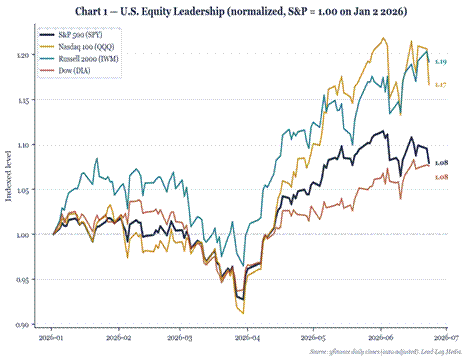
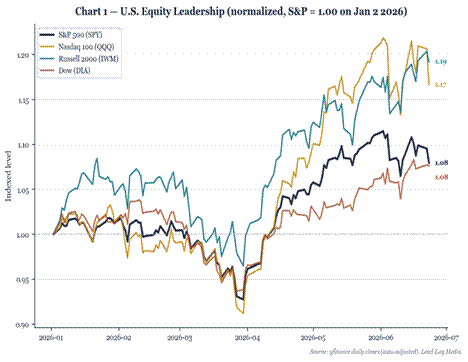
U.S. equities cracked under that gravity. The S&P 500 fell 1.43% on Tuesday to close 7,365.46, down 1.94% on the week from the prior 7,511.35 baseline, while the Nasdaq Composite shed 2.99% on the week and the Nasdaq 100 dropped 3.29% on the session alone. The epicenter was the AI-chip complex: a violent KOSPI-driven semiconductor unwind — Samsung and SK Hynix each down more than 12% in Seoul — cascaded into Wall Street, dragging the technology sector ETF XLK down 4.14% on the day as Micron sold off roughly 13% into its earnings. The Dow held within a fraction of flat and the Russell 2000 finished the week higher, a textbook signal that this was a mega-cap valuation reset, not broad credit stress; high-yield credit barely flinched. The VIX jumped 18.77% to 19.49, elevated caution rather than fear, still shy of the 20 handle.
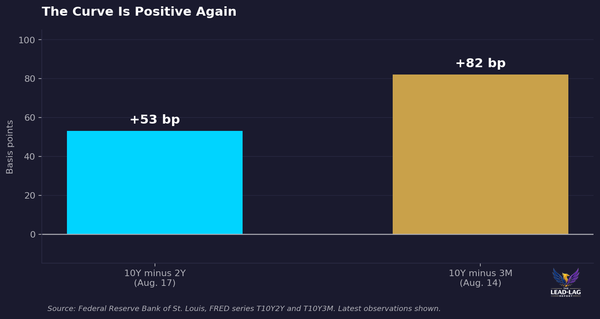
Underneath the equity tape, the bond market told the same hawkish story in a different language. The curve bear-steepened post-FOMC — the 10-year backed up toward roughly 4.51% as the dot-plot shock did its work — before Tuesday’s risk-off sent a flight-to-quality bid back into Treasuries. The macro print sharpened the contradiction the Fed is now living inside: the S&P Global flash composite PMI rose to 52.2, a five-month high, with manufacturing at a 49-month high, even as the survey flagged factory employment falling at its fastest pace since 2009 and input-price inflation near its highest since early 2023. Growth and inflation are both running hot while hiring buckles. That is not a recession call; it is the simultaneous growth-plus-inflation-persistence signal that tightens Warsh’s exit path and validates the dot plot the market spent the week trying to fade.
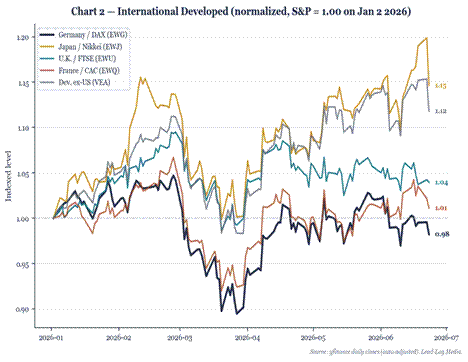
Asia delivered the week’s defining shock, and it was structural. Korea’s KOSPI plunged 9.99% to 8,203.84, triggering a Level-1 circuit breaker — the fourth of 2026 and tenth in the index’s history — after the Financial Supervisory Service warned that regulators had been “too hasty” approving sixteen leveraged single-stock ETFs on Samsung and SK Hynix, products with roughly $9 billion in mostly-retail assets. Foreign investors dumped some $2.6 billion in a single session. This is the same leveraged-ETF fragility that produced June’s earlier circuit breaker, and it is the channel that carried chip contagion to Tokyo, where the Nikkei 225 fell 3.55%, snapping an eight-day winning streak that had earlier broken 70,000 intraday for the first time. Hong Kong’s Hang Seng fell 1.82%; the AI trade is now a single global position, and it deleveraged everywhere at once.
Europe leaned into the tightening regardless. The STOXX Europe 600 slipped 0.73% to 634.63 and the DAX fell 0.98%, their largest single-session drop since early June as the chip unwind tracked west, with STMicroelectronics down 9.11%. The policy backdrop is the durable story: the ECB raised its deposit rate 25 basis points to 2.25% on June 11 — its first hike since September 2023 — explicitly citing the Hormuz-linked energy shock, while the Bank of Japan lifted its call rate to 1.00%, a 31-year high. The peace trade, meanwhile, is contested rather than concluded. Hormuz closure reached Day 116; the Geneva memorandum signed Friday June 19 snagged that Sunday — roughly a dozen vessels crossed, down from ~32 Saturday — before a Burgenstock de-confliction channel restored a fragile safe-passage understanding. Crude kept drifting lower anyway — ICE Brent August settled $76.88, NYMEX WTI August $73.05 — because the market is trading the dollar and the dot plot, not the headlines out of the Strait.
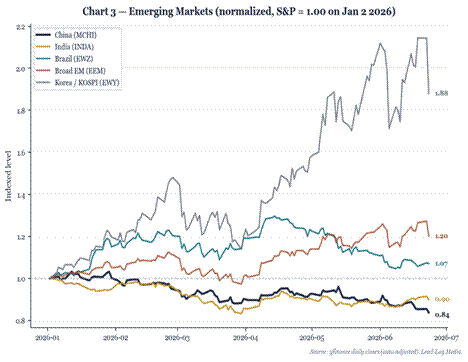
Emerging markets fractured along the same fault line. China’s CSI 300 fell 2.77% off its 5,061 high as the Korea selloff rippled through Hong Kong-listed chip names, and the Hang Seng China Enterprises index sat near a 52-week low — a reminder that property prices have now fallen for more than 35 consecutive months beneath a 4.5%-to-5% growth target. India was the relative haven: the Sensex eased about 1.16% on the session even as its verified weekly close held near 77,094, with the Reserve Bank of India having held its repo rate at 5.25% on June 5 in a neutral stance, its second consecutive hold after roughly 100 basis points of cumulative easing earlier in the cycle. I am deliberately citing the RBI hold against its own June 5 statement rather than aggregator chatter, because the cumulative-cut figure is exactly where prior editions drifted.
Brazil kept easing into the disinflation it can actually see. The Banco Central do Brasil cut the Selic rate to 14.25% at its June 17 meeting, a third consecutive 25-basis-point reduction from the 15.00% cycle peak, even as it flagged a “more challenging” inflation scenario — the mirror image of the developed-market hiking impulse. The Ibovespa held above 170,000, a constructive read versus the prior edition’s 169,648 baseline. The MENA picture stayed genuinely contested: Iran re-declared a Hormuz closure on June 20, the U.S. denied it, and shipping data showed traffic still flowing through the chokepoint even as the rhetoric escalated. Gulf equities have largely priced the peace, but they are in wait-and-verify mode — the divergence between Iran’s closure claims and the AIS tanker tracks is precisely the kind of same-news-cycle conflation that has to be dated separately, not blended.
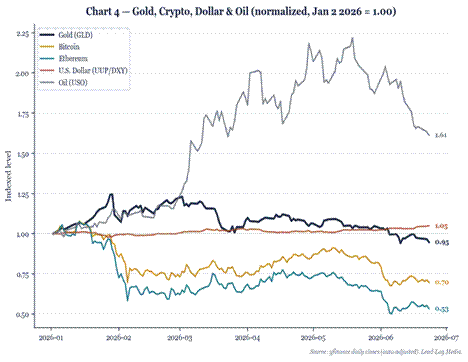
Which brings the whole thing back to the metals desk, where the thesis lives or dies. COMEX August gold settled $4,129.90, a 1.24% session loss that finally took it through the $4,320 floor — now down 22.35% from the January 29 all-time high of $5,318.40, the deepest drawdown of the 2026 cycle. I want to be precise about the instrument: this is the COMEX futures settle, not a spot tick or an LBMA fix, and the breach is best read as an inflection rather than a refutation. The thesis stands at two validators and one emerging refuter. Gold genuinely held through five weeks of the Hormuz oil unwind; what cracked it this week was the dollar at a 13-month high near 101.36 and a dot plot promising higher real rates. The refusal was real. The dot plot was simply a larger force.
The rest of the complex confirms the monetary read over the geopolitical one. Silver crashed 4.46% on the session, widening the gold/silver ratio to roughly 66.5:1 — silver is capitulating to the peace trade faster than gold, which is exactly what you would expect if bullion’s marginal driver had shifted from war premium to rate premium. Crude kept its quiet downward drift, with WTI August at $73.05 and Brent August at $76.88, both still some 10% below pre-memorandum levels. Crypto traded as the high-beta tail of the same risk-off impulse: Bitcoin fell to $62,477 and Ethereum to $1,664 as the strong dollar and the equity slump pulled liquidity out of the speculative complex. In my view, the market is missing that the gold breach and the chip rout are not two stories — they are one repricing, and the asset class quietly screaming it is the dollar.
Here is what I am watching next week. First, the gold-refusal thesis at T+14: does bullion stabilize as a rate story above $4,000, or does the $5,318-anchored drawdown push through a deeper level on a still-rising dollar. Second, Hormuz around Day 123 — whether the Burgenstock de-confliction channel survives Iran’s contested closure claims or the memorandum ruptures outright. Third, the Bank of Japan’s next move, with OIS pricing roughly 70% odds of a further hike toward 1.25% and USD/JPY flirting again with intervention territory. Fourth, whether Korea’s KOSPI can recover from its fourth circuit breaker without a fresh leveraged-ETF cascade. Fifth, the August WTI roll and the next EIA print into a Cushing inventory near operational lows. Sixth, the ECB and BoE paths into their next meetings now that Europe has flipped to tightening. And seventh, China property prices into a 36th month of declines. The contradiction I opened with — a Fed admitting stagflation while growth prints a five-month PMI high — is the one every one of these threads ultimately resolves against. The dot plot is on borrowed time only if growth breaks first; until it does, gold’s floor stays broken.
The Lead-Lag Report is provided by Lead-Lag Publishing, LLC. All opinions and views mentioned in this report constitute our judgments as of the date of writing and are subject to change at any time. Information within this material is not intended to be used as a primary basis for investment decisions and should also not be construed as advice meeting the particular investment needs of any individual investor. Trading signals produced by the Lead-Lag Report are independent of other services provided by Lead-Lag Publishing, LLC or its affiliates, and positioning of accounts under their management may differ. Please remember that investing involves risk, including loss of principal, and past performance may not be indicative of future results. Lead-Lag Publishing, LLC, its members, officers, directors and employees expressly disclaim all liability in respect to actions taken based on any or all of the information on this writing.