
Oil, Sentiment, and the Correction That Nobody Wanted
Where Does the Market Go When Every Tailwind Becomes a Headwind?

Key Highlights
• The S&P 500 closed its fifth consecutive losing week, falling to 6,368.85, down 8.7% from its January all-time high and posting its worst week since the Iran war began.1
• The 10-year Treasury yield surged to 4.44%, its highest since July 2025, as oil prices and inflation expectations repriced simultaneously.6
• Gold held near $4,460 per ounce, up over $1,300 year-over-year, reinforcing its role as the consensus hedge in a world with no consensus.13
• University of Michigan consumer sentiment collapsed to 53.3, a three-month low, while year-ahead inflation expectations jumped to 3.8% from 3.4%.5
The Surface Narrative
The fifth straight week of losses has finally pulled both the Dow and the Nasdaq into correction territory, each down over 10% from their respective peaks. The S&P 500 fell 108 points on Friday alone, closing at 6,368.85, its worst weekly performance since the war with Iran began in late February.1 On the surface, the proximate cause is familiar: oil. Brent crude hovered near $107 per barrel, and West Texas Intermediate held above $93, both roughly 50% above where they stood barely a month ago.2 The Strait of Hormuz remains effectively closed to non-Iranian-approved traffic, and Tehran’s rejection of Washington’s 15-point ceasefire proposal on Monday set the tone for the entire week.3
But the surface narrative obscures more than it reveals. President Trump’s decision to pause strikes on Iranian energy infrastructure for ten days, through April 6, was supposed to be the de-escalation the market needed. Instead, equities sold off harder. The reason is not complicated. Pausing military action without securing diplomatic concessions does not reduce risk. It merely delays it. And markets, which are forward-looking by nature, priced the uncertainty of what happens on April 7, not the temporary calm of March 27.
The week’s economic data reinforced the growing tension between a labor market that refuses to crack and an inflation outlook that refuses to cooperate. Initial jobless claims came in at 210,000, essentially flat, while continuing claims fell to 1.819 million, the lowest since May 2024.4 This is not the labor market of an economy on the brink. Yet the University of Michigan’s final March consumer sentiment reading collapsed to 53.3, with year-ahead inflation expectations jumping to 3.8% from 3.4% in February.5 The consumer is employed but afraid. That combination has consequences.
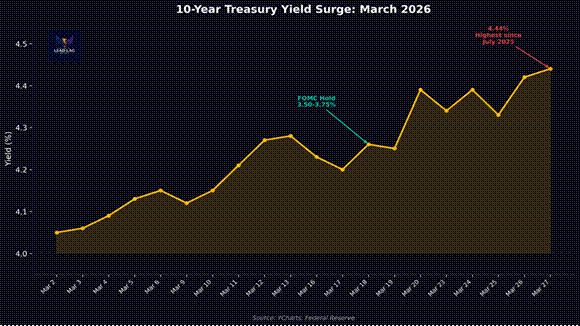
Figure 1: The 10-year Treasury yield surged from 4.05% to 4.44% across March, reaching its highest level since July 2025, driven by oil-fueled inflation expectations.
The Real Catalyst
The real story of this week is not oil per se, but the way oil is now transmitting through every layer of the financial system simultaneously. The 10-year Treasury yield rose to 4.44%, its highest since July 2025, up nearly 40 basis points in a single month.6 That repricing is not driven by growth optimism. It is driven by inflation expectations being revised upward at the same time growth expectations are being revised down. The breakeven inflation rate has widened meaningfully, and the 10-year TIPS yield climbed to 2.13%, suggesting real rates are rising even as nominal growth expectations deteriorate.
This is the textbook definition of a stagflationary impulse. And it is the single most dangerous configuration for equity valuations, because it undermines both the numerator (earnings) and the denominator (the discount rate) of any standard valuation framework. JPMorgan cut its year-end S&P 500 target to 7,200 from 7,500 earlier this month, but that revised target still implies roughly 13% upside from current levels.7 The question is whether anyone believes the path to get there will be smooth. It will not be.
The Federal Reserve, for its part, held rates steady at 3.50% to 3.75% on March 18, as expected.8 But the updated dot plot told a more important story: seven of nineteen participants now expect no rate cuts at all in 2026, up from six in December. The median still suggests one additional cut, but the distribution is widening, and the hawks are gaining ground. Fed Chair Powell acknowledged that “the implications of developments in the Middle East for the U.S. economy are uncertain,” which is central banker language for “we have no idea what oil at $107 means for our models.”
The PCE inflation data for February, released earlier in the month, showed headline inflation at 2.8% year-over-year, slightly below expectations, while core PCE came in at 3.1%, near a two-year high.9 That was before oil’s most aggressive leg higher. The March numbers, when they arrive, will almost certainly show acceleration. And a Fed that is already reluctant to cut will become even more so.
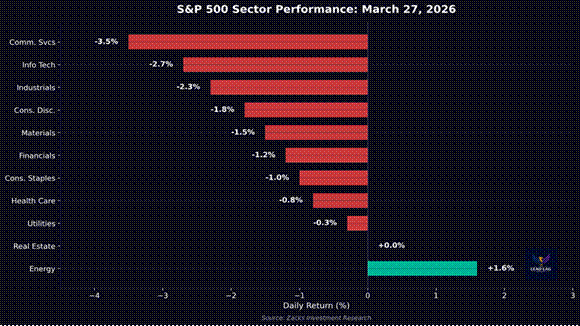
Figure 2: Sector dispersion on March 27 reveals the market’s real message: energy is the only sector generating positive returns as growth and tech names lead the selloff.
Divergences Beneath the Surface
The sector rotation underway tells a cleaner story than the headline index. On Thursday alone, Communication Services fell 3.5%, Information Technology dropped 2.7%, and Industrials lost 2.3%.10 Energy, by contrast, rose 1.6%. This is not a broad-based risk-off move. It is a repricing of the relative value of cash flows in a world where the cost of energy is the binding constraint.
