
Streak Broken: Hot Jobs Print Kills Tech, Iran Strikes Revive Energy, AI Rotation Begins
S&P -2.55% Snaps 9-Week Run; Nasdaq -4.65% On Broadcom Miss + AI Pullback; XLE +2.45% Flips Back To Leader On Iran/Israel Strikes; Jobs +172K Pushes Fed Cuts To 2027; Gold -5.0%; 10Y Holds 4.55%

Special Announcement
A smarter approach to fixed income investing
SanJac Alpha offers actively managed fixed income ETFs designed to pursue opportunities while also managing risk across today’s fixed income landscape.
The SanJac Alpha Low Duration ETF (SJLD) seeks current income and capital preservation through short-term, high-grade credit markets.
The SanJac Alpha Core Plus Bond ETF (SJCP) seeks to maximize total returns while maintaining a moderate risk profile by providing exposure to a diverse range of Treasury, Agency, and Investment-Grade Bonds, Mortgage-Backed Securities (MBS), mREITs, and Preferred Stocks. Seeks to maximize total return while balancing risk by providing exposure to a broad range of bond products with a bias toward high-grade credits.
Markets change. Volatility is here.
It’s time for active management.
IMPORTANT INFORMATION
SanJac Alpha offers two exchange-traded funds. The funds’ investment objectives, risks, and expenses must be considered carefully before investing. The prospectus contains this and other important information about the investment company. Please read it carefully before investing. A copy of the prospectus can be found by visiting www.sanjacalpha.com or by calling 1-800-617-0004.
Investing involves risk, including loss of principal.
ETFs are subject to additional risks that do not apply to conventional mutual funds, including the risks that the market price of an ETF’s shares may trade at a premium or discount to its net asset value, an active secondary trading market may not develop or be maintained, or trading may be halted by the exchange in which they trade, which may impact an ETF’s ability to sell its shares.
Shares of any ETF are bought and sold at market price (not NAV) and are not individually redeemed from the ETF. Brokerage commissions will reduce returns.
The SanJac Alpha exchange-traded funds are distributed by Quasar Distributors, LLC.
DISCLAIMER – PLEASE READ: This is sponsored advertising content for which Lead-Lag Publishing, LLC has been paid a fee. The information provided in the link is solely the creation of SanJac Alpha. Lead-Lag Publishing, LLC does not guarantee the accuracy or completeness of the information provided in the link or make any representation as to its quality. All statements and expressions provided in the link are the sole opinion of SanJac Alpha and Lead-Lag Publishing, LLC expressly disclaims any responsibility for action taken in connection with the information provided in the link.
Streak Broken: Hot Jobs Print Kills Tech, Iran Strikes Revive Energy, AI Rotation Begins
Below is an assessment of the performance of some of the most important sectors and asset classes relative to each other with an interpretation of what underlying market dynamics may be signaling about the future direction of risk-taking by investors. The below charts are all price ratios which show the underlying trend of the numerator relative to the denominator. A rising price ratio means the numerator is outperforming (up more/down less) the denominator. A falling price ratio means underperformance.
LEADERS: ENERGY ROARS BACK, TECH HOLDS THE TREND DESPITE PULLBACK
Technology (XLK) – Bruised But Still Structurally Leader
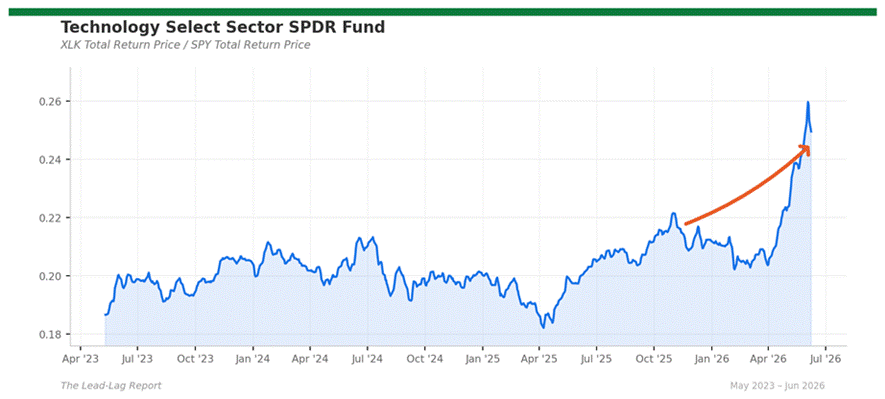
Tech took its first real hit in months but the structural trend remains intact. XLK/SPY is +5.51% one-month and +19.59% three-month — still by far the strongest sector ratio in the report. The week was ugly: XLK closed Friday June 5 at $180.30, down 5.61% on the week, the worst single-sector decline since April. Broadcom (AVGO) was the proximate trigger — the chip giant beat top and bottom line but Hock Tan refused to raise the 2026 AI semiconductor revenue target from $100 billion, and the stock cratered 13.66%. The Philadelphia Semiconductor Index fell 4.71% on the week after being up over 8% Monday-Wednesday. This is a positioning unwind, not a thesis break: the +19.59% three-month lead means tech is still the cleanest leader, and the AI capex narrative is intact. Watch for buy-the-dip flows in chips this week if 10-year yields stabilize.
Energy (XLE) – Flipped Back To Leader On Iran/Israel Strike Resumption
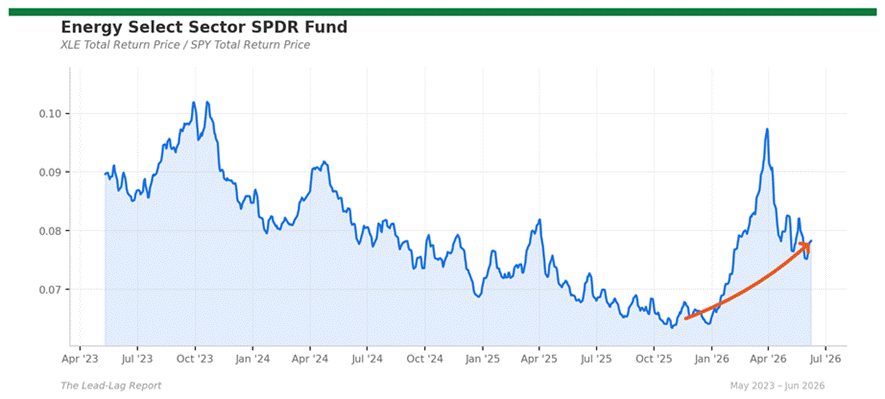
Energy was the only S&P sector positive on the week, gaining 2.49% per First Trust’s weekly tape. XLE/SPY is now +0.67% one-month after the dramatic regime flip — last week’s report had XLE classified as a laggard at -10.3% one-month, and a single week of Iran-Israel exchange activity has reversed the entire setup. XLE closed Friday June 5 at $57.67, up 2.45% on the week. Brent surged 4.2% to $104.50/bbl intraweek on fears of a prolonged Hormuz blockade, then settled around $94 by Friday and $94.63 Monday June 8 as Iran announced a halt to strikes pending Israeli response in Lebanon. WTI sits near $91.30. Marathon Petroleum led the sector +5.32%. The setup: as long as Hormuz risk premium stays elevated and the Iran-Israel exchange continues episodic flare-ups, energy holds leadership. The flip from laggard to leader in one week is the cleanest regime change in this report, mirroring the inverse pattern from last week.
Russell 2000 / Small Caps (IWM) – Hanging On Despite The Selloff
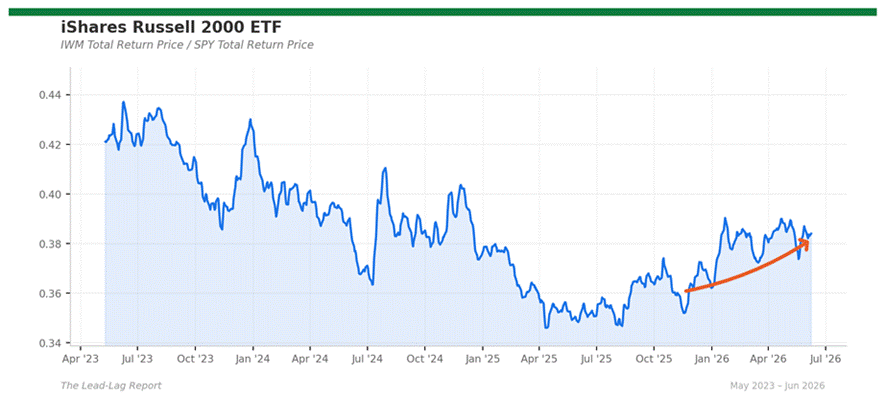
IWM closed Friday June 5 at $284.11, down 2.91% on the week, but the IWM/SPY ratio held up better than the absolute decline suggests. The ratio is -2.29% one-month and -0.14% three-month — essentially flat against the S&P after the tech-led selloff. Small caps have been the underrated trade: when growth leaders correct, breadth-driven small caps usually outperform on a relative basis because they have less weight in the AI complex unwinding. The Fed-rate hawkish reset (Goldman now sees no cuts until 2027) hurt absolute small cap pricing via the floating-rate debt channel, but relative-to-SPY the math still works on a rotation basis. Until the broader market either confirms a deeper correction OR mounts a recovery led by something other than mega-cap tech, small caps stay in the leader column.
European Banks vs U.S. Banks (EUFN/XLF) – Structural Lead Holds Even As Momentum Slows
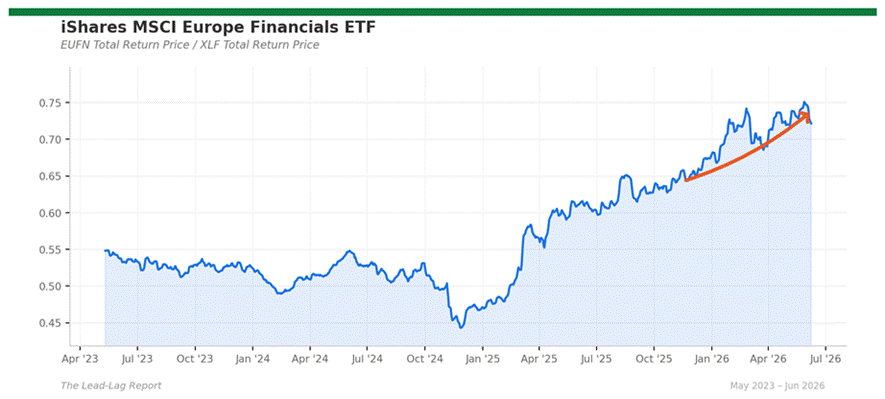
EUFN/XLF: -3.79% one-month, +1.92% three-month. The transatlantic spread compressed sharply this week as U.S. banks actually outperformed European banks on the relative tape (XLF +1.40% WoW vs EUFN -3.01% WoW). EUFN closed Friday June 5 at $37.49, down 3.01% on the week, while XLF was +1.40% on the energy bid (banks are correlated with energy through loan book exposure to oil & gas). The three-month +1.92% lead remains intact, however, and the structural thesis is unchanged: the ECB is past its easing cycle while the Fed faces hike risk — putting U.S. banks in the curve-flat trap that European banks escaped earlier. UniCredit, Deutsche Bank, BNP all continue to print strong margin expansion. The one-month dip is noise within a multi-month trend; we keep this in the leader column but watch for the three-month to flip negative before re-classifying.
High-Yield Credit vs Treasuries (JNK/GOVT) – Credit Spreads Refuse To Blow Out
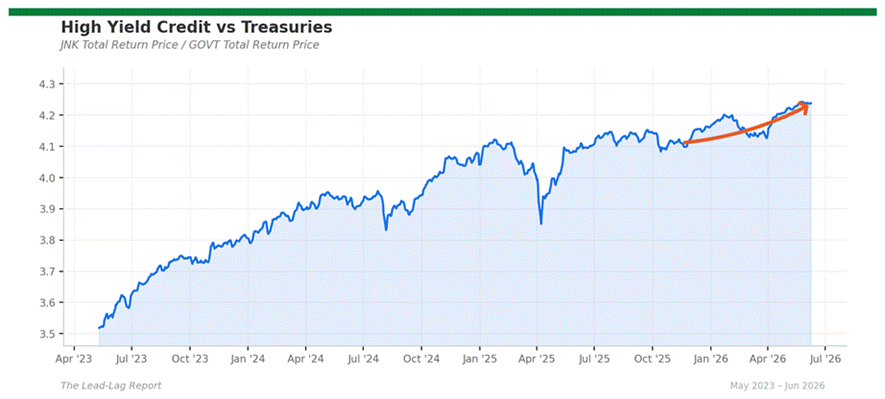
JNK/GOVT: +0.36% one-month, +2.04% three-month. JNK closed Friday June 5 at $95.73 while GOVT closed at $22.61. Even as the S&P fell 2.55% and tech got hit 4.65%, high-yield credit spreads held remarkably firm — a defensive signal that markets aren’t yet pricing recession or default spike. The HY OAS remains in tight quartile territory. The strong May jobs print (+172K vs +80K expected) reinforces the no-recession message. The risk to this trade: if economic data DOES crack going forward (next CPI June 10, next jobs report early July), default math suddenly matters and this ratio reverses fast. For now, carry continues to win against bleeding principal in duration. We keep this in the leader column.
Lumber / Gold – Pro-Growth Signal Accelerates Hard
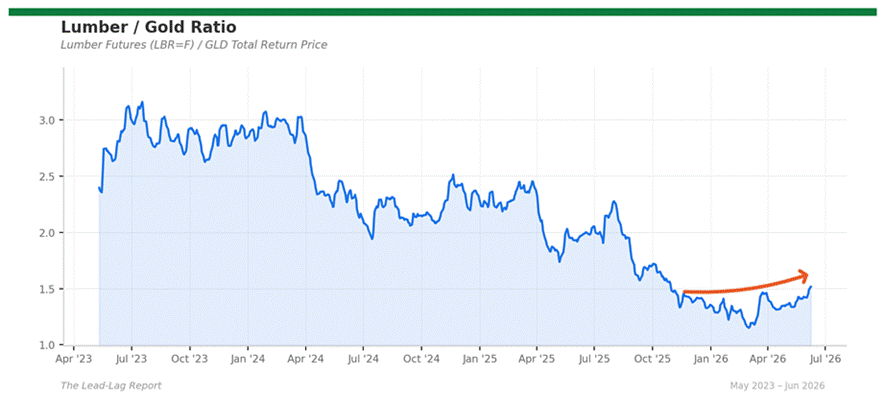
Lumber/Gold went vertical this week. The ratio is +14.41% one-month and +29.85% three-month — the cleanest accelerating leader trend in the entire report. Lumber futures (LBR=F) closed Friday June 5 at $612.00, up 3.49% on the week, while GLD collapsed 5.01% WoW to $396.24. Two forces working in opposite directions: housing starts data has firmed in the rate-cut-delayed environment (cash buyers staying active), pushing lumber demand; gold simultaneously broke down on the hot jobs print which pushed Fed cut expectations out to 2027 and lifted real yields. The classic Lumber/Gold pro-growth signal is screaming. The catch: if NVDA/Broadcom-led AI rotation deepens into a broader growth scare, gold re-asserts immediately and lumber rolls over. For now, this is the strongest tactical leader signal in the report.
Emerging Markets (EEM) – Battered This Week But Three-Month Lead Holds
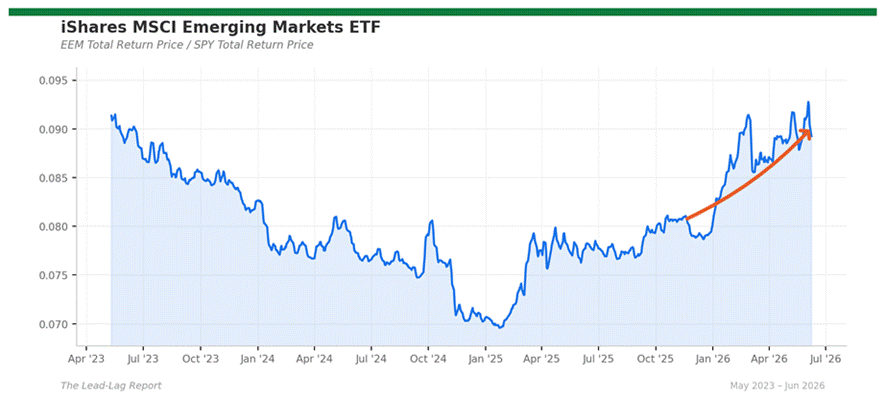
EEM/SPY: -4.78% one-month, +1.33% three-month. EEM had its worst week of 2026 — down 5.85% to close Friday at $65.75 — as the dollar firmed on the hot jobs print and the AI-rotation unwind hit Asian tech (TSMC, Samsung, Tencent). DXY rose +1.07% to 96.60 on Friday after the jobs print, removing the dollar-weakness tailwind that had supported EM. The three-month lead at +1.33% is now the thinnest it’s been all year. We’re keeping EEM in the leader column for now because the three-month is still positive and the structural EM bid (commodity exporters, cheap valuations vs U.S.) hasn’t broken, but this is the weakest leader signal in the report. If next week’s CPI print comes in hot AND DXY breaks above 97, we flip EEM to laggard.
LAGGARDS: DEFENSIVES BOUNCE, GOLD COLLAPSES, BONDS STILL BROKEN
Gold (GLD) – Worst Weekly Loss Of The Year
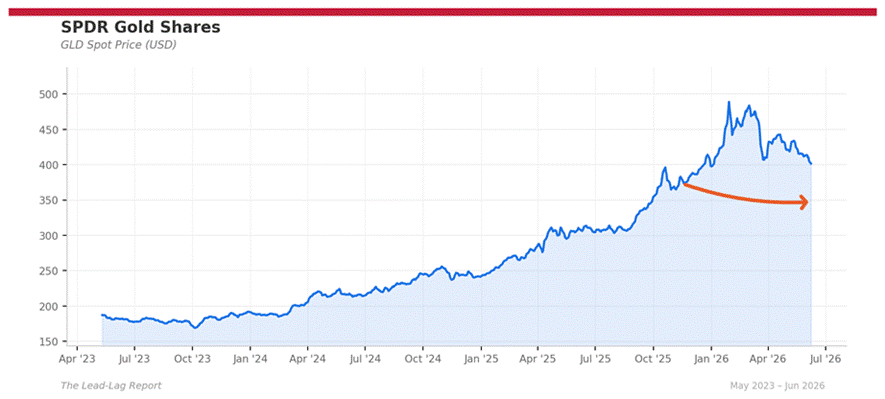
Gold had its worst week of 2026, with GLD down 5.01% to close Friday June 5 at $396.24. GLD/SPY is -8.52% one-month and -22.20% three-month — the worst structural laggard in the report. The hot May jobs print (+172K vs +80K forecast) was the primary catalyst: Goldman Sachs immediately pushed Fed rate-cut expectations out to 2027 from 2026, real yields rose, and the dollar firmed. Markets are now pricing roughly 50% odds of a Fed HIKE rather than cut by year-end (per CreditUnions commentary tracking). The April 21 gravestone doji thesis continues to play out. Gold remains structurally broken until either inflation reaccelerates meaningfully OR a real recession scare returns — neither of which the data currently supports.
Health Care (XLV) – Tactical Bounce But Structural Trend Unchanged
