
The 200-Day Is All That Is Left
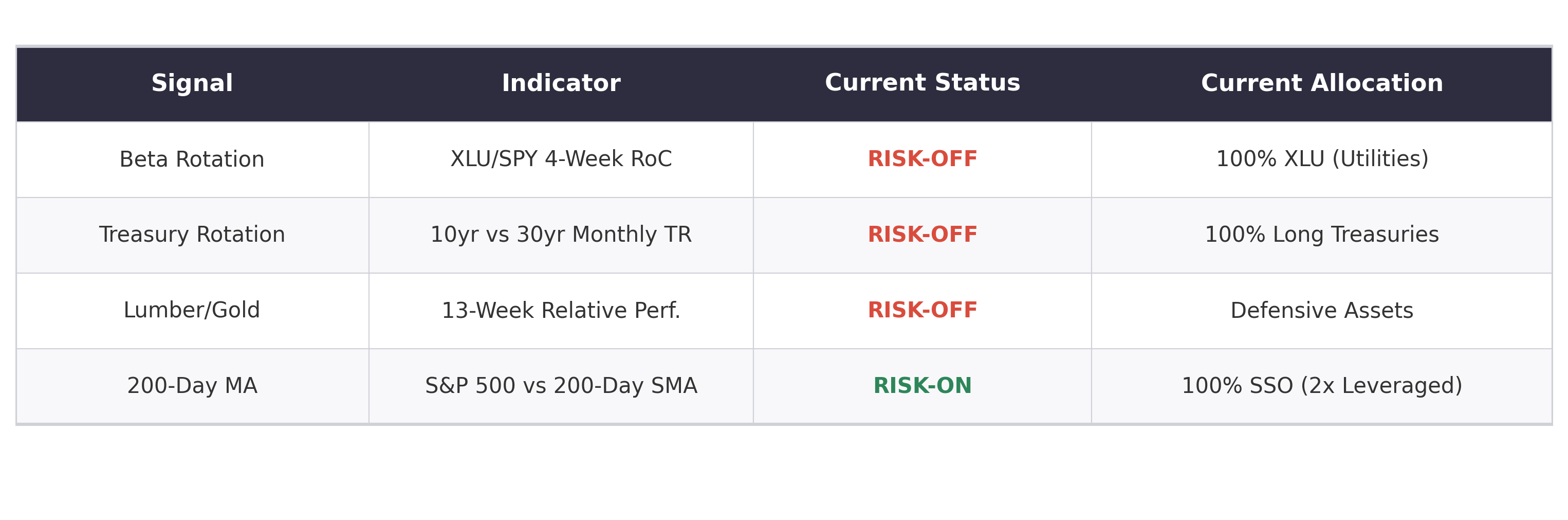
Three of four intermarket signals remain Risk-Off as the US-Iran war disrupts global energy markets. The S&P 500 clings to its 200-day moving average — the last line of technical defense.

Key Takeaways:
• The Beta Rotation signal (XLU/SPY 4-week RoC of +1.27%) remains Risk-Off, though it has cooled from +10.74% the prior week. The compression reflects broad selling pressure hitting even defensive sectors as the war intensifies — but Utilities are still outperforming the S&P 500 on a relative basis.
• Treasuries are sending mixed signals. The February monthly data (TLT +4.24% vs IEF +2.14%) keeps the signal Risk-Off, but this week’s sharp Treasury selloff — TLT falling from $89.23 to $87.14 in three sessions — reflects rising inflation expectations from the oil shock. The bond market is now caught between safe-haven flows and inflation fears.
• The Lumber/Gold divergence is extreme. Gold’s 13-week return of +20.02% versus Lumber’s +0.45% is among the widest readings since this signal’s inception. Gold above $5,100/oz while Lumber stagnates is a clear indictment of real economic growth expectations.
• The S&P 500’s 2.9% cushion above its 200-day moving average (6,586.1) has narrowed from 4.9% just two weeks ago. The 200-day level near 6,570 is being closely watched as critical long-term support. A breach would flip the final signal to Risk-Off and produce a 4-of-4 defensive reading.
SIGNAL SUMMARY
MARKET COMMENTARY
Two weeks into the US-Iran war, 3 of four intermarket signals remain Risk-Off. The conflict that began February 28 has now escalated into a full-scale disruption of global energy markets. Iran’s attacks on shipping in the Strait of Hormuz — through which roughly 20% of the world’s oil transits — and strikes on Gulf Arab oil infrastructure have sent crude prices on a historic ride. West Texas Intermediate spiked above $116 per barrel on Monday before plunging more than $25 intraday, while Brent crude settled near $92 on Wednesday after the IEA announced a record 400-million-barrel strategic reserve release that failed to calm the market. Oil remains roughly 35-40% above pre-war levels.
The equity market is under visible strain. The Dow Jones Industrial Average closed at a three-month low on Wednesday, March 11, falling 289 points to 47,417 as 10- through 30-year Treasury yields jumped on inflation risks. The S&P 500 slipped 0.1% on Wednesday after February CPI data came in steady — but the forward-looking threat from energy-driven inflation looms large. Nine of eleven S&P 500 sectors finished the day in the red.
The 200-Day Moving Average signal remains the sole Risk-On holdout, with the S&P 500 at 6,775.79 trading 2.9% above its 200-day SMA of 6,586.1. Technical analysts are watching the 200-day level near 6,570 as critical long-term support. The cushion has narrowed meaningfully from 4.9% two weeks ago, and if the conflict persists, this buffer could evaporate quickly.
The Beta Rotation signal (XLU/SPY 4-week RoC) has cooled to +1.27% from +10.74% last week, as both Utilities and the S&P 500 sold off amid broad risk-off trading. The reading remains positive — still Risk-Off — but the compression suggests the initial flight to Utilities has stabilized. XLU fell 0.6% on Tuesday as the war-driven selloff became indiscriminate, hitting even traditionally defensive sectors.
The Treasury signal remains firmly Risk-Off. TLT returned +4.24% in February versus IEF’s +2.14%. However, Treasuries have come under pressure this week as yields jumped on inflation fears from the oil shock. TLT dropped from $89.23 on Monday to $87.14 by Wednesday’s close — a sharp reversal that reflects the bond market’s emerging concern that war-driven energy costs will feed through to consumer prices in coming months.
The Lumber/Gold divergence tells the starkest story. Gold has returned +20.02% over the past 13 weeks, holding above $5,100/oz as safe-haven demand surges alongside inflation hedging and geopolitical risk premiums. Lumber has returned a negligible +0.45% over the same period — barely positive — as the cyclically-sensitive commodity most tied to housing and real economic activity stalls completely. With oil prices threatening a broad economic slowdown, Lumber’s stagnation is a leading indicator of the growth headwinds ahead. All seven Lumber/Gold sub-strategies remain positioned defensively.
The intermarket framework continues to flash caution. The signals that rotated defensively before the war have been validated by events, and the ongoing Strait of Hormuz disruption ensures that the risk premium is not going away soon. The question is no longer whether the signals were right — it is whether the S&P 500’s 200-day moving average can hold as the last line of defense.
