
The 8-4 Vote and the ¥5.4 Trillion Lie.
A Fed Divided Like It’s 1992, A Yen Defense That Cost 7% of FX Reserves, and Records Built on Borrowed Time

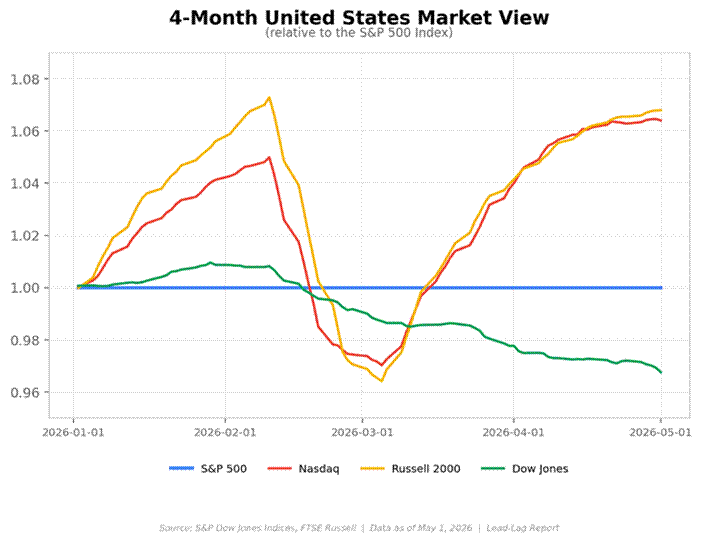
The Federal Open Market Committee voted 8-4 on April 29 to hold the federal funds rate at 3.50–3.75%. That is the most divided the Committee has been since October 1992, and the split is not a footnote. On one side, Governor Miran argued for an immediate cut. On the other, Presidents Hammack, Kashkari, and Logan pushed to remove the easing bias entirely—effectively arguing that the next move might be up, not down. Powell held the center, kept rates unchanged, and delivered what markets will remember as his final press conference as Chair. He will remain as a Governor, but the institutional signal was unmistakable: the person who guided the Fed through the 2022 hiking cycle, the 2023 pivot debate, and the 2024–2026 cuts is stepping back from the podium at precisely the moment when the Committee can’t agree on its own direction. The bond market processed that complexity efficiently. The 10-year Treasury yield rose 8 basis points to 4.39%. The 2-year added 9 basis points to 3.89%. The curve is steepening, but not because growth is accelerating—it’s because no June cut is coming, and the path beyond June is genuinely unclear. The Strait of Hormuz remains closed, the ISM Manufacturing Prices subindex printed 84.6 in April (the highest since April 2022), and Core PCE for March came in at 3.2% year-over-year, the hottest reading since November 2023. That is the inflation data the next Fed Chair will inherit.
The week of April 27–May 1 was the most consequential earnings stretch of 2026, and the market’s verdict was surgical in a way that tells you something important about where we are in the cycle. Alphabet reported $109.9 billion in revenue, up 22%, with Cloud accelerating 63% to $20 billion—a genuine beat, and the stock jumped 10% the next session. Microsoft reported $82.9 billion in revenue, Azure up 40%, a clean beat on the headline—and the stock sold off 3% because the company guided $190 billion in full-year capital expenditure. Meta reported $56.3 billion in revenue, up 33%, $7.31 in EPS—and fell 5% after-hours because CapEx guidance came in at $125–$145 billion for the year. Amazon reported $181.5 billion in revenue, AWS up 28%, net income of $30.3 billion boosted by the Anthropic investment—broadly well-received. Apple reported Q2 FY2026 on April 30: $111.2 billion in revenue, EPS of $2.01, a $100 billion buyback authorization, and the stock added 3.2% on May 1. The sorting principle is not which company grew faster. It is which growth came with visible capital discipline versus unconstrained infrastructure spending. Cloud growth at Alphabet was rewarded because the return profile looks credible. CapEx at Microsoft and Meta was punished because $190 billion and $145 billion are numbers that require long holding periods to justify. The S&P 500 closed at a new all-time high of 7,230.12 on May 1. The Nasdaq ended the week at 25,114.44, also a record, capping what was April’s best month since 2020 at +14%. The index hit those numbers while the market was simultaneously telling two of the five mega-cap companies that their spending plans were a problem.
The macro data framing those records deserves its own paragraph. Initial jobless claims for the week ending April 26 printed 189,000—the lowest reading since 1969. That is not a typo. The labor market is not breaking. ISM Manufacturing for April came in at 52.7, an expansion reading, with the Prices Paid subindex at 84.6—the highest since April 2022, when the Fed was still in the early stages of its historic tightening cycle. Both the employment and the inflation data are running hotter than the Committee’s models projected. The VIX closed Friday at 16.99, down from 18.92 the prior week. The Russell 2000 closed at 2,812.82, up roughly half a percent on the day. The Dow finished at 49,499.27, essentially flat, continuing to lag on a relative basis as the chart above illustrates. The April NFP print will arrive May 8 and will either confirm that the labor market tightness is durable or provide the first genuine softening signal of the year. What the current data combination—ATH equities, 189K claims, 84.6 ISM Prices, a divided FOMC, and a still-closed Strait—most resembles is not the soft landing. It resembles the last quarter before the soft landing narrative breaks in one direction or the other.
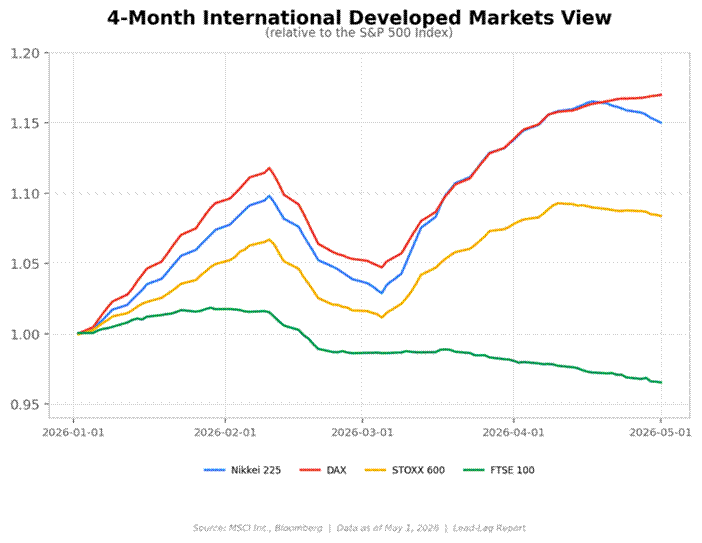
The Bank of Japan’s April 28 decision was a 6-3 hawkish hold—meaning the Committee held at current rates but three members voted to hike immediately to 1.00%, and the FY2026 core CPI forecast was lifted from 1.9% to 2.8%. That is not a central bank preparing to ease. The Nikkei 225 closed above 60,000 for the first time in its history on April 27, touching 60,537 before pulling back—with Tokyo then closed for Golden Week through May 6. The index is the dominant story in international developed markets, running well above the S&P 500 on a relative basis across the four-month period. June 15–16 is now the live date for the next BoJ hike, with implied probability sitting near 66%. What the BoJ decision clarified is that Japan’s central bank is more concerned about inflation persistence than about the yen’s structural weakness—a posture that the FX market tested immediately and violently. The STOXX 600 finished essentially flat for the week at 611.55. The DAX added 0.6% to roughly 24,339, the strongest performer in continental Europe, benefiting from industrial activity that has not yet been fully repriced for energy cost inflation. The FTSE 100 at 10,364, roughly flat on the week, continues to lag, weighed down by a UK inflation print that came in at 3.3% in March—three-tenths above the Bank of England’s own forecast—and a Bank of England that has held at 3.75% with its next decision meeting not until June 18.
The ECB held unanimously at 2.00% on April 30, but Lagarde’s characterization of the decision as “informed but based on insufficient information” is among the more honest admissions from a central bank in recent memory. The Committee debated a hike. Both the adverse and severe macro scenarios embed two hikes in their projections. Q1 GDP came in at just +0.1% quarter-on-quarter, below the 0.2% consensus, as energy cost transmission worked its way through the industrial base. April CPI for the eurozone surged to 3.0%, with energy up 10.9%—a direct function of the Hormuz supply shortfall and TTF gas at €45.41 per megawatt-hour, up 39% year-on-year. On the earnings side, BP reported Q1 profits up 453% year-on-year to $3.8 billion—the highest quarterly figure in four years—and Adidas topped guidance by 16%. Shell reports May 7. The energy sector is the clearest beneficiary of the Hormuz disruption and the reason XLE is the best-performing US sector at +10.3% year-to-date, even as nearly every other cyclical sector lags. What the international developed chart shows is an asset class that has been outperforming the S&P 500 for four months straight, driven by earnings momentum and a weaker dollar, now beginning to price a more complicated second half.
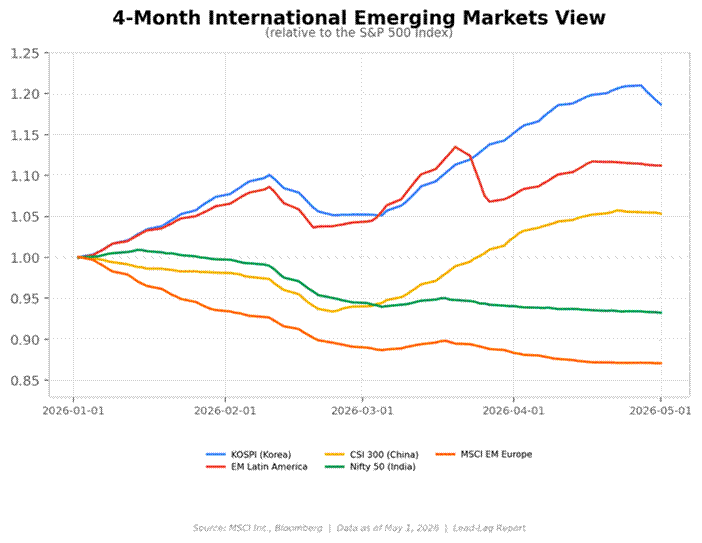
The Strait of Hormuz remains closed. Brent crude peaked intraday at $126 on April 29—a four-year high—before reversing to approximately $105 by April 30 as a combination of demand destruction signals and short-covering unwound the spike. WTI was trading in the $103–$106 range on May 1. The EIA’s April estimate puts the supply shortfall at 9.1 million barrels per day. Approximately 2,000 vessels remain trapped. The IRGC announced a “new management framework” for the Persian Gulf on May 2, language that neither reopens the Strait nor signals imminent resolution. The War Powers Act 60-day clock expired May 1; the Trump administration is claiming a “ceasefire” pauses it, a legal position that has not been tested in a comparable context. The UAE left OPEC effective May 1, the most significant structural change to the cartel’s composition in years, removing a member that has increasingly aligned production decisions with market pricing rather than cartel discipline. Against that backdrop, Korea’s KOSPI hit a new intraday all-time high above 6,750 on April 30, closing at 6,598.87 on May 1—a pullback of 1.38% from the high, but still the dominant performer in the EM complex. Korea is a net energy importer and a semiconductor exporter, and the AI buildout cycle that is punishing Microsoft’s CapEx multiples is simultaneously driving demand for the chips Korea’s fabs produce. The EEM ETF closed May 1 at $63.50, up 15.99% year-to-date.
