
The Bond Market Voted Friday
Warsh confirmed, Powell walked out, CPI printed 3.8%, stocks hit all-time highs on Thursday — and then the 10-year yield had the final word.

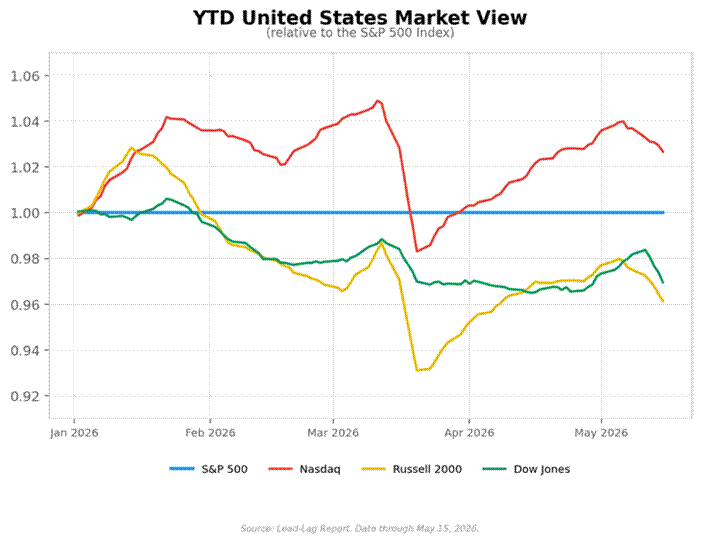
The Senate confirmed Kevin Warsh as the 17th Federal Reserve Chair on May 13 by a vote of 54–45. One Democratic senator crossed the aisle. Jerome Powell’s term as Chair expired May 15. He is staying on the Board of Governors — the first former Fed Chair to do so in roughly 75 years — because his governor term runs to January 2028 and because, apparently, the institution needs continuity in a way that the Trump administration is not providing. What this means in practice: Powell has a vote at the June 16–17 FOMC meeting, on a committee he no longer chairs, presided over by a man who was not his choice, facing the first hot inflation print of the new regime. The market priced all of this correctly in the initial days of the week. The S&P 500 set a new all-time high of 7,501.24 on Thursday. The Dow reclaimed 50,000 for the first time since the Iran war began in late February, closing at 50,063.46. The Nasdaq reached 26,635 intraday. Cisco had just reported $15.8 billion in revenue, record AI orders raised to $9 billion for the year, and the stock surged 15% after-hours. Applied Materials followed with $7.91 billion in quarterly revenue and a gross margin of 50% — its highest in 25 years. The AI capex supercycle narrative was alive and validated and priced into equities at new record levels.
Then the bond market voted. The 10-year Treasury yield rose roughly 12 basis points on Friday alone to close at 4.60%, its highest level since the spring of 2025. The 2-year added 9 basis points to 4.09%. The curve steepened to +51 basis points — not because growth is accelerating, but because the market is pricing out any 2026 cuts and beginning to take seriously the possibility that the next Fed move might not be a cut at all. The S&P 500 fell 1.24%. The Dow gave back 537 points. The Nasdaq shed 1.54%. The Russell 2000 — rate-sensitive, energy-cost-exposed, the canary in the macro coal mine — dropped 2.4%, the week’s worst performer. The proximate cause was oil. Brent crude moved above $111 a barrel on Friday. The Strait of Hormuz entered its 76th day closed to commercial traffic. Iran called U.S. demands “Unreasonable.” Trump called Iran’s counter-proposal “a piece of garbage.” The Pentagon said mine-clearing could take up to six months. The IEA has characterized this as the largest oil supply disruption in modern history. None of that was new information on Friday. What was new was the April CPI: +3.8% year-over-year, the hottest print since May 2023. And the April PPI: +6.0% year-over-year, the largest gain since December 2022. And the April NFP: +115,000 — well above the 48,000–55,000 consensus. That combination — accelerating inflation, resilient labor market, oil above $111, and a brand-new Fed Chair inheriting an FOMC whose forward rate expectations have already collapsed from 80 basis points of 2026 cuts to fewer than 20 — is the definition of stagflation risk re-entering the narrative. The record close on Thursday was real. The Friday reversal was also real. The question Warsh now owns: which of those two days describes 2026?
Nvidia reports on May 20. The consensus expects $78.8 billion in revenue — 78% year-over-year growth. The stock went into the week at all-time highs. JPMorgan noted that Mag-7 earnings growth is running more than 40 percentage points above the rest of the index. Cisco’s AI order trajectory and AMAT’s record margins say the infrastructure buildout is intact. The bull case says the AI capex cycle is large enough to sustain earnings growth even if the cost of capital rises. The bear case says 4.60% on the 10-year, CPI at 3.8%, a new Fed Chair with unknown reaction functions, and oil at $111 is not a backdrop for record P/E multiples. Both cases were represented in the same week. The ATH happened Thursday. The bond market answered Friday.
