
The Bounce Before the Binary.
A Relief Rally, a Jobs Surprise, and the Entire World Holding Its Breath for Sunday

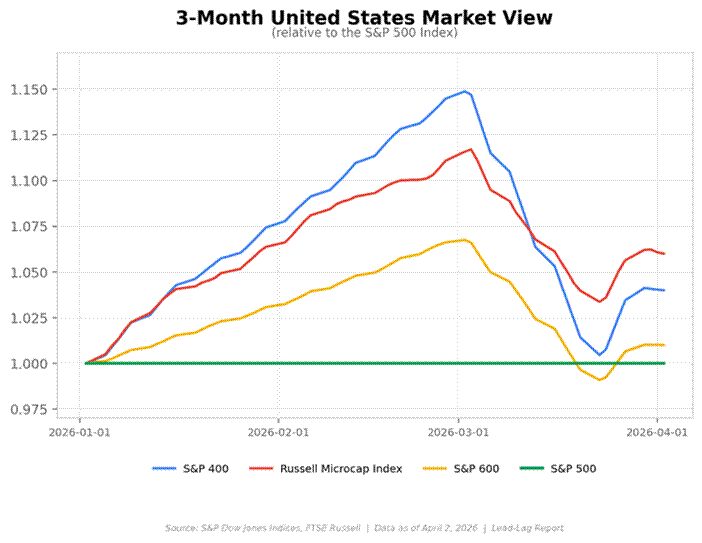
The five-week losing streak is over. The S&P 500 surged 3.4% this week to close at 6,582.69 on Thursday—the last trading day before Good Friday—snapping what had become the longest consecutive weekly decline since the 2022 bear market. The Dow rose 3.0% to 46,504. The Nasdaq led with 4.4%. The Russell 2000 gained 3.3%, putting small caps firmly into positive territory year-to-date and continuing their relative outperformance over large caps. But before anyone declares the all-clear, understand what drove this rally: a single rumor. On Wednesday, Trump told reporters the Iran conflict would end “within weeks.” Markets ripped. Then on Thursday he walked it back, threatening energy infrastructure strikes after April 6. Markets gave back half the gains. This is not a durable bottom. This is a market trading one headline at a time with one eye on the calendar.
The sector divergence widened further into absurdity. XLE is now up nearly 38% year-to-date with a record 14-week winning streak—though it actually fell 3.9% on Thursday as WTI surged 11.4% in a single session. Read that again: the energy ETF fell on the day oil had its largest single-day dollar gain since the April 2020 Covid rebound. The explanation is positioning—traders taking profits into a $111 WTI print that screams “peak fear.” IGV remains down 24.5% year-to-date. The 62-point spread between the best and worst sectors is no longer an anomaly. It’s a regime. Consumer discretionary got a brief reprieve but Tesla fell another 5% on Thursday. The VIX dropped to 23.87 from 31.05 the prior week—the largest single-week VIX decline of the year—but still sits well above the 15–18 range that defined calm in 2024.
The macro data was a study in contradiction. March nonfarm payrolls shocked at +178,000 versus the +59,000 consensus—released on Good Friday while markets were closed, meaning equities will digest this number Monday. ISM Manufacturing came in at 52.7, expanding for a third consecutive month, but Prices Paid surged to 78.3—the highest since June 2022—confirming what every consumer already knows: oil is flowing through to everything. Initial claims at 202,000 hit a near two-year low. The 10-year Treasury jumped to 4.37% in after-hours trading Friday on the jobs beat. The bond market is now telling you what the equity market refuses to accept: rate cuts are not coming. Betting markets give a 92% probability the Fed holds all year. The word “stagflation” keeps getting thrown around. I’d call it something more specific: a labor market that won’t crack and an inflation impulse that won’t quit, all while the geopolitical risk premium expands by the hour.
