
The Ceasefire Mirage
A Relief Rally Built on Headlines, an 11% Oil Spike, and the Longest Losing Streak Finally Snaps

Below is an assessment of the performance of some of the most important sectors and asset classes relative to each other with an interpretation of what underlying market dynamics may be signaling about the future direction of risk-taking by investors. The below charts are all price ratios which show the underlying trend of the numerator relative to the denominator. A rising price ratio means the numerator is outperforming (up more/down less) the denominator. A falling price ratio means underperformance.
LEADERS: THE WAR PREMIUM PERSISTS, BUT THE BOUNCE IS TELLING YOU SOMETHING
Energy (XLE) – Still the Trade of the Year, Even After This Week’s Whipsaw
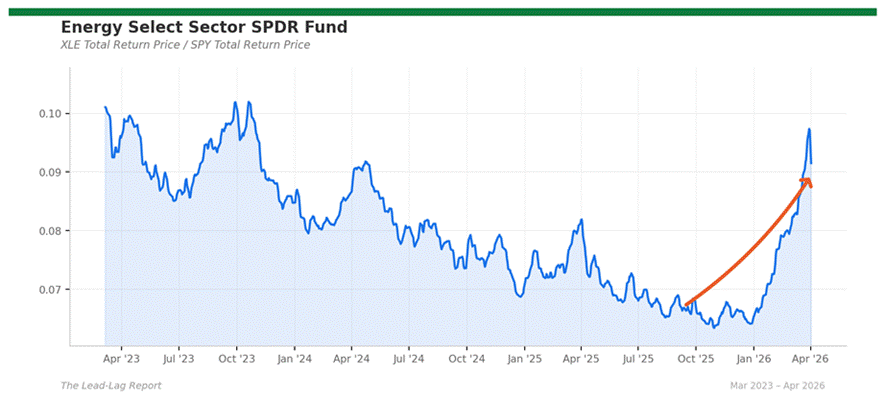
Energy gave back ground this week but remains the dominant leader by a wide margin. The XLE/SPY ratio fell 7.9% for the holiday-shortened week as the S&P 500 surged 3.78% on ceasefire optimism while energy fell 4.37%. The whipsaw was extraordinary: on Monday, stocks rallied nearly 3% on unverified reports that Iran’s president was open to ending the war, sending oil from $109 down toward $100. Wednesday added gains as Trump announced a two-to-three-week withdrawal timeline. Then Thursday’s prime-time address crushed the optimism — Trump offered no clear resolution and pledged to escalate strikes on Iranian infrastructure, sending WTI crude surging 11% in a single session to $111.54 per barrel, the largest single-day dollar gain since 2020 according to Barron’s. Despite the weekly pullback in the ratio, the three-month outperformance remains an extraordinary 35.7%. The Strait of Hormuz is still effectively closed to normal transit, and until a verifiable ceasefire materializes, energy’s structural advantage holds. The weekly pullback is noise against a three-month trend that shows no sign of breaking.
Materials (XLB) – The Reshoring Bid Won’t Quit
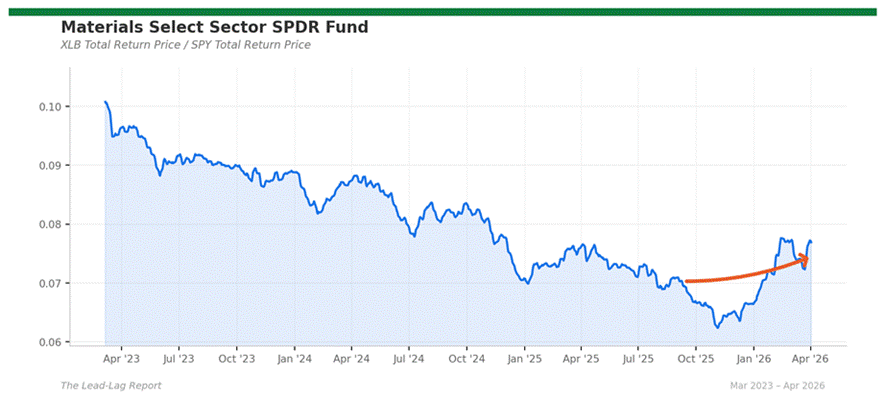
Materials pulled back 1.0% relative to SPY this week but the three-month outperformance of 14.1% keeps the sector firmly in the leader column. The slight weekly underperformance came as the broad market relief rally lifted everything, compressing the relative advantage of defensive and commodity-linked sectors. But the structural drivers remain intact: defense spending acceleration, tariff-driven import substitution, and persistently elevated PPI at 3.4% headline and 3.9% core are creating a floor for commodity-linked equities that didn’t exist a year ago. Import prices surged 1.3% month-over-month in the most recent data, more than double consensus, signaling that input cost pressures continue to favor producers over consumers. Materials have become a structural leader alongside energy, and the one-month gain of 3.2% confirms the trend remains intact despite weekly noise.
Utilities (XLU) – Defensive Leadership Tested by the Risk-On Bounce
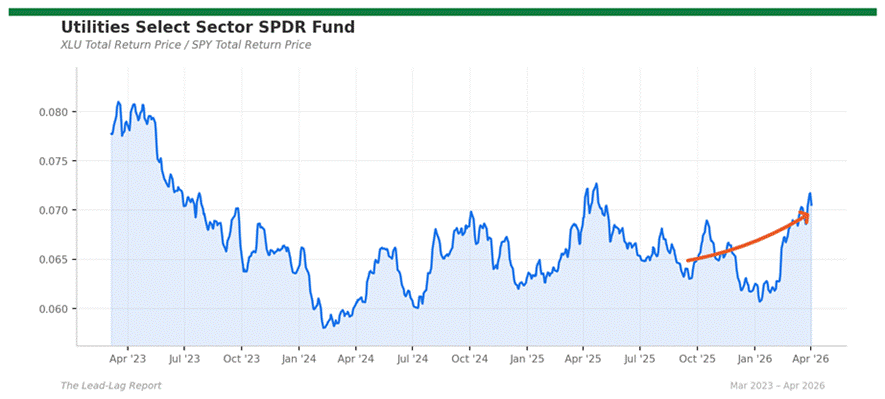
Utilities underperformed SPY by 2.8% this week as the relief rally favored risk-on assets over defensives. The three-month outperformance of 12.3% remains substantial, but this week’s price action is a reminder that defensive sectors give back ground quickly when sentiment shifts. The 10-year yield fell to 4.31% by Wednesday from 4.44% the prior week, which should have helped utilities, but the magnitude of the equity bounce (S&P 500 +2.9% on Monday alone) overwhelmed the rate tailwind. I still believe the three-month trend is intact: the AI data center power demand narrative provides structural support, and the VIX’s move back above 30 on Thursday after Trump’s speech suggests the risk-off environment hasn’t truly ended. Utilities gave back a week’s worth of relative gains, but one week does not reverse a quarter of outperformance.
Consumer Staples (XLP) – The Defensive Rotation Takes a Breather
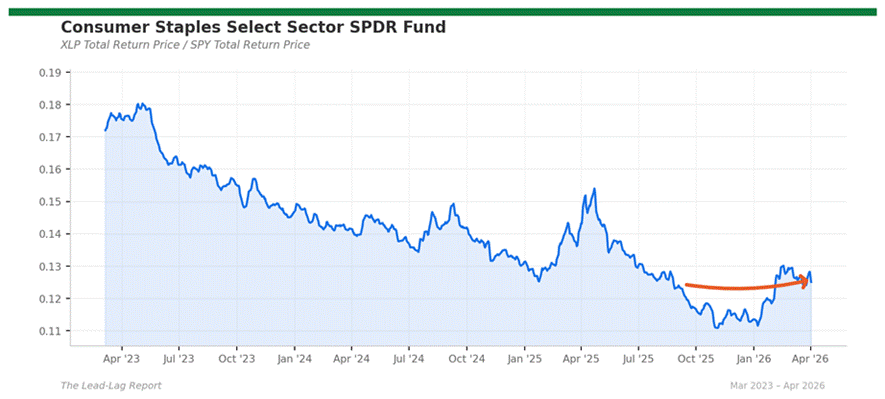
Staples underperformed SPY by 3.6% this week, the sharpest weekly relative decline in the current cycle. The three-month outperformance of 10.1% remains meaningful but the one-month figure has flatlined at -0.1%, signaling that the defensive rotation may be losing momentum if equities find a bottom. The University of Michigan consumer sentiment at 53.3 with inflation expectations at 3.8% still supports the fundamental case for staples, but when the Nasdaq surges 3.8% in a single session on ceasefire hopes, nobody is rotating into Procter & Gamble. This is the classic challenge for defensive positions: they protect on the way down but drag on the way up. I’m keeping staples in the leader column on the three-month trend, but I’m watching the one-month ratio closely for signs of a more durable shift.
Industrials (XLI) – Reshoring Plus Risk-On Equals Double Tailwind
