
The Ceasefire That Resolved Nothing.
A Two-Week Pause, a $19 Oil Crash, and Islamabad’s Historic Failure

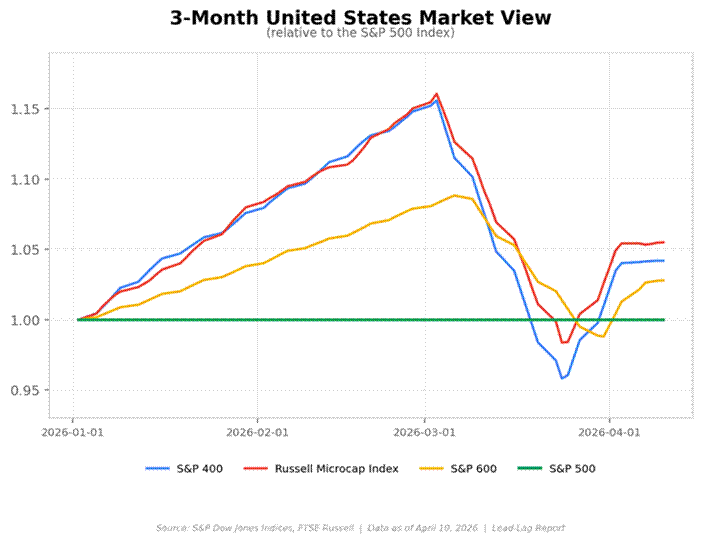
The market had its best week of the year, and it happened because of a ceasefire that has already begun to unravel. The S&P 500 surged 3.56% to close at 6,816.89. The Dow added 3.03% to 47,916.57. The Nasdaq led with a 4.68% gain to 22,902.89. The Russell 2000 jumped 4.00% to 2,630.59, pushing small caps to +1.9% year-to-date—outperforming the large-cap index by nearly six points on a relative basis. Look at the chart above. The mid-March crash—the one that sent small caps deep into the red—is visibly recovering. The S&P 400 and Russell Microcap led the bounce, which is exactly what you would expect from a risk-on, ceasefire-driven relief rally. Smaller companies are more domestically oriented, more sensitive to liquidity conditions, and more responsive to fear dissipation. When the VIX collapses from 23.87 down to 19.49 in a single week, it is small caps that move first.
The sector story is extraordinary and has not gotten the attention it deserves. Energy came into this week up roughly 41% year-to-date, a number that simply has no precedent in modern market history for a full calendar-year run. Then came the ceasefire. Oil crashed nearly $19 per barrel in a single session—the largest one-day dollar collapse since April 2020. WTI settled at $96.57. Brent at $95.20. XLE—the energy ETF—fell 3.9% on the week and is now approximately +27% year-to-date, having given back roughly a third of its peak gains almost instantly. On the other end: IGV, the software ETF, sits at $74.67, down 27.5% year-to-date, hitting a fresh 52-week low. A 54-point spread between the best and worst performing major sectors is not a market anomaly. It is a market that has been repriced around a single geopolitical variable for four straight months. UMich consumer sentiment printed 47.6—an all-time record low—and you can draw a straight line from oil prices through gasoline through consumer confidence to that number. March CPI headline came in at 3.3% year-over-year. Gasoline was up 21.2% month-over-month, the largest single monthly gain ever recorded. Core at 2.6%. This is not mysterious.
The 10-year Treasury closed at 4.31%. That number tells you something the equity bulls may not want to hear: the bond market is not celebrating the ceasefire. Oil down $19, inflation impulse fading, and yet the 10-year barely moved. That means the bond market has already partially priced out the oil-driven inflation spike—and what remains is structural. The rate cut cycle is not being brought forward by this ceasefire. The Fed is still data-dependent, the data is still hot, and the uncertainty shock from the Strait closure is not fully resolved. The VIX at 19.49 is lower than last week but still elevated relative to the 2024 baseline. This market is pricing relief, not resolution. And those are very different things.
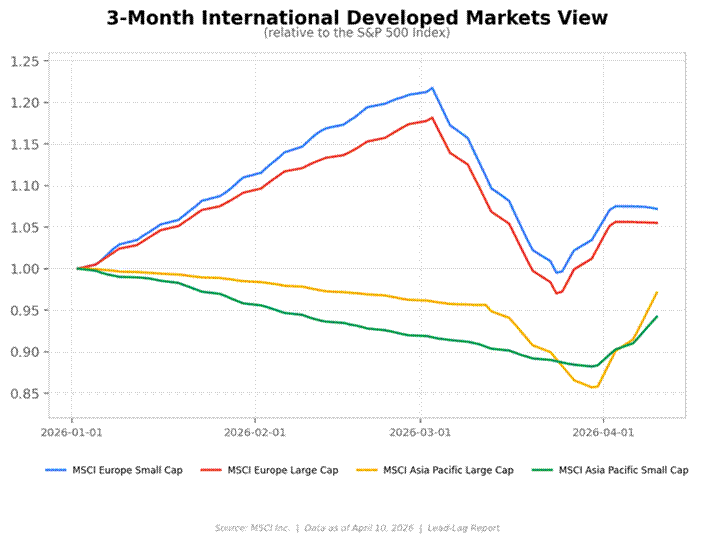
Europe had a massive week. The MSCI Europe indices are at or near year-to-date highs on a relative basis against the S&P 500, and the chart above shows why: while US equities were crashing through mid-March as the Hormuz disruption worsened, Europe—which depends heavily on Gulf oil but had partially pre-hedged through LNG diversification post-Ukraine—was simultaneously pricing both the energy risk and the possibility of resolution. When the ceasefire hit, Europe ripped harder than the US on a percentage basis. The DAX, CAC 40, and FTSE all surged. European small caps, which had been the best-performing cohort globally even through the worst of the crisis due to domestic demand insulation, extended that lead. The ceasefire is particularly meaningful for Europe because natural gas, which had been creeping back toward post-Ukraine highs as Hormuz-linked LNG shipments backed up, has begun to ease. This matters more to a German manufacturer or a Spanish consumer than it does to a Midwestern service business.
Asia Pacific is a more complicated picture. Japan’s Nikkei bounced hard on the ceasefire news—oil down sharply is unambiguously good for a country that imports essentially all of its energy—but the yen story is still working against Japanese equities on a dollar-adjusted basis. USD/JPY sits at 159.25. The yen has weakened steadily against the dollar throughout this entire period, which means that MSCI Asia Pacific returns in dollar terms lag the headline Nikkei index. The April 27–28 Bank of Japan meeting is now the key event: markets currently price a 57% probability of a hike. If the BoJ moves, the yen strengthens, Japanese equities fall in local terms but rise in dollar terms, and the carry trade unwinds again. The 2024 carry trade unwind episode should still be fresh in everyone’s memory. It is not a small risk. Meanwhile, MSCI Asia Pacific Small Cap remains the worst-performing developed market cohort year-to-date, still sitting well below the S&P 500 reference line. The bounce was real but the hole is deep.
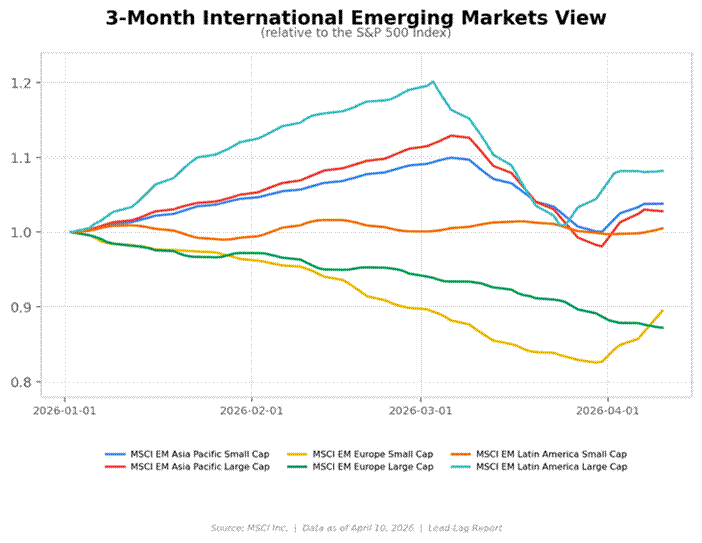
The two-week ceasefire created a binary flip in emerging markets that the chart above makes visible. EM Latin America large cap—driven by Brazil’s Petrobras, Mexico’s Pemex, and Colombia’s Ecopetrol—has been the top-performing EM cohort all year, precisely because these are net oil exporters benefiting from elevated crude prices. Now oil has crashed $19 in a week. This will hit EM LatAm earnings. But here is the counterintuitive point: those stocks barely sold off. The market is treating the ceasefire as temporary, and the forward oil price curve reflects that. The ceasefire lasts two weeks. The Strait is not open. Only 15 ships transited in the first three days post-ceasefire announcement—compared to a normal rate of roughly 500 per week. US Navy destroyers entered the Strait on April 11 to begin mine-clearing operations, and Iran immediately threatened to attack them. The market is not pricing EM LatAm large caps as if WTI is going to $70. It is pricing them as if $96 is a temporary floor on the way back to $110.
EM Asia bounced hard on the ceasefire—India’s Nifty, South Korea’s KOSPI, and Taiwan’s TAIEX all surged as energy input costs fell. These are net energy importers, so oil down is unambiguously good for their current accounts. But the Islamabad talks collapse introduces a new ceiling. The first direct US-Iran negotiations since 1979 ran for 21-plus hours over April 11-12. VP Vance led the US side. They covered the nuclear program. They collapsed. Iran said there is “no plan for a next round of negotiations.” Trump responded by announcing a full naval blockade of any vessel that had paid Iran a Hormuz transit toll. That is not a ceasefire extension. That is escalation by another mechanism. EM Asia was buying relief; it is now re-pricing blockade risk. EM Europe—Russia-adjacent, commodity-linked, sanctions-constrained—remains the worst EM cohort by a wide margin and barely moved on the ceasefire news. There is no positive scenario for EM Europe in any of the outcomes currently on the table.
