
The Deal That Isn’t a Deal
A 5-Day Pause, a 12% Gold Crash, and Yields That Won’t Come Down

Below is an assessment of the performance of some of the most important sectors and asset classes relative to each other with an interpretation of what underlying market dynamics may be signaling about the future direction of risk-taking by investors. The below charts are all price ratios which show the underlying trend of the numerator relative to the denominator. A rising price ratio means the numerator is outperforming (up more/down less) the denominator. A falling price ratio means underperformance.
LEADERS: ENERGY, HARD ASSETS, AND THE YIELD CURVE TELL THE REAL STORY
Energy (XLE) – The Only Trade That Keeps Working
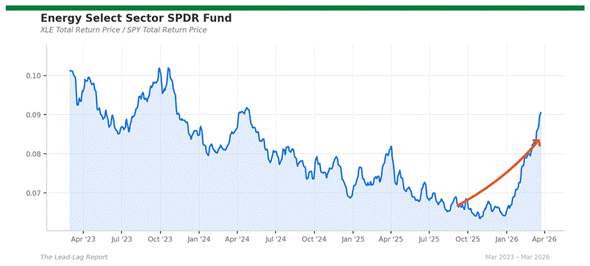
Energy’s dominance reached absurd proportions this week. The XLE/SPY ratio surged another 4.7% for the week ending March 20 and is now up an extraordinary 42.1% over three months — the most extreme relative energy move since the 2022 Russia-Ukraine supply shock. Brent crude rose 8.8% for the week to close at approximately $112 on Friday, March 20, having hit $119 intraday the day before on the South Pars and Qatar LNG strikes. The S&P 500 fell 1.9% for the week while energy was the only sector to gain, up approximately 2.75%. Year-to-date, energy is now up a staggering 33% while the S&P 500 is down approximately 3%. The Interactive Brokers weekly commentary noted this marks the second widest YTD sector performance dispersion since 2002. Monday’s Trump-Iran “productive talks” announcement briefly sent Brent plunging from $109 to $92, but Iran’s parliament quickly denied any negotiations were taking place, and crude recovered above $100. The Strait of Hormuz remains at approximately 5% capacity. Until a verifiable ceasefire materializes, the energy premium isn’t going anywhere.
Utilities (XLU) – Rate Sensitivity Catches Up to the Defensive Darling
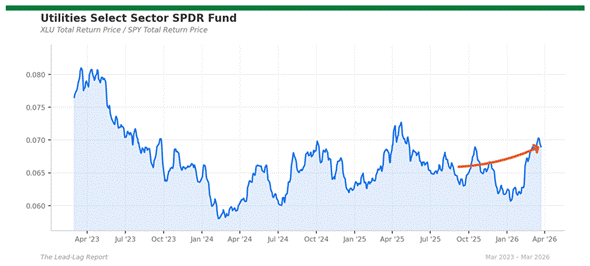
Utilities remain a three-month leader with the XLU/SPY ratio still up 10.4% over that period, but this week delivered a wake-up call: the sector dropped approximately 5.0% for the week ending March 20, the steepest weekly decline among all S&P 500 sectors. The catalyst was the dramatic spike in Treasury yields — the 10-year jumped 14 basis points to 4.39% on Friday alone, its highest level since July 2025. The 30-year yield surged to 4.96%, within a hair of the psychologically important 5% level. Mortgage rates spiked to 6.53%. Markets began pricing in a roughly 30% probability of a Fed rate hike by October, up from just 6% the day before, according to CME Group data. Utilities are the most rate-sensitive equity sector, and when yields spike this aggressively, even the strongest defensive positioning gets punished. The AI data center demand narrative and the risk-off bid that has powered utilities all year haven’t disappeared, but they’re now fighting a rising-rate headwind that wasn’t present two weeks ago. I still believe utilities are a three-month leader, but the near-term trend deserves monitoring.
Treasuries (GOVT) – The Safety Bid Survives the Yield Spike
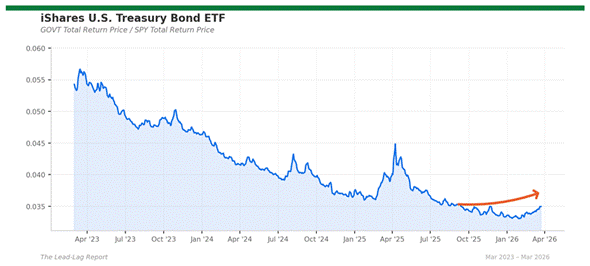
Despite the dramatic rise in Treasury yields — the 10-year surging from 4.20% on March 17 to 4.39% on March 20 — the GOVT/SPY ratio still rose 1.3% this week and is up 3.4% over three months. This seems contradictory, but the math is simple: equities fell faster than bonds. The S&P 500 dropped 1.9% for its fourth straight losing week while Treasuries delivered a positive 0.15% return, their first meaningful weekly gain in weeks according to the Bloomberg Aggregate data. The bond market is caught in a fierce tug-of-war: hedge funds are unwinding complex leveraged Treasury positions — including 2-year/10-year yield spread trades and swap spread bets — which is aggravating the selloff in yields, according to Bloomberg. At the same time, flight-to-quality demand from equity investors is providing a floor for bond prices. The FOMC’s March 18 decision to hold at 3.50–3.75% now looks like it may have been the last hold before the conversation shifts to hikes. The Fed is in an impossible position: oil above $100 is feeding inflation, but the economy printed negative payrolls in February. Treasuries outperforming equities tells you risk appetite is deteriorating despite the yield noise.
TIPS (TIP) – The Inflation Trade Nobody Can Ignore
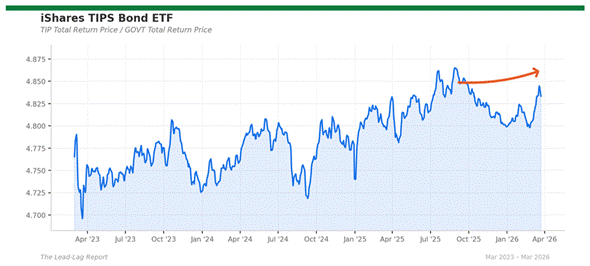
The TIP/GOVT ratio pulled back slightly this week (down 0.4%) but remains positive over three months at +0.4%, maintaining its quiet but consistent outperformance of nominal Treasuries. February PPI came in hot at 0.7% month-over-month — the largest monthly gain since July 2025 — with the year-over-year rate accelerating to 3.4% headline and 3.9% core. The FOMC raised its 2026 PCE inflation forecast to 2.7% for both headline and core, acknowledging that inflation progress has stalled. Breakeven inflation rates are trending higher as the market prices in an environment where energy costs remain structurally elevated. The tariff regime on metals and industrial inputs is adding another layer of cost pressure that has not fully filtered through to consumer prices. TIPS continue to offer the most direct portfolio hedge against the stagflation scenario that is rapidly becoming the base case — rising prices alongside economic deceleration. With the bond market now pricing a 30% chance of a rate hike, the case for inflation-protected securities has only strengthened.
Lumber/Gold Ratio – Gold’s Collapse Powers an Even Bigger Move
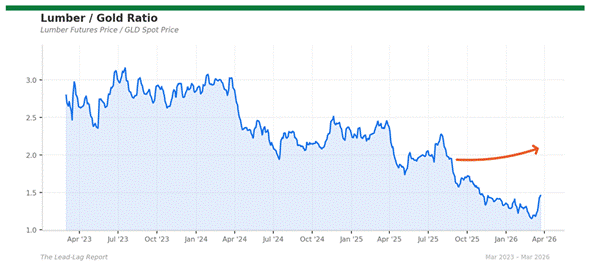
The lumber/gold ratio delivered another dramatic week, surging 11.1% as gold’s crash deepened. Gold fell another 12% this week — on top of last week’s 7.4% decline — bringing the cumulative drop to approximately $640 per ounce from the $5,020 high just two weeks ago. Spot gold hit a four-month low of $4,359 on Monday morning, March 23, in what USAGOLD described as gold’s worst single-session move in years, before partially recovering on Trump’s Iran talks announcement to approximately $4,503. Lumber futures at $596 held relatively steady, and the mechanical effect of gold’s collapse has pushed the lumber/gold ratio up 5.7% over three months and 24.4% over the past month. The gold crash appears driven by the same forces that spiked yields: hedge fund deleveraging, the repricing of rate cut expectations to rate hike risk, and a dollar that has stabilized. This ratio normally signals the balance between economic optimism and fear. When it surges this sharply on gold’s decline rather than lumber’s rise, it’s telling you the fear trade is unwinding violently — but that doesn’t necessarily mean the economic outlook has improved.
Industrials (XLI) – Reshoring Narrative Provides a Floor
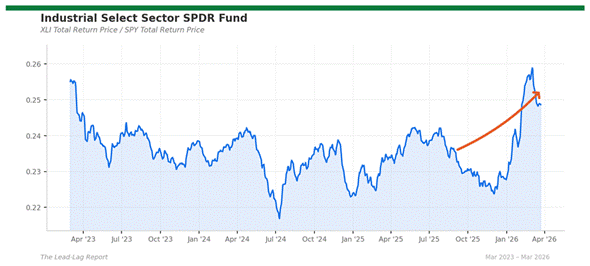
Industrials gained 0.2% relative to SPY this week and remain up 9.0% over three months, making this a sector that continues to lead despite the macro turbulence. The reshoring mega-cycle, driven by the tariff regime and administration priorities around domestic manufacturing, is providing structural support that few other cyclical sectors enjoy. Toyota’s announcement of a $1 billion investment in its Kentucky and Indiana plants — part of a $10 billion U.S. commitment over five years — is the latest example of the capital flow that is reshaping the industrial landscape. The sector’s three-month strength has come despite rising input costs from oil above $100, which is a tax on the transportation and logistics backbone of the industrial economy. ISM Manufacturing has been in expansion territory, and the tariff-driven reshoring tailwind appears strong enough to offset the cyclical headwinds from the war. Industrials are down 2.9% over the past month, but the broader trend remains intact. This is a sector where the secular story — onshoring, infrastructure, defense spending — is powerful enough to ride out even the kind of macro volatility we’re experiencing.
