
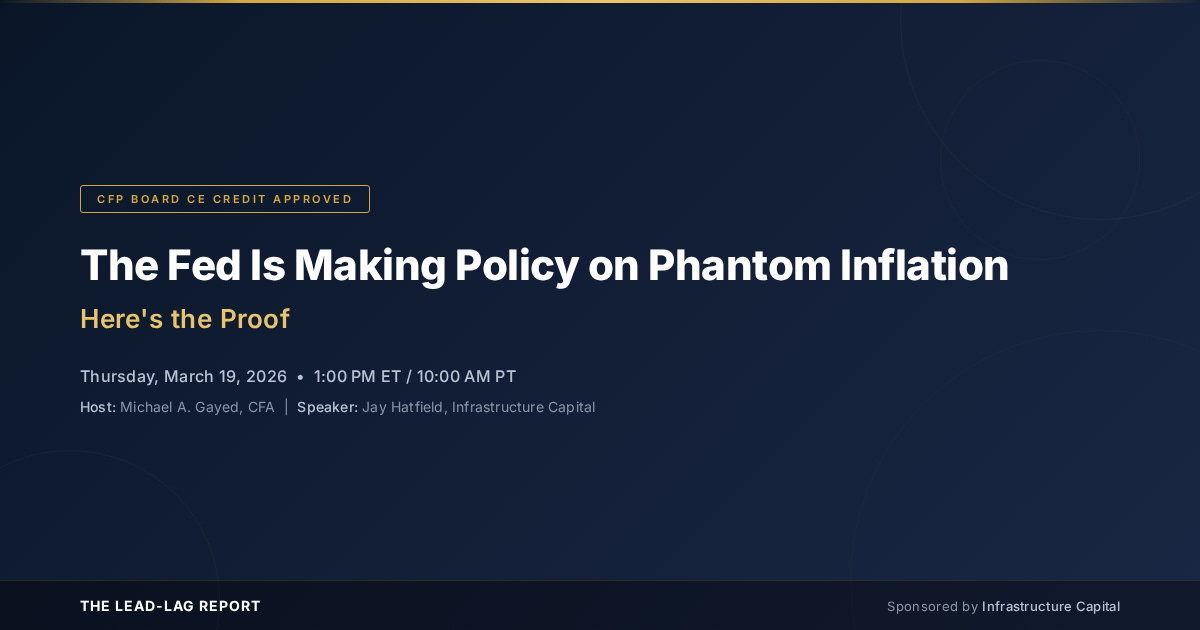
The Fed Is Making Policy on Phantom Inflation — Here’s the Proof
Post-Fed webinar with Infrastructure Capital on broken inflation data, private credit panic, and the mid-April setup

WEBINAR — TOMORROW
Thursday, March 19, 2026 | 1:00 PM ET / 10:00 AM PT
Host: Michael A. Gayed, CFA — Portfolio Manager & Publisher of The Lead-Lag Report
Guest Speaker: Jay Hatfield — CEO and Portfolio Manager, Infrastructure Capital Advisors, LLC
Sponsor: Infrastructure Capital Advisors, LLC (InfraCap)
CE Credit: 1 CFP® Continuing Education Credit available
👉 Register for the Webinar Here
Tomorrow I’m sitting down with Jay Hatfield, CEO of Infrastructure Capital Advisors, for a post-Fed webinar that I think every advisor and investor needs to hear. Jay has been one of the sharpest macro voices I know, and his team’s work on real inflation measurement is, frankly, exposing a serious flawin how the Fed makes policy.
If you’ve been following my work, you know I’ve been sounding the alarm on how distorted the official inflation data is. Jay’s going to break this down in a way that will change how you think about inflation, rate cuts, and what comes next for markets.
The Fed’s Inflation Target Is Built on Broken Data
The Fed’s 2% inflation target is both too low and too precise. But the bigger problem is that the data they’re using to measure progress toward that target is fundamentally broken.
The PCE index — the Fed’s preferred inflation gauge — uses shelter data from CPI that is delayed by TWO YEARSrelative to actual market rents. Think about that. The Fed is making real-time policy decisions based on housing costs that are two years stale.
It gets worse. PCE also uses imputed prices that are completely disconnected from market inflation. The most distorted component? Imputed financial services. When stock prices rise, the calculation assumes investors are paying higher management fees — even though actual management fees haven’t changed. It’s a phantom inflation reading.
The BEA performs other arcane estimates on top of this: deposit account prices based on interest rates, insurance inflation based on loss rates vs. actual rates charged. The imputed financial services component alone raised Y/Y inflation by 0.5%relative to the market-based estimate.
The result? Y/Y PCE core came in at 3.1% vs. a market rate of 2.5%. That’s a massive gap — and it’s the gap the Fed is making policy on.
Realflation: What Inflation Actually Looks Like
Infrastructure Capital publishes a measure they call “Realflation” — a recalculation of PCE core using market rents and market financial services inflation instead of the BEA’s imputed figures.
Their finding? PCE-R for the last twelve months: 1.9%. That’s below the Fed’s 2% target. Which means the Fed should be cutting the Fed Funds rate to the neutral rate of 2.75%as soon as we get clarity on oil prices post resolution of the Iran war.
This is a big deal. The market is positioned for higher-for-longer. But if Jay’s analysis is right — and I believe it is — the Fed is overtightening based on phantom inflation.
Why March Has Been Brutal — And When It Gets Better
The stock market is normally weak in March after earnings season ends. Once the flow of company-specific information dries up, the news vacuum gets filled by short sellers, random acts of war, and negative political developments. It happens every year.
But this March is particularly problematic: the Iranian war disrupting oil, fear mongering about private credit, and bear theses on AI are all converging at once. Jay and I are going to unpack why most of these fears are overblown.
Oil Market: Worst Case vs. Reality
Let’s talk about what the oil market is actually pricing in vs. what’s likely:
Worst-case scenario: Indefinite closure of the Strait of Hormuz → oil at $140/barrel
Equilibrium price absent war: Approximately $60/barrel
The worst case is extremely unlikely — the entire world ex Iran and Russia wants the Strait open
Expect oil to trade in the $100 range near-term
Expect the Strait of Hormuz to be reopened within a month, possibly involving US ground troops
Oil should trade below $70/barrel after reopening
Private Credit: The Market Has Massively Overreacted
The private credit panic is one of the most overstated risks I’ve seen in a while. Here’s the math:
Absolute worst-case loss rate in private credit: 10% — that assumes an unprecedented 15% default rate with a very low 33% recovery
For context: during the Great Financial Crisis, the peak default rate was approximately 10% for high yield bonds and private credit
Banks and the high yield market should not sustain significant losses — they have very limited exposure to the buyout credit market
Yet BDCs, alternative asset managers, and some financials have been sold down over 30%
That implies an overreaction of at least 20% given the most draconian potential loss rate of 10%. This is a setup for a significant snap-back.
AI Short Theses: Inconsistent and Overstated
Here’s the thing about the current AI bear case that drives me crazy: the theory that cloud service companies will get inadequate returns on capex YET every software business will be supplanted by AI — these are inconsistent. You can’t have it both ways.
Jay’s forecast: cloud service companies will achieve excess returns on investment as every business recognizes both the opportunity and competitive risk of AI. Some software companies will be disrupted, sure — but many enterprise-level companies like Oracle will benefit as they assist clients implementing AI while maintaining mission-critical systems.
The April Power Rally Setup
This is the section I’m most excited to discuss with Jay. Here’s the setup:
The reality of these short theses won’t be clear until Q1 earnings season in mid-April
We should get clarity on Strait of Hormuz reopening by mid-April
Stock market often weak going into tax payment season on April 15th
The result? Expect a POWER RALLY in mid-April as we enter the seasonally strong April earnings season. In the interim, expect volatile trading with good support in the 6,600 range for S&P 500 Index as US economic fundamentals are strong.
Jay reiterates his 8,000 year-end target on the S&P 500 Index with 3 Fed cuts still likely after oil prices decline.
What We’ll Also Cover
Review of the Fed meeting and interest rate outlook for 2026
Investment strategies for the current market environment
Why income strategies are useful in a balanced portfolio
Deploying risk management and diversification strategies
This is a webinar worth your time. Register below.
👉 Register for the Webinar Here
Thursday, March 19, 2026 | 1:00 PM ET / 10:00 AM PT
See you there.
The Lead-Lag Report is provided by Lead-Lag Publishing, LLC. All opinions and views mentioned in this report constitute our judgments as of the date of writing and are subject to change at any time. Information within this material is not intended to be used as a primary basis for investment decisions and should also not be construed as advice meeting the particular investment needs of any individual investor. Trading signals produced by the Lead-Lag Report are independent of any particular portfolio, model, and do not take into account the individual financial circumstances of any investor. Subscribers should use the information provided as an additional input to their own research and analysis.
Infrastructure Capital Advisors, LLC (InfraCap) is a registered investment adviser. This webinar is for informational purposes only and does not constitute investment advice. Views expressed are those of the speakers and may not reflect those of any affiliated entities. Investing involves risk, including possible loss of principal. CFP® CE credit is available to participants who attend the full session and complete required documentation.