The Fed Just Held Rates Again. This REIT CEF Just Raised Its Distribution 12.5%.
Cohen & Steers' flagship real estate fund is yielding 8.2% at near-zero discount — and REITs may finally be the right place to be.

Every week, we’ll profile a high yield investment fund that typically offers an annualized distribution of 6-10% or more. With the S&P 500 yielding less than 2%, many investors find it difficult to achieve the portfolio income necessary to meet their needs and goals. This report is designed to help address those concerns.
On April 29, the Federal Reserve held rates steady at 3.50%–3.75% for the third consecutive meeting — and the vote was the most fractured since October 1992. Four dissents. Three regional presidents voted against any easing bias in the statement. One governor voted *for* an immediate cut. The result: a Fed that is simultaneously too hawkish for the doves and too dovish for the hawks, paralyzed by competing signals — sticky inflation from energy prices, a softening labor market, and genuine uncertainty from Middle East conflict. Polymarket now puts the odds of zero additional cuts in 2026 at 57%. Rate futures are pricing the next move for September at the earliest, if at all.
For REIT investors, the math here is genuinely complicated. Rates remaining elevated is a headwind for property valuations — higher cap rates, higher borrowing costs, and a competing 4%+ risk-free rate siphoning demand. REITs have underperformed the broad market for two years running, and the 2022 rate shock left scars. But here is the tension that creates opportunity: the same cycle that crushed REIT valuations also created a setup where REITs are now one of the most interest-rate-sensitive assets in the market. When the Fed eventually resumes cutting — and it has already cut 75 basis points in late 2025 — the rebound can be violent and fast.
This is the macro backdrop for a fund that just sent a very clear signal. In January 2026, the managers of a $2.49 billion REIT closed-end fund raised the monthly distribution by 12.5% — from $0.08 to $0.09 per share — the first raise in the fund’s managed distribution history. That is not a defensive posture. That is a statement of confidence. The fund is Cohen & Steers Quality Income Realty Fund (NYSE: RQI), and it is currently ranked #1 in its peer group year-to-date while trading at essentially par — a near-zero -0.23% discount after spending most of 2025 at a -5% to -7% discount. Something is happening here.
The Fund
Ticker: RQI | Market Price: $13.16 | NAV: $13.13 | Discount: -0.23%
Total Common Assets: $1.78 billion | Total Managed Assets: $2.49 billion | Inception: February 28, 2002
Monthly Distribution: $0.09/share | Annualized Yield: ~8.2% at market | Annualized Yield on NAV: ~8.2%
Effective Leverage: ~28.5% | Expense Ratio (ex-leverage): 1.38% | Holdings: ~200 securities
Cohen & Steers is not just a REIT manager — it is *the* REIT manager. Founded in 1986, the firm pioneered the concept of listed real estate investment as an institutional asset class and invented the REIT closed-end fund structure. It manages approximately $77 billion in assets across global real estate, preferred securities, and infrastructure strategies. When Cohen & Steers has a view on real estate, it is not one analyst’s opinion — it is the institutional view that the entire sector eventually converges around.
RQI is their flagship retail vehicle, a leveraged closed-end fund that has been paying monthly distributions since 2002 and has returned $27.59 per share in cumulative distributions to shareholders since inception — nearly double the original $15.00 IPO price, in distributions alone. The fund is managed by three portfolio managers: Jason Yablon (PM since 2012, Head of Listed Real Estate at Cohen & Steers), Mathew Kirschner (PM since 2019), and Elaine Zaharis-Nikas (PM since 2024, overseeing the preferred securities sleeve).
What makes RQI fundamentally different from simply owning VNQ or a passive REIT index? Four things. First, active sector rotation — Cohen & Steers is constantly tilting the portfolio toward structural growth themes and away from secular headwinds. Second, leverage (~28.5% of managed assets via a BNP Paribas credit facility) that amplifies both yield and total returns. Third, a preferred securities sleeve (~22% of net assets) that adds non-REIT income from financial institutions and utilities. Fourth, a quality bias — the firm deliberately constructs the portfolio around balance sheet strength, FFO sustainability, and management track record, not just market-cap weighting.
Portfolio Composition
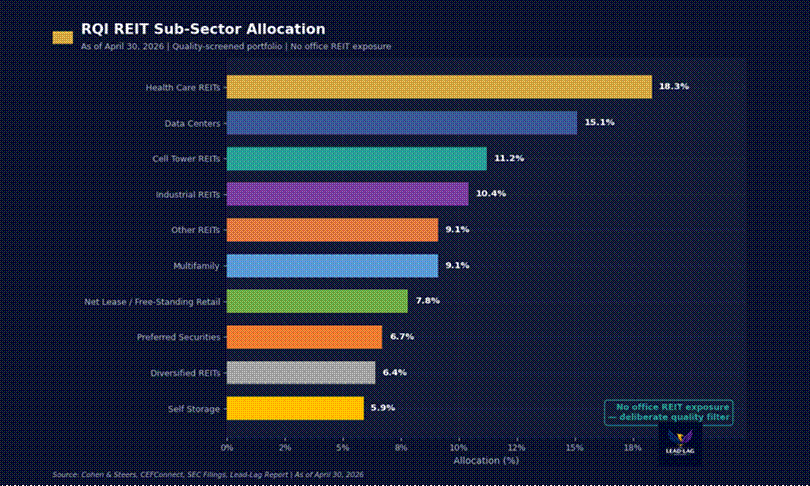
RQI holds approximately 200 securities across 15 REIT sub-sectors, and the sector weightings tell you everything about how Cohen & Steers views the world.
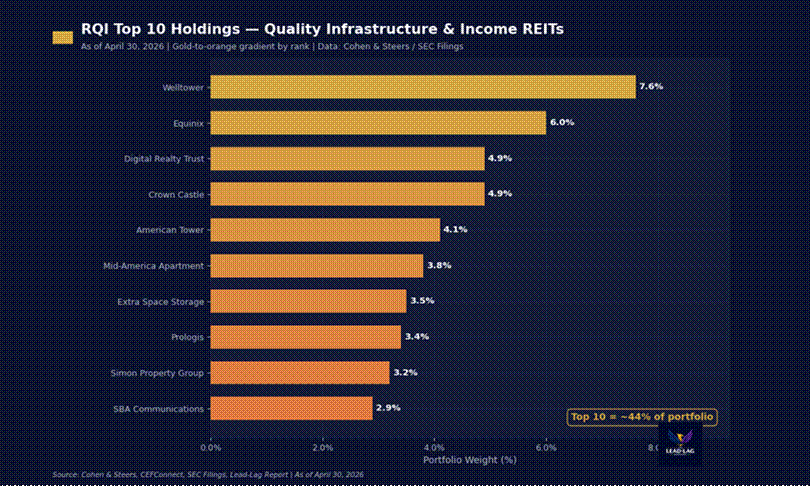
Health care REITs are the single largest allocation at 21.3% of net assets, led by Welltower at 11.3% of managed assets. Telecommunications (cell towers) is the second-largest at 17.0%, anchored by American Tower (6.0%) and Crown Castle (4.9%). Data centers represent 14.3% of equity, with Digital Realty Trust at 6.5% and Equinix at 3.5%. Industrials (Prologis at 4.9%) add another 9.4%. Multifamily sits at 5.7%.
The composition reflects deliberate conviction. The three largest allocations — health care, cell towers, data centers — share a common characteristic: structural demand that exists independently of the interest rate cycle. Senior housing demand is driven by demographics, not monetary policy. AI infrastructure buildout is driven by hyperscaler capex commitments, not the Fed funds rate. 5G densification is driven by wireless network capacity, not the yield curve.
And then there is what RQI *doesn’t* own in size. Office REITs represent just 5.4% of equity — a tiny residual in a fund this size. Cohen & Steers recognized early that hybrid work was a structural, not cyclical, shift. The WeWork implosion and the broader office vacancy crisis (national vacancy now ~20.5%) has vindicated that call. The fund sidestepped the worst-performing REIT sub-sector of the decade.
Approximately 22% of net assets sits in preferred securities — a mix of exchange-traded preferreds (12.0%) and over-the-counter preferreds (10.4%), skewed toward banking and utilities. This sleeve is managed by Elaine Zaharis-Nikas and serves as the income engine that supplements REIT dividends. An additional 2.7% is in corporate bonds.
RQI Sector Allocation
RQI Top Holdings
Historical Performance
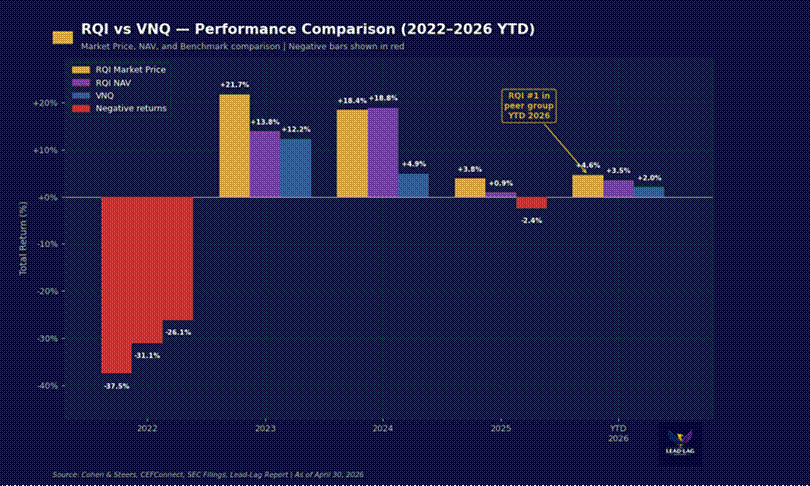
The leverage in RQI makes the return history look like a cardiac monitor — and you need to understand that before you buy. In 2019, RQI returned +53.9% in price versus VNQ’s +28.9%. In 2021, it returned +56.7% versus VNQ’s +40.5%. The leverage amplified every bull market dollar into substantially more.
Then 2022 happened. The Fed hiked from 0.25% to 4.50% in twelve months — the fastest tightening cycle in forty years — and RQI fell -31.0% in price, -26.9% on NAV. VNQ fell -26.3%. The leverage amplified the loss, and the discount widened simultaneously, compounding the price return damage. This is the known risk with leveraged REIT CEFs. It is real and it must be priced into any position.
The recovery has been equally strong. 2023: +15.7% price, +15.1% NAV. 2024: +8.1% price, +5.8% NAV. 2025 was messy — tariff shock hit REITs alongside everything else — but RQI still managed +2.1% price. And 2026 YTD through late April: +18.3% price, +12.0% NAV, #1 in peer group.
The long-term numbers validate the structure. Over 10 years, RQI has returned 9.03% annualized on price and 7.48% on NAV — versus VNQ’s 4.63%. That 4.4 percentage point annual spread compounds into roughly 50% more cumulative wealth over a decade. Since inception in 2002, NAV has compounded at 8.86% annually. For a fund paying out over 8% per year in distributions, that is a genuinely impressive absolute return record.
RQI vs Benchmark Performance Comparison
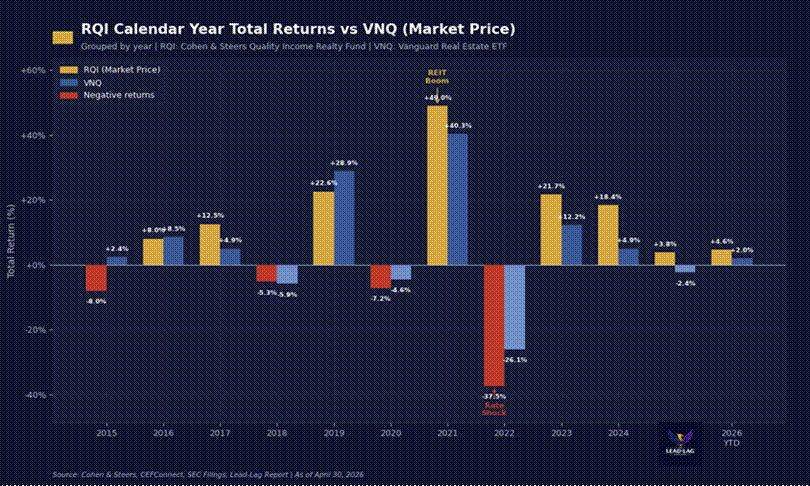
RQI Calendar Year Returns
The Rate Story
Let me be direct about the current macro setup, because it cuts both ways.