The Great Rotation Accelerates
Is This the Beginning of the End for U.S. Growth Dominance?

Below is an assessment of the performance of some of the most important sectors and asset classes relative to each other with an interpretation of what underlying market dynamics may be signaling about the future direction of risk-taking by investors. The below charts are all price ratios which show the underlying trend of the numerator relative to the denominator. A rising price ratio means the numerator is outperforming (up more/down less) the denominator. A falling price ratio means underperformance.
LEADERS: DEFENSIVES, COMMODITIES, AND THE REST OF THE WORLD ARE EATING AMERICA’S LUNCH
Energy (XLE) – Iran Tensions and Tariff Chaos Fuel a Monster Year
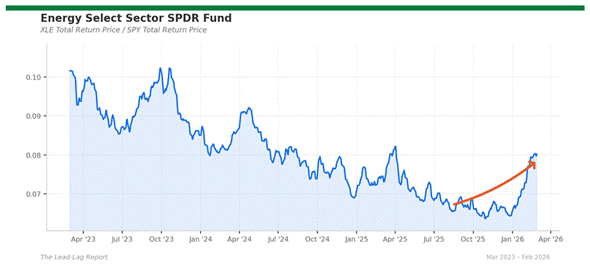
Energy stocks continue to be the undeniable leader of 2026, with XLE up a stunning 25% year-to-date against a flat S&P 500. The ratio to SPY has surged to new 52-week highs, and the uptrend shows no signs of slowing. Iran nuclear tensions escalated sharply late in the week after U.S. negotiators left Geneva disappointed, and President Trump signaled that military options remain on the table. WTI crude jumped nearly 3% on Friday alone to close around $67 per barrel, with prices spiking above $72 intraday on Monday. The combination of geopolitical risk premium, OPEC discipline, and the Supreme Court’s tariff ruling — which eliminated IEEPA tariffs but left the new 15% Section 122 global tariff intact — continues to create a supportive backdrop for energy equities. This is one of the most decisive relative trends I’ve seen in years.
Consumer Staples (XLP) – The Defensive Bid That Won’t Quit

Staples have staged a remarkable turnaround in 2026, up nearly 16% year-to-date on a total return basis and sharply outperforming the S&P 500. The ratio has broken out to levels we haven’t seen since late 2022, and the momentum is accelerating. Consumer staples gained another 2.7% last week — the second-best sector performance — as investors continue to rotate into predictable cash flows amid rising macro uncertainty. With Q4 GDP printing at just 1.4% annualized and consumer confidence expectations stuck below 80 for the 13th consecutive month (a historically reliable recession signal), the bid for defensives makes complete sense. After two years of being left for dead, XLP is back.
Utilities (XLU) – Rate Sensitivity Meets Safe Haven Demand
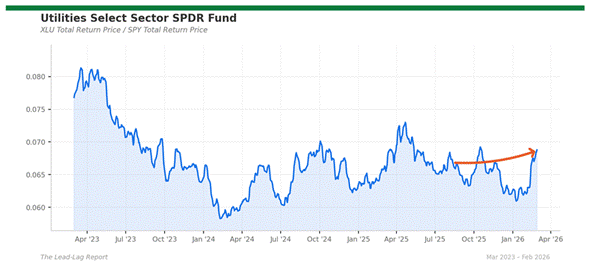
Utilities were the best-performing sector last week, up 2.9%, and are now up nearly 12% year-to-date. The ratio to SPY has been climbing steadily since the start of the year, and the breakout above the downtrend that was in place from late 2023 through most of 2025 is now well-established. The drop in the 10-year Treasury yield below 4% — the first time in months — is a powerful tailwind for this rate-sensitive group. With the 10-year settling at 3.97% after falling roughly 25 basis points through February, utilities are benefiting from both their yield appeal and their defensive character. The VIX rising above 21 from under 18 in just a few sessions only adds fuel to the defensive rotation.
Emerging Markets Equity (EEM) – Outperformance of a Generation
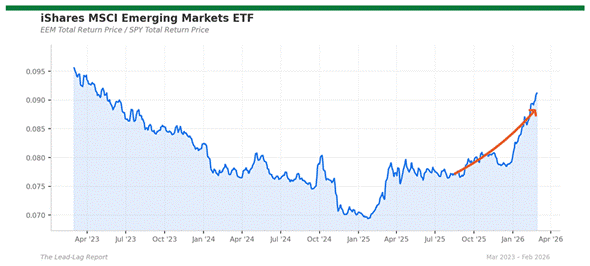
This is the chart that should have every U.S.-centric investor’s attention. EEM is up approximately 15% year-to-date versus the S&P 500’s near-zero return, and over the past year, emerging markets have crushed domestic equities with a 42.5% return against SPY’s 15.6%. The ratio has broken out of a multi-year downtrend, and the move is broad-based — not just China. The weak U.S. dollar, which is trading around 98 on the DXY (down nearly 8% over the past 12 months), is a massive catalyst for EM equities. Add in the global tariff regime reshuffling trade flows, improving EM fundamentals, and the sheer valuation discount to U.S. stocks, and this ratio could have significantly more room to run. I’ve been waiting for this breakout for years.
EAFE / Developed International (EFA) – Rest of World Pulls Ahead

It’s not just emerging markets. EFA outperformed SPY by a 31.6% to 17.7% margin in 2025, and the trend has only intensified in early 2026. European banks (EUFN) have been a standout within the international allocation, benefiting from rising European yields and a re-rating of the financial sector abroad. The narrative that the U.S. is the only game in town — a narrative that held for over a decade — is being directly challenged by price. The dollar weakness is a compounding factor here: every basis point of DXY decline amplifies international returns for U.S.-based investors. With the DXY stuck in a 96–102 range and structurally lower versus a year ago, the tailwind persists.
TIPS (SPIP) – Inflation Protection Is in Demand Again

The ratio of TIPS to nominal Treasuries has been grinding higher, and January’s inflation data gave the move fresh legs. Headline PPI shocked to the upside at +0.5% month-over-month, with core PPI printing +0.8% versus the +0.3% consensus — the biggest miss in recent memory. While headline CPI eased to 2.4%, the PPI data suggests pipeline price pressures remain very much alive, particularly with the new 15% global tariff adding cost pressures to imported goods. ISM Manufacturing prices paid have been in expansion territory for 16 consecutive months, printing at 59.0 in January. The market is starting to price in the possibility that the last mile of the inflation fight is stickier than the Fed wants to admit. TIPS are reflecting that concern.
Bonds / Treasuries (GOVT) – Bonds Finally Leading Stocks