
The Strait Is Open. The Crisis Isn’t.
Record Highs, an Oil Collapse, and a Ceasefire That Expires Tuesday

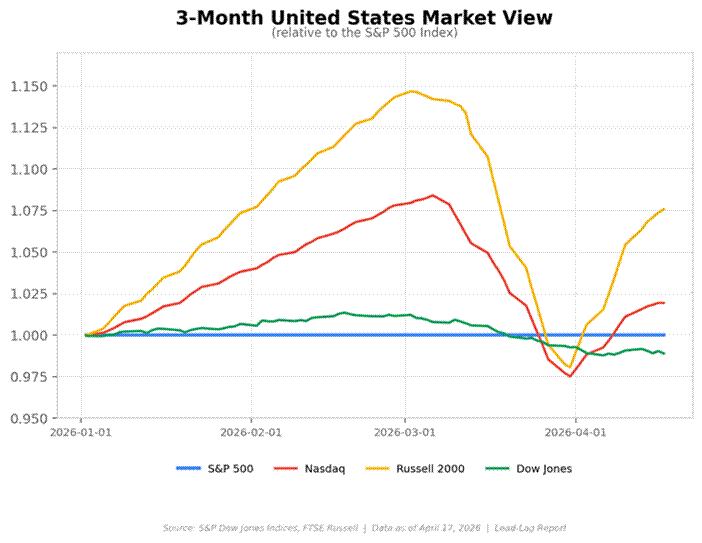
The S&P 500 closed Friday at 7,126.06. That is a record high. The Nasdaq gained 6.8% on the week, extending its winning streak to 13 consecutive sessions. The Russell 2000 surged 5.6%, bringing its year-to-date return to +11.9%—nearly triple the S&P 500’s +3.6%. The Dow finished at 49,447.43, up 3.2% on the week. Every major index is now above its January 1 starting line. The VIX collapsed from 19.23 to 17.48. By the numbers, this was one of the best weeks of 2026. The market is celebrating. And here is what it is celebrating: a statement by Iran’s Foreign Minister on Friday morning that the Strait of Hormuz is “completely open.” That single sentence, issued at 8:14 a.m. Eastern time, moved global asset prices by trillions of dollars. Trump echoed the claim on Truth Social. Both said “completely open.” Yet Hapag-Lloyd, Maersk, and the Norwegian Shipowners’ Association all said they would not send ships through until safety and insurance questions are resolved. Only two vessels transited on Thursday. The strait is “open” the way a road with mines on it is open: technically passable, practically terrifying.
The sector breakdown tells a story the headline index conceals. Energy—XLE—fell nearly 5% on the week as WTI crude collapsed 13.2% to roughly $84 and Brent dropped roughly 10% on the week to $90.38. Yet XLE remains the year’s best-performing sector at approximately +22% year-to-date, which tells you how far it had run in the preceding weeks. At the other end, consumer discretionary (XLY) surged +6.66% on the week as falling oil prices fed through to consumer spending expectations. IGV, the software ETF, sits near 52-week lows at approximately -27% year-to-date. The spread between sector winners and losers is not narrowing—it is simply rotating. Small caps are the notable story on the domestic side: the Russell 2000’s +11.9% YTD return versus the S&P 500’s +3.6% represents the clearest regime signal in domestic markets. The bounce from mid-March has not merely recovered the crash—it has exceeded the pre-crash highs.
The macro data was mixed in ways that matter. March CPI came in at 3.3% headline and 2.6% core—hotter than most hoped, cooler than feared. Initial jobless claims beat at 207,000. The Philadelphia Fed index printed 26.7, a substantial beat. But industrial production missed at -0.5%. Bank earnings were excellent across the board: JPMorgan reported $5.94 EPS, Goldman Sachs hit $17.23 billion in quarterly revenue—its second-highest quarter ever with segment records across the board, Citigroup grew earnings 14%, Bank of America 7%. Netflix beat on EPS but fell 10% after guiding weak on Q2 subscriber growth. The FOMC meeting is April 28–29, and betting markets assign a 99% probability of a hold. Oil’s collapse this week is being read as incrementally positive for a June cut, but the Fed’s credibility is staked on not cutting into record equity prices. The market is pricing a soft landing. What it may be getting is a ceasefire rally into a binary geopolitical event.
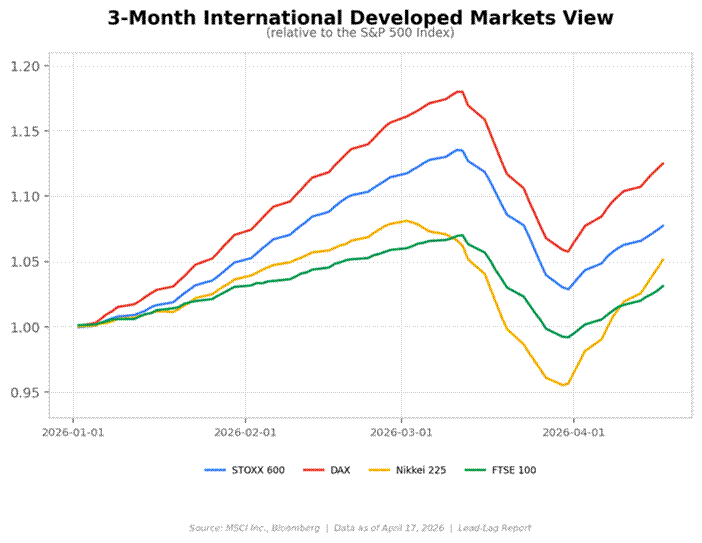
The STOXX 600 closed at 626.58, marking its fourth consecutive weekly gain and a +1.91% advance on the week. The DAX rose 3.77% to 24,702. The Nikkei 225 gained 2.73% and touched an all-time high of approximately 59,500 on Thursday before settling at 58,476—the latest benchmark to join the record-high club in what is becoming an unusually synchronized global equity rally. The FTSE 100 lagged at +0.63% to 10,668, held back by stubbornly elevated UK inflation. The ECB is widely expected to hold at its April 30 meeting, with approximately 97% probability priced in. Eurozone CPI sits at 2.6%, and a June hike is increasingly discussed rather than dismissed. ASML had a standout week, reporting €8.8 billion in sales with a 53% gross margin—numbers that confirm semiconductor infrastructure spending is accelerating even as software multiples compress. TTF natural gas fell nearly 10% to €38.6 per megawatt-hour, a six-week low, as the Hormuz relief trade spread from oil to gas.
Japan is the chart’s central irony. The Nikkei hit an all-time high while the Bank of Japan’s hike probability collapsed from approximately 70% to approximately 10%. BoJ Governor Ueda refused to signal any tightening at the IMF/G20 meetings, citing Hormuz uncertainty and global financial conditions. The consensus has shifted: June or July is now the expectation. USD/JPY sits at 159.24, just under the 160 psychological trigger that Finance Minister Katayama has warned against. He has warned before. The market has heard warnings before. The BoE is projected to hold at 3.75% through all of 2026 as UK GDP beat with +0.5% month-over-month growth—a data point that sounds positive until you consider that it’s coming alongside inflation that refuses to cooperate. Europe is outperforming the S&P 500 year-to-date by a meaningful margin, but that margin was built in the first six weeks of the year before the Hormuz crisis rewired every cross-asset correlation.
