
When Oil Broke Gold's Hand
The Hormuz peace trade unwound crude and yields in lockstep, but gold refused to follow the script — and that refusal is the whole tell.

Special Announcement
Fintech-enabled Growth & Income
TappAlpha’s mission is simple: To make powerful investing strategies accessible to everyday investors and advisors — so more people can build wealth with confidence and purpose.
TappAlpha’s Growth and Income funds, TSPY and TDAQ, reimagine core equity by layering tax-efficient monthly potential income onto the S&P 500 and Nasdaq-100.
Get market exposure + meaningful income potential — with the TappAlpha Growth & Daily Income ETFs.
Disclosures:
Investors should carefully consider the investment objectives, risks, charges and expenses of the ETFs identified on this site. This and other important information about the Fund are contained in the prospectus, which can be obtained by visiting tappalphafunds.com or by calling (844) 403-2888. The prospectus should be read carefully before investing.
ETFs are subject to additional risks that do not apply to conventional mutual funds, including the risks that the market price of an ETF’s shares may trade at a premium or discount to its net asset value, an active secondary trading market may not develop or be maintained, or trading may be halted by the exchange in which they trade, which may impact a Fund’s ability to sell its shares. Shares of any ETF are bought and sold at market price (not NAV) and are not individually redeemed from the Fund. Brokerage commissions will reduce returns.
The Fund invests in options contracts that are based on the value of the Index, including SPX and XSP options for TSPY and XND and NQX options for TDAQ. This subjects the Fund to certain of the same risks as if it owned shares of companies that comprised the Index, even though it does not own shares of companies in the Index. The Fund will have exposure to declines in the Index. The Fund is subject to potential losses if the Index loses value, which may not be offset by income received by the Fund. To the extent that the Fund invests in other ETFs or investment companies, the value of an investment in the Fund is based on the performance of the underlying funds in which the Fund invests and the allocation of its assets among those ETFs or investment companies. The Fund may incur high portfolio turnover to manage the Fund’s investment exposure. The Fund is classified as “non-diversified” under the 1940 Act.
As of the date of this prospectus, the Fund has no operating history and currently has fewer assets than larger funds. Like other new funds, large inflows and outflows may impact the Fund’s market exposure for limited periods of time. This impact may be positive or negative, depending on the direction of market movement during the period affected.
Due to the short time until their expiration, 0DTE options are more sensitive to sudden price movements and market volatility than options with more time until expiration. Because of this, the timing of trades utilizing 0DTE options becomes more critical. Even a slight delay in the execution of 0DTE trades can significantly impact the outcome of the trade. 0DTE options may also suffer from low liquidity, making it more difficult for the Fund to enter into its positions each morning at desired prices. The bid-ask spreads on 0DTE options can be wider than with traditional options, increasing the Fund’s transaction costs and negatively affecting its returns. These risks may negatively impact the performance of the fund.
Distributor: Foreside Fund Services, LLC
DISCLAIMER – PLEASE READ: This is sponsored advertising content for which Lead-Lag Publishing, LLC has been paid a fee. The information provided in the link is solely the creation of TappAlpha. Lead-Lag Publishing, LLC does not guarantee the accuracy or completeness of the information provided in the link or make any representation as to its quality. All statements and expressions provided in the link are the sole opinion of TappAlpha, and Lead-Lag Publishing, LLC expressly disclaims any responsibility for action taken in connection with the information provided in the link.
When Oil Broke Gold’s Hand
● WTI cratered 14.4% on the week to $75.83 and Brent shed 13.5% to $79.46 as a US–Iran MOU put Strait of Hormuz reopening on the clock — the cleanest geopolitical-premium unwind of the cycle.
● Gold held at $4,353 and the 10-year retraced to roughly 4.46% — meaning crude and yields obeyed the peace trade while gold flatly refused, decoupling from the very risk premium it supposedly tracked.
● Warsh’s first FOMC delivered the hawkish hold the bond market was quietly preparing for — unanimous 12-0 vote, median 2026 dot moved to 3.8% from 3.4%, easing bias gone, one 25bp hike now penciled in by year-end; Warsh almost certainly abstained from his own dot.
Let me lead with the contradiction, because it is the entire edition. When the US and Iran signed a memorandum of understanding on June 15 and put a Strait of Hormuz reopening inside a thirty-day window, the market did exactly what the textbook says it should: it stripped the geopolitical risk premium out of the crowded trades. WTI front-month — NYMEX July 2026 — collapsed 14.4% on the week to $75.83, and ICE Brent August front fell 13.5% to $79.46. The 10-year retraced from its 4.55% post-payrolls peak back to roughly 4.46%. VIX compressed 17.4% to 16.41. Every leg of last week’s “yield repricing unwind” thesis came apart at the seams — except one. Gold, the asset that is supposed to be the purest expression of geopolitical fear, closed at $4,353, holding its gains while the fear that allegedly bid it up walked out the door. That divergence between oil and gold is not noise. In my view it is the most important intermarket signal on the board this week, and it is telling you something about durable versus flighty money that the headline tape is missing.
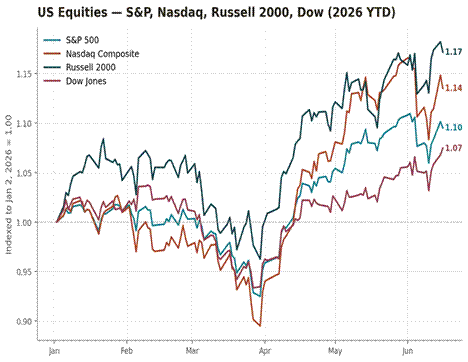
Start with the US, where the regime looks deceptively orderly. The S&P 500 added 1.69% on the week to 7,511.35, the Nasdaq Composite ran 2.72% to 26,376, and the Dow extended its run 2.22% to 51,999 — comfortably back above the 50,000 line it first reclaimed in May, not some maiden voyage. The Russell 2000 moved with the cyclical crowd, but the leadership story underneath is the rotation that matters: financials (XLF) led the tape at +3.60% over five sessions while energy (XLE) was the lone meaningful laggard at -3.54%, deepening the leader-to-laggard flip whose MACD rolled over back on May 27. This is the intermarket plumbing working in plain sight. A 14% crude collapse mechanically drains the forward inflation impulse — energy was running +23.5% year-over-year in the May CPI print — and banks get paid twice: once on the disinflation read that takes the edge off hawkish repricing, and again on the steepening pressure as the front end pulls cuts forward by a hair. The 2s10s sits around +38–39bp, little changed from roughly +42bp at the June 10 high — the curve flattening modestly into the FOMC rather than steepening.
But do not confuse the rotation for resolution. Core CPI is still +2.9% year-over-year, May PPI ran +6.5% year-over-year, and the 172,000-job May payrolls blowout has not been revised away. The energy leg of the inflation story is reversing; the labor and core legs are not. That is why the market repriced cuts back in only at the margin — the 9bp move in the 10-year — rather than pricing an actual easing cycle. Earnings color the same picture: the slate was light into the meeting, with CarMax, Jabil and Progressive due June 17, and the AI capex engine still anchored by NVIDIA’s +140% year-over-year EPS from its May quarter. The tape is rallying on lower oil, not on a Fed pivot, and those are very different fuels.
The only event that actually mattered Wednesday afternoon delivered the answer in a single move. The Fed held at 3.50%–3.75% on a unanimous 12-0 vote — the first unanimous vote in a year — but the dot plot did the talking. The median 2026 dot moved from 3.4% in March to 3.8% in June, formally penciling in one quarter-point hike before year-end and erasing the last 2026 cut that had survived the March projections. Nine of eighteen committee members now project at least one hike this year. Only eighteen dots were submitted versus nineteen in March, meaning Kevin Warsh — the 17th Chair, sworn in May 22 — almost certainly abstained from his own projection, consistent with his stated skepticism of forward guidance. The statement itself shed its easing bias and was meaningfully shortened. Year-end PCE projections were lifted to 3.6% from 2.7%. The contradiction I flagged before the meeting — a deflating oil complex giving him cover to stay neutral — held in spirit but the committee leaned the other way: the labor and core inflation legs of the inflation story carried more weight than the unwinding energy leg, and the dot plot blinked toward a hike where the market was pricing a hold-into-cuts path. Two-year yields jumped roughly ten basis points to 4.15% on the print, equities sold off about a half percent off the SEP, and money markets repriced toward thirty basis points of net tightening by December where they had been pricing twenty before. This is the hawkish hold the bond market has been quietly preparing for. Warsh did not need to flirt with hike language — his committee did it for him.
(Continued for paid subscribers)
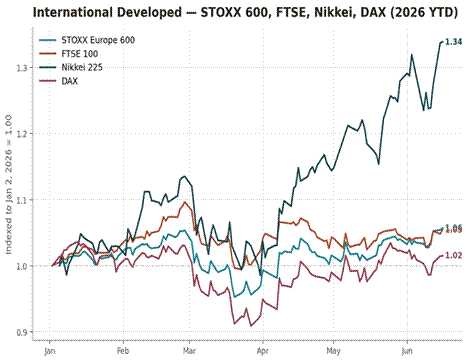
Across the Atlantic the relief rally was even cleaner. The STOXX Europe 600 printed a fresh record close Tuesday June 16 at 636.00 (+2.81% on the week), with Monday Jun 15 already touching an intraday record near 639.20, led by the peripheral financials — Spain’s IBEX (+5.44%) and Italy’s MIB (+4.32%) — as the BTP-Bund spread compressed to 72bp, a multi-month tight. This is the Eurobanks-over-US-banks trade extending into its eighth-plus week, and the ECB’s June 11 hike to a 2.25% deposit rate — the first G7 tightening of the Iran shock — keeps feeding the net-interest-margin story. The DAX lagged (+0.97%), caught between the risk-on tape and a firmer euro pinching exporters, while German ZEW expectations swung +20.7 points to +10.5, the first positive reading since the war began — pure forward-looking optimism, given current conditions still sit at -81.0.
Japan is where the regime shift is loudest. The Bank of Japan hiked 25bp to 1.00% on a 7-1 vote — the highest policy rate since 1995 — with Governor Ueda hospitalized and Deputy Governor Uchida deliberately vague on the path to neutral. The Nikkei 225 broke through 70,000 intraday for the first time ever on June 16 before settling back to close at 69,317 (+5.96%); be precise about that — the index touched the milestone but did not close above it. USD/JPY barely flinched at 160.36, parked in the same intervention-sensitive zone where Tokyo already spent a record ~¥11.7 trillion this spring per official MOF disclosure (Apr 28–May 27 window), because a fully-priced hike with no 50bp surprise is a non-event for the pair. The 10-year JGB rose to 2.61%. A central bank tightening into Brent below $80 is running a dual-disinflationary play on its import-heavy base — and the market read it as constructive, not contractionary.
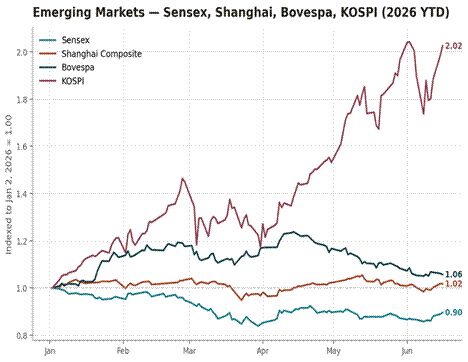
The emerging-market tape split exactly along the oil seam, and that split is the cleanest read of who wins and who loses from the peace trade. India, the quintessential oil importer, ran higher — the Sensex closed at 76,264 (+3.73%) and the Nifty 50 at 23,623 (+2.16%) — as cheaper crude eased the current-account and inflation math, with the rupee firming toward 94.54 and the RBI holding its repo at 5.25% after roughly 100bp of cumulative cuts. China diverged: the Shanghai Composite essentially flatlined at 4,091.89 (-0.11% on the day), still digesting a 35th consecutive month of falling new-home prices despite fresh Shanghai purchase-rule relaxation. The bifurcation between an importer that rallies on cheap oil and a structurally-impaired domestic demand story is the EM story in miniature.
The other side of that seam is Brazil, where the oil collapse hit directly. Petrobras absorbed the crude move — down 5.15% Monday as the deal shock registered — dragging the Ibovespa to back-to-back losses near 169,648 (-0.45% Tuesday) even as the broader risk-on tone held. The real softened toward 5.09 against the dollar, and Copom’s Wednesday decision sits in the same “Super Wednesday” window as the FOMC, split between a hold and a cut from the 14.50% Selic. The lesson EM is teaching this week is the durable-versus-flighty distinction in raw form: oil-importer FX and equity drew durable buyers on improved fundamentals, while commodity-exporter complexes saw the flighty geopolitical bid evaporate the moment the premium did.
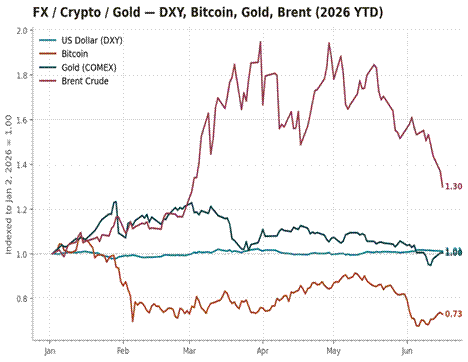
So return to gold, because this is where the edition lives. Crude obeyed the peace trade. Yields obeyed the peace trade. The DXY barely moved — 99.54, down 0.38%, refusing the classic safe-haven bid an oil shock unwinding “should” have triggered. Bitcoin ran 6.11% to $65,684 and Ether 8.58% to $1,792.67 on the same risk-on relief. And gold, the asset whose entire June rally was attributed to the Hormuz risk premium, closed at $4,353 — roughly 18% below its January peak near $5,318, but holding, not unwinding, while the premium that supposedly explained it walked off the field.
The market is missing what that refusal means. If gold were merely a geopolitical-fear trade, it would have sold off with crude this week; it didn’t. It is trading on the real-rate path — a deflating oil complex lowers the forward inflation trajectory and pulls real yields down — and on a quiet bid for the one asset that doesn’t care which Chair runs the Fed. After the 2pm SEP release, gold held above $4,330 while the dollar firmed and yields jumped — the same refusal pattern, now stress-tested against a hawkish surprise that should have hurt it most. Copper up 2.71% to $6.481 reinforces the read: this is reflation-and-duration money, not fear money. Oil broke gold’s hand this week, and gold didn’t let go. That is durable money showing its grip, and it is living on borrowed time only if the disinflation it is pricing reverses.
What I’m watching next week: the follow-through on a dot plot that just penciled in a hike — does Warsh’s first press conference frame it as a forecast or a commitment, and does the 2-year yield extend its move toward 4.20%; the Geneva MOU signing scheduled for June 19 and whether it survives the diverging US–Iran reads on Hormuz “service fees”; the Hormuz Day 109-to-120 window for any slippage in the thirty-day reopening clock; the BoJ follow-through after its move to 1.00% and whether USD/JPY tests intervention levels again; the oil–gold correlation watch — does gold’s refusal to unwind hold, or does it finally catch down to crude; the BoE on June 18 and its vote split; and China’s stimulus deliberation as property prices fall for a 35th straight month. The peace trade unwound the easy legs. The leg that refused to unwind is the one worth your attention.
The Lead-Lag Report is provided by Lead-Lag Publishing, LLC. All opinions and views mentioned in this report constitute our judgments as of the date of writing and are subject to change at any time. Information within this material is not intended to be used as a primary basis for investment decisions and should also not be construed as advice meeting the particular investment needs of any individual investor. Trading signals produced by the Lead-Lag Report are independent of other services provided by Lead-Lag Publishing, LLC or its affiliates, and positioning of accounts under their management may differ. Please remember that investing involves risk, including loss of principal, and past performance may not be indicative of future results. Lead-Lag Publishing, LLC, its members, officers, directors and employees expressly disclaim all liability in respect to actions taken based on any or all of the information on this writing.