

Below is an assessment of the performance of some of the most important sectors and asset classes relative to each other with an interpretation of what underlying market dynamics may be signaling about the future direction of risk-taking by investors. The below charts are all price ratios which show the underlying trend of the numerator relative to the denominator. A rising price ratio means the numerator is outperforming (up more/down less) the denominator. A falling price ratio means underperformance.
LEADERS: ENERGY DOMINANCE, DEFENSIVE ROTATION, AND A LUMBER COMEBACK NOBODY SAW COMING
Energy (XLE) – South Pars Changed Everything
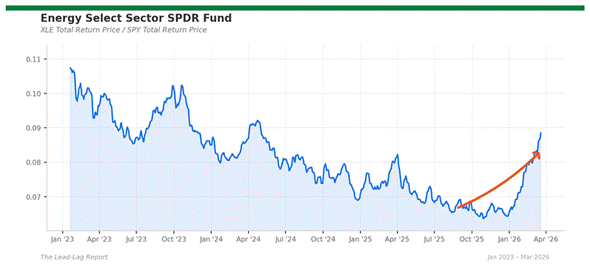
Energy’s dominance reached a new level this week after Israel struck Iran’s South Pars gas field — the world’s largest — on March 19, and Iran retaliated by hitting Qatar’s LNG facilities, knocking out an estimated 17% of global LNG export capacity for what analysts expect will be a 3–5 year repair timeline. The XLE/SPY ratio surged another leg higher and is now up a staggering 35.6% over three months, the most extreme relative energy move since the Russia-Ukraine shock of early 2022. Brent crude spiked to $119 intraday on March 19 before pulling back as a late-session geopolitical headline triggered a reversal; WTI hit approximately $98. Iran is now developing a “selective” vetting system for Strait of Hormuz transit, with traffic down 95% and only India, Pakistan, China, and Iraq actively negotiating passage. The FOMC held rates at 3.50–3.75% on March 18 with an 11–1 vote, acknowledging the impossible bind: oil-driven inflation running hot while the economy decelerates. Energy isn’t just a trade anymore — it’s the axis around which every other asset class is rotating. With Brent still above $110 and no Hormuz resolution in sight, the XLE/SPY ratio could have substantially more room to run.
Utilities (XLU) – The Only Shelter That’s Actually Working
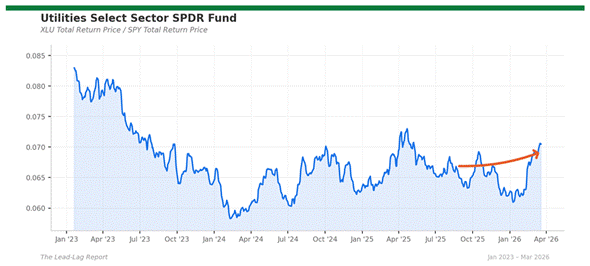
Utilities extended their remarkable 2026 run with the XLU/SPY ratio climbing another 11.3% over three months, making this the most sustained period of utility outperformance since the 2022 bear market. In a week where the S&P 500 fell to fresh 2026 lows at 659.80 on March 19 — down approximately 0.4% for the week through Thursday — utilities continued to attract capital as the ultimate defensive allocation. The AI data center demand narrative provides a rare secular growth tailwind for a traditionally boring sector, but make no mistake: this is primarily a fear trade. The FOMC’s dot plot showed 14 of 19 officials expecting zero or one rate cut in 2026, with the median at just one cut, and Waller — who had been a reliable dove — flipped to hold. That hawkish repricing should theoretically hurt rate-sensitive utilities, but the risk-off bid is overwhelming any yield sensitivity. When oil spikes to $119 and a major gas field gets bombed, investors aren’t doing duration math — they’re reaching for the safest equity exposure available.
Treasuries (GOVT) – The Flight to Quality Deepens
