
Why 2026 Could Be the Year for Commodities

For much of the past decade, commodities have lived in the shadow of equities. Growth narratives, technology leadership, and financial assets dominated investor attention, while real assets cycled quietly in the background. That dynamic may be on the verge of changing.
As we look ahead to 2026, a growing body of evidence suggests commodities are entering a far more constructive phase. Shifting inflation dynamics, changing monetary policy expectations, and rising geopolitical and supply-chain constraints are all converging in ways that historically have favored hard assets.
To explore this theme in depth, I’m hosting a live webinar focused on why 2026 could be a pivotal year for commodities, with a particular emphasis on gold, platinum, and the broader market implications.
👉 Register here:
https://us06web.zoom.us/webinar/register/WN_h9AfEjN0SXu4_dY2GLrJDg
Why Commodities Are Back on the Radar
Commodities tend to perform best when traditional market assumptions are challenged. Periods marked by economic transitions, policy uncertainty, and structural inflation pressures have historically been fertile ground for real assets.
As global markets move further away from the ultra-stable conditions that defined much of the 2010s, investors are increasingly re-examining the role commodities can play in diversification, risk management, and long-term portfolio resilience.
Rather than viewing commodities as a short-term trade, the more relevant question may be whether we are entering a multi-year environment where they reclaim strategic importance.
The Case for Gold and Platinum
Gold has long served as a barometer for macro stress and monetary confidence. In an environment where policy credibility, fiscal discipline, and currency stability are all under scrutiny, gold’s role as a portfolio stabilizer deserves renewed attention.
Platinum, meanwhile, presents a very different but equally compelling narrative. Often overshadowed by gold, platinum sits at the intersection of industrial demand, technological change, and constrained supply. That combination has historically produced powerful inflection points when conditions align.
Understanding how these metals differ—and how they may complement each other—is critical for investors thinking beyond traditional stock and bond allocations.
Broader Market Implications
Commodity cycles rarely occur in isolation. When real assets gain traction, they tend to influence equity leadership, sector rotation, and risk appetite across markets. Inflation-sensitive assets, currency trends, and volatility dynamics often move in tandem with commodity strength.
In this session, we’ll discuss how a commodity-friendly backdrop could reshape broader market behavior and what investors should be watching as 2026 approaches.
Webinar Details
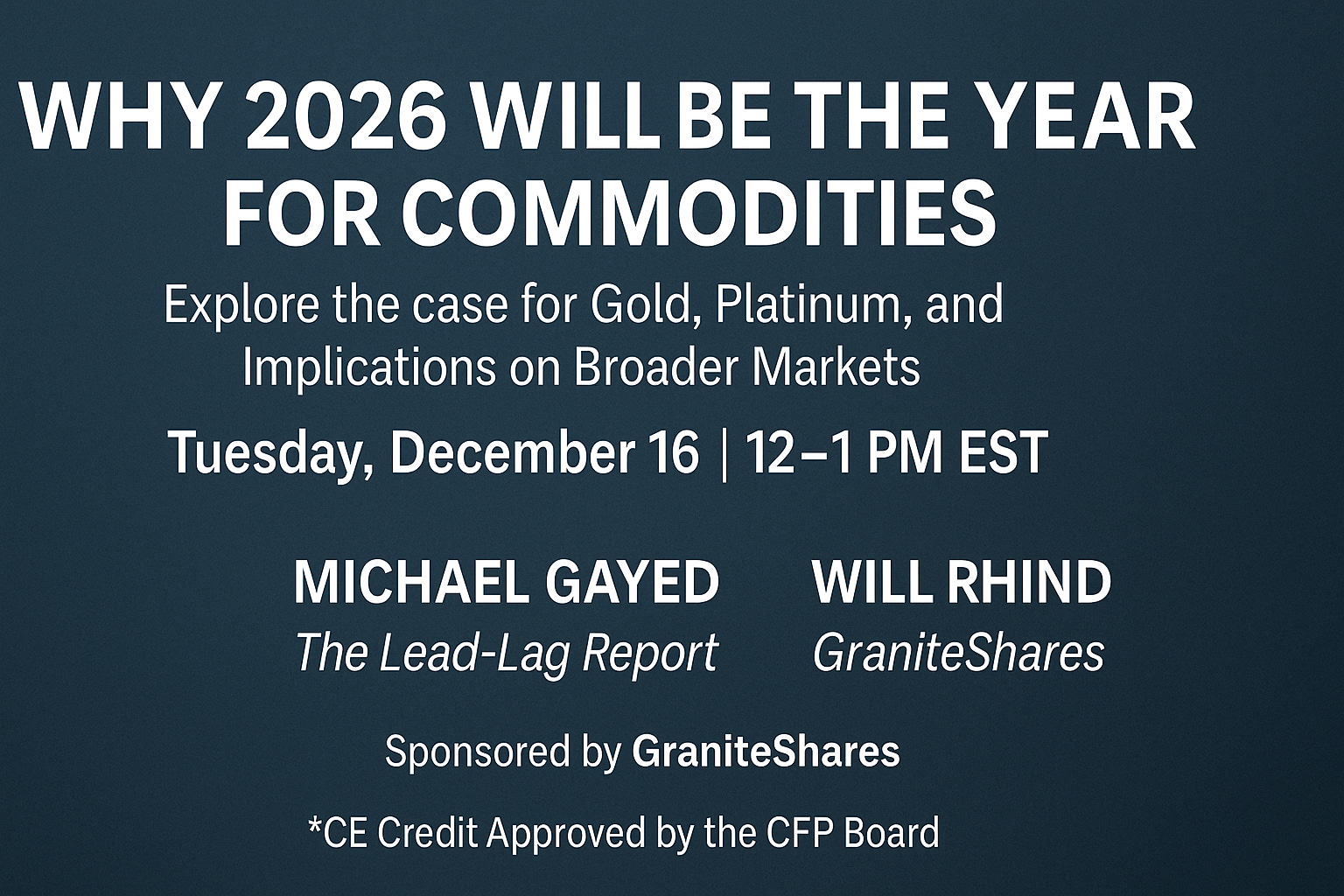
Topic: Why 2026 Will Be the Year for Commodities
Host: Michael A. Gayed, CFA — The Lead-Lag Report
Sponsor: GraniteShares
Date: Tuesday, December 16
Time: 12:00–1:00 PM ET
CE Credit: Approved by the CFP Board
Audience: All investors
This webinar is designed to be educational, forward-looking, and accessible—whether you actively allocate to commodities or are simply evaluating how macro conditions may evolve over the next market cycle.
👉 Save your seat here:
https://us06web.zoom.us/webinar/register/WN_h9AfEjN0SXu4_dY2GLrJDg
I look forward to having you join the discussion.
The Lead-Lag Report is provided by Lead-Lag Publishing, LLC. All opinions and views mentioned in this report constitute our judgments as of the date of writing and are subject to change at any time. Information within this material is not intended to be used as a primary basis for investment decisions and should also not be construed as advice meeting the particular investment needs of any individual investor. Trading signals produced by the Lead-Lag Report are independent of other services provided by Lead-Lag Publishing, LLC or its affiliates, and positioning of accounts under their management may differ. Please remember that investing involves risk, including loss of principal, and past performance may not be indicative of future results. Lead-Lag Publishing, LLC, its members, officers, directors and employees expressly disclaim all liability in respect to actions taken based on any or all of the information on this writing.