
Why Credit Markets Are at a Crossroads Heading Into 2026 — and What It Means for $JOJO
Have credit markets truly settled down, or are they simply catching their breath?

Through much of 2025, corporate credit appeared remarkably calm. High-yield bond funds rallied, defaults stayed low, and investors grew comfortable with the idea that the worst of the tightening cycle had passed. Beneath that surface, however, a more uneasy narrative has been taking shape. Several large asset managers now describe credit markets as being “at a crossroads,” reflecting concern that elevated borrowing costs are finally starting to bite, even as expectations for monetary easing move closer.¹
The tension is straightforward. Policy rates remain restrictive enough to pressure corporate balance sheets, yet credit spreads have not meaningfully widened. Investors are still being paid relatively little extra to own riskier bonds, despite the fact that refinancing conditions are far less forgiving than they were earlier in the decade. PineBridge Investments notes that while the Federal Reserve may begin easing policy, the lagged effects of high rates are only now working through corporate cash flows.¹ Whether credit fundamentals improve or deteriorate from here depends largely on how long policy stays tight and how resilient growth proves to be.
Tight Spreads, High Rates, and Fragile Confidence
Other managers echo this caution. Man Group’s 2026 credit outlook highlights that high-yield spreads effectively “round-tripped” during 2025, ending the year close to where they began.² Markets absorbed a variety of shocks without repricing risk in a sustained way. That stability can be interpreted as confidence, but it can also signal complacency. Historically, periods of unusually tight spreads have often preceded sharp, sudden adjustments rather than slow, orderly transitions.
That fragility became more apparent toward the end of the year. When the Federal Reserve delivered a widely expected rate cut in October, bond markets reacted not with relief but with selling pressure. Invesco’s November outlook described how corporate spreads widened after the announcement, driven less by the cut itself and more by Chair Powell’s caution around future policy moves.³ The message markets heard was that easing would not be automatic. If inflation proved sticky or growth remained firm, rates could stay higher for longer.
This shift in tone unsettled investors who had grown accustomed to assuming policy support would arrive quickly. Allianz Global Investors observed that even isolated stresses, such as brief disruptions in regional banking, were enough to cause short-lived spikes in credit spreads before calm returned.⁴ The pattern is telling. Fundamentals remain intact, but confidence is thin. Credit markets appear stable until they are not.
How Investors Are Positioning for Asymmetric Risk
Against this backdrop, portfolio positioning has grown more defensive. Rather than chasing incremental yield, many managers are emphasizing quality and flexibility. Invesco reports extending duration modestly at the front end of the curve and favoring higher-quality spread sectors where balance sheets appear more resilient.⁵ PineBridge’s credit team has taken a similar approach, trimming higher-beta exposures and rebuilding liquidity.⁶ The objective is not to predict a downturn, but to avoid being forced sellers if conditions deteriorate.
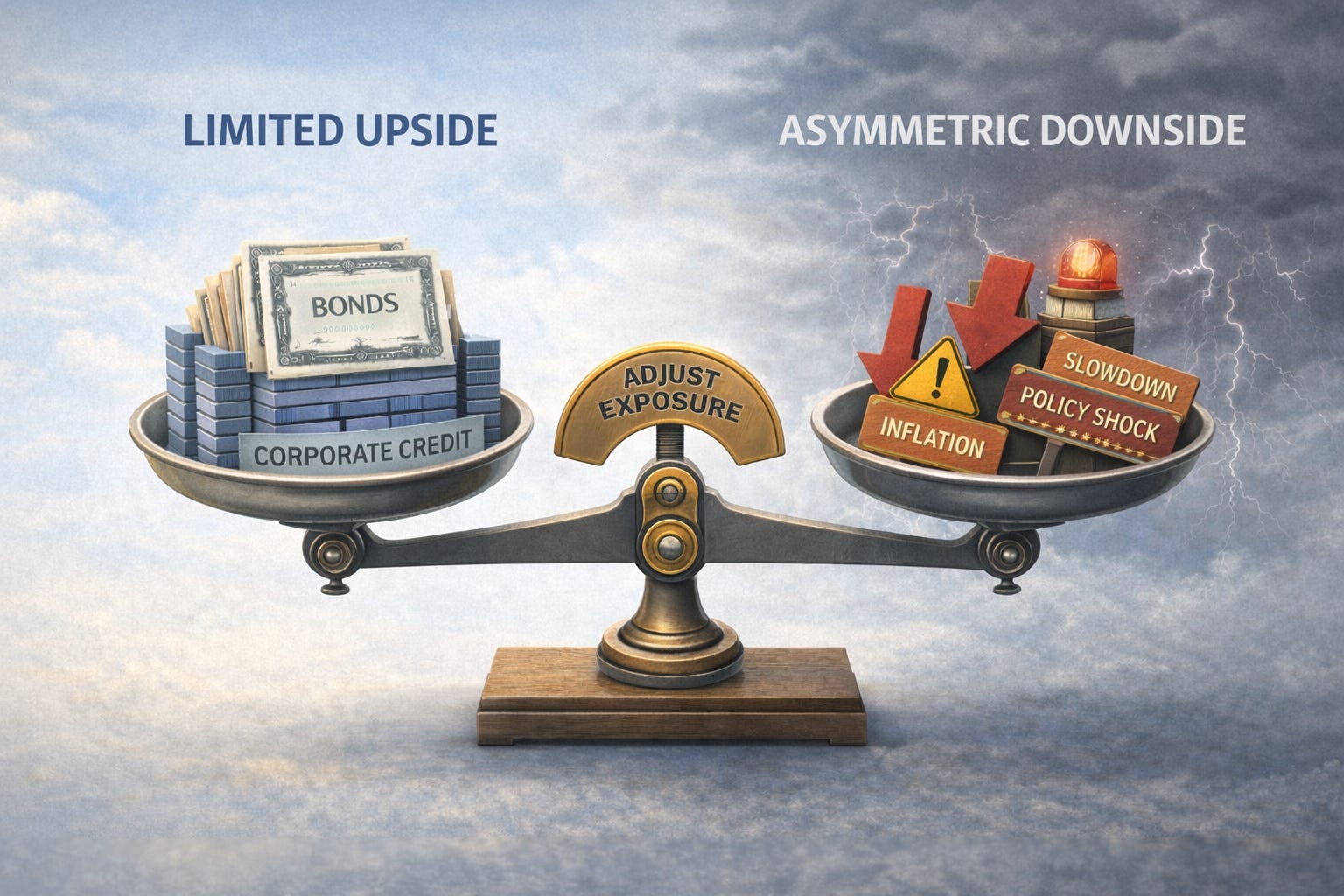
This behavior reflects a broader recognition that upside in credit may be limited. With spreads already tight, there is less room for prices to rise meaningfully. At the same time, downside risks remain asymmetric. A modest slowdown, a policy surprise, or renewed inflation pressure could all prompt a rapid reassessment of credit risk. In that environment, the ability to adjust exposure matters more than squeezing out marginal income.
Why Tactical Credit Rotation Matters at This Juncture
This is where tactical approaches to fixed income have attracted renewed attention. Unlike traditional buy-and-hold bond strategies, tactical credit strategies aim to respond dynamically to changing risk conditions. The ATAC Credit Rotation ETF (JOJO) is built around that premise. Rather than maintaining constant exposure to high-yield bonds, the strategy rotates between risk-on credit and defensive Treasury positions based on market signals.⁷
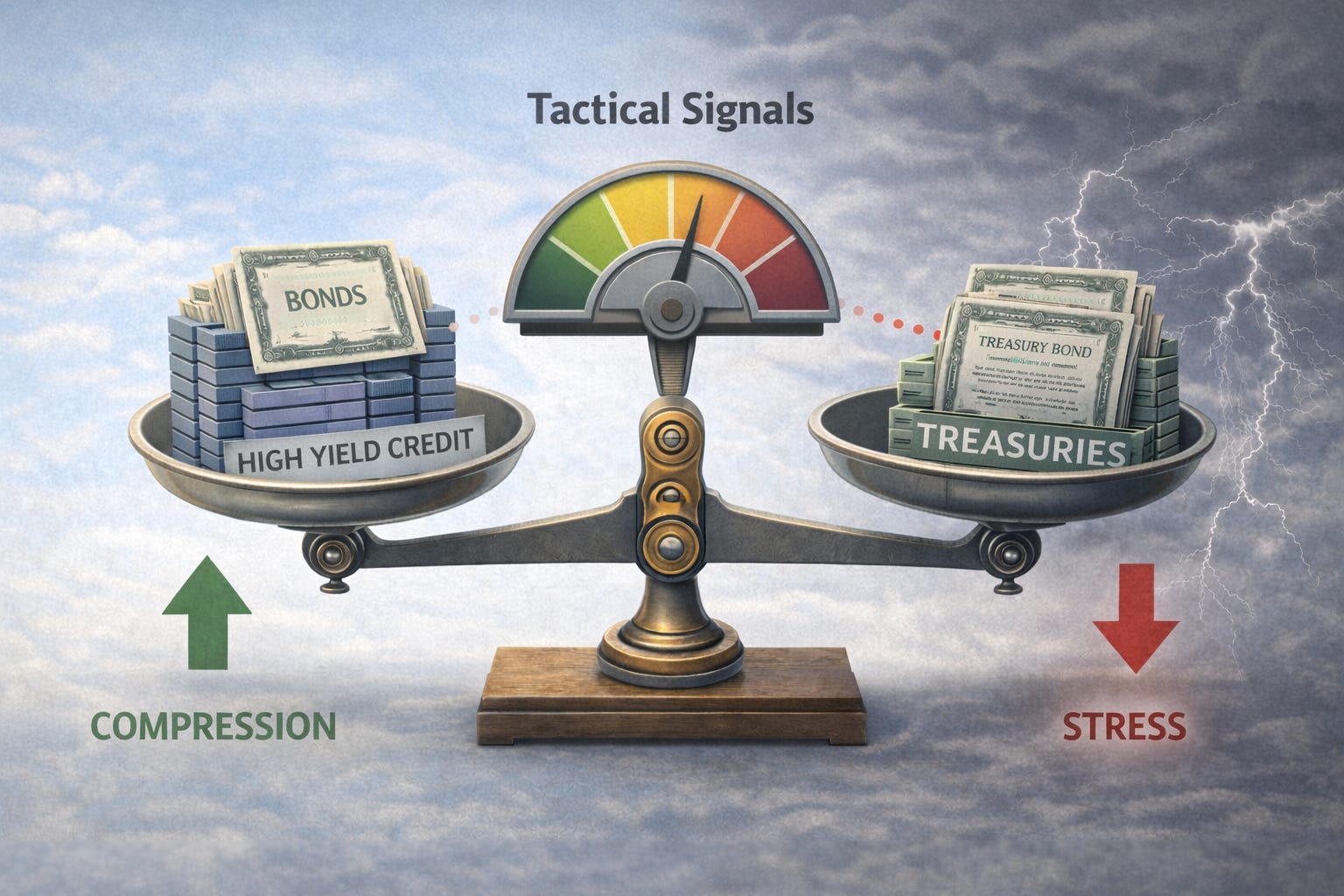
The underlying logic is simple. When credit conditions are benign and spreads are compressing, the strategy seeks exposure to higher-yielding segments of the bond market. When stress indicators rise, it shifts toward Treasuries, aiming to reduce drawdowns during periods of widening spreads. The signals used to guide these shifts are rules-based and derived from observed market behavior, including relative performance trends across defensive equity sectors.
During periods when credit risk is mispriced, this flexibility can matter. In early 2025, JOJO’s managers highlighted that spreads remained historically low, leaving little margin for error.⁸ A strategy able to step aside when risk begins to rise may avoid some of the sharp declines that often accompany credit market reversals. That benefit comes with trade-offs. If credit remains calm and spreads stay tight, a static high-yield allocation may generate higher income over time.
It is also important to recognize that JOJO is not a guaranteed solution. As an actively managed ETF, it carries higher expenses than many passive bond funds, and its effectiveness depends on the continued relevance of its signals. The fund is relatively small and comparatively new, which may matter to some investors. Tactical strategies can also lag during strong, uninterrupted risk-on environments.
Still, the appeal of flexibility is clear given the current backdrop. Credit markets do not appear to be pricing in much adversity, even as refinancing risks and policy uncertainty persist. For investors concerned about preserving capital rather than maximizing income, a strategy that can automatically reduce exposure during periods of stress may be worth consideration.
Looking ahead to 2026, credit markets face a narrow path. Continued economic resilience could allow spreads to remain contained, potentially benefiting investors who stay fully invested. Alternatively, delayed effects from higher rates or a shift in policy expectations could trigger a repricing of risk. The challenge is that these transitions rarely unfold gradually.
At a crossroads, preparation often matters more than prediction. Tactical strategies like JOJO are designed around that insight, seeking to adapt rather than forecast. For investors weighing how much credit risk to carry into an uncertain environment, the question is not whether volatility will return, but how portfolios will respond when it does.
Consider $JOJO. I believe in it. I wouldn’t have launched the fund if I didn’t.
Footnotes
PineBridge Investments, Investment Strategy: Credit Markets at a Crossroads, September 2025.
Man Group, 2026 Credit Outlook: Divergence Meets Opportunity, October 2025.
Invesco, Investment Grade Outlook: Insights for November, November 2025.
Allianz Global Investors, Late Cycle Calls for Resilient Income and Duration, November 2025.
Invesco, Investment Grade Outlook: Insights for November, November 2025.
PineBridge Investments, Public Credit Resilience and Private Debt, September 2025.
ATAC Funds, ATAC Credit Rotation ETF (JOJO) Overview, 2025.
ATAC Funds, JOJO Fact Sheet, October 2025.
Junk debt, also known as high-yield bonds or speculative-grade debt, refers to fixed-income securities issued by companies or governments with lower credit ratings, offering higher interest rates to compensate investors for the elevated risk of default.
Duration measures a bond’s sensitivity to interest rate changes, representing the weighted average time it takes to receive all cash flows from the bond.
The VIX index, often called the "fear gauge" of Wall Street, is a real-time market index that measures the market's expectation of 30-day forward-looking volatility derived from S&P 500 index options prices, serving as a key barometer of investor sentiment and market risk.
The ICE BofA BB US High Yield Index Option-Adjusted Spread measures the yield differential between BB-rated corporate bonds and a spot Treasury curve, quantifying the risk premium for below-investment-grade debt with a BB rating in the US market.
As with all ETFs, Fund shares may be bought and sold in the secondary market at market prices. The market price normally should approximate the Fund’s net asset value per share (NAV), but the market price sometimes may be higher or lower than the NAV. The Fund is new with a limited operating history. There are a limited number of financial institutions authorized to buy and sell shares directly with the Fund, and there may be a limited number of other liquidity providers in the marketplace. There is no assurance that Fund shares will trade at any volume, or at all, on any stock exchange. Low trading activity may result in shares trading at a material discount to NAV.
Because the Fund invests in Underlying ETFs an investor will indirectly bear the principal risks of the Underlying ETFs, including but not limited to, risks associated with investments in ETFs, equity securities, growth stocks, large and small capitalization companies, non-diversification, fixed income investments, derivatives and leverage. The prices of fixed income securities may be affected by changes in interest rates, the creditworthiness and financial strength of the issuer and other factors. An increase in prevailing interest rates typically causes the value of existing fixed income securities to fall and often has a greater impact on longer duration and/or higher quality fixed income securities. The Fund will bear its share of the fees and expenses of the underlying funds. Shareholders will pay higher expenses than would be the case if making direct investments in the underlying funds.
Because the Fund expects to change its exposure as frequently as each week based on short-term price performance information, (i) the Fund’s exposure may be affected by significant market movements at or near the end of such short-term periods that are not predictive of such asset’s performance for subsequent periods and (ii) changes to the Fund’s exposure may lag a significant change in an asset’s direction (up or down) if such changes first take effect at or near a weekend. Such lags between an asset’s performance and changes to the Fund’s exposure may result in significant underperformance relative to the broader equity or fixed income market. Because the Adviser determines the exposure for the Fund based on the price movements of gold and lumber, the Fund is exposed to the risk that such assets or their relative price movements fail to accurately predict future performance.
Past performance is no guarantee of future results.
The Fund’s investment objectives, risks, charges, expenses and other information are described in the statutory or summary prospectus, which must be read and considered carefully before investing. You may download the statutory or summary prospectus or obtain a hard copy by calling 855-ATACFUND or visiting www.atacfunds.com. Please read the Prospectuses carefully before you invest.
Investing involves risk including the possible loss of principal.
JOJO is distributed by Foreside Fund Services, LLC.
Learn more about $JOJO at https://atacfunds.com/jojo/ Lead-Lag Publishing, LLC is not an affiliate of Tidal/Toroso or ACA/Foreside.