

Key Highlights
Gold and silver suffered historic single-day collapses after an extended speculative surge.
The crash followed a sharp reversal in U.S. dollar strength and interest-rate expectations.
Policy credibility and shifting Federal Reserve leadership played a central role in the reversal.
Precious metals revealed vulnerabilities when positioned as crowded “safe haven” trades.
U.S. Treasuries may be regaining relevance as the preferred risk-off asset amid slowing growth signals.
Precious Metals Euphoria Meets Reality
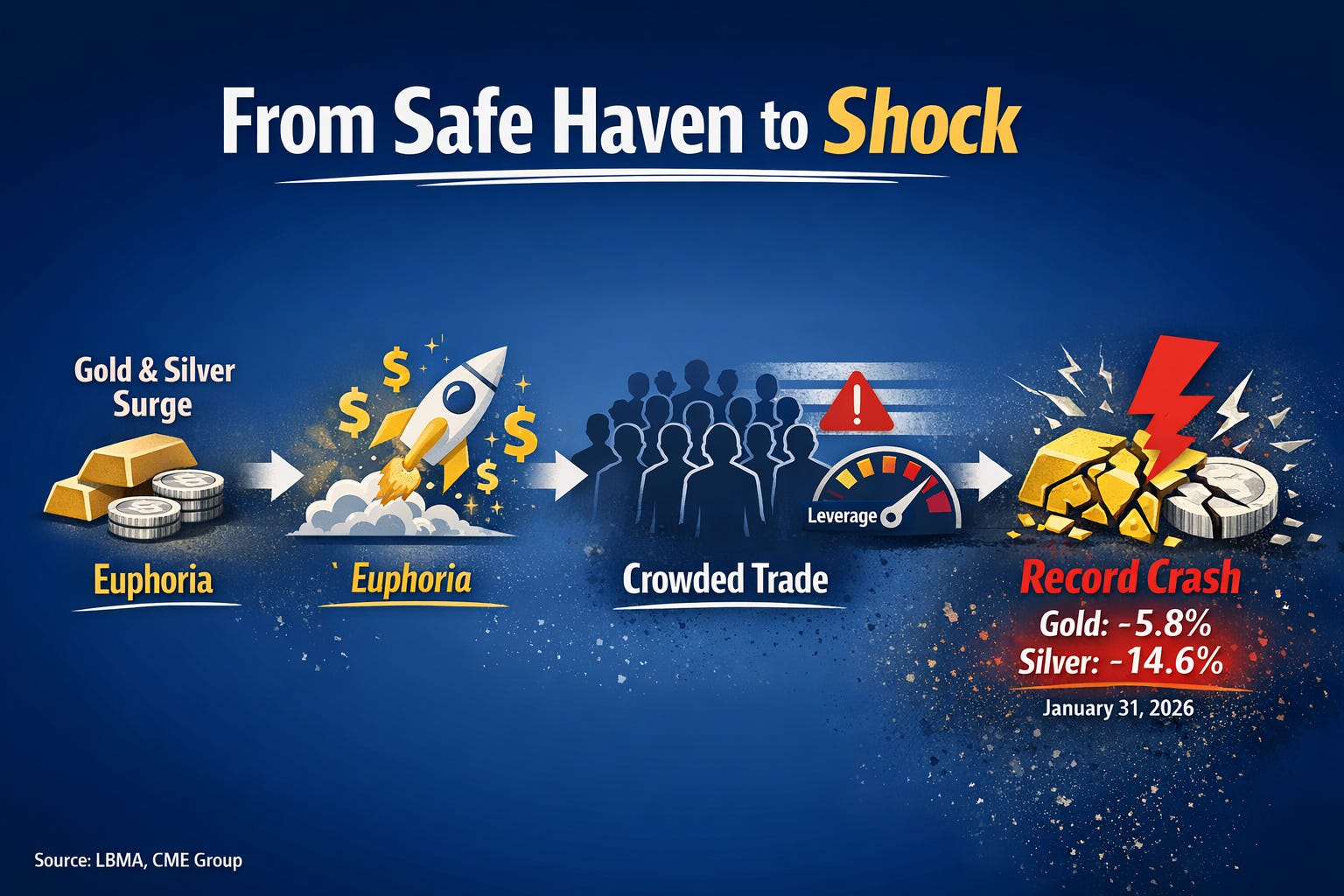
Gold and silver have long occupied a privileged place in the investor psyche. They are widely viewed as financial shelter during periods of uncertainty, inflation, or geopolitical stress. That perception was put to the test in late January when both metals experienced a sudden and violent collapse following an extraordinary rally. After spending much of the prior year climbing relentlessly, gold had surged to record levels while silver posted gains rarely seen outside periods of acute financial stress. The optimism proved fragile.
In a single trading session, gold suffered its steepest daily decline in more than a decade, while silver endured its worst one-day plunge since 1980.¹ Prices that had appeared unstoppable reversed with stunning speed. The episode rattled investors who had embraced precious metals as reliable ballast against volatility, raising uncomfortable questions about whether these assets had become less of a hedge and more of a speculative vehicle.
The rally itself had been fueled by a convergence of macro anxieties. Persistent geopolitical tensions, skepticism toward fiscal discipline, and lingering concerns about inflation all contributed to strong demand for hard assets. At the same time, a growing “sell America” narrative took hold. Capital flowed out of the U.S. dollar and into commodities, particularly gold and silver, as confidence in monetary stability wavered.²
By late January, speculative momentum reached a fever pitch. Silver, in particular, rose at a pace that far exceeded traditional inflation expectations. That divergence hinted that something other than price stability fears was driving demand. Instead, metals appeared to be absorbing broader systemic unease—concerns about policy credibility, financial leverage, and the durability of growth.
The unraveling was swift. As prices peaked, leverage was elevated and positioning heavily skewed toward further upside. When sentiment shifted, liquidity evaporated. Margin calls accelerated selling, stop-loss orders cascaded, and what had been framed as a safe haven quickly behaved like a high-beta risk asset. The resulting crash delivered a stark reminder that even historically defensive assets can become unstable when crowded and overextended.³
Policy Shock and the Fragility of “Safe Havens”
The immediate catalyst for the metals collapse came from an abrupt shift in U.S. policy expectations. President Trump’s nomination of Kevin Warsh as the next Chair of the Federal Reserve surprised markets and altered assumptions about the future path of monetary policy. Warsh is widely viewed as more hawkish on inflation than his predecessor, and his nomination triggered a rapid repricing across asset classes.
Bond yields jumped to their highest levels in over a year, while the U.S. dollar strengthened sharply. For gold and silver, which offer no yield and typically benefit from a weaker dollar, the implications were immediate. The conditions that had supported their ascent—falling real rates, loose financial conditions, and currency skepticism—reversed almost overnight.⁴
The reaction exposed how dependent the metals rally had become on a specific macro narrative. Once the perception of an increasingly accommodative and politicized Federal Reserve faded, the rationale for extreme positioning in precious metals weakened. The “debasement trade,” which assumed persistent dollar erosion and policy complacency, lost traction.²
Silver’s behavior leading into the crash offered additional insight. Historically, silver tends to outperform gold during periods of economic stress rather than pure inflationary episodes. Its outsized gains suggested that investors were responding to deeper concerns about growth and liquidity. In that sense, the metals rally functioned as a warning signal rather than a straightforward hedge. When confidence in policy discipline improved, that warning abruptly unwound.
The episode also highlighted the unusual market dynamics of recent years. Traditional correlations have repeatedly broken down. Stocks and bonds fell together during the inflation shock of 2022, undermining the effectiveness of diversified portfolios. Treasuries, long considered the cornerstone of risk-off positioning, struggled under the weight of rising yields and expanding fiscal deficits. As a result, investors increasingly turned to gold and silver as alternative refuges.
That shift may now be reversing. The violent repricing in metals underscores their vulnerability when expectations change. While gold retains long-term strategic appeal, particularly for central banks and long-horizon investors, its recent behavior challenged the assumption that it will always serve as a stabilizing force during market stress.³
Treasuries and the Re-Emergence of Traditional Risk-Off Behavior
For much of the past several years, U.S. Treasuries have occupied an unfamiliar position: distrusted as a hedge and avoided as a source of stability. Rising inflation, aggressive rate hikes, and ballooning government debt undermined confidence in bonds just as equity volatility increased. The breakdown of the classic stock-bond relationship left many investors searching for alternatives.
That backdrop makes the recent metals crash particularly significant. It may mark a turning point in the hierarchy of safe assets. With yields now meaningfully higher than they were during the previous decade, Treasuries once again offer income alongside potential price appreciation in the event of economic slowing. The risk-reward profile has improved materially.
