Layoffs Are at Seven-Year Lows. The Jobless Rolls Just Jumped.
Initial claims averaged 197,750 over four weeks, the lowest since at least 2019 and 12 percent below a year ago. Continuing claims just hit a four-month high. Hiring, not firing, now sets the unemployment rate.


Complimentary for advisors today: Sourced Market Thread Kit

Sourced market threads, ready to reuse across channels. A sourced primary X thread in your voice, with alternate hooks, LinkedIn versions, a short email teaser and source notes.
What you receive
- Primary thread
- Alternate hooks
- LinkedIn-adapted posts
- Short email/newsletter teaser
- Source notes
- Chart-ready data or Chart recommendation
Cost in credits: 2. Turnaround: 3-5 business days. Delivered as: an AI-prepared draft that you review. Best for: Advisors who want credible, shareable market content.
It is complimentary for advisors. There is no invoice from us. You earn the credits by showing up: attend a sponsored Lead-Lag Media webinar, meet a fund issuer in a one-on-one introduction, or join one of our advisor dinners.
Prefer to browse first? See all 34 services at advisor.leadlagmedia.com, or read about Lead-Lag Media's advisor services.
Credits carry no cash value and are not payment for services. Drafts are prepared with AI assistance and are for your and your firm’s review before use; they are not investment, legal, tax or compliance advice, and nothing is guaranteed. Services are offered to financial advisors and are not a solicitation to retail investors.
Initial jobless claims came in at 203,000 for the week of November 14, and the four-week average now stands at 197,750. That is the lowest four-week average in the FRED data back to 2019, below anything in the 2019 labor market, and 12 percent below the same weeks a year ago, when the average was 224,750. [1] By the measure that tracks actual layoffs in near real time, employers are letting almost nobody go. Headlines read that as labor market strength. The second series published in the same release disagrees about the part that matters. [2]
Continuing claims, the count of people still collecting unemployment insurance a week or more after filing, jumped to 1,763,000 for the week of November 7, up 70,000 in one week and the highest reading in four months, since early July. [2] Layoffs are the quietest in seven years of data, yet the people who do lose a job are taking longer to come off the rolls. Those two facts do not fight each other. Together they describe a specific kind of labor market, and it is not the one either the recession callers or the soft-landing crowd is describing.
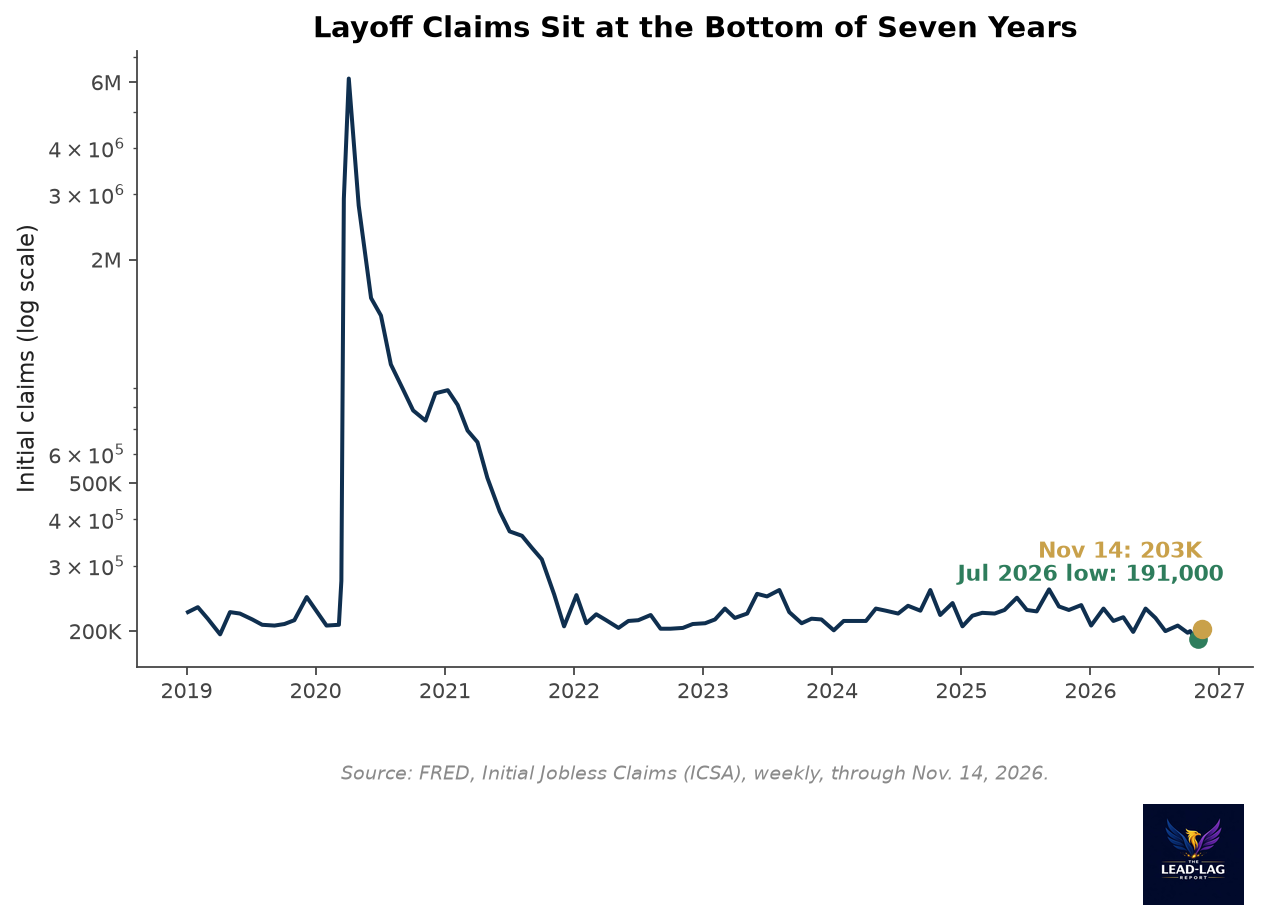
Start with the layoff side, because it really is remarkable. The last five weeks of initial claims read 203,000, 202,000, 191,000, 195,000 and 195,000. The single lowest week in the entire series since 2019 was 189,000 this past July, and 191,000 landed just two weeks ago. [1] The 2019 labor market, which everyone remembers as unsustainably tight, averaged roughly 218,000 a week. Today's employers are firing at a pace the pre-pandemic economy never sustained. In a recession, this series snaps above 250,000 and heads for 300,000, as it did in mid-2023 when it touched 259,000 before easing. Nothing like that is on the tape now. [1]
Now the part that spoils the party. Continuing claims have drifted up from about 1,693,000 at the end of October to 1,763,000 in the latest week. That 70,000 single-week move is large for this series, which usually walks in 10,000 and 20,000 steps. [2] A year ago the count was 1,943,000, so the year-over-year direction is still down by about 9 percent, but the trajectory since the fall is the wrong way, and the level now matches where it stood in the spring, when the unemployment rate was drifting higher for the same reason it drifts higher now. [2]
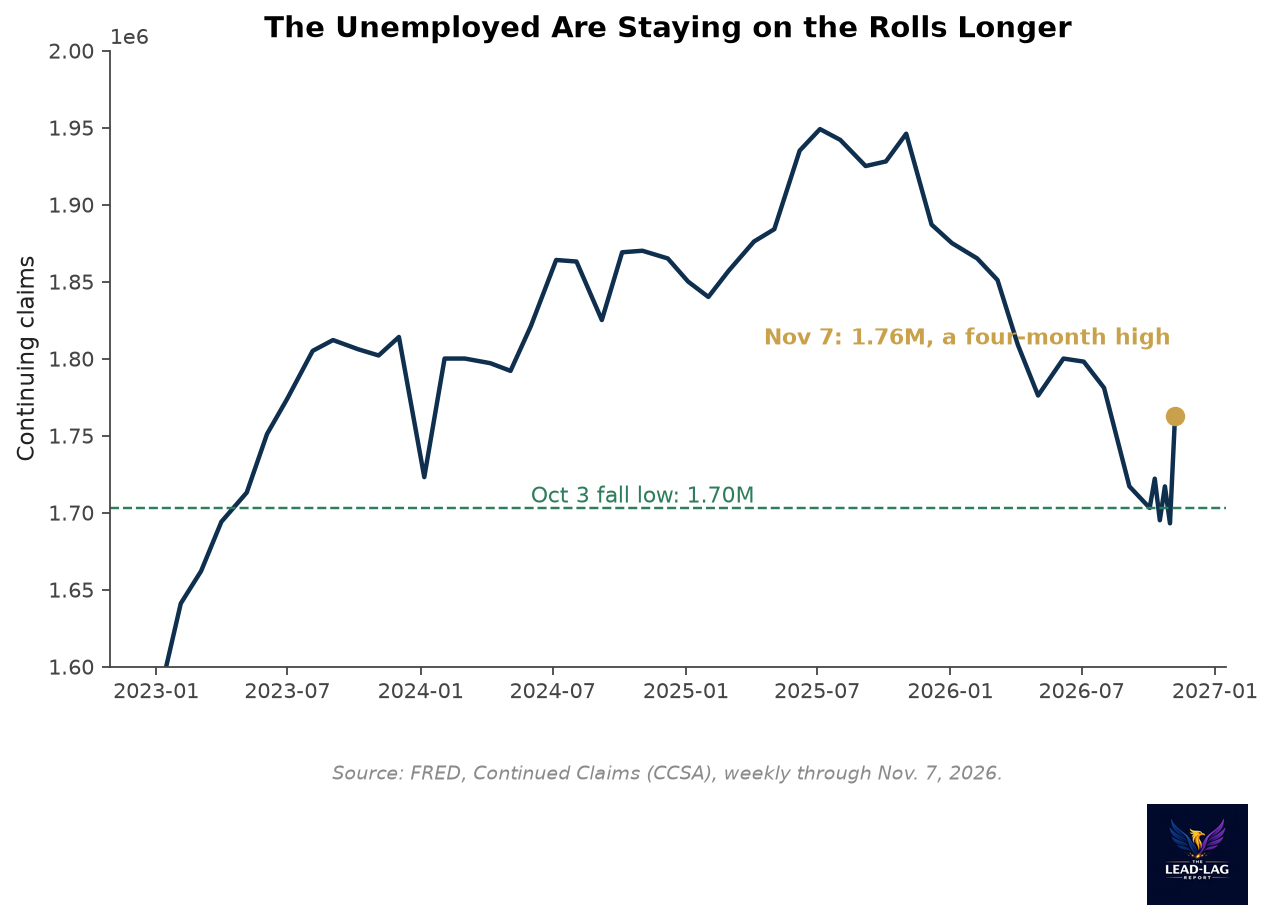
The cleanest way to see the mismatch is to put the two Novembers side by side. The four-week average of initial claims fell from 224,000 in November 2025 to 197,750 now, while continuing claims fell from about 1,943,000 to 1,763,000, a shallower decline that has reversed direction in the last month. Fewer people are being let go, and the ones who are let go are landing in a pool that drains slowly. [1] [2]
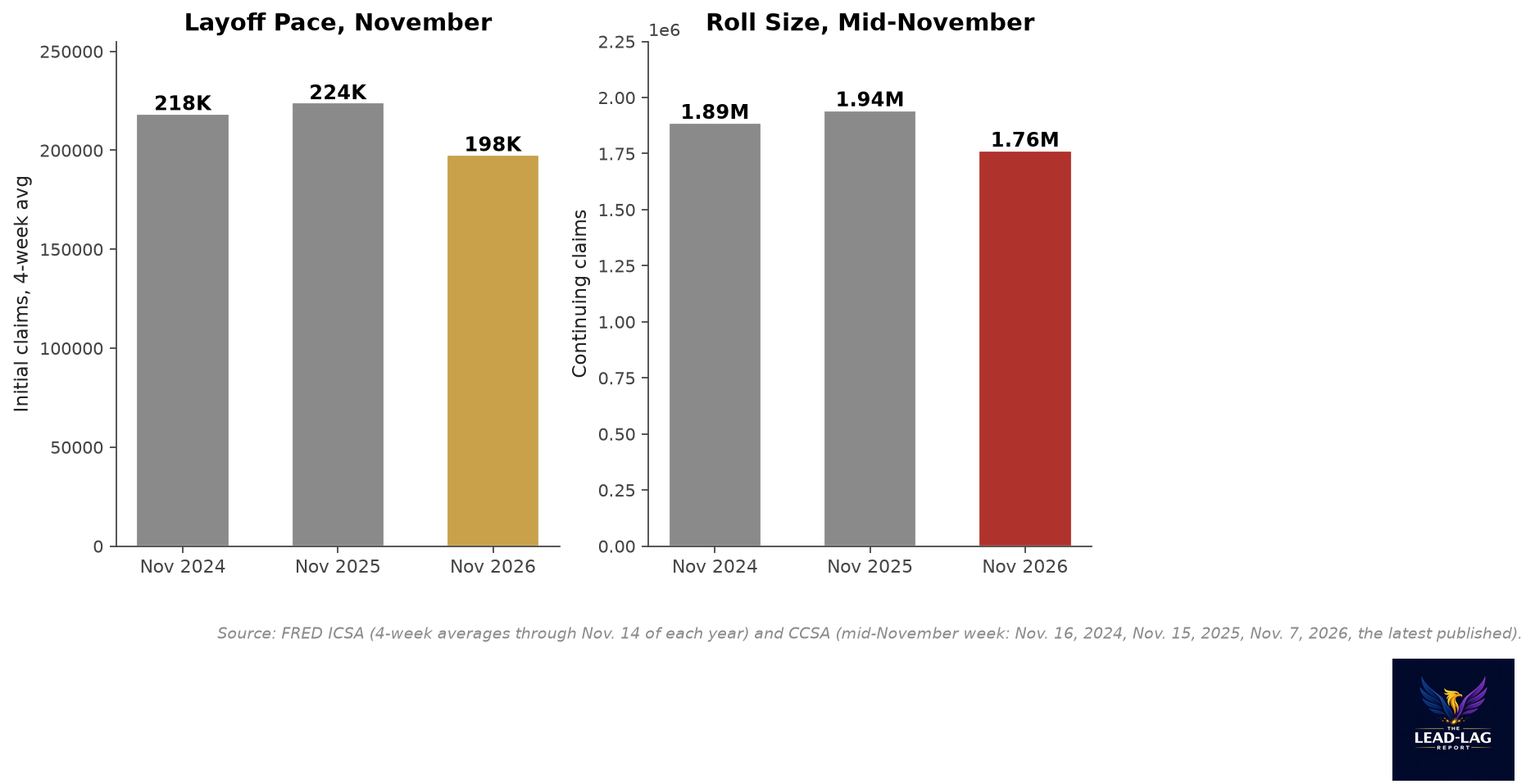
What kind of labor market behaves this way? One where hiring, not firing, sets the unemployment rate. Firms are not doing mass reductions, which is why claims sit at cycle lows and why consumer spending keeps holding up week after week. But firms are also being unusually selective about backfilling, which is why the people who do lose a job spend longer between paychecks. Economists argue about whether that is real slack or a matching problem, with job seekers slow to accept offers that pay less than the ones they lost. The claims data cannot settle that argument, but it can tell you which story to watch for: in a firing recession, initial claims lead the damage. In a slow-hire stall, continuing claims lead it while layoffs stay quiet, which is precisely the current configuration. [1] [2]
The honest bear case writes itself. A 70,000 jump in continuing claims in one week is one observation, the series is noisy around the holidays, and the November 7 reference week precedes the latest initial claims week by a full week. The jump could revise away. If continuing claims keep climbing through December while initial claims sit still, the slow-hire stall is confirmed and the unemployment rate edges up even with no layoffs anywhere. If continuing claims fall back toward the October lows, this reads as noise and the labor market is simply quiet in both directions. [2]
The takeaway: layoffs are at seven-year lows while the jobless pool is at a four-month high, and that pairing means the labor market's next move is decided by hiring, not firing. For positioning, that distinction matters more than any single headline number, because a no-layoff economy with slow rehiring keeps consumption alive while capping the upside in cyclical employment. Watch the next two Thursday releases: the initial claims four-week average below 200,000 with continuing claims back under 1.7 million is the quiet-market scenario, and the reverse pairing is the one that turns this from a curiosity into a signal. [1] [2]
Notes
- FRED, Initial Jobless Claims (ICSA), weekly, through November 14, 2026: 203,000 in the latest week; prior weeks 202,000 (Nov. 7), 191,000 (Oct. 31), 195,000 (Oct. 24), 195,000 (Oct. 17); four-week average 197,750, the lowest in the series back to 2019; four-week average 224,750 in the comparable weeks of 2025; series low 189,000 on July 18, 2026; 2019 weeks averaged roughly 218,000; 259,000 in early September 2025 was the post-2023 high
- FRED, Continued Claims (CCSA), weekly, through November 7, 2026: 1,763,000 in the latest week, up from 1,693,000 on October 31 and the highest since early July 2026 (1,798,000 on July 4); about 1,943,000 in mid-November 2025; about 1,887,000 in mid-November 2024; fall 2026 lows near 1,693,000
Paid members get the full Weekly Signals, the weekly Leaders and Laggards and every chart behind each call. Start with 7 days free.
The Lead-Lag Report is provided by Lead-Lag Publishing, LLC. All opinions and views mentioned in this report constitute our judgments as of the date of writing and are subject to change at any time. Information within this material is not intended to be used as a primary basis for investment decisions and should also not be construed as advice meeting the particular investment needs of any individual investor. Trading signals produced by the Lead-Lag Report are independent of other services provided by Lead-Lag Publishing, LLC or its affiliates, and positioning of accounts under their management may differ. Please remember that investing involves risk, including loss of principal, and past performance may not be indicative of future results. Lead-Lag Publishing, LLC, its members, officers, directors and employees expressly disclaim all liability in respect to actions taken based on any or all of the information on this writing.