
Read the Prologue: The Price of a Quiet Yen
Free excerpt: the prologue and the five-question checklist from The Price of a Quiet Yen by Michael A. Gayed, CFA.
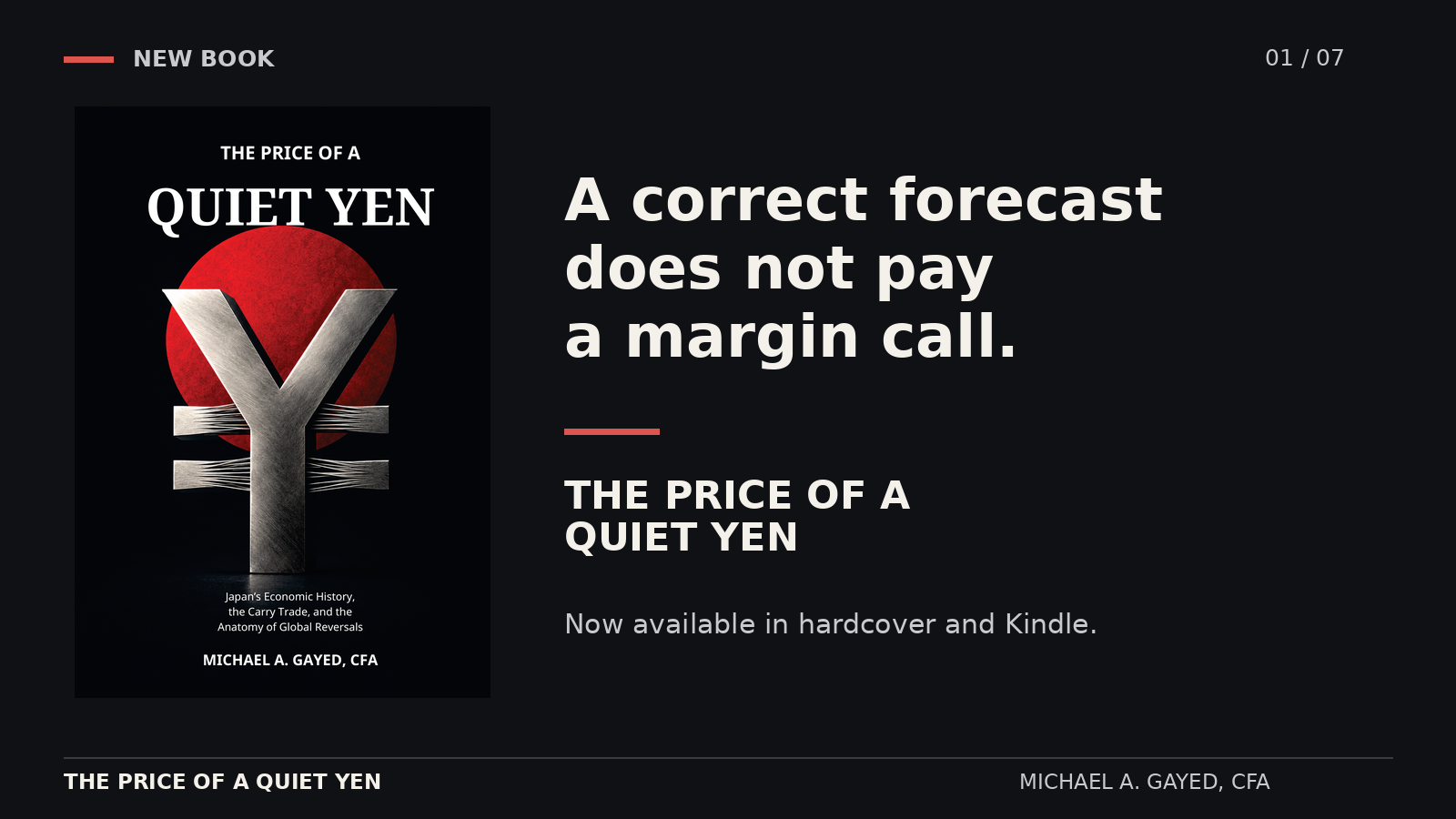
Two free excerpts from The Price of a Quiet Yen: Japan's Economic History, the Carry Trade, and the Anatomy of Global Reversals by Michael A. Gayed, CFA: the prologue, and the five-question checklist from the end of the book.
Get the hardcover: $44.95 | Get the Kindle edition: $9.99
Prologue: When the Funding Currency Turned
On October 7 and 8, 1998, the yen rose sharply against the dollar. The retrospective investigation by the Committee on the Global Financial System found no evident contemporaneous macroeconomic development that adequately explained the sudden movement; unwinding leveraged positions financed by yen borrowing, it concluded, seemed to have played an important role.
Consider an unhedged borrower repaying yen debt from dollar assets. A stronger yen means the same yen repayment requires more dollars. If the dollar price of the investment is also falling, the resources available to meet that obligation shrink just as its dollar cost rises. The attractive investment and the inexpensive financing can become a single urgent problem.
The international setting was already unsettled. Russia’s effective default and rouble devaluation on August 17 had been followed by mounting market strains, while Long-Term Capital Management was recapitalized by private counterparties on September 23. Both preceded the October currency reversal.
The distinction between a private recapitalization and a government cash rescue matters. In his October 1 testimony, Alan Greenspan said the Federal Reserve Bank of New York had facilitated discussions but that no Federal Reserve funds had been put at risk. His concern was the potential damage from rapidly liquidating a complicated portfolio into fragile markets, including damage to participants who had no direct involvement with the fund.
A market does not need every investor to change their economic forecast before prices change violently. It may be enough for important participants to lose the financing or collateral capacity that allowed them to express the forecast. The CGFS account describes credit-constrained investors shrinking their balance sheets as collateral values eroded; those closing yen-financed positions needed to acquire yen to repay the borrowing.
That demand has a different origin from a favorable judgment about Japanese growth. Buying the funding currency can be an act of withdrawal, not confidence. To understand the transaction, follow the obligation being extinguished rather than assume every buyer wants a larger long-term investment.
The same investigation described a broader feedback process: deleveraging reduced liquidity, changing prices damaged collateral and credit assessments, and those pressures encouraged further withdrawal. A position intended to exploit a small price difference can become exposed to a much larger difference between the time its owner needs and the time its counterparties will allow.
It would be convenient to make one fund’s distress the explanation for the reversal. But the report treats Russia, LTCM, counterparty concerns, and the unwinding of other leveraged positions as interacting developments; its account of yen carry unwinding is qualified, not a transaction-by-transaction attribution of the currency move.
That limitation strengthens the question this book asks. We do not need to pretend that every trade is visible to understand why a financing structure can become vulnerable. We need to identify the asset, the liability, and the circumstances under which someone must change the position.
October 1998 belongs in a longer history. Before examining how a domestic interest rate became an international source of leverage, we have to understand the economy and institutions behind it. The story begins with Japan, not with a hedge fund.
From the closing chapters:
Five Questions Before You Trust a Trade
A market opinion is incomplete until it can survive a balance-sheet examination. Use these questions to test the structure around an investment, not to produce a score or a forecast. An answer that depends on an unknown contract term should remain an unanswered question.
What do I actually own?
Name the instrument, its currency, and the source of its return. Separate income from price appreciation and a cash asset from a derivative claim. A sovereign bond, a fund holding sovereign bonds, and a leveraged position financed against those bonds need not offer the same experience to their owners. Describe the position itself before relying on the reputation of the underlying asset.
What do I owe, and in which currency?
Write down the financing and derivative obligations alongside the assets. Identify the interest rate, maturity, collateral terms, and exchange-rate convention. Then separate gross contractual payments from amounts that can legally and operationally be netted. A currency hedge belongs in this examination as another contract, not as permission to stop examining the balance sheet. These are the distinctions developed in “Follow the Liability” and “The Trade Without the Loan.”
Who can demand cash or collateral?
Identify the lender, broker, clearing arrangement, derivative counterparty, or redeeming investor with a claim on resources. Check what each can demand under the actual agreement rather than assume that every claimant has the same rights. Ask which assets are eligible to meet the demand and which are already pledged. A valuable asset and an available source of cash are not interchangeable.
How much time do I really have?
Put the relevant dates on one calendar: interest resets, maturity, hedge renewal, settlement, collateral calls, and any applicable investor-redemption terms. Distinguish a floating-rate reset from the need to refinance principal. Compare those dates with the time required to sell or finance assets under stress. “Long term” describes an intention until the financing and liquidity arrangements support it.
What if other investors need the same exit?
Examine the assumption that somebody else will provide liquidity on acceptable terms. Ask what happens if the funding currency strengthens while the investment falls, collateral terms tighten, or the hedge requires a cash payment. Do not assume all of these shocks will occur together; use them to identify which combinations the position cannot absorb. The scenarios in the preceding chapters are alternatives to test, not probabilities to memorize.
Finish with a plain-language statement: “If this condition occurs, this claimant can require this payment or collateral, in this currency, by this time. These resources are available to meet it, and this is the fallback if they are insufficient.” Where the amount depends on market prices, state the relationship and the scenario rather than invent a fixed number.
This exercise does not eliminate loss or replace examination of the actual agreements. Its purpose is narrower: to expose the assumptions that an attractive asset story can conceal. If the explanation of how you will meet the obligation is less developed than the explanation of why the asset should rise, the analysis is not finished.
The full book runs 402 pages with 32 chapters and 30 figures. More about the book.
Get the hardcover: $44.95 | Get the Kindle edition: $9.99
Already read it? An honest Amazon review helps other readers decide. Free review copies are available for readers.