Weekly Signals
Offense Holds the Line
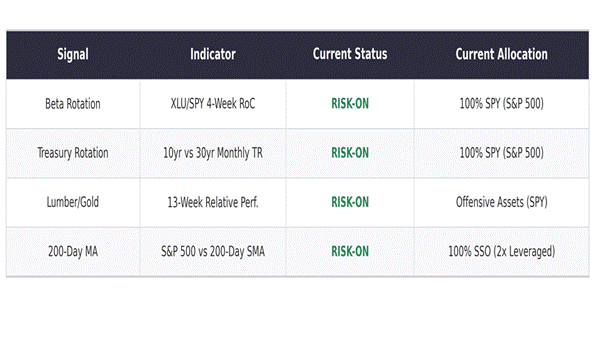
Every intermarket signal stays on offense for a second straight week. Trend, rotation, commodities, and Treasury behavior remain unanimously aligned with risk.

Weekly Signals
Every intermarket signal stays on offense for a second straight week. Trend, rotation, commodities, and Treasury behavior remain unanimously aligned with risk.

Weekly Signals
Every intermarket signal flips to offense. Trend, rotation, commodities, and Treasury behavior all aligned on the same side.

Weekly Signals
All four intermarket signals agree: offense is the play. Trend, rotation, and commodities all aligned.

Weekly Signals
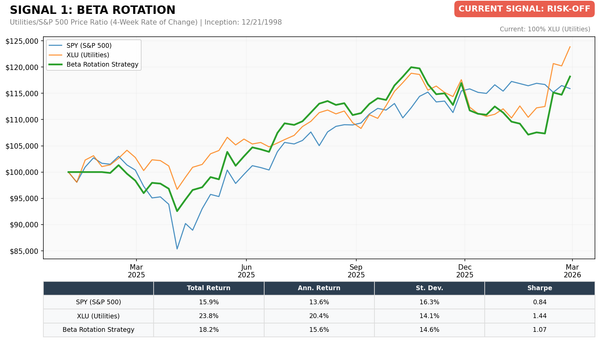
Key Takeaways * The Beta Rotation signal (XLU/SPY 4-week RoC of +1.65%) remains Risk-Off for the sixth consecutive week. Despite the S&P 500’s 3.4% weekly rally, utilities maintained their relative edge. XLU at $46.34 continues to attract defensive flows, reflecting persistent uncertainty

Weekly Signals
Three of four signals favor risk-on positioning, though one holdout warrants attention.

Weekly Signals
Signals are split evenly between offense and defense, pointing to a market at an inflection point.

Weekly Signals
Signal Summary Week Ending March 30, 2026 | By Michael A. Gayed, CFA Key Takeaways • The Beta Rotation signal (XLU/SPY 4-week RoC of +3.33%) remains Risk-Off for the fifth consecutive week. XLU at $45.59 rebounded modestly from last week’s $44.65 level, while SPY at

Weekly Signals
Three of four signals favor safety as the S&P 500 breaks further below its 200-day moving average. Gold's crash drives the lone Risk-On reading.

Weekly Signals
Three of four signals favor safety. The S&P 500 has broken its 200-day moving average — and the lone Risk-On reading is gold's crash, not improving fundamentals.
Weekly Signals
Three of four risk-off signals front-ran the geopolitical shock. The US-Iran conflict and resulting oil spike were the event risk that Utilities, Treasuries, and Gold had been pricing in for weeks.

Weekly Signals
Why Duration Could Win the Next Cycle

Weekly Signals
How Utilities and Long-Duration Treasuries Are Quietly Signaling That Growth Fears—Not Inflation—Are Back in Control