
Two Central Banks Are About to Hike Into the Same Shock, and Japan's AI Names Blinked First
The Nikkei's AI-led crack and Wall Street's calm absorption of a 90% Fed-hike repricing trace to the same source: two central banks tightening in the same week, with credit already pricing the stress equity hasn't.

Today’s Lead-Lag Report post is sponsored by CapeTales

Your child sees their own face on the cover. Then they read it 17 times.
CapeTales turns a real moment in your child’s life — starting school, making a new friend, facing a fear, welcoming a new sibling — into a personalized 24-page comic book where they star as the hero. Their actual face on every page. Their favorite stuffed animal, toy, or pet as the sidekick. A real, printed book you can hold, not an app or a screen.
How it works
- Upload a photo and tell CapeTales the moment your child is being brave about
- Choose one of four art styles: Superhero Comic, Storybook Warmth, Watercolor Adventure, or Bold & Graphic
- CapeTales builds a custom 24-page story starring your child and ships the finished book to your door
Single issues run $99. The 5-Pack runs $300 — five copies of the same book for $60 each, a $195 savings for grandparents, siblings, and the toy box.
A review of the week just completed and a look at the week ahead.
KEY HIGHLIGHTS
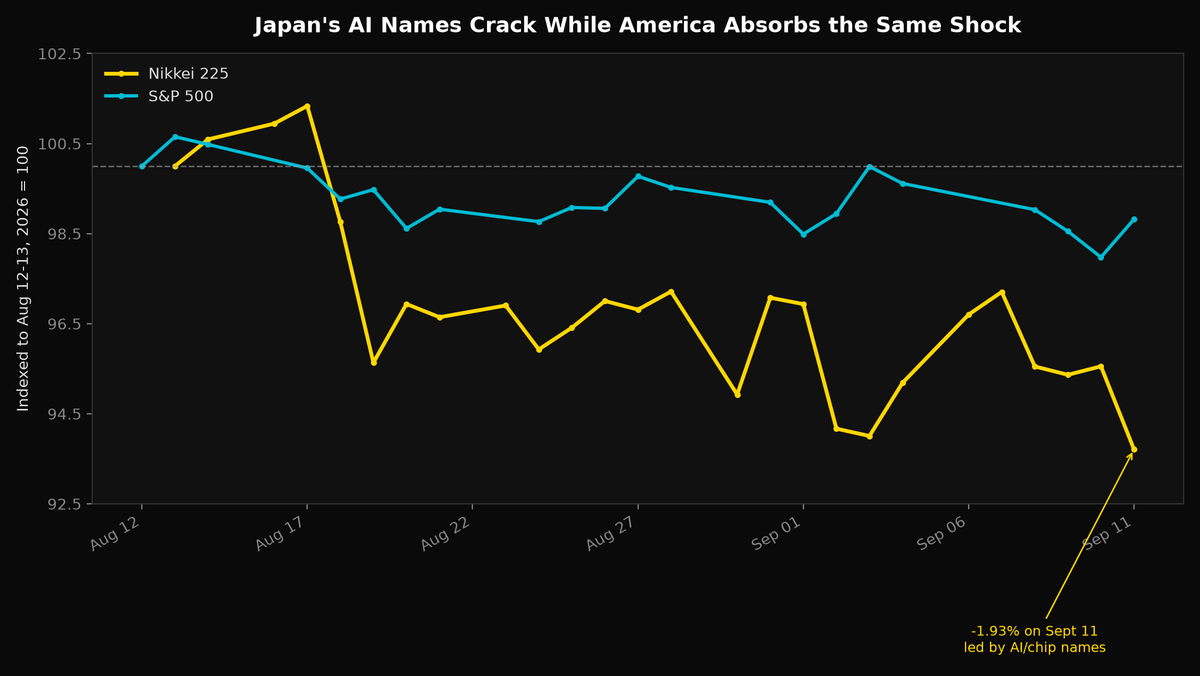
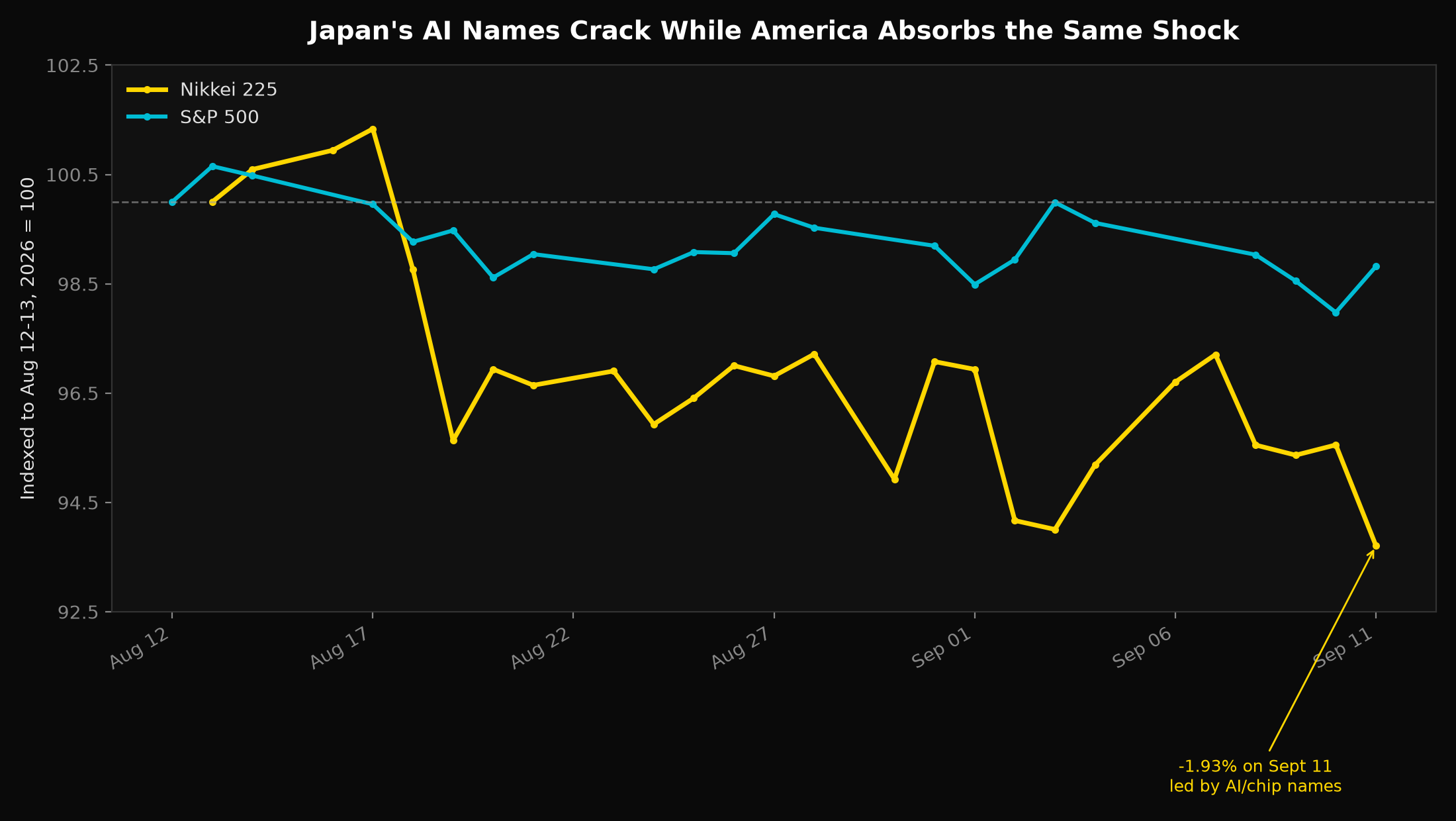
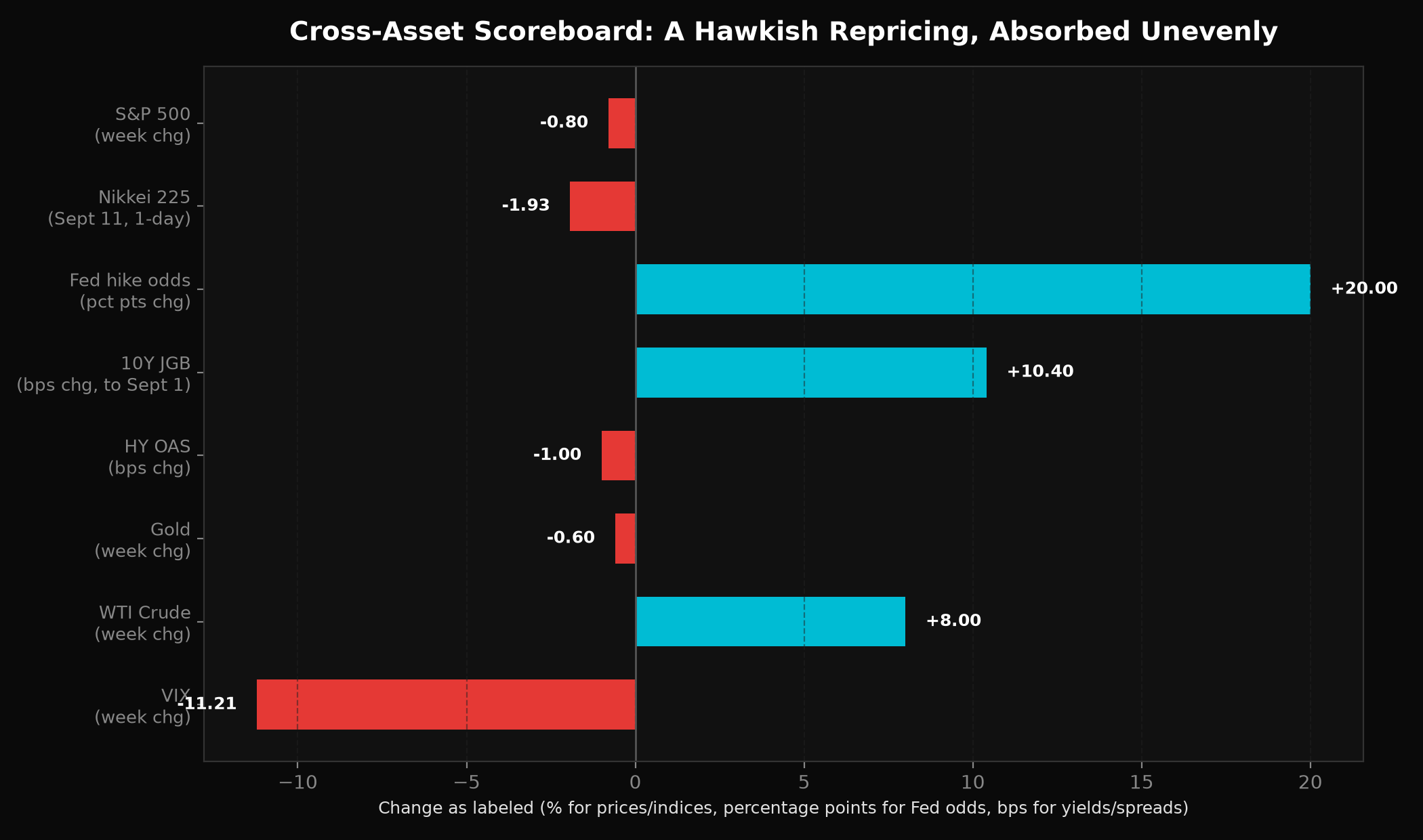
- The Nikkei 225 fell 1.93 percent to 64,011.34 on September 11, its steepest one-day decline among major global indices that session, led by AI and semiconductor names — Kioxia fell as much as 8 percent and SoftBank Group as much as 7 percent — while the S&P 500 rose 0.86 percent the same day to 7,656.98, still down 0.80 percent for the week.
- August CPI rose 0.4 percent month over month and 3.4 percent year over year, with core CPI up 0.3 percent month over month, a print that pushed CME FedWatch market-implied odds of a quarter-point Fed hike at next week's meeting to nearly 90 percent, up from about 70 percent before the report, even as most economists surveyed before the release still expected a hold.
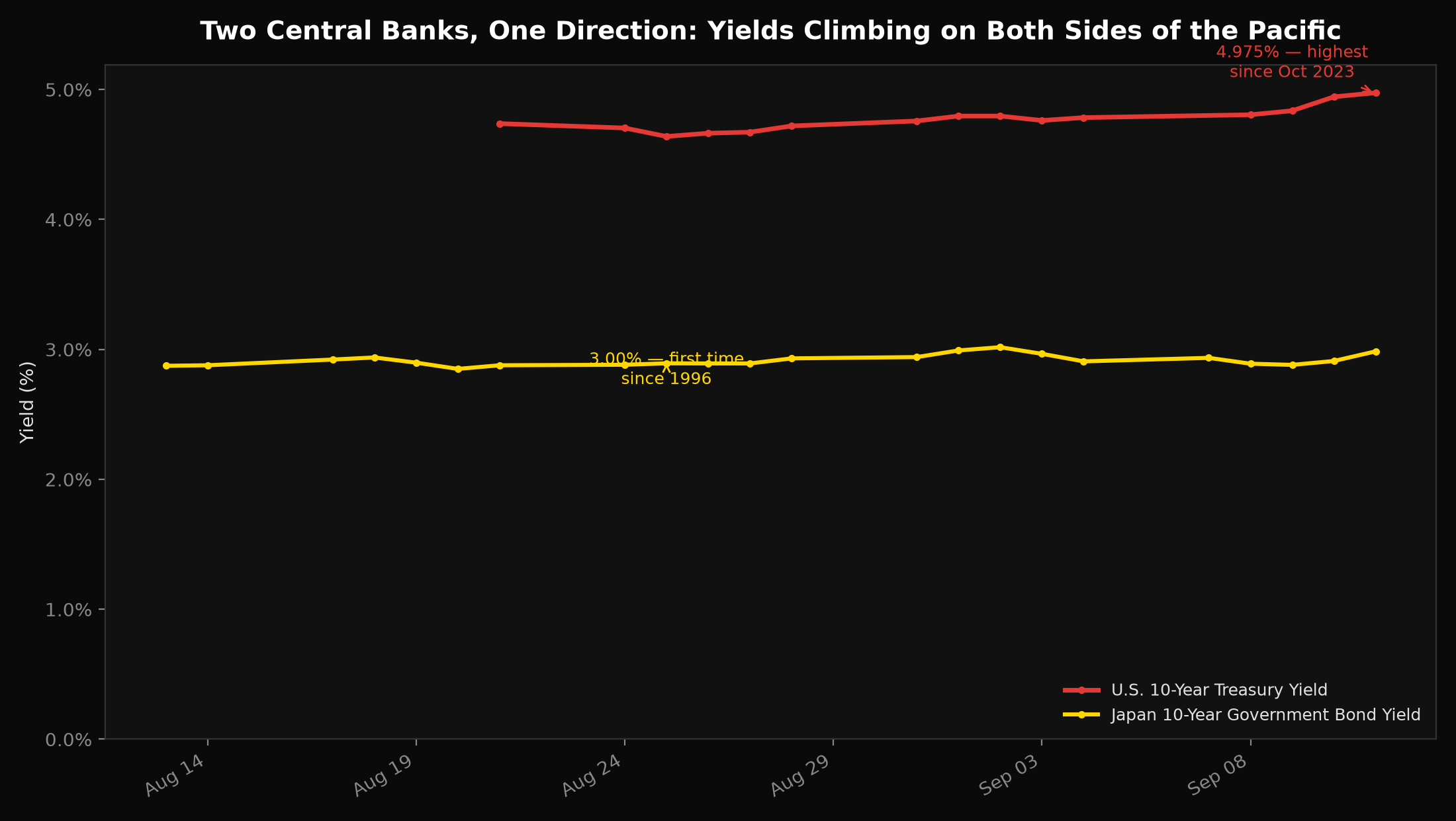
- Japan's 10-year government bond yield touched 3.00 percent on September 1 for the first time since 1996, and markets are now pricing greater than 90 percent odds the Bank of Japan raises its policy rate to 1.25 percent at its September 17-18 meeting.
- Oracle's five-year credit default swap spread has climbed to roughly 2.03 percentage points, an eighteen-year high, even as 2026 hyperscaler capital expenditure tracks toward $690 billion — the credit market pricing AI-financing risk that the equity index has not yet had to absorb.
THE SURFACE NARRATIVE
Last week's question was whether copper's silence was a demand signal in hiding or a supply story with nothing left to say. This week the silence broke in Tokyo instead. The Nikkei 225 fell 1.93 percent to 64,011.34 on September 11, its steepest drop among major global benchmarks that day, dragged lower by the same AI and semiconductor names that have carried the entire rally: Kioxia fell as much as 8 percent intraday, SoftBank Group as much as 7 percent (note.com market recap). The proximate causes were a rapid yen appreciation toward 153 per dollar, a fresh oil spike, and markets pricing greater than 90 percent odds the Bank of Japan hikes its policy rate at next week's meeting. Stocks down, bonds down, yen up, all at once — a textbook tightening-bites-risk-assets session.
The American side of the surface looks calmer, and for one day it was: the S&P 500 rose 0.86 percent on September 11 to 7,656.98, snapping a four-session losing streak, even as August CPI landed hotter than hoped — headline up 0.4 percent month over month and 3.4 percent year over year, core up 0.3 percent (CNBC). That print pushed CME FedWatch market-implied odds of a hike next week to nearly 90 percent, up from about 70 percent beforehand, even though a Reuters poll taken just before the release still had most economists expecting a hold (Reuters) — a genuinely hawkish market repricing that the index absorbed with a rally, not a selloff. The S&P still finished the week down 0.80 percent, its worst weekly showing since late August (Morningstar).
Layer in the backdrop and the surface story gets its headline: the oil supply shock is real. The Strategic Petroleum Reserve sits near 286.6 million barrels, its lowest since 1982, after strikes on Iranian tankers near Kharg Island and in the Gulf of Oman through early September, and OPEC has no visible spare capacity left (Reuters). Brent has traded above $100 for weeks. Frankfurt, London, and now Tokyo are all treating that chokepoint as an inflation problem worth hiking for, and Washington's own CME-implied odds suggest the Fed may be next.
That is the surface. The surface is incomplete. It treats Japan's selloff as a local story about a stubborn yen and American resilience as proof the Fed-hike risk is priced in. Neither is quite right, because both moves trace to the same underlying source: a bond market on both sides of the Pacific finally pricing two central banks that are done waiting on an energy shock to pass on its own.
THE REAL CATALYST
The real catalyst this week was not the Nikkei's drop or the S&P's bounce individually. It was that the credit and rates markets underneath both equity tapes are pricing tightening faster and harder than either index has been asked to absorb, in two different currencies, for two different reasons.
Start with Japan. Governor Kazuo Ueda has said the BOJ will not fall behind the curve (FT), and Reuters reports the BOJ is now expected to raise its policy rate to 1.25 percent at its September 17-18 meeting, a decision markets are pricing at greater than 90 percent odds (Reuters). Japan's 10-year yield touched 3.00 percent on September 1, the first time in thirty years, and Treasury Secretary Bessent's late-August meeting with Ueda pressed Tokyo toward "decisive" yen defense — the tell that this hike is currency-and-bond-market-forced, with the Takaichi government's record fiscal 2027 budget requests, near 143 trillion yen, doing much of the forcing (Reuters; Sedaily). When a central bank hikes into a currency crisis rather than an overheating economy, the equity names most exposed to imported cost pressure and global capital flows are the first to reprice — which is exactly what happened to Kioxia and SoftBank on September 11, not to Toyota or the broader industrial complex.
The U.S. side of the same mechanism just moved faster than expected. August CPI's hotter-than-hoped core print took market-implied hike odds for next week's FOMC from about 70 percent to nearly 90 percent in a single morning (CBS News). Economists surveyed by Reuters just before the release still leaned toward a hold, so the two readings disagree — but the direction of the surprise, not the modal outcome, is the point. That is not a Fed quietly holding steady while inflation cools — it is a market that spent the summer arguing about cuts now pricing a hike, in the same week Japan is doing the same thing for adjacent reasons. Two of the world's most important central banks are reaching for the same tool inside the same seven-day window, one importing an energy shock it cannot control, one facing a domestic inflation print that just would not cooperate.
Now the piece that explains why American equities absorbed their hawkish repricing so calmly: the AI trade has stopped being financed the way the index assumes. An estimated $500 billion-plus of AI-related debt has been issued in 2026 — Morgan Stanley's own forecast puts the full-year figure near $570 billion — moving the marginal funding of the largest capital program in modern corporate history out of cash flow and into credit (Reuters). Credit has noticed in a way the S&P 500 has not: Oracle's five-year CDS spread has climbed to roughly 2.03 percentage points, an eighteen-year high (Bloomberg), even as hyperscaler 2026 capital expenditure tracks toward $690 billion (Futurum Group). None of that stress showed up in Friday's 0.86 percent bounce. It is sitting underneath it.
DIVERGENCES BENEATH THE SURFACE
Three divergences deserve naming.
The first is between Japan's headline index, which fell only 1.93 percent, and the specific names doing the falling. If this were a broad growth scare, the decline would be diversified across sectors. It was not — Kioxia and SoftBank, both AI-and-semiconductor-adjacent, led the drop by a wide margin, which means Japan's version of this week's story is really an early tremor in the same AI-financing question the U.S. credit market is asking about Oracle, wearing a currency-crisis costume.
The second, and more important for U.S. portfolios, is between the AI capex narrative and the AI credit narrative. Equity says $690 billion in 2026 hyperscaler capex is unambiguously bullish for an index whose largest constituents keep compounding. Credit says something else: an eighteen-year high in Oracle's default-risk gauge, a genuine outlier even against a backdrop of near-record technology valuations. When the two disagree about the same balance sheets, credit has historically been the earlier witness — it gets paid first, and it started repricing before the CPI-driven hike odds even moved.
The third is between the Fed's newly hawkish repricing and gold's continued softness. Gold sits in the mid-$4,300s, down modestly on the week, even as the 10-year TIPS real yield has climbed to roughly 2.58 percent, a cycle high (tradingeconomics). Gold is a referendum on the opportunity cost of a zero-yielding asset against a rising real rate, and this is the exact configuration — rising real yields into a live oil shock — that tightens financial conditions fastest against debt-financed, long-duration capex like the AI buildout.
The lead-lag relationship this week is between AI-linked credit, already at an eighteen-year stress high, and the equity indices on both sides of the Pacific, which have not yet been asked to reprice for it. When this kind of gap has appeared historically, equity has usually caught up within weeks once the catalyst is a specific credit event rather than a slow grind — and Japan's September 11 session, where the AI-adjacent names moved first and hardest, may be the earliest version of that catch-up rather than a one-off currency story.
The bear case deserves a hearing: Japan's decline could be purely a yen-and-BOJ story with no read-through to U.S. AI credit, and Oracle's CDS blowout could be idiosyncratic to one company's leverage profile rather than systemic. If both are true, the U.S. AI complex trades through this cleanly. Here is what argues against a fully idiosyncratic read: the two stories broke in the same week, both concentrated in AI-and-semiconductor-adjacent names, both against a backdrop of central banks moving faster than expected. That is a weaker coincidence than it looks.
THE WEEK AHEAD
The week of September 15 to 19 contains the cleanest signal-reset trigger of the quarter. The FOMC meets September 15-16 with CME-implied hike odds near 90 percent after Friday's CPI print. If the Fed hikes and the statement leans on oil-driven inflation the way European and U.K. central banks already have, the U.S. formally joins the synchronized global tightening move, and the question becomes whether U.S. AI-adjacent names react the way Japan's did on September 11. If the Fed hikes but frames it as a one-time insurance move against a supply shock, equities may again absorb it calmly, deepening the divergence between rates and risk assets that this issue has described.
Second, watch the BOJ's own September 17-18 meeting, two days after the Fed. A 1.25 percent hike is now priced at greater than 90 percent odds; the open question is guidance on pace, and whether Japan's AI and semiconductor names stabilize or extend September 11's decline once the decision is actually delivered rather than anticipated.
Third, watch Oracle's CDS spread through both central bank decisions. A break meaningfully above its current eighteen-year high in the days following either meeting would confirm AI-financing stress is deepening on a global tightening backdrop, not just a single-company story.
Watch item for the week ahead: if the Nikkei 225 closes below 63,000 on any day between the FOMC and BOJ decisions, it would mark a fresh multi-week low and confirm that Japan's September 11 session was the start of a genuine AI-adjacent repricing rather than a one-day currency wobble. If instead the Nikkei stabilizes or recovers through both central bank decisions, that argues the September 11 drop was a liquidity event, not a fundamental one.
WHAT ADVISORS SHOULD BE TELLING CLIENTS
If a client asks about the Nikkei's drop: this was not a broad Japanese growth scare. It was concentrated in the same AI-and-semiconductor names driving the U.S. rally, triggered by a currency-and-rate shock rather than an earnings shock. What would change that read: continued weakness spreading beyond AI-adjacent names into the broader industrial complex.
If a client asks about the Fed hiking into an oil shock: the honest answer is that markets moved from pricing a 70 percent chance to a 90 percent chance of a hike in a single morning, and equities absorbed it without flinching — for now. What would change that: any sign that U.S. AI-adjacent credit starts moving the way Japan's AI-adjacent equities just did.
If you take nothing else from this week: two of the world's most important central banks are converging on tightening policy in the same seven-day window, driven by an energy shock and a hot inflation print respectively, and the first visible casualty was not a currency pair or a bond auction — it was AI-adjacent equities in Tokyo. Watch whether that pattern crosses the Pacific after this week's decisions.
The weight of observable systematic evidence currently favors continued U.S. equity resilience through the FOMC decision, with the qualification that a synchronized global tightening cycle that has already produced one sharp, AI-concentrated equity selloff this week is not a configuration this framework treats as contained until proven otherwise. That is the setup, not a prediction.
Signals lead. Markets lag. The gap between them is where the opportunity lives.
DISCLAIMER: The Lead-Lag Report is provided by Lead-Lag Publishing, LLC. All opinions and views mentioned in this report constitute our judgments as of the date of writing and are subject to change at any time. Information within this report is for informational purposes only and should not be considered as investment advice. This is not a solicitation to buy or sell securities.
Past performance is not indicative of future results. All investments involve risk, including the possible loss of principal.
© 2026 Lead-Lag Publishing, LLC

