The AI Capex Bubble Won't Die From Demand. It'll Die From Spreads.
Capex Cycles Die From the Top of the Capital Stack. Everyone Is Watching the Wrong Number.

Today’s Lead-Lag Report post is sponsored by Evoke

The future is highly uncertain, with potential challenges in growth, inflation, and geopolitics, making diversification crucial.
Most investors are unknowingly underdiversified. A traditional 60/40 portfolio is 98% correlated to the stock market, potentially exposing investors to more risk than they realize. The S&P 500 historically experienced extended periods of underperformance, including:
1. Underperforming cash from 1966 to 1982 during inflationary times
2. A 0% average return from 1929 to 1949
3. A lost decade prior to the recent 15-year bull market
Historical bear markets often started with high valuations. Given current high valuations, we may be on the verge of another challenging period for U.S. equities.
Risk parity seeks to offer a more diversified allocation than conventional mixes. By spreading risk across global equities, Treasuries, TIPS, and commodity producers and gold, investors can maintain a low-cost, tax-efficient passive mix seeking:
1. Equity-like long-term expected returns
2. Lower risk than stocks
3. Reduced risk of a lost decade
To learn more about the RPAR Risk Parity ETF, visit rparetf.com.
Before investing you should carefully consider the Fund’s investment objectives, risks, charges, and expenses. This and other information is in the prospectus. A prospectus may be obtained by clicking here. Please read the prospectus carefully before you invest.
Investing involves risk. Principal loss is possible.
Distributed by Foreside Fund Services, LLC.
Data source: Bloomberg.
DISCLAIMER – PLEASE READ: This is sponsored advertising content for which Lead-Lag Publishing, LLC has been paid a fee. The information provided in the link is solely the creation of Evoke Advisors. Lead-Lag Publishing, LLC does not guarantee the accuracy or completeness of the information provided in the link or make any representation as to its quality. All statements and expressions provided in the link are the sole opinion of Evoke Advisors and Lead-Lag Publishing, LLC expressly disclaims any responsibility for action taken in connection with the information provided in the link.
The AI Capex Bubble Won't Die From Demand. It'll Die From Spreads.
Capex Cycles Die From the Top of the Capital Stack. Everyone Is Watching the Wrong Number.
MICHAEL A. GAYED, CFA
AUG 27, 2026
KEY HIGHLIGHTS
- The consensus AI-bust script waits for hyperscaler guidance cuts and disappointing GPU utilization. That is the wrong tributary. Capex cycles historically break at the top of the capital stack — in the cost and availability of financing — well before the demand side confesses.
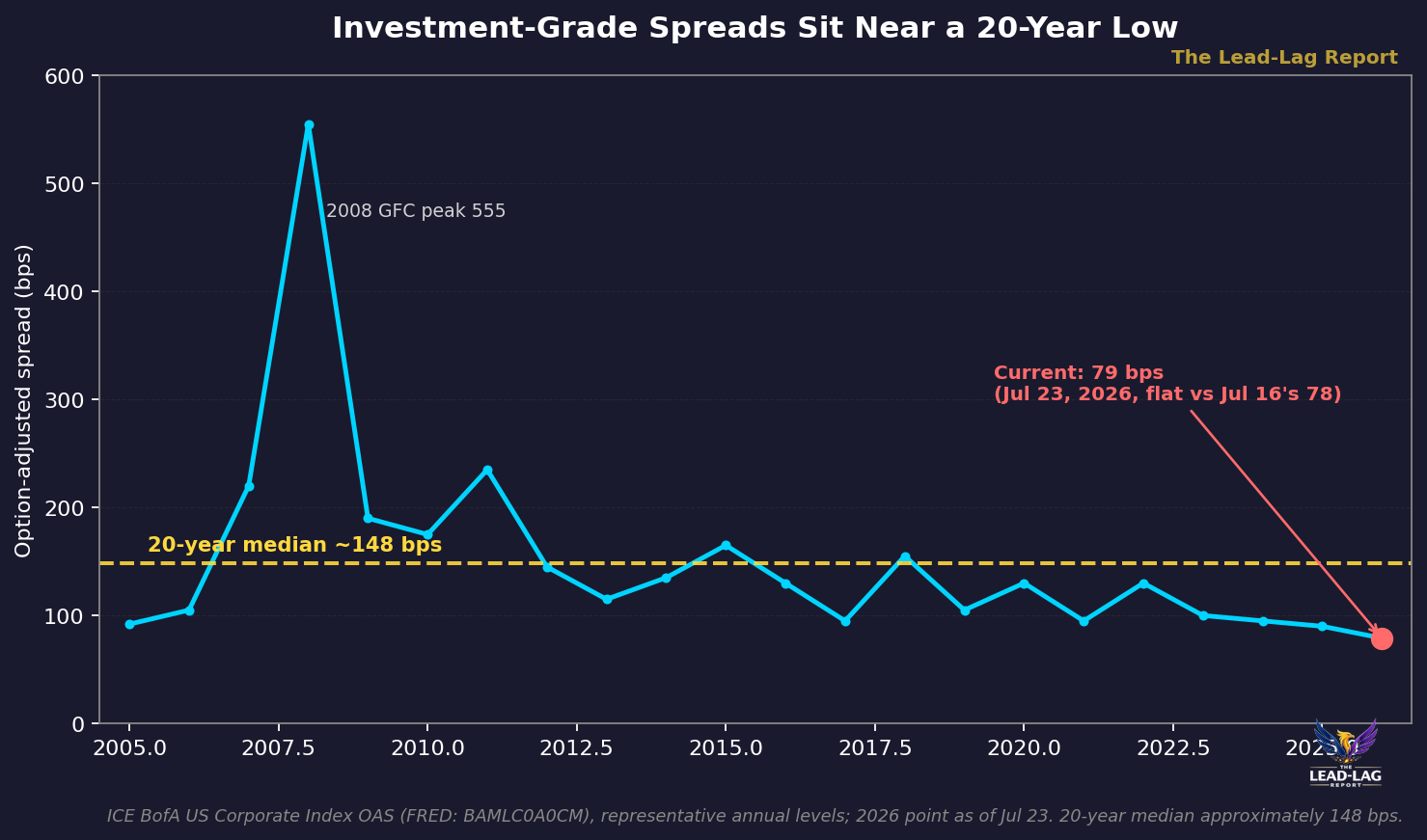
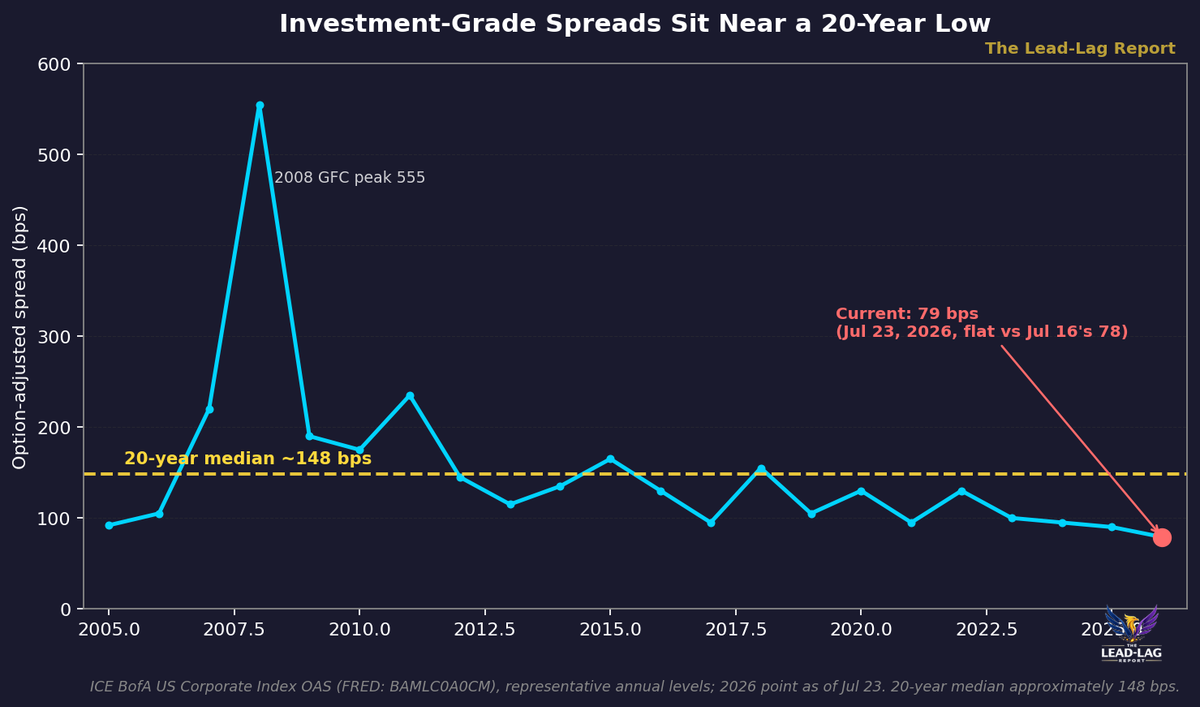
- The broad investment-grade index is not the tell anymore. It sat at 78 basis points on July 16 and sits at 79 today — essentially flat. The tell is the hyperscaler-specific bond basket, which has widened from about 118 basis points in February to roughly 153.5 basis points in mid-July, now more than 25 basis points wider than the broad index, a 10-year high in that gap.
- Oracle was cut to BBB-, one notch above junk, on July 9, with S&P naming OpenAI concentration as a key credit risk. Alphabet's July 22 print showed capex guidance raised for the second straight quarter, to $195-205 billion, alongside the company's first negative free-cash-flow quarter since its 2004 IPO.
- None of that has slowed the issuance. Amazon priced a weak-demand $25 billion deal on July 7 — 2.5x covered versus 3.2x in March — and a $12 billion-plus BlackRock-led bond sale for Meta's El Paso data center is pricing the week of July 27. 2026 AI-related debt issuance has already surpassed all of 2025 by Goldman Sachs's count.
- Nvidia's revenue does not need to disappoint. It needs to compound fast enough to outrun a 70 basis point spread widening on roughly $500 billion of committed capex financing. Nobody is modeling that. Everyone is modeling utilization. The hyperscaler-specific basket already moved 35 basis points wider since February — the financing desk is starting to answer first.
August 27, 2026 Update
The thesis was tested this week. The tributary widened.
First, the hyperscaler-specific spread widening documented in the original piece has now been formalized in issuance-weighted data: median spreads on 2-to-4-year Amazon, Alphabet, Meta and Oracle bonds moved from 30 basis points to 40, five-to-seven-year paper moved from 50 to 60, and long-dated 20+ year debt moved from roughly 108.5 to 118 basis points — a median widening of about 22 basis points across the curve.[21] Seventy-eight of the 91 hyperscaler bonds issued in 2026 are already trading at wider yields than at issuance.[22]
Second, Oracle's credit deterioration continued after the July 9 downgrade to BBB-. Its five-year CDS spread has moved from roughly 40 basis points a year ago to more than 200 basis points now, with implied default probability above 16 percent — the highest in the hyperscaler cohort.[23] That is idiosyncratic-first stress, arriving in the exact order the thesis predicted.
Third, Nvidia's Q2 FY27 print on August 26 delivered revenue of $96.22 billion, ahead of guidance, with Data Center at $89 billion. Q3 guide is $108 billion.[24] The demand side has not disappointed. But the aggregate hyperscaler capex figure printed for Q2 was $166 billion — up 87 percent year over year and 27 percent quarter over quarter — while 12-month forward guidance implies roughly $916 billion in run-rate spend and a projected $1.2 trillion for the year after.[24] The revenue is compounding fast. The commitment schedule is compounding faster.
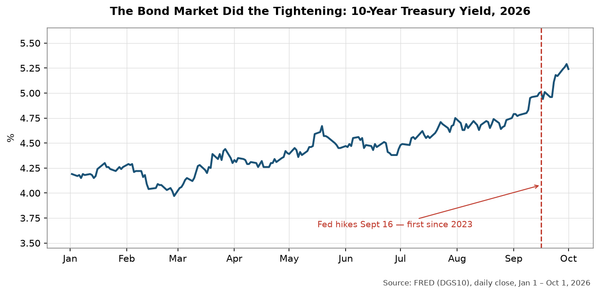
The 10-year Treasury closed at 4.67 percent on August 26. Broad IG spreads remain compressed at roughly 80 basis points. The AI-linked 10-year hyperscaler basket is trading at about 121 basis points on an issuance-weighted basis.[25] The gap between the broad index and the hyperscaler-specific basket is not narrowing. That is the tributary this piece was written about. It is doing what the piece said it would.
Capex cycles do not die from the bottom. They die from the top of the capital stack. The demand disappointment everyone waits for is a lagging symptom, not the cause. The cause is almost always the same: the marginal dollar of financing gets more expensive, the refinancing window narrows, and a buildout calibrated to cheap money discovers that money is no longer cheap. The receiver arrives at the financing desk long before he arrives at the sales floor.
The entire AI-bust debate is being conducted in the wrong language. The bears are counting GPUs, tracking utilization, quoting MIT surveys on enterprise return. The bulls are counting tokens, inference cost curves, and total addressable market. Both are arguing about the demand side. Both are watching the sales floor. Neither is watching the financing desk, which is where this cycle will actually turn.
Here is the claim in one sentence. The AI capex cycle is roughly 60% credit-financed, that credit was priced at a 20-year low in spreads, and a reversion toward the historical median breaks the funding math before the demand math ever gets a chance to. Watch the bond tributary.
The Consensus Is Staring at the Wrong Number
Read any AI-skeptic piece and the structure is identical. It opens with the capex figure — the Big Five hyperscalers guiding toward roughly $700 billion of 2026 capital spending, roughly double 2025. It pivots to demand: MIT's Project NANDA finding that 95% of organizations report zero return on generative AI, enterprise pilots stalling, coverage ratios of AI revenue against AI capex sitting well below one. It concludes that when the guidance cut comes, the multiple compresses and the cycle ends.
That narrative may even be directionally right about the eventual outcome. It is wrong about the mechanism and therefore wrong about the timing and the early-warning signal. A guidance cut is a decision. Decisions can be deferred for years by management teams with balance-sheet room, shareholder patience, and — critically — open capital markets. Amazon deferred discipline through a 95% collapse in trailing free cash flow. The demand tell is the last domino, not the first.
The first domino is price of capital. And the price of capital for this buildout is set in the investment-grade bond market, where the broad index still sits near 79 basis points — in the bottom decile of post-crisis readings, and roughly half the 20-year median, essentially unchanged from where it sat a week and a half ago.[1] That flatness is exactly why the real number consensus is missing is not the index. It is the hyperscaler-specific basket sitting inside it, which has already broken away from the index and is quietly doing the work the headline spread has not done yet.[14]