The AI Payback Clock Is Running Backward
The infrastructure is real. The return evidence is arriving later than the spending.

Today’s Lead-Lag Report post is sponsored by Evoke

The future is highly uncertain, with potential challenges in growth, inflation, and geopolitics, making diversification crucial.
Most investors are unknowingly underdiversified. A traditional 60/40 portfolio is 98% correlated to the stock market, potentially exposing investors to more risk than they realize. The S&P 500 historically experienced extended periods of underperformance, including:
1. Underperforming cash from 1966 to 1982 during inflationary times
2. A 0% average return from 1929 to 1949
3. A lost decade prior to the recent 15-year bull market
Historical bear markets often started with high valuations. Given current high valuations, we may be on the verge of another challenging period for U.S. equities.
Risk parity seeks to offer a more diversified allocation than conventional mixes. By spreading risk across global equities, Treasuries, TIPS, and commodity producers and gold, investors can maintain a low-cost, tax-efficient passive mix seeking:
1. Equity-like long-term expected returns
2. Lower risk than stocks
3. Reduced risk of a lost decade
To learn more about the RPAR Risk Parity ETF, visit rparetf.com.
Before investing you should carefully consider the Fund’s investment objectives, risks, charges, and expenses. This and other information is in the prospectus. A prospectus may be obtained by clicking here. Please read the prospectus carefully before you invest.
Investing involves risk. Principal loss is possible.
Distributed by Foreside Fund Services, LLC.
Data source: Bloomberg.
DISCLAIMER – PLEASE READ: This is sponsored advertising content for which Lead-Lag Publishing, LLC has been paid a fee. The information provided in the link is solely the creation of Evoke Advisors. Lead-Lag Publishing, LLC does not guarantee the accuracy or completeness of the information provided in the link or make any representation as to its quality. All statements and expressions provided in the link are the sole opinion of Evoke Advisors and Lead-Lag Publishing, LLC expressly disclaims any responsibility for action taken in connection with the information provided in the link.
The AI Payback Clock Is Running Backward
The infrastructure is real. The return evidence is arriving later than the spending.
MICHAEL A. GAYED, CFA
AUG 27, 2026
KEY HIGHLIGHTS
August 27, 2026 Update
The revenue arrived. The capex commitment grew faster.
The core question in this piece was whether revenue conversion could catch the depreciation schedule being funded in the present. Two months of new data, and the gap is widening rather than closing.
Nvidia reported Q2 fiscal 2027 on August 26. Revenue was $96.22 billion, roughly $5.4 billion ahead of the guide midpoint. Data Center revenue was $89 billion, 92 percent of total. Q3 guidance is $108 billion, another sequential step higher.[10] This is a real revenue print. It is not the constraint.
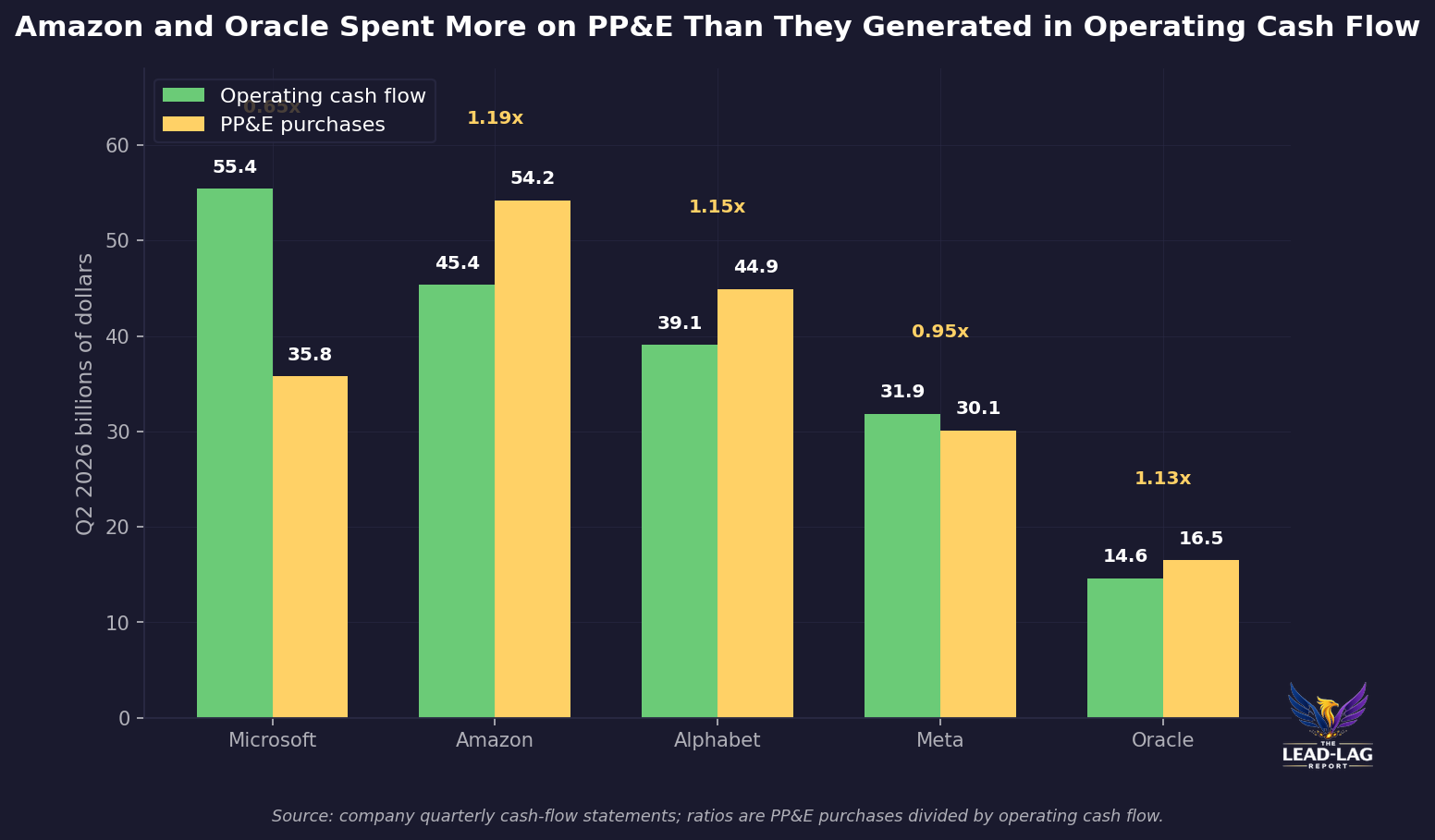
The constraint is what happened on the customer side of that print. Combined Q2 property, plant, and equipment purchases from Amazon, Microsoft, Alphabet and Meta totaled roughly $166 billion — up 87 percent year over year and 27 percent quarter over quarter.[11] Amazon alone spent $54.21 billion; Alphabet $44.92 billion; Microsoft $35.80 billion; Meta $31.08 billion. Twelve-month forward hyperscaler capex is now tracking around $916 billion in run-rate terms, with credible sell-side projections of roughly $1.2 trillion the year after.[11] The spend is not decelerating.
The cash-flow ratio matters here. Amazon's Q2 capex-to-operating-cash-flow ratio remained above one on the reported quarter. Alphabet just posted its first negative free-cash-flow quarter since its 2004 IPO and paused its buyback for the first time since 2017, raising $80 billion in fresh equity partly to keep funding capex — while raising its own guidance for a second consecutive quarter.[12] That is not a liquidity crisis. It is exactly what the piece described: models funded in the present by cash that has not yet arrived.
The falsifier this piece stated in July required aggregate AI-linked revenue to grow at least as fast as aggregate capex for four consecutive quarters. On the latest quarter alone, revenue grew fast — but not that fast. The clock has not been stopped. It has been reset one quarter later.
• The AI buildout is a legitimate demand story, but the capital commitment is arriving before the macro payoff is visible.
• The binding question is not whether the technology works. It is whether revenue, productivity, and operating cash flow can catch the depreciation schedule being created today.
• The market is still rewarding the infrastructure narrative, while the evidence underneath it is becoming more uneven across companies and sectors.
• The thesis is falsifiable: sustained revenue conversion, cash generation above capex, and a broad productivity impulse would force a different conclusion.
Every infrastructure cycle begins with a true statement. Railroads changed the economy. Fiber changed communications. Electricity changed production. Artificial intelligence is changing the way information is processed. The mistake is not recognizing the technology. The mistake is assuming that a true technology automatically produces a good first-wave capital return.
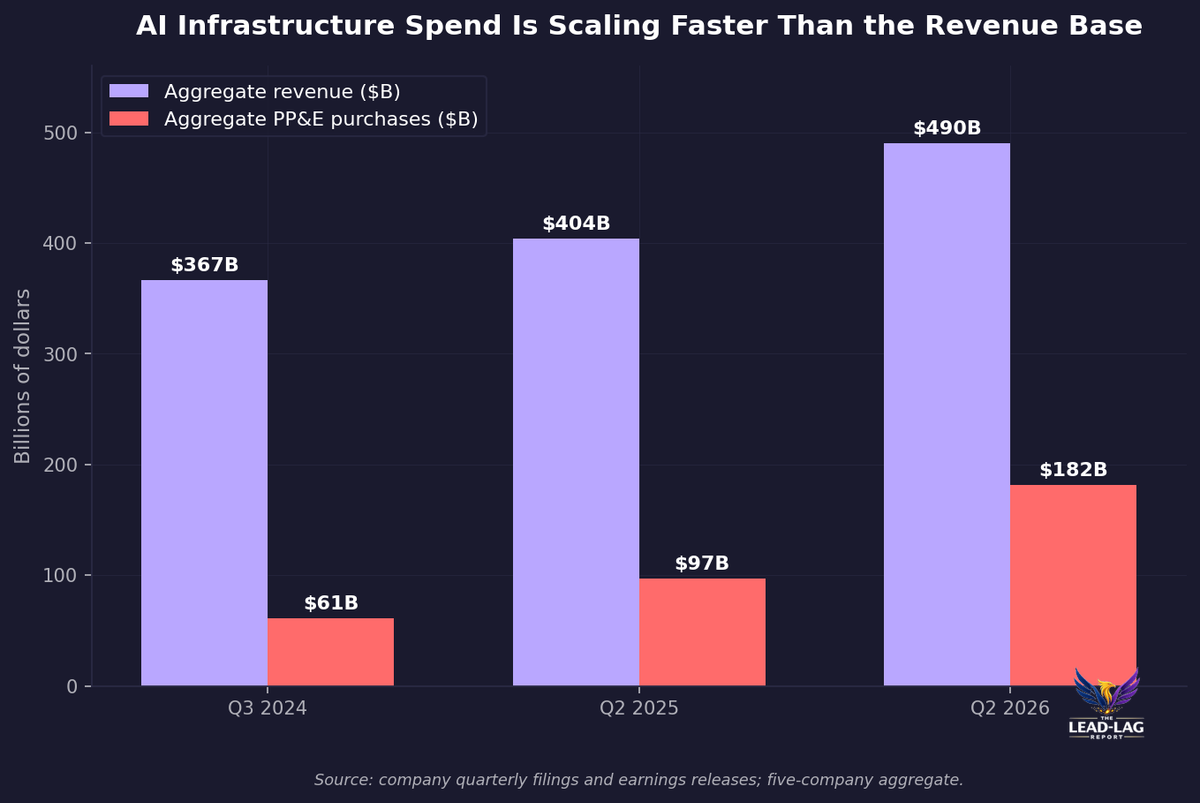
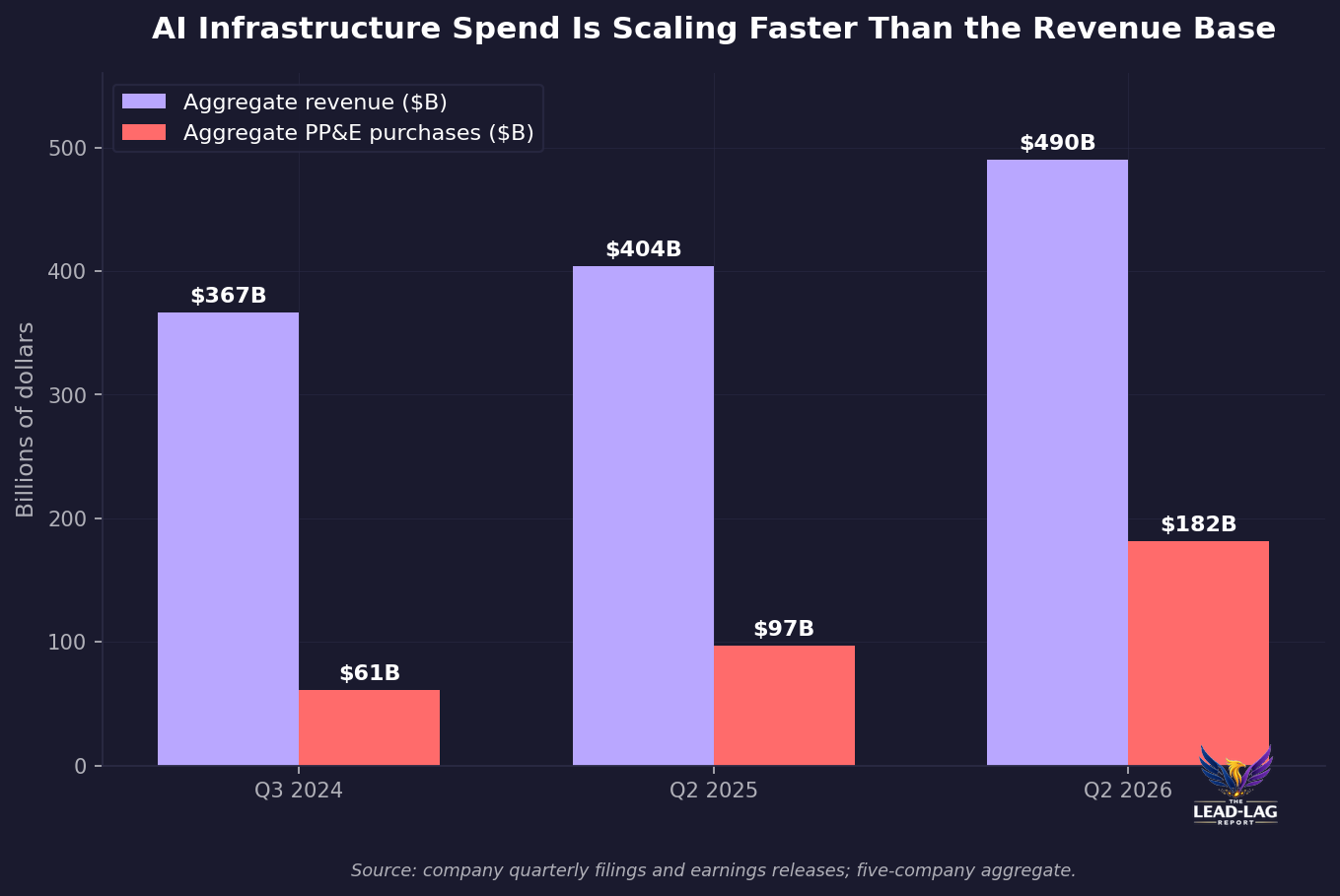
The current AI buildout is now large enough to be a macro question. Five major infrastructure spenders reported a combined $181.5 billion of property, plant, and equipment purchases in their latest reported quarters, against $490.4 billion of combined revenue.[1] In the comparable 2024 quarter, the same calculation was $61.2 billion of capex against $366.6 billion of revenue. The spending is growing much faster than the revenue base that must eventually absorb it.
That does not make the capex irrational. It makes the payback clock the central variable. If the useful output from these systems arrives quickly, the current investment becomes a platform. If the output arrives slowly, the same investment becomes a depreciation, power, and financing problem. Both outcomes can be true at the same time as the technology remains real.
The Spend Is Leading the Cash
The first tell is the relationship between capital spending and operating cash flow. In the latest quarter, Amazon spent $54.2 billion on property and equipment against $45.4 billion of operating cash flow. Oracle spent $16.5 billion against $14.6 billion. Microsoft, Alphabet, and Meta remained cash-flow positive after the spend, but the margin is not static: their latest capex-to-operating-cash-flow ratios were roughly 0.65, 1.15, and 0.95, respectively.[2] The point is not that any one quarter breaks the model. The point is that a model which depends on future utilization is being funded in the present by cash that has not yet arrived.
This is why aggregate capex can be misleading. The revenue line is already real, but not all revenue is AI revenue and not all AI revenue is incremental. Cloud customers may be shifting workloads, software customers may be experimenting, and internal products may be using the same infrastructure. The accounting captures the sale. It does not yet tell us whether the new capital earns a return above its full economic cost.
The market has an understandable answer: let the platforms spend now because they have balance sheets strong enough to carry the experiment. That is the steelman. Microsoft generated $55.4 billion of operating cash flow in the latest quarter, Alphabet $39.1 billion, and Meta $31.9 billion. There is no immediate liquidity crisis in those numbers.[3] But a strong balance sheet changes who can finance the buildout; it does not change the hurdle rate. A company can afford to make a low-return investment for longer than a weaker competitor. It still has to make the investment earn its keep.