The Duration Ambush
Why long rates may not follow the Fed lower this time. Term-premium repricing, bill-heavy issuance, and volatile foreign demand — the exposures the consensus is quietly mispricing.

Today’s Lead-Lag Report post is sponsored by WisdomTree

Today’s Lead-Lag Report is brought to you by our friends at WisdomTree. The front end of the curve is doing the heavy lifting in income portfolios right now. WisdomTree’s Floating Rate Treasury Fund (USFR) holds floating-rate U.S. Treasury notes whose coupons reset weekly to the 3-month T-bill auction rate plus a spread. That means yield that moves with the Fed, without the duration risk that has whipsawed other bond holdings over the last three years. For investors who want Treasury credit quality and a real-time response to rate-path uncertainty, USFR is built for this regime. Learn more about USFR here → https://www.wisdomtree.com/us/products/fixed-income/usfr?utm_source=leadlag&utm_medium=referral
There are risks associated with investing, including possible loss of principal. Fixed income investments are subject to interest rate risk; their value will normally decline as interest rates rise. Fixed income investments are also subject to credit risk, the risk that the issuer of a bond will fail to pay interest and principal in a timely manner or that negative perceptions of the issuer’s ability to make such payments will cause the price of that bond to decline. While the U.S. government guarantees the timely payment of interest and principal on U.S. Treasuries, the Fund is not guaranteed. The Fund invests in derivatives, which can be volatile and involve various types and degrees of risk. Please read the Fund’s prospectus for specific details regarding the Fund’s risk profile.
INVESTORS SHOULD CAREFULLY CONSIDER THE INVESTMENT OBJECTIVES, RISKS, CHARGES AND EXPENSES OF THE FUNDS BEFORE INVESTING. TO OBTAIN A PROSPECTUS CONTAINING THIS AND OTHER IMPORTANT INFORMATION, PLEASE CALL 866.909.9473, OR VISIT WISDOMTREE.COM/US TO VIEW OR DOWNLOAD A PROSPECTUS. READ THE PROSPECTUS CAREFULLY BEFORE YOU INVEST.
Distributor: Foreside Fund Services, LLC
DISCLAIMER – PLEASE READ: This is sponsored advertising content for which Lead-Lag Publishing, LLC has been paid a fee. The information provided in the link is solely the creation of WisdomTree. Lead-Lag Publishing, LLC does not guarantee the accuracy or completeness of the information provided in the link or make any representation as to its quality. All statements and expressions provided in the link are the sole opinion of WisdomTree, and Lead-Lag Publishing, LLC expressly disclaims any responsibility for action taken in connection with the information provided in the link.
The Duration Ambush
Why long rates may not follow the Fed lower this time
Macro Observations is a weekly deep-dive into the exposures the consensus is quietly mispricing. Each installment takes one narrative the market treats as settled and interrogates the structural evidence that says it may not be.
The consensus trade of the next easing cycle is almost too clean. The Federal Reserve cuts, the short end falls, and the long end obligingly follows it lower. Lock in duration before the move, the story goes, and let the whole curve reprice down. It is a comfortable story because it has usually been true. It may not be true this time, and the reason has almost nothing to do with the Fed.
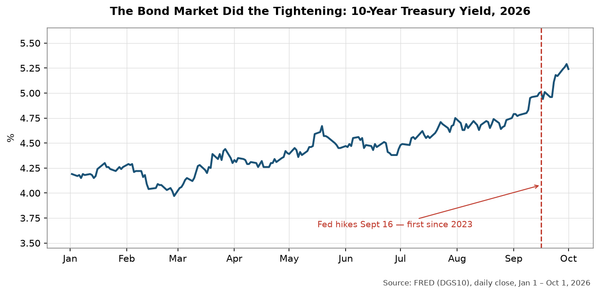
What sets the long end is not the policy rate. It is the compensation investors demand to hold duration risk, the term premium, and that number has been repricing higher for three years while the market kept staring at the dot plot. The Treasury has masked the shift with a bill-heavy financing strategy that pushed the reckoning into the future. The future is arriving.
What the market believes
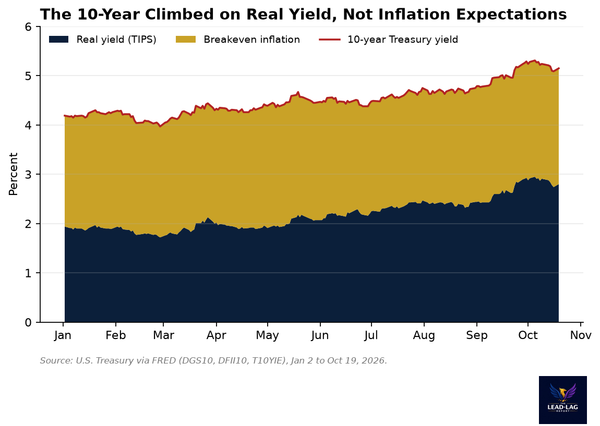
The prevailing framing treats the long bond as a lever attached to the funds rate. Cut the policy rate and the 10-year yield deflates in sympathy, because a lower path for short rates today mechanically lowers the expected average of short rates over the next decade. That is the expectations-hypothesis half of a yield, and it is real. What the consensus forgets is the other half. A long yield is the expected path of short rates plus a term premium, the extra yield that clears the market for the risk of holding a bond whose price can move against you for ten or thirty years.
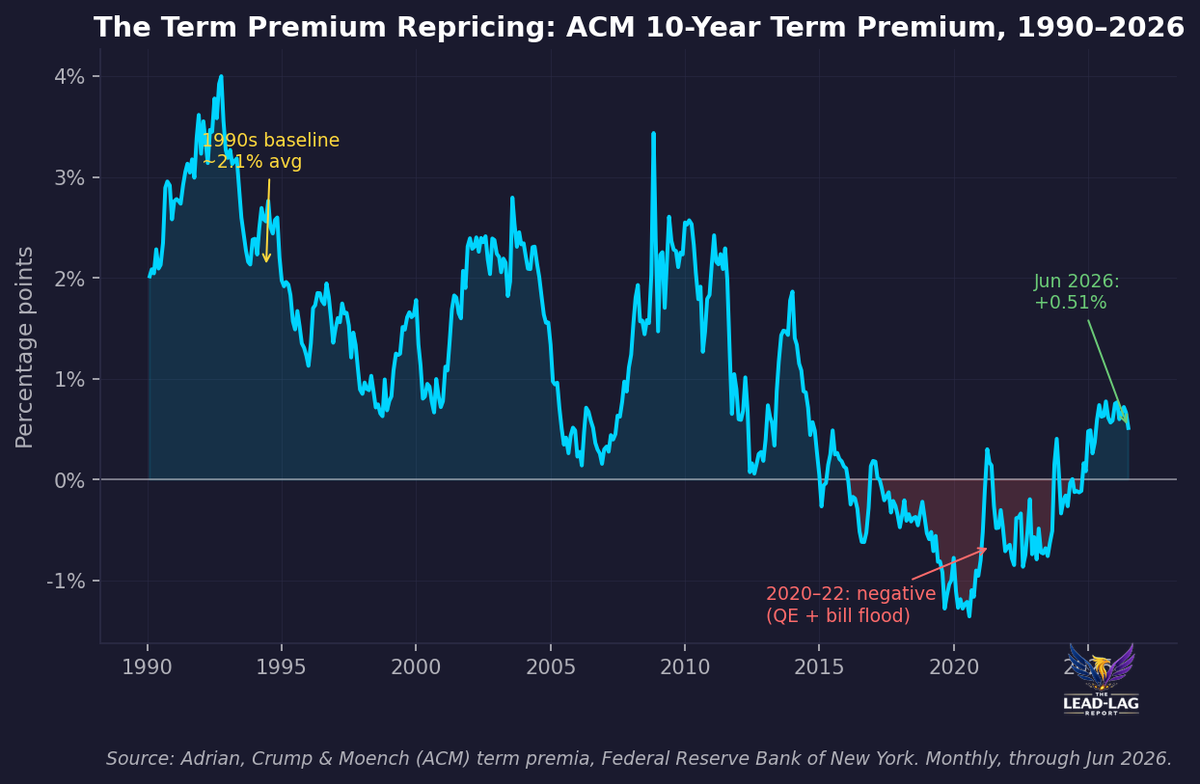
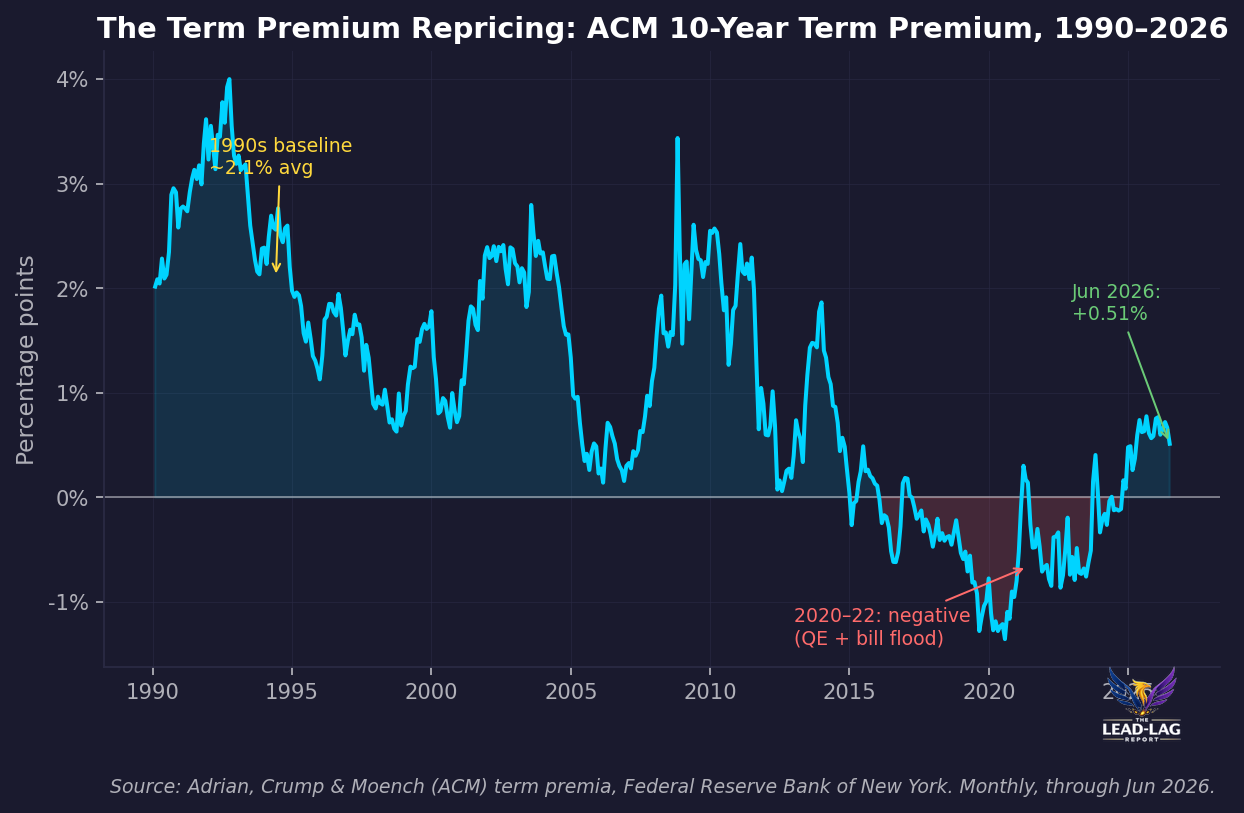
For most of the last cycle that term premium was not just low. It was negative. The ACM series maintained by the New York Fed, built by Tobias Adrian, Richard Crump, and Emanuel Moench, averaged roughly negative 0.66% across 2020 through 2022.[1] Investors were paying for the privilege of owning duration. When the term premium is negative, a Fed cut and a falling long yield move together beautifully, because there is no supply-and-demand friction fighting the policy signal. That is the world the consensus is still trading. It is not the world we are in.
The repricing the consensus refuses to read
As of June 2026, the ACM 10-year term premium stood at positive 0.51%, up from deeply negative territory only three years earlier.[1] That is not noise. It is a regime change in the price of duration risk, and it is happening independent of where the funds rate goes next. To understand why, follow the supply.
The Treasury has financed an enormous deficit by leaning on the front end. Bills, securities maturing in a year or less, now make up roughly 22% of total marketable debt.[2] The Treasury Borrowing Advisory Committee has for years described a normal range of 15% to 20%, with 20% treated as a sensible long-run average and 15% as a lower bound that supports market functioning.[3] We have been above that band since September 2023.[4]
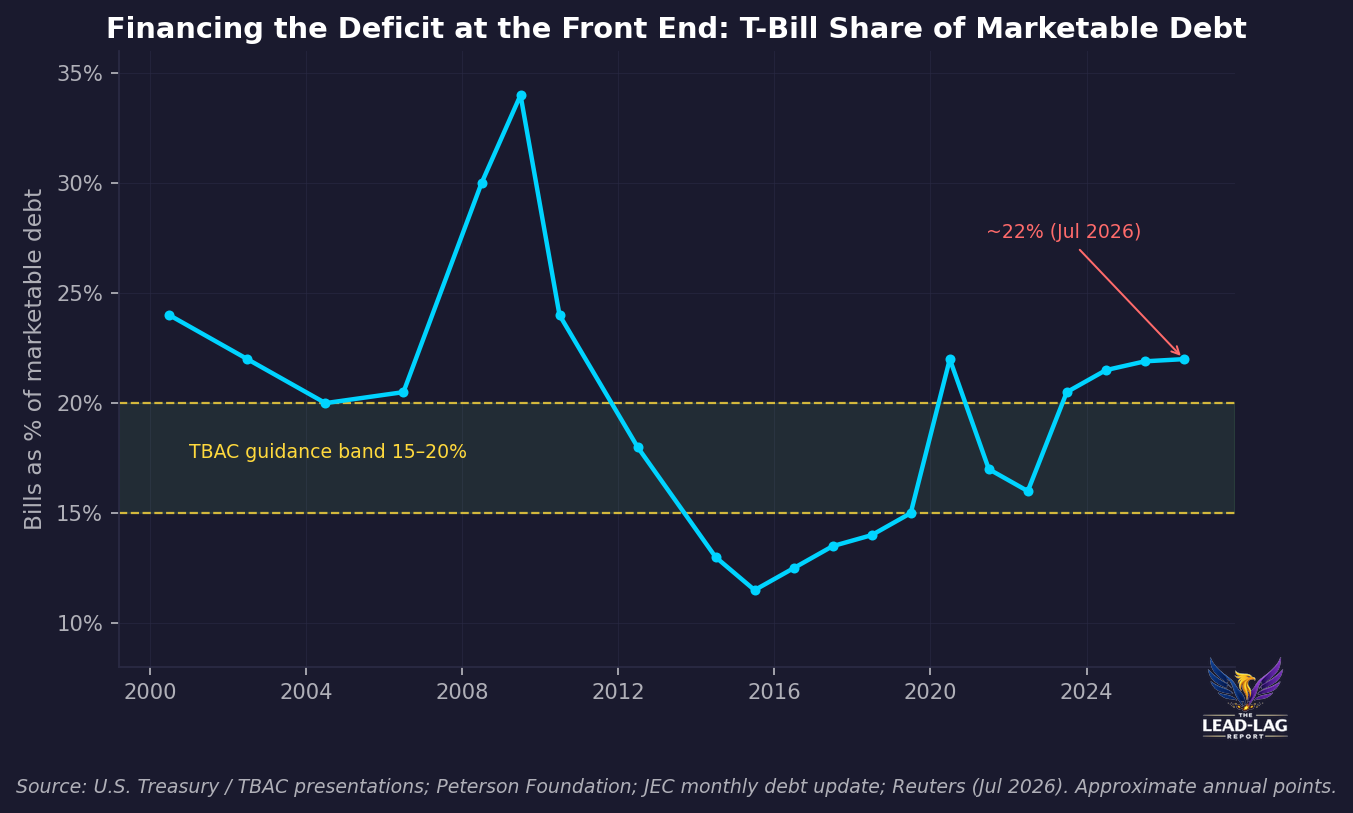
This matters because bills and coupons draw on different buyers. Bills are absorbed by money market funds and cash-parking institutions that care about yield and liquidity, not duration. Coupons, the notes and bonds that actually carry term premium, must be placed with duration buyers, and that pool is shrinking relative to supply. By running the bill share hot, the Treasury has deferred the coupon issuance that ultimately clears against a smaller set of long-duration investors. The 4-week bill now averages around $94 billion per offering in 2026, the single largest security the Treasury sells, versus roughly $47 billion a decade ago.[5] Financing at the front end is not free. It defers the term-premium bill; it does not cancel it.
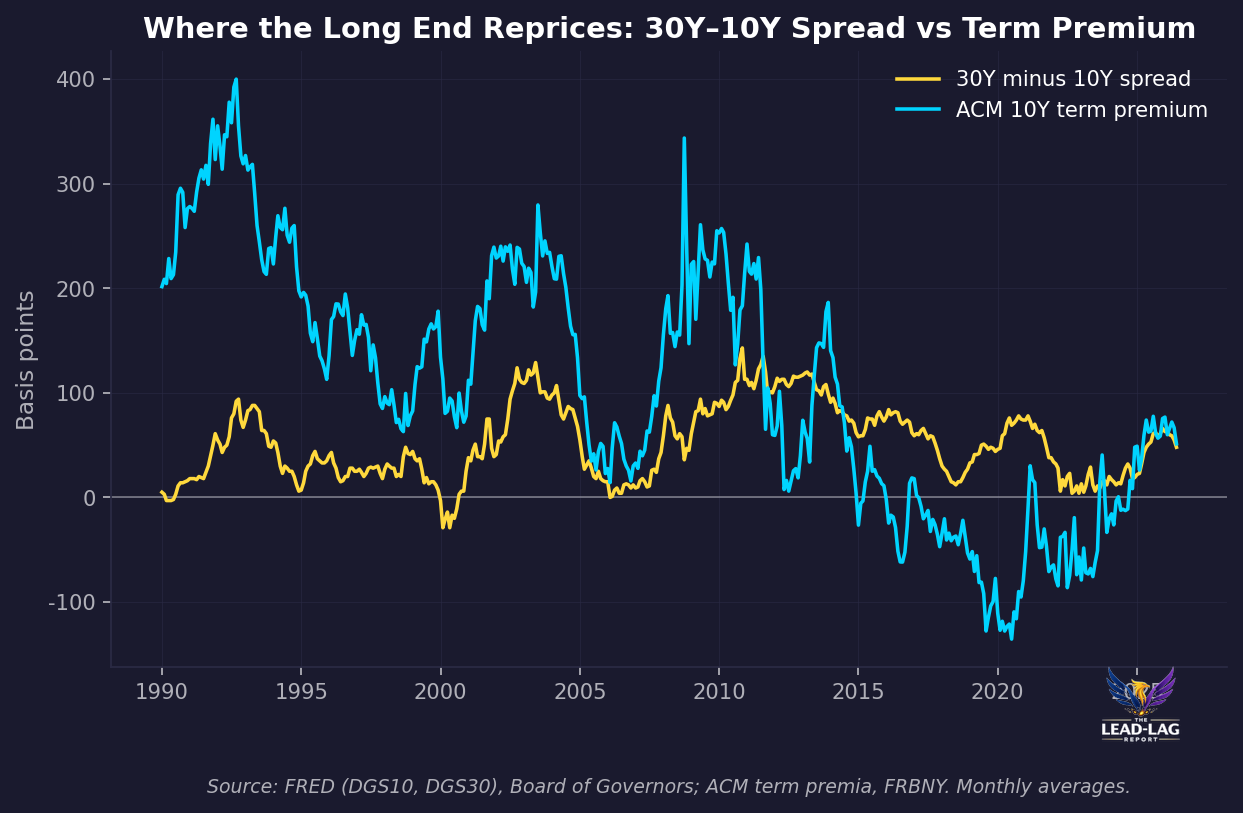
You can see where the pressure lands by watching the 30-year minus 10-year spread against the term premium itself. The long end steepens precisely when duration compensation rises, and the two have been moving together as the premium has climbed off its lows.[1] [6] That is the market re-learning that the long bond is a risk asset, not a policy derivative.
The buyer question nobody wants to answer
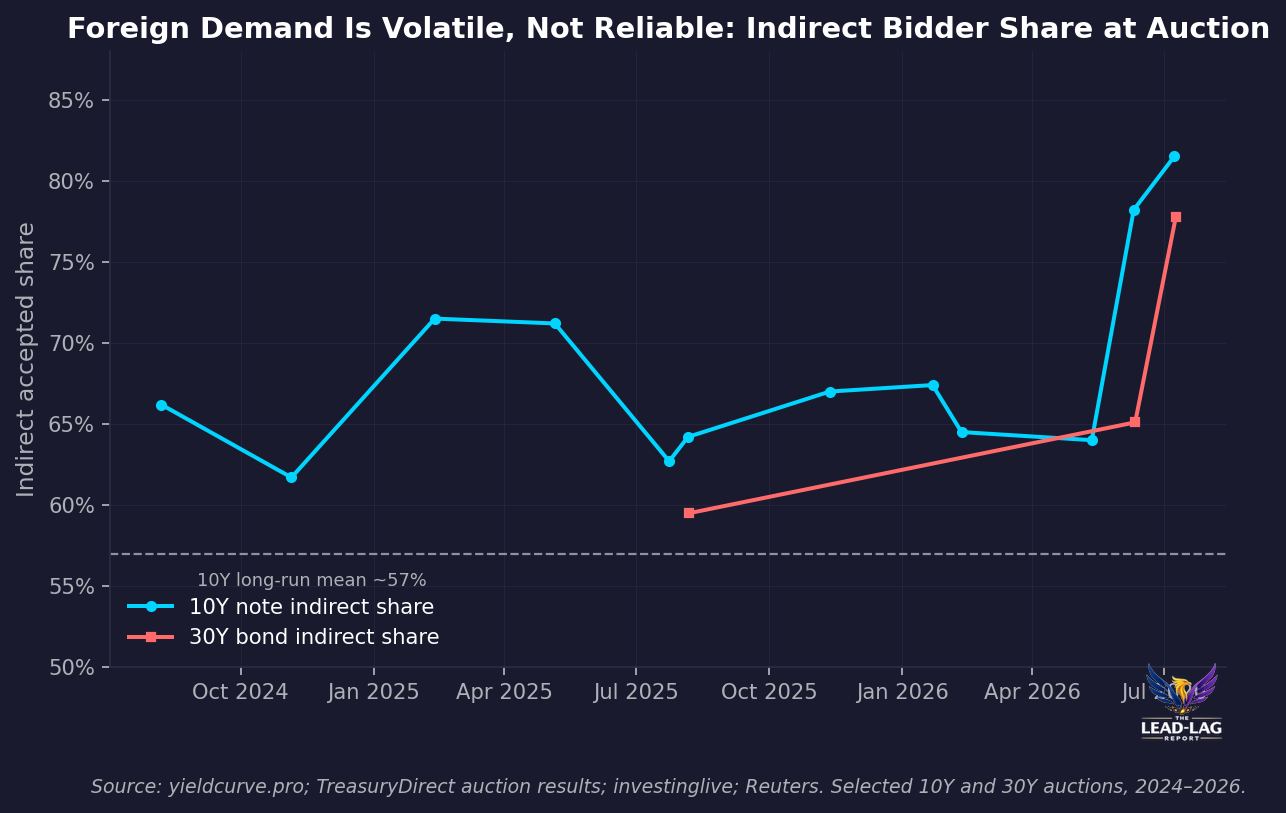
The reflexive rebuttal is that foreign demand will always show up. And on the headline, it has. Indirect bidders, the standard proxy for foreign central banks and overseas institutions, took 81.5% of the July 2026 10-year auction, one of the highest shares on record, and 30-year indirect participation printed near 78% the same month.[7] [8] On its face that looks like the old reserve-accumulation machine humming along.
Look closer and the picture is less reassuring. The indirect share is not trending smoothly higher. It is swinging violently, from the low 60s to the low 80s within a few auctions, and the domestic direct-bidder share has repeatedly sagged to multi-year lows while primary dealers absorb the residual.[7] [9] A market that clears on a knife edge, dependent on a single volatile buyer category and a dealer balance sheet backstop, is not a market that has structurally solved for the supply. It is a market that is one bad auction away from a term-premium repricing event.
The 2003–2007 parallel, running in reverse
There is a precedent for term premium being crushed by a structural buyer, and it is instructive precisely because it is now running backward. From roughly 2003 to 2007, Asian central banks recycled trade surpluses into Treasuries on a massive, price-insensitive scale. Alan Greenspan called the resulting collapse in long yields a conundrum, because the Fed was hiking and the long end would not budge. That was term premium compression driven by a deep, coordinated, reserve-accumulating buyer.
The condition that produced the conundrum was global reserve consolidation into a single asset. What we have now is the opposite: fragmentation. Reserve managers are diversifying, gold has been accumulated aggressively by official buyers, and the marginal foreign bid is more tactical and more conditional than the automatic surplus recycling of twenty years ago. The same mechanism that once suppressed the term premium is unwinding. A conundrum in reverse does not produce a conundrum. It produces a repricing.
What this means for exposure
None of this is a call on the direction of the funds rate. The Fed may well cut, and the front end may well fall. The asymmetry sits in the assumption that the long end has to come with it. If the term premium continues normalizing toward anything resembling its pre-2015 range, and the 1990s averaged north of 2%, a Fed cut could be met by a long end that holds or even backs up, steepening the curve through the term-premium channel rather than the policy channel.[1]
The exposure that deserves scrutiny here is duration, and specifically the long-duration Treasury position held on the thesis that cuts guarantee capital gains at the back end. That is a bet on the term premium staying suppressed while coupon supply grows and the buyer base fragments. It is a bet against the supply-and-demand arithmetic. The regime, not the direction of policy, is the risk. Positioning built on the old reaction function is exposed to a repricing it is not being paid to bear.
What would prove me wrong
This thesis is falsifiable, and I want to name the condition plainly. If the term premium resumes a sustained decline even as the Treasury ramps coupon issuance into 2027, that would mean a structural source of duration demand exists that I have not identified, and the bill-heavy strategy will have been a bridge to genuinely deeper coupon appetite rather than a deferral. A durable move back toward zero or negative ACM term premium, coincident with rising 10-year and 30-year auction sizes and stable-to-firming indirect participation, would kill the argument.[1] [10] I am watching the quarterly refunding coupon schedule and the ACM print, not the dot plot, for the answer.
The market has spent three years treating the long bond as a lever wired to the Fed. It is a risk asset priced by supply, demand, and the compensation for duration, and every one of those inputs is moving against the consensus at once.
Few understand this.
— — —
Notes
- Adrian, Tobias, Richard K. Crump, and Emanuel Moench. ACM Treasury Term Premia (ACMTP10), monthly through June 2026. Federal Reserve Bank of New York. https://www.newyorkfed.org/research/data_indicators/term-premia-tabs
- "US Treasury bill issuance grows, heightens long-term risk." Reuters, July 23, 2026. Reuters
- Report to the Secretary of the Treasury from the Treasury Borrowing Advisory Committee, July 31, 2024. U.S. Department of the Treasury. home.treasury.gov
- "Quarterly Treasury Refunding Statement." Peter G. Peterson Foundation, July 10, 2026. pgpf.org
- Peter G. Peterson Foundation, July 10, 2026. 4-week bill averaging ~$94bn per issuance in 2026 versus ~$47bn in 2016. pgpf.org
- Board of Governors of the Federal Reserve System, 10-Year (DGS10) and 30-Year (DGS30) Treasury constant maturity rates, via FRED, Federal Reserve Bank of St. Louis. FRED DGS10
- "Foreign Demand at U.S. 10-Year Treasury Auction Hits Third Highest on Record." Indirect bidders 81.5% at July 8, 2026 10-year auction. nashnova.com
- "U.S. Treasury auctions off $22 billion of 30 year bonds." investinglive, July 9, 2026. 30Y indirect share ~77.74% vs. ~65.1% six-auction average. investinglive.com
- 10-Year indirect auction results (2024–2026, long-run mean ~57%). yieldcurve.pro
- "Considerations for T-bill Issuance," TBAC charge, Q3 2024. U.S. Department of the Treasury. home.treasury.gov PDF
The Lead-Lag Report is provided by Lead-Lag Publishing, LLC. All opinions and views mentioned in this report constitute our judgments as of the date of writing and are subject to change at any time. Information within this material is not intended to be used as a primary basis for investment decisions and should also not be construed as advice meeting the particular investment needs of any individual investor. Trading signals produced by the Lead-Lag Report are independent of other services provided by Lead-Lag Publishing, LLC or its affiliates, and positioning of accounts under their management may differ. Please remember that investing involves risk, including loss of principal, and past performance may not be indicative of future results. Lead-Lag Publishing, LLC, its members, officers, directors and employees expressly disclaim all liability in respect to actions taken based on any or all of the information on this writing.