
The Fed Just Told You It Might Hike. The Volatility Market Isn't Listening. TSPY Is Set Up For Both.
How a daily 0DTE covered call strategy on SPY turns a divided Fed, a compressed VIX, and a sticky-inflation regime into monthly income potential.

The Fed Just Told You It Might Hike. The Volatility Market Isn’t Listening. TSPY Is Set Up For Both.
How a Daily 0DTE Covered Call Strategy on SPY Turns a Divided Fed, a Compressed VIX, and a Sticky-Inflation Regime Into Monthly Income Potential
Key Highlights
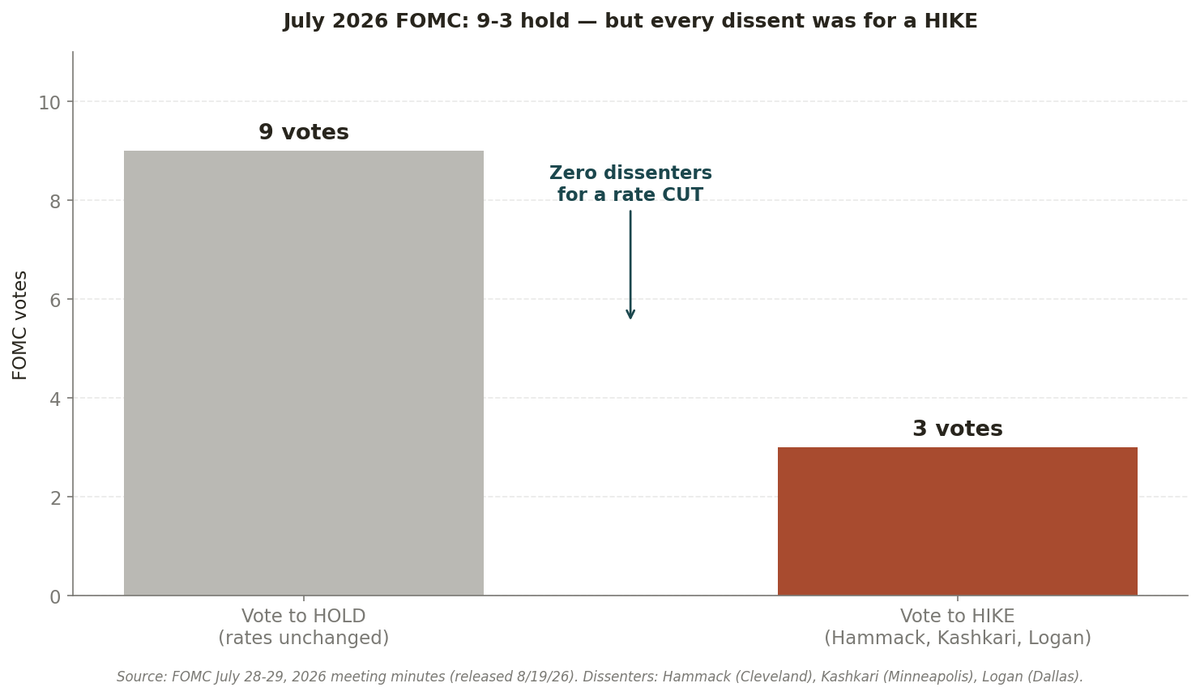
The Federal Open Market Committee (FOMC) held the federal funds rate at 3.50–3.75% at its July 28–29, 2026 meeting on a 9-3 vote — the most fractured decision in years — with three regional Fed presidents (Hammack, Kashkari, and Logan) each preferring a quarter-point hike, not a cut. (Yahoo Finance, CNBC)
July FOMC minutes released August 19, 2026 show the case for an immediate hike circulated broadly before the committee ultimately held; the next meeting is September 15–16, with Chair Warsh addressing Jackson Hole August 27–29. (Yahoo Finance, Crestwood Advisors)
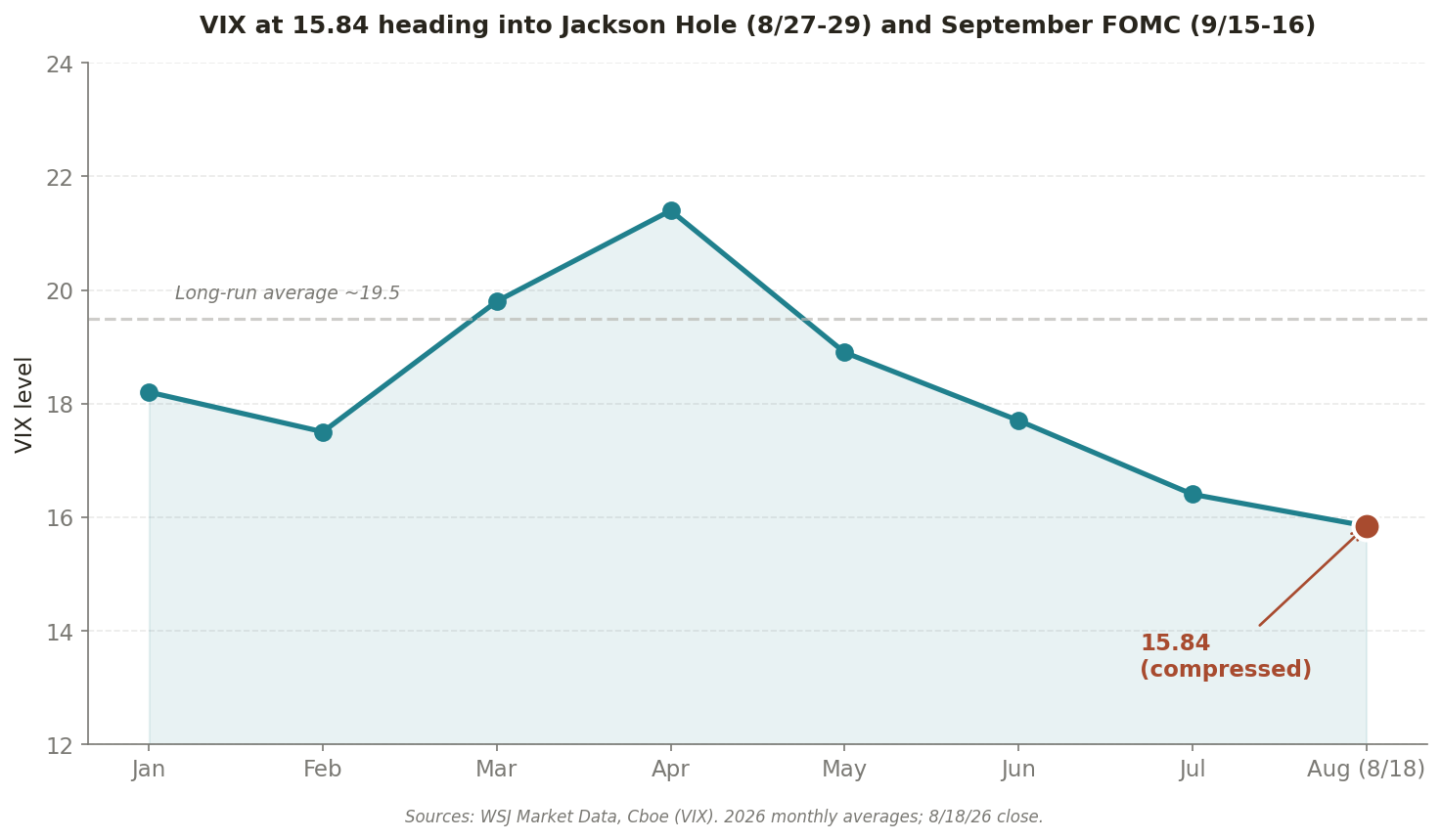
The CBOE VIX — the Cboe Volatility Index, a widely followed gauge of the market’s expectation of S&P 500 volatility over the next 30 days — closed at 15.84 on August 18, 2026 — one of the most compressed readings of the cycle — while the 10-year Treasury yield sits at 4.694%, and the 30-year at 5.31%. (WSJ, Yahoo Finance, FRED)
The TappAlpha S&P 500 Growth & Daily Income ETF (TSPY) uses a daily 0DTE (zero-days-to-expiration) covered call strategy on SPY (the SPDR S&P 500 ETF Trust, which tracks the S&P 500 Index) — selling call options that expire the same trading day. As of August 4–7, 2026, TSPY manages approximately $316.58M in AUM with a 13.94% distribution rate and paid its August distribution of $0.30007 per share on August 5. (ETF Central, TappAlpha)
A compressed VIX (a VIX level well below its long-run average) plus hawkish-Fed optionality (the possibility that the Fed shifts toward raising rates) plus a $500M+ TappAlpha platform crossing that threshold in early May 2026 — this is exactly the setup a daily premium-harvest engine is built for. (OTC Markets)
TSPY 30-Day SEC Yield: 0.41% (as of 7/31/26)
Standardized performance: TSPY
The performance data quoted represents past performance. Past performance does not guarantee future results. The investment return and principal value of an investment will fluctuate so that an investor’s shares, when sold or redeemed, may be worth more or less than their original cost and current performance may be lower or higher than the performance quoted. Performance current to the most recent month-end can be obtained above. Returns less than one year are not annualized.
Short term performance, in particular, is not a good indication of the fund’s future performance, and an investment should not be made based solely on returns.
Market performance is the price at which shares in the ETF can be bought or sold on the exchanges during trading hours, while the net asset value (NAV) represents the value of each share’s portion of the fund’s underlying assets and cash at the end of the trading day.
July 2026 FOMC: 9-3 hold — but every dissent was for a HIKE
Figure 1. July 2026 FOMC hold vote breakdown. Three regional Fed presidents dissented in favor of an immediate rate hike; zero dissenters argued for a cut. Source: FOMC meeting minutes released 8/19/26.
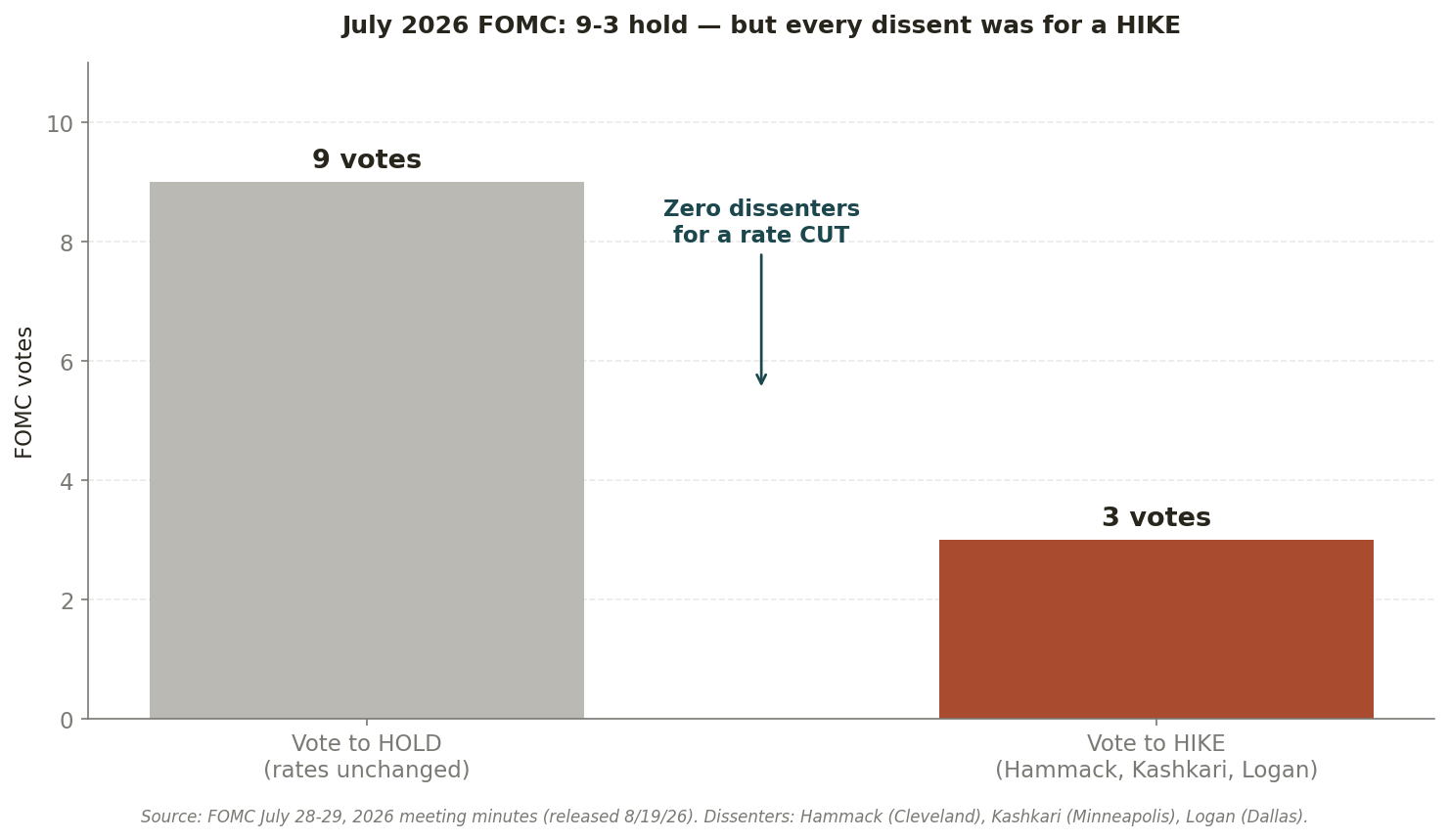
Today, August 19, 2026, the Federal Reserve released the minutes of its July 28–29 meeting. The picture those minutes painted was not the picture markets have been trading. The committee held the federal funds rate at 3.50–3.75% by a 9-3 vote — with three regional bank presidents each dissenting in favor of an immediate quarter-point hike. (Yahoo Finance) Beth Hammack of Cleveland, Neel Kashkari of Minneapolis, and Lorie Logan of Dallas all argued the same thing behind closed doors: inflation is not cooling fast enough, and monetary policy is not tight enough. (CNBC)
Three regional Fed presidents dissenting toward tightening — at a meeting where the majority still voted to hold — is not a normal FOMC. It is a committee that is one bad inflation print away from actually hiking. And it comes at a moment when the market is pricing something almost the opposite: broad-market volatility is compressed to 15.84 on the VIX, ten-year Treasury yields have climbed back toward 4.7%, and the equity market has largely absorbed the Fed’s uncertainty as background noise. (WSJ, Yahoo Finance)
That gap — between what the Fed is signaling and what the volatility market is pricing — is the setup this advertorial exists to describe. It is a setup with two possible resolutions, both of which we believe favor a strategy built to be paid daily to sell short-dated options (options with very little time remaining until expiration) on the S&P 500. If the Fed holds and inflation cools, the current compressed volatility regime persists and premium keeps getting harvested. If the Fed pivots hawkish at Jackson Hole or the September 15–16 meeting, realized volatility snaps higher and the premium available to sellers rises. The one outcome that isn’t priced anywhere in this market is the rate-cut cavalry riding to the rescue. And that outcome is exactly what income investors spent 2025 waiting for.
The Income Math Under a Divided Fed
The S&P 500 dividend yield remains near the low end of its multi-decade range. Ten-year Treasuries at 4.694% offer meaningful nominal yield (yield before adjusting for inflation), but the July FOMC minutes make clear that this yield is not going to come down in a straight line — three FOMC voters believe it should be higher. (Yahoo Finance) An income allocation built on the assumption of falling front-end (short-term) and long-end (long-term) interest rates is running against the actual composition of the Federal Open Market Committee.
Meanwhile, Reuters reported August 12 that traders continue to bet on a September Fed hold — but only narrowly, and only because July CPI showed cooling for a second consecutive month. (Reuters) One hot print between now and September 16 flips that consensus. The State Street Global Advisors weekly note put it succinctly: “Three Fed dissents point to a gradual, pre-emptive tightening bias rather than urgency.” (SSGA) A pre-emptive tightening bias — a lean toward raising rates before inflation accelerates further — is not a phrase that describes a market waiting for a cut. It describes a market bracing for the opposite.
For income investors, this is the environment where fixed-yield instruments trade at a discount to their apparent yield — the yield implied by today’s price. The 10-year is paying 4.694%, but its price could easily give back several percentage points if Chair Warsh comes out of Jackson Hole (August 27–29) sounding like the three dissenters. (Crestwood Advisors)
The alternative — a strategy that seeks to generate income from short-dated option premium rather than from duration (the interest-rate exposure that comes with holding longer-term bonds) or from equity dividends — is designed to reduce that risk. It doesn’t require the Fed to cut. It doesn’t require inflation to fall. It requires only that the S&P 500 continue to have a daily options market with buyers willing to pay for short-dated calls. That market has never been larger.
VIX at 15.84 heading into Jackson Hole and September FOMC
Figure 2. VIX 2026 monthly average trajectory, with the 8/18/26 close of 15.84 highlighted. The long-run average of ~19.5 is shown for reference. Sources: WSJ Market Data, Cboe.
Where the S&P 500 Options Market Actually Is
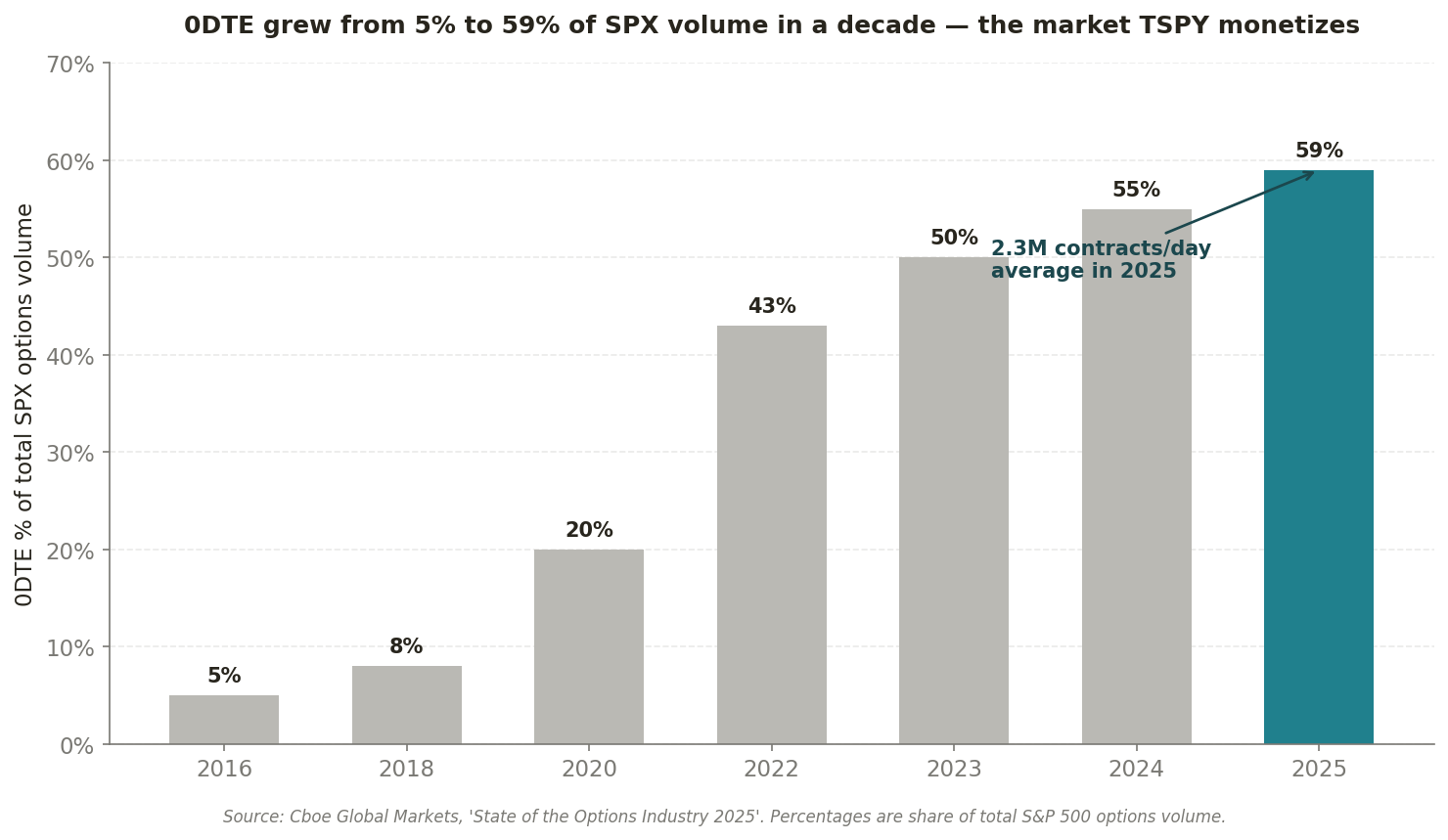
Zero-days-to-expiration options — 0DTE — are the dominant flow in the largest options market in the world. SPX 0DTE contracts averaged 2.3 million contracts per day in 2025 and represented 59% of total S&P 500 options volume, up from roughly 5% in 2016. (Cboe Global Markets) Daily-expiry options are not a niche. We believe they are the baseline of how the S&P 500 volatility complex now functions.
That structural shift is the pre-condition for the strategy behind TSPY. Every trading morning, the fund holds SPY — the SPDR S&P 500 ETF Trust, tracking the S&P 500 Index — and writes out-of-the-money call options against that holding, with each option expiring at the close of that same session. (TappAlpha)
Each morning, the strategy resets. Each afternoon, the options expire — worthless if the S&P 500 finishes below the strike, in-the-money if it does not. Either way, the premium collected that morning is realized as income. The next trading day, the strategy begins again.
Theta — the rate at which an option loses value as time passes — is the mechanic. A call option with less than seven hours until expiration is a decaying asset by construction. The seller of that call — assuming enough liquidity and enough demand from buyers — is being paid for time that has almost none left to run. That is why 0DTE became the dominant flow: for buyers, it’s a leveraged directional bet with limited premium at risk; for sellers, it’s the fastest theta available in a listed market.
Why the Compressed VIX Is Still the Right Setup
A VIX at 15.84 sounds like a bad environment for selling volatility. In the traditional covered-call framework — monthly options, static strikes, low turnover — that would be correct. Low VIX means low absolute premium.
But that framework does not apply to a daily 0DTE strategy. A monthly covered call locks in a strike and a premium at one point in the volatility cycle and rides it for thirty days. A daily 0DTE covered call re-strikes every single trading morning at the prevailing volatility level. When VIX is at 15.84, the morning’s write is small. When VIX is at 25, the morning’s write is larger. The engine adapts to the regime on a next-day basis.
That adaptability is precisely what a divided-Fed, sticky-inflation environment rewards. Between now and the September 15–16 FOMC meeting, the market is going to receive the July CPI report, the August CPI report, and Chair Warsh’s Jackson Hole address. (Crestwood Advisors) Any one of those events could flip the VIX regime from 15 to 25 in a single session. A daily-write strategy captures that transition immediately — the morning after volatility rises, the strike is set at the new higher level and the premium collected reflects the new regime.
The static-strike, monthly-write alternative doesn’t. It sits on a strike written when VIX was 15, watches the underlying move against it, and either buys back the option at a loss or takes the underlying’s downside.
That is the structural argument for a daily-write engine in a compressed-vol environment that could break either direction: it is architected to profit from volatility change, not just from volatility level.
The TSPY Distribution History
TSPY paid $0.30007 per share on August 5, 2026 — the fund’s most recent monthly distribution. (TappAlpha) The distribution rate stood at 13.94% as of August 4, 2026, with a 30-day SEC yield of 0.41% as of July 31, 2026. (TappAlpha)
TSPY has now paid monthly distributions consistently since inception. The fund had grown to approximately $318.74M in AUM as of August 19, 2026, with a 12-month trailing distribution yield of 13.88%. (ETF Central) That growth is a function of the same setup this advertorial has been describing: advisors and investors looking for income that does not require them to make a specific call on where the Fed is going next.
In May 2026, TappAlpha crossed $500 million in total platform assets — doubling AUM in just four months. (OTC Markets) The category the firm calls Growth + Income is not a marketing label. It is the mechanical description of what a daily 0DTE covered call ETF seeks to deliver: exposure to the underlying index (growth), plus daily-harvested option premium (income). Neither side of that ledger requires a Fed pivot. Both sides are designed to work in the current regime.
0DTE grew from 5% to 59% of SPX volume in a decade
Figure 3. 0DTE share of total S&P 500 options volume, 2016–2025. Averaged 2.3M contracts per day in 2025. Source: Cboe Global Markets, ‘State of the Options Industry 2025.’ Data as of year-end 2025.
The Setup Into September
Here is where the market actually sits as of August 19, 2026:
Fed funds at 3.50–3.75%, held on a 9-3 vote with three FOMC dissenters preferring a hike. (Yahoo Finance)
July FOMC minutes released today confirm the tightening debate is now the operative debate inside the committee. (Yahoo Finance)
VIX at 15.84 — one of the most compressed readings of the cycle. (WSJ)
10-year at 4.694%, 30-year at 5.31%. (Yahoo Finance, FRED)
Jackson Hole August 27–29; September FOMC September 15–16. (Crestwood Advisors)
TSPY monthly distribution: $0.30007 per share, distribution rate 13.94%, AUM $316.58M. (TappAlpha, ETF Central)
None of those numbers depend on a rate-cut narrative. Some of them — the compressed VIX and the tight-labor, sticky-inflation regime — are exactly what a daily-write premium-harvest strategy is designed to monetize. Others — the hawkish FOMC dissents and the upcoming Jackson Hole address — are the option-value the strategy holds if the current calm gives way to a sharper move.
For an income allocation that does not want to bet on the direction of the Fed and does not want to bet on the direction of the long bond, TSPY offers the third path: seek to monetize volatility every single trading day, take the premium, do it again tomorrow. (TappAlpha)
That is not a bet against the Fed. It is a strategy that is agnostic to what the Fed does next. In a market this divided, that agnosticism is the value.
The Fund’s investment objectives, risks, charges and expenses must be considered carefully before investing. This and other important information is contained in the Prospectus and SAI, which may be obtained by following the links or by calling 1.833.759.6110. Please read the prospectus carefully before investing.
Investments involve risk. Principal loss is possible.
Distributor: Foreside Fund Services, LLC, Member FINRA.
ETFAC-4976143-11/25
DISCLOSURE — PLEASE READ: This is a sponsored article for which Lead-Lag Publishing, LLC has been paid a fee. Lead-Lag Publishing, LLC does not guarantee the accuracy or completeness of the information provided in the article or make any representation as to its quality. All statements and expressions provided in this article are the sole opinion of TappAlpha and Lead-Lag Publishing, LLC expressly disclaims any responsibility for action taken in connection with the information provided in the article.
Risk Disclosures:
Investing involves risk. Principal loss is possible. The Fund’s shares will change in value, and you could lose money by investing in the Fund. The Fund may not achieve its investment objectives.
The S&P 500® Index is a widely recognized benchmark index that tracks the performance of 500 of the largest publicly traded U.S. companies across major industry sectors. The Index is market-capitalization weighted.
Due to the short time until their expiration, 0DTE options are more sensitive to sudden price movements and market volatility than options with more time until expiration. Because of this, the timing of trades utilizing 0DTE options becomes more critical. Even a slight delay in the execution of 0DTE trades can significantly impact the outcome of the trade. 0DTE options may also suffer from low liquidity, making it more difficult for the Fund to enter into its positions each morning at desired prices. The bid-ask spreads on 0DTE options can be wider than with traditional options, increasing the Fund’s transaction costs and negatively affecting its returns. These risks may negatively impact the performance of the fund.
The Fund’s use of a covered call strategy may limit the Fund’s ability to participate in the appreciation of the S&P 500® Index beyond the strike price of the written call options.
Distributions may consist of return of capital. Return of capital reduces a shareholder’s tax basis in Fund shares.
The Fund currently expects, but does not guarantee, to make distributions on a monthly basis. If the Fund does make distributions, the amounts of such distributions will likely vary greatly from one distribution to the next. These distributions may exceed the Fund's income and gains for the Fund's taxable year. Distributions in excess of the Fund's current and accumulated earnings and profits will be treated as a return of capital. Monthly distributions, if any, may consist of returns of capital, which would decrease the Fund’s NAV and trading price over time. As a result, an investor may suffer significant losses to their investment.
The equity securities in which the Fund invests will generally be those of companies with large market capitalizations. Exchange-Traded Funds (ETFs) trade like stocks, are subject to investment risk, and will fluctuate in market value. Transactions in shares of ETFs will result in brokerage commissions, which will reduce returns. There is no assurance that the investment process will consistently lead to successful investing.
The Fund is structured as an ETF and as a result, is subject to special risks. Shares are bought and sold at market price (closing price), not net asset value (NAV), and are not individually redeemed from the Fund. Market price returns are based on the midpoint of the bid/ask spread at 4:00 p.m. Eastern Time (when NAV is normally determined) and do not represent the return you would receive if you traded at other times.
Options Risk: The Fund invests in options contracts, which are financial derivatives that derive their value from an underlying asset such as stocks, indices, or commodities. Options trading involves significant risks, including the potential for substantial losses and the risk of losing the entire investment.
Passive Strategy/Index Risk. SPY and VOO are not actively managed. Rather, SPY and VOO attempt to track the performance of an unmanaged index of securities. This differs from an actively managed fund, which typically seeks to outperform a benchmark index. As a result, SPY and VOO will hold constituent securities of the Index regardless of the current or projected performance of a specific security or a particular industry or market sector.
Index Tracking Risk. While SPY and VOO are intended to track the performance of the S&P 500® Index (the “Index”) as closely as possible (i.e., to achieve a high degree of correlation with the Index), SPY and VOO’s return may not match or achieve a high degree of correlation with the return of the Index due to expenses and transaction costs incurred in adjusting the Portfolio.
Non-Diversification Risk. The Fund is classified as “non-diversified” under the 1940 Act. As a result, the Fund is only limited as to the percentage of its assets which may be invested in the securities of any one issuer by the diversification requirements imposed by the Internal Revenue Code of 1986, as amended (the “Code”). A decline in the value of an investment in a single issuer could cause a Fund’s overall value to decline to a greater degree than if the Fund held a more diversified portfolio. The Fund seeks to achieve its investment objective by entering into one or more options contracts. The Fund may invest a relatively high percentage of its assets in a limited number of issuers and/or in options contracts with a single counterparty or a few counterparties. As a result, the Fund may experience increased volatility and be more susceptible to a single economic or regulatory occurrence affecting one or more of these issuers and/or counterparties.
Trailing 12-month Distribution Rate: The TTM distribution rate is a historical measure of income distributed by a fund over the past 12 months as a percentage of its current NAV or Market Price.
The tax rules governing options are complex, change frequently and depend on the individual taxpayer’s situation. Some tax protected accounts such as Traditional or Roth IRA’s may have tax benefits for the strategy employed by TSPY. Investors are responsible for consulting their own tax advisor as to the tax consequences associated with TSPY.
The Distribution Rate refers to the income an ETF pays out to its investors, expressed as a percentage of the ETF’s price (usually the fund’s Net Asset Value or market price). This rate includes dividends, interest, or capital gains that the ETF distributes to its shareholders over a given period (typically the last 12 months).
The 30-Day SEC Yield is a standardized yield calculation developed by the U.S. Securities and Exchange Commission (SEC) that reflects the income earned by the ETF’s underlying holdings (like bonds or dividend-paying stocks) over the past 30 days, after subtracting fund expenses.
The Cboe Volatility Index (CBOE VIX, or VIX) is a real-time index that measures the market’s expectation of 30-day forward-looking volatility of the S&P 500® Index, derived from the prices of S&P 500 Index options. It is commonly referred to as the market’s “fear gauge.” A lower VIX reading generally indicates that options are pricing in less expected volatility; a higher reading indicates more. It is not possible to invest directly in an index.
SPY refers to the SPDR® S&P 500® ETF Trust, an exchange-traded fund that seeks to track the performance of the S&P 500® Index. The Fund uses SPY as the underlying reference asset against which it writes daily call options. SPY is not affiliated with TappAlpha or the Fund.
The Consumer Price Index (CPI) is a measure published monthly by the U.S. Bureau of Labor Statistics that tracks the average change over time in the prices paid by urban consumers for a market basket of consumer goods and services. It is a widely used indicator of inflation.