The Pipes That Power AI, Repriced: A Renamed, Restructured Bet on Energy Infrastructure
Kayne Anderson's flagship midstream fund has been rebranded, switched to a monthly and 20% higher distribution, and rallied 39% this year, yet the discount to NAV has widened rather than closed.

Today’s Lead-Lag Report post is sponsored by workzone

Kill The Busywork. Get Your Week Back.
It’s called vibe coding: you describe what you want in plain English, and AI builds it. Landing pages and campaigns. Dashboards and reports for leadership. Automations that kill the busywork. No code, no waiting on anyone else. On July 30th, we’ll show you how, starting from the beginning.
DISCLAIMER – PLEASE READ: This is sponsored advertising content for which Lead-Lag Publishing, LLC is being paid a fee. The information provided is solely the creation of workzone. Lead-Lag Publishing, LLC does not guarantee the accuracy or completeness of the information provided or make any representation as to its quality. All statements and expressions provided are the sole opinion of workzone and Lead-Lag Publishing, LLC expressly disclaims any responsibility for action taken in connection with the information provided.
The Pipes That Power AI, Repriced: A Renamed, Restructured Bet on Energy Infrastructure
Kayne Anderson's flagship midstream fund has been rebranded, switched to a monthly and 20% higher distribution, and rallied 39% this year, yet the discount to NAV has widened rather than closed.
KEY HIGHLIGHTS
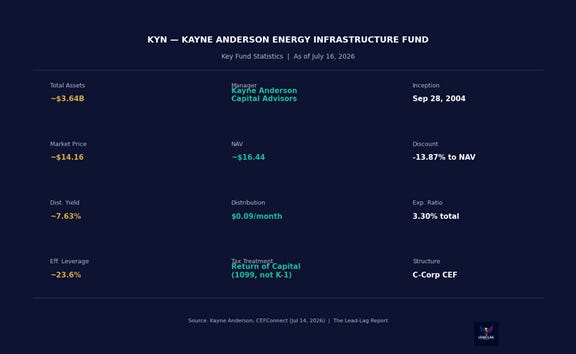
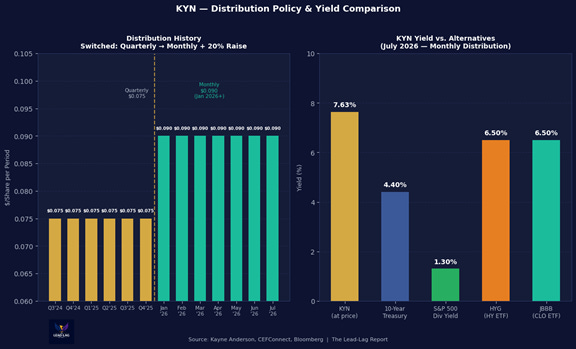
- Yield: 7.63% distribution yield | $0.09/month (switched from quarterly, raised 20%)
- Tax: Return of capital distributions — 1099 (not K-1)
- Valuation: -13.87% discount to NAV — wider than 52-week avg (-11.89%); mean-reversion potential
- 2026 YTD: +25.7% price return as AI energy demand lifts midstream; NAV rose faster
- AUM / Cost: ~$3.64B total assets | 3.30% expense ratio (C-Corp tax drag included)
Every week, we'll profile a high yield investment fund that typically offers an annualized distribution of 6-10% or more. With the S&P 500 yielding less than 2%, many investors find it difficult to achieve the portfolio income necessary to meet their needs and goals. This report is designed to help address those concerns.
Macro/Market Context
The single most important energy story of this decade is not the price of oil. It is electricity, and more specifically the electricity required to power artificial intelligence. Every major hyperscaler, from Microsoft and Google to Amazon and Meta, is racing to build and expand data centers that consume power on a scale the grid has never had to accommodate. The fastest-deployable source of baseload power for that buildout is natural gas, and natural gas moves through pipelines. RBC Capital Markets estimated in May 2026 that natural gas consumption from data centers could reach roughly 6.1 billion cubic feet per day by 2030, a demand driver that simply did not exist when most pipeline investors first built their thesis.
The reframing has been swift enough to reach the mainstream financial press. Fortune ran the headline "Data centers and gas demand make boring pipelines great again" in April 2026, and that same month ADI Analytics described "midstream's shift from pipes to power platforms." The companies that own and operate these systems are the toll collectors of the energy economy. They do not need oil at a hundred dollars a barrel to profit. They collect fees on volume, and volume is rising because the AI campuses being built across the country have to be fed.
One vehicle that packages this exposure into a single listed security is the Kayne Anderson Energy Infrastructure Fund (KYN), a closed-end fund managed by Kayne Anderson Capital Advisors, L.P. The fund was officially renamed from the Kayne Anderson MLP/Midstream Investment Company in June 2026, a change that captures how the underlying business has broadened from pure MLPs toward the wider energy infrastructure that now includes the power backbone of the data center era. KYN owns a concentrated portfolio of the largest midstream operators in North America and pays a distribution that yields roughly 7.63% at the current price. It is not a quiet income vehicle. It is a leveraged, high-conviction wager on the arteries of the continent's energy system, and it has just gone through a transformation that changes how the fund should be read.
Fund Background
Structure. KYN is a non-diversified closed-end fund that trades on the NYSE. It launched on September 28, 2004, and operates on a fiscal year ending November 30. Unlike most closed-end funds, which are organized as regulated investment companies, KYN is structured as a C-corporation, a detail that carries meaningful tax consequences discussed later.
Manager. The fund is managed by Kayne Anderson Capital Advisors, L.P., a firm with deep specialization in energy and midstream infrastructure investing. That focus matters in a sector where portfolio construction, leverage management, and tax handling require dedicated expertise.
Scale and leverage. KYN now manages roughly 3.64 billion dollars in total assets, with net assets attributable to common shareholders of about 2.78 billion dollars. That is a dramatic increase from the fund's footprint a year or two ago, driven by both asset appreciation and the sector's expansion. Effective leverage sits near 23.6% of assets, notably lower than the 30 to 33 percent range the fund carried in prior cycles. The deleveraging is a meaningful risk reduction, though leverage still amplifies both gains and drawdowns.
Pricing. As of July 16, 2026, KYN trades near 14.16 dollars per share against a net asset value of roughly 16.44 dollars, a discount to NAV of about negative 13.87 percent. Over the trailing 52 weeks the shares have ranged from 11.31 to 14.70 dollars, and the average discount over that period has been negative 11.89 percent. The price is up roughly 39% so far this year.
Portfolio Composition
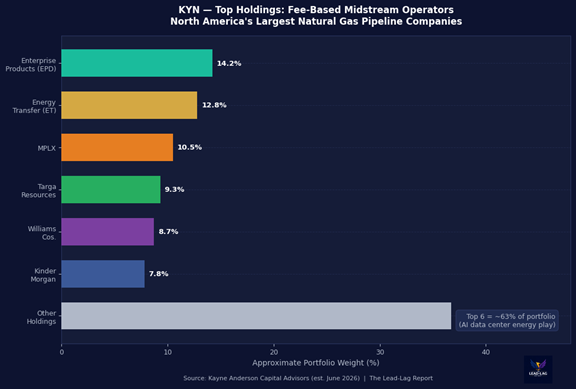
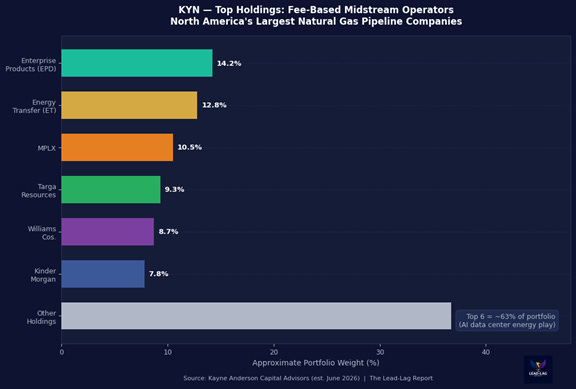
KYN holds a concentrated basket of midstream energy companies. The largest positions are Enterprise Products Partners (EPD) at about 14.2%, Energy Transfer (ET) at 12.8%, MPLX at 10.5%, Targa Resources at 9.3%, Williams Companies at 8.7%, and Kinder Morgan at 7.8%, with the remaining roughly 36.7% spread across other holdings. These are the largest and most established operators of natural gas pipelines, LNG terminals, and crude oil pipelines on the continent. The portfolio is entirely North American, spanning the United States and Canada, with no meaningful international exposure.
The defining characteristic of these businesses is that they are fee-based. This is the most misunderstood aspect of midstream investing. When most investors hear MLP or pipeline, they assume they are making an oil price bet. They are not. Enterprise Products Partners, Williams, and MPLX charge fees to transport gas and liquids through their systems regardless of whether crude trades at sixty dollars or a hundred. Many contracts are take-or-pay, meaning the customer pays for capacity whether or not it is used. The economics resemble toll roads far more than oil wells, and that distinction is exactly why the data center demand story flows so directly into these companies' revenue.
The tradeoff for that focus is concentration. The top six holdings alone represent more than 60 percent of the portfolio, which is materially more concentrated than a broadly diversified closed-end fund. That concentration works in the investor's favor when midstream is in favor and works against the investor when it is not. It is worth noting that the sector has undergone a wave of conversions from MLP structures to C-corporation structures over the past several years, so the portfolio now blends both MLPs and C-corp midstream operators, which is part of why the fund's own name has moved away from an MLP-centric label.
Performance Analysis
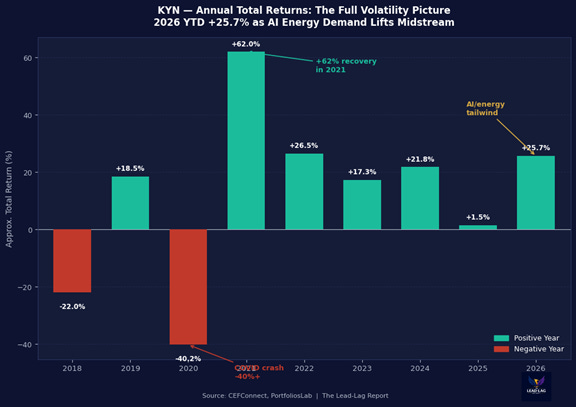
KYN's history is a lesson in volatility, and 2026 has been a lesson in what happens when a beaten-down sector catches a genuine secular tailwind. The fund's price is up roughly 39% year to date, and its total return, which layers the distribution on top of price appreciation, sits near positive 25.7% by the standard total-return measure that also accounts for the deep discount at which the shares entered the year. That is a powerful run, and it has been driven almost entirely by the market waking up to what AI-era gas demand means for the pipes.
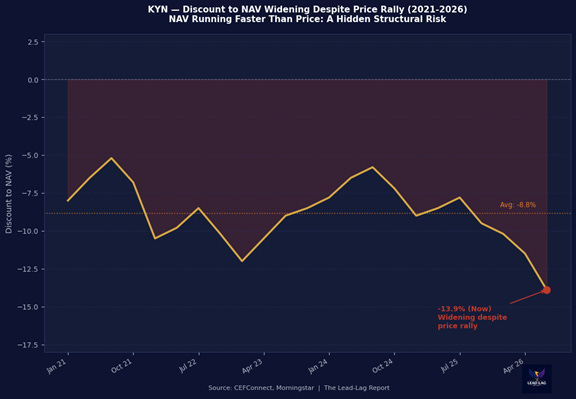
The more revealing number is buried in the relationship between price and NAV. The shares climbed hard, but net asset value climbed even harder. That is the only way to reconcile a 39% price rally with a discount that has widened from the high single digits to negative 13.87 percent. In plain terms, the underlying midstream businesses in the portfolio appreciated faster than the fund's own share price could keep up with. The market bid up KYN meaningfully, and still did not bid it up enough to match the growth in the assets it holds.
The discount to NAV therefore adds a dimension that most performance discussions miss. KYN has historically traded at a persistent discount, and today's negative 13.87 percent is not only wider than the 52-week average of negative 11.89 percent, it is well below the tighter levels near negative 8 percent that the fund reached at points over the past year. For a patient investor, a reversion from a 13.87 percent discount back toward the 8 percent area would represent a second source of return layered on top of the distribution, independent of what the underlying assets do next. That said, the widening itself is a caution flag, which I address below.
Macro Environment
The bull case for KYN rests on demand for the infrastructure it owns, and that demand has moved from thesis to headline. The AI data center buildout is the newest and arguably most powerful driver. Natural gas is the fastest-deployable baseload power source for hyperscalers, and it reaches power plants through the pipelines KYN's holdings own and operate. RBC's estimate of roughly 6.1 billion cubic feet per day of data center gas demand by 2030 is the kind of structural volume growth that fee-based operators are built to monetize.
The LNG export boom reinforces the case. As the United States has become the world's largest LNG exporter, demand for gas gathering and transportation infrastructure has climbed alongside it. Permian production growth keeps crude pipelines full, and midstream operators are increasingly pivoting toward power generation partnerships, a shift ADI Analytics captured in describing the move from pipes to power platforms. The story is no longer obscure, which is both its strength and its complication for new buyers.
The risks are real. A recession would reduce industrial gas demand. Political risk is genuine, particularly the possibility of a policy reversal on LNG exports or a tightening of pipeline permitting. And because midstream closed-end funds are often held as yield alternatives, they carry some interest-rate sensitivity, since higher rates can compress valuations as investors demand yield elsewhere. Oil prices matter less than commonly assumed for fee-based operators, but sentiment around oil still moves the shares.
Distribution Policy
The distribution has been restructured, and the change matters. KYN now pays 0.09 dollars per share every month, having switched from its former quarterly cadence of 0.075 dollars per share. On an annualized basis that moves the payout from roughly 0.30 dollars to 1.08 dollars per share, a jump of about 20 percent once the shift to monthly and the higher rate are combined. At the current price of 14.16 dollars, that annualized 1.08 dollars produces a distribution yield of about 7.63 percent. Two things are happening at once here: a more frequent payment schedule that income-focused holders tend to value, and a genuine raise in the underlying dollars distributed. Management does not restructure a distribution upward, and commit to a monthly rhythm, unless it has confidence in the cash flows behind it. I read the change as a signal.
The nature of that distribution is where KYN gets interesting and where it is most frequently misunderstood. The distributions are overwhelmingly characterized as return of capital for tax purposes. This is not a sign of financial distress. It is a direct consequence of how midstream businesses work. MLPs depreciate their assets heavily, generating large non-cash deductions that offset ordinary income, and those deductions flow through and cause the fund's distributions to be classified as return of capital. For a shareholder, that generally means you do not pay tax on this income in the year you receive it. Instead your cost basis is reduced, and the tax is deferred until you sell. For a long-term holder in a taxable account, that is one of the most tax-efficient yield structures available in the market.
One structural point deserves emphasis. Because KYN is organized as a C-corporation rather than a regulated investment company, shareholders receive a 1099 at year-end rather than a Schedule K-1. Investors who own MLPs directly must contend with K-1 forms, state filing complications, and unrelated business taxable income issues in retirement accounts. Owning KYN sidesteps all of that. The K-1 headache of direct MLP ownership is, in fact, one of the strongest reasons some investors choose the fund wrapper instead.
Advantages
The AI energy demand story is the most compelling long-term reason to own KYN. Data center electricity consumption is a secular tailwind for natural gas pipelines that did not exist when most pipeline investors formed their views, and it is now backed by concrete forecasts rather than speculation. KYN owns shares in the companies that own the pipes gas travels through on its way to powering AI. If the buildout continues at anything close to current projections, volumes across the fund's holdings should benefit for years.
The fee-based nature of the income is a structural advantage that the market persistently misprices. KYN is not an oil price bet. Its holdings charge tolls to move hydrocarbons, and many of those tolls are locked in under take-or-pay contracts. That makes the cash flows far steadier than the commodity headlines would suggest, and it gives the newly raised distribution a real foundation rather than a financial-engineering one.
The distribution restructuring is itself an advantage worth naming. A move to monthly payments plus a roughly 20 percent raise, from 0.30 to 1.08 dollars annualized, is a management signal of confidence in the durability of underlying cash flows. Combined with the return of capital tax treatment and the 1099 simplicity, a taxable investor receives high, tax-deferred current income on a schedule that supports regular income planning.
Finally, the discount to NAV of nearly 14 percent provides a margin of safety and a potential second engine of return. Buying midstream assets for roughly 86 cents on the dollar means investors capture the distribution and stand to gain additional appreciation if the discount compresses toward its recent tighter levels. Because the discount is currently wider than both its 52-week average and its recent highs, the mean-reversion setup is more favorable now than it was during the tighter windows of the past year.
Disadvantages
The widening discount is the most counterintuitive fact in this report, and it deserves to be treated as a yellow flag rather than dismissed as pure opportunity. A discount does not usually widen while a fund's price is rallying 39 percent. The fact that it has means NAV outran price, and it raises a fair question about whether the market is deliberately withholding full credit from these assets. It could be a temporary dislocation that reverts, or it could reflect a market that expects the underlying midstream valuations to cool. Investors buying today are making a bet on the former, and that bet is not guaranteed.
The second concern is simply that a great deal of good news is now in the price. At 14.16 dollars, near the top of a 52-week range that runs to 14.70, and after a total return above 25 percent this year, the easy money in the AI energy re-rating has likely already been made. The story is mainstream now. Fortune wrote the headline. When a thesis reaches that stage, the asymmetry of buying it shifts, and new capital is paying up for a narrative that early holders got at a deep discount.
The cost structure is heavier than it looks. The total expense ratio of 3.30 percent is high, and it embeds the C-corporation tax drag that pure MLP exchange-traded funds do not carry. Because KYN pays corporate income tax on its income, there is a real cost inside the wrapper. Investors are accepting a form of tax leakage in exchange for the 1099 simplicity and the leveraged exposure, and 3.30 percent is a meaningful hurdle the portfolio must clear before shareholders see net returns.
Leverage and concentration round out the risk picture. Effective leverage near 23.6 percent is lower than the fund's historical range and that is welcome, but it still amplifies drawdowns in a shock, and KYN has fallen more than 60 percent in past crises. Concentration compounds the point, with the six largest positions exceeding 60 percent of assets, so trouble at one or two large operators would hit the fund hard. Political and regulatory risk, from LNG export policy to pipeline permitting, sits on top of all of it.
Final Thoughts
KYN has transformed. It has a new name that better reflects its business, a distribution that is now monthly and roughly 20 percent higher, a much larger asset base, and lower leverage than it carried in prior cycles. The AI energy demand thesis that underpins it has moved from the margins to the mainstream, and the fund's 39 percent price gain this year is the market's acknowledgment of that shift. For a conviction investor in North American energy infrastructure, the fee-based income model, the tax-efficient return of capital treatment, and the wider-than-average discount all remain genuinely attractive. But two tensions define this moment. The first is that with the story now well understood and the shares near their 52-week high, the easy re-rating may be behind us. The second is that the discount widened rather than narrowed during the rally, which is either a mispricing waiting to correct or a signal that the market is pricing the assets more cautiously than the price alone suggests. I lean toward the view that the wider discount offers real mean-reversion potential, but I would not confuse a high-yield energy bet with a stable income holding. KYN rewards patience and a strong stomach. Position it accordingly.
The Lead-Lag Report is provided by Lead-Lag Publishing, LLC. All opinions and views mentioned in this report constitute our judgments as of the date of writing and are subject to change at any time. Information within this material is not intended to be used as a primary basis for investment decisions and should also not be construed as advice meeting the particular investment needs of any individual investor. Trading signals produced by the Lead-Lag Report are independent of other services provided by Lead-Lag Publishing, LLC or its affiliates, and positioning of accounts under their management may differ. Please remember that investing involves risk, including loss of principal, and past performance may not be indicative of future results. Lead-Lag Publishing, LLC, its members, officers, directors and employees expressly disclaim all liability in respect to actions taken based on any or all of the information on this writing.