The Warsh Test, Round Two: Hiking Into a Bond Rally
The Fed promised one more hike. Oil, jobs, credit spreads and a sudden bond rally now argue for patience. What the dots, the 2-year yield and breakevens say heading into the Oct. 28 decision.


Today’s Lead-Lag Report post is sponsored by Infrastructure Capital Advisors

Jay Hatfield on markets and the economy, Monday at 2:00 PM ET
Infrastructure Capital Advisors sponsors this Lead-Lag Live webinar. Founder and CEO Jay Hatfield joins Michael Gayed on Monday, October 26 at 2:00 PM ET for a live look at markets and the economy, built for advisors who field these questions from clients every week. Jay will explain what he is watching and why, in plain English, and take questions live.
On the agenda:
- Housing starts, mortgage rates and what the Fed may do next
- How a real-time inflation measure compares with reported CPI
- Where credit markets stand on AI infrastructure financing
- How the 10-year yield relates to Fed policy
Registration is free and takes under a minute. Bring the questions your clients have been asking you about rates, housing, inflation and credit. Register free here.
DISCLAIMER – PLEASE READ: Sponsored by Infrastructure Capital Advisors, LLC. Views expressed are those of the speaker and are not investment advice. This is sponsored advertising content for which Lead-Lag Publishing, LLC has been paid a fee. The information provided in the link is solely the creation of Infrastructure Capital Advisors, LLC. Lead-Lag Publishing, LLC does not guarantee the accuracy or completeness of the information provided in the link or make any representation as to its quality, and expressly disclaims any responsibility for action taken in connection with the information provided in the link.
The Warsh Test, Round Two: Hiking Into a Bond Rally
The Fed meets Oct. 27 to 28 after a 12 to 0 hike, with CPI at 3.7%, payrolls up 29,000, Brent above $116 and the 10-year yield just posting its biggest one-day drop since 2023. Why a hawkish hold is the base case and what would change it.
MICHAEL A. GAYED, CFA
The Federal Reserve meets on Tuesday and Wednesday, and for the first time this year the bond market has handed Kevin Warsh a problem instead of a mandate. Six weeks ago the committee raised rates 12 to 0 and told everyone another hike was likely by year end. Since then oil has surged, credit spreads have widened, payroll growth has nearly stopped, and on Thursday the 10-year yield had its biggest one-day drop since March 2023. The question for October 28 is not whether inflation is too high. It is whether the Fed hikes into a market that has started hedging a slowdown.[1][2]
Key Highlights
- The FOMC raised the federal funds target to 3.75% to 4.00% on September 16 by a 12 to 0 vote, its first hike since July 2023 and the first under Chair Warsh.[1][3]
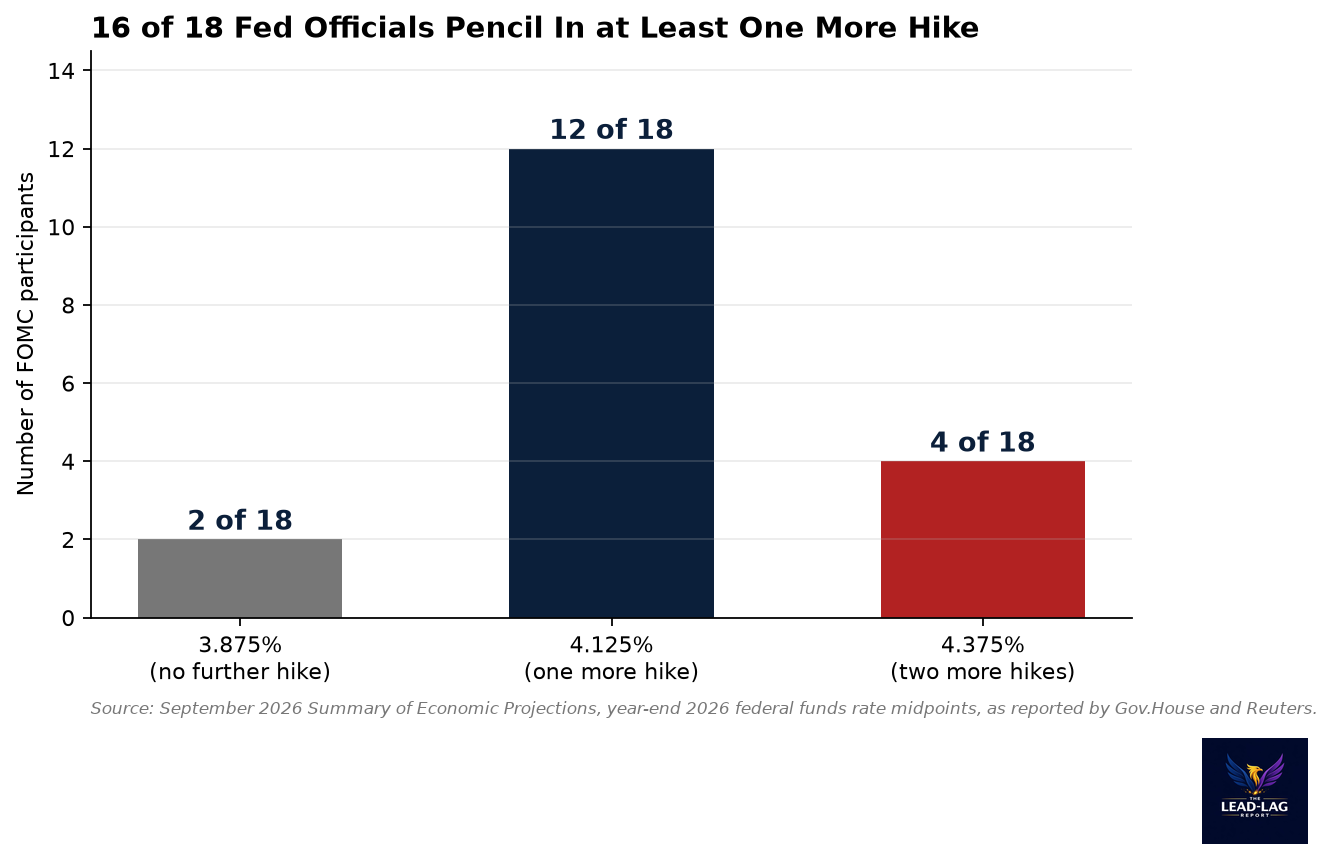
- In the September projections, 12 of 18 officials put the year-end rate at 4.125%, four at 4.375% and two at 3.875%. Sixteen of 18 expect at least one more hike.[3][4]
- September CPI rose 3.7% from a year earlier, with energy up 20.4% and gasoline up 34.2%. Core CPI rose 2.6%. Payrolls rose just 29,000 and unemployment was 4.2%.[5][3]
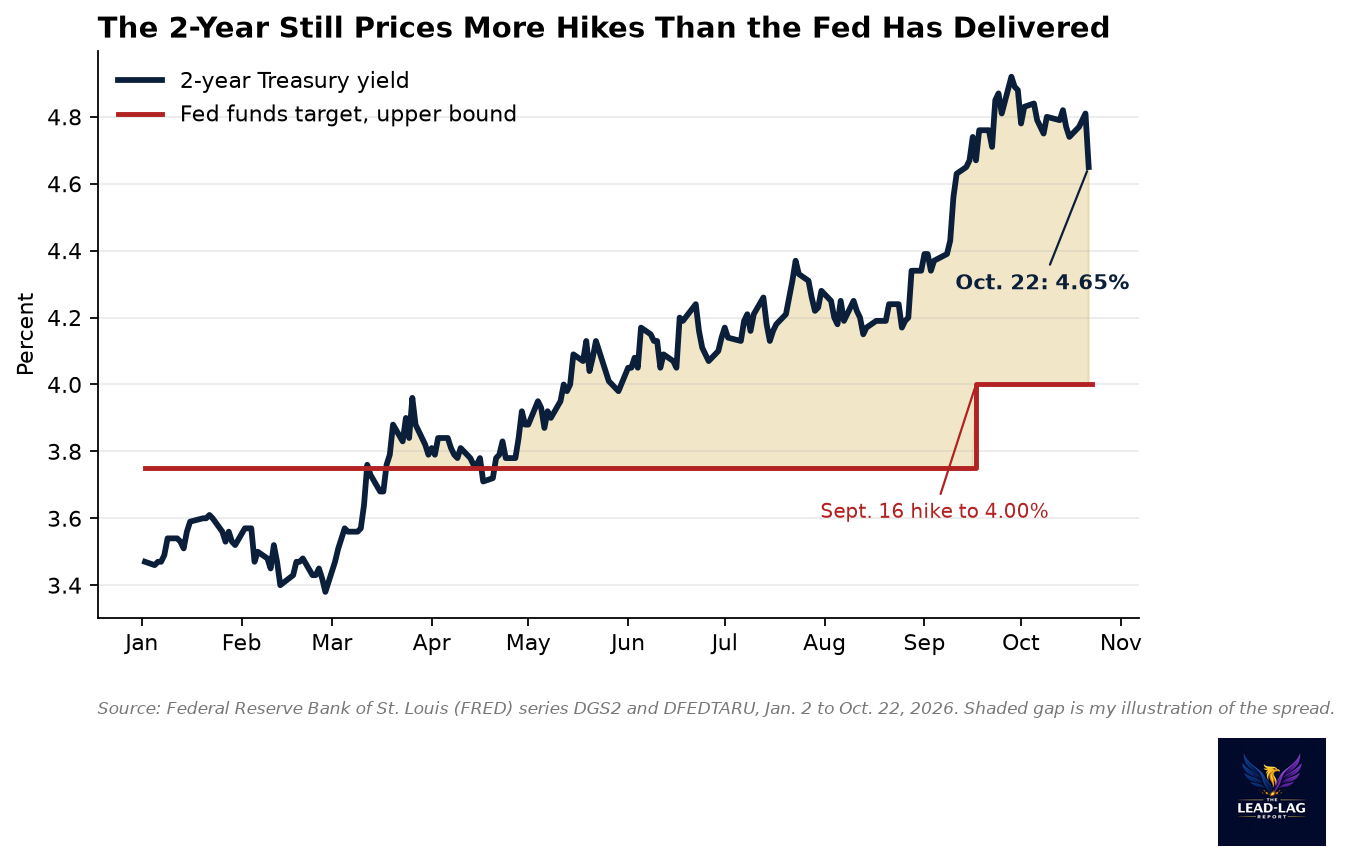
- The 2-year Treasury yield fell to 4.65% on October 22, still 65 basis points above the 4.00% top of the target range. The 10-year breakeven inflation rate sits at 2.34%.[6][7]
- Published research is nearly unanimous on a hold: 40 of 41 houses tracked by FinChiefs expect no change on Wednesday, with December the live meeting.[8]
What The Fed Promised In September
Start with what the committee actually said. The September statement read: "Inflation remains elevated. Today's policy action will support a timelier return to the Committee's 2 percent goal. The Committee will deliver price stability."[3] Warsh put it more bluntly at his press conference, saying the hike came because "inflation is too high and has been for too long."[9]
The minutes, released October 7, kept the door open in both directions. Most participants judged that "another increase in the target range for the federal funds rate would likely be appropriate by year end," and the same minutes say they "approached each meeting with an open mind."[10][3] That sentence leaves two meetings in play, this one and December 8 to 9. It does not choose.
The dots are the clearest guide. Twelve of the 18 participants placed the year-end midpoint at 4.125%, one hike above today. Four placed it at 4.375%, two hikes. Only two saw no further move.[3] Eight of 18 also expected at least one more hike in 2027.[11] That is a committee leaning hawkish as a group, not a chair dragging a reluctant board.
The two most important voices since then have said the same thing in different words. Governor Christopher Waller said on October 8: "If the economic data continue to come in as expected, I anticipate additional hikes to support a timelier return of inflation to our 2 percent goal." He added that "the hikes do not need to come at consecutive meetings."[3] New York Fed President John Williams said on October 13 that "it may be appropriate to have one more rate hike," and then, pointedly, "It's still mid-October."[3]
Read those together and the message is patience, not reluctance. The committee wants one more hike. It does not need it this week.
What Changed In Six Weeks
Here is where it gets harder. Almost every input the Fed watches moved after September 16, and they did not all move the same way.
Inflation went up. September CPI rose 0.6% in a single month and 3.7% over a year. Energy prices are up 20.4% and gasoline 34.2% from a year earlier.[5] The October Beige Book said "higher oil prices permeated all District reports."[3] Core CPI, at 2.6%, is a different story. The headline is an energy story, and energy is the one input monetary policy cannot drill for.
Oil kept going. Brent settled at $116.72 on Friday, its highest since April 29, after starting October below $97.[12][13] That is a gain of more than 20% in three weeks. It is a supply shock, driven by attacks in the Gulf and reports of renewed strikes on Iran, not by demand running hot.[12][14]
Jobs went quiet. September payrolls rose 29,000. July was revised to a loss of 10,000, and August was cut to 133,000 from 162,000. The unemployment rate is 4.2%.[3] The Beige Book said "most Districts described little or no net change in overall employment levels."[3]
Credit stopped cooperating. The ICE BofA US High Yield option-adjusted spread reached 3.40% on October 22, its widest since March 30 and 80 basis points above the August 28 low. The CCC spread, the market's weakest borrowers, reached 13.40%.[15]
And bonds rallied. On October 22 the 10-year Treasury yield fell 17 basis points to 4.972%, the largest one-day drop since March 10, 2023, while the S&P 500 fell 1.2%.[2][16] Bloomberg reported that the rally reduced bets on another Fed hike this year.[16] By my calculation, the 20-day correlation between long Treasuries and the S&P 500 turned negative this week for the first time since July.[17] Bonds are behaving like a hedge again.
So the Fed walks in with headline inflation rising, core flat, a supply shock in energy, hiring near zero, and credit spreads drifting wider. That is a textbook stagflation mix. It is also the hardest kind of mix to set policy against.
What The Market Is Pricing
The simplest market read is the gap between the 2-year Treasury yield and the policy rate. The 2-year closed at 4.65% on October 22, against a target range topping out at 4.00%.[6] It was 4.81% the day before.[6] That gap is not a forecast of a single meeting, but it tells you the market still expects the policy rate to be higher over two years than it is today.
Meeting by meeting, odds for an October hike were near 24% on October 13, jumped above 50% in trading after the CPI report, and then eased later that day.[3] Sell-side research has settled on a hold. FinChiefs counted 40 of 41 houses expecting no change on Wednesday, calling it "a hawkish pause rather than the end of tightening."[8]
The detail I find most telling is in inflation expectations. Oil rose about 25% from June 1 to October 23 by the price of the USO oil fund. Over the same stretch the 10-year breakeven inflation rate barely moved, and on October 23 it was 2.34%.[17][7] On October 22, the day of the bond rally, the breakeven actually fell 5 basis points while the real yield fell 12.[7][18]
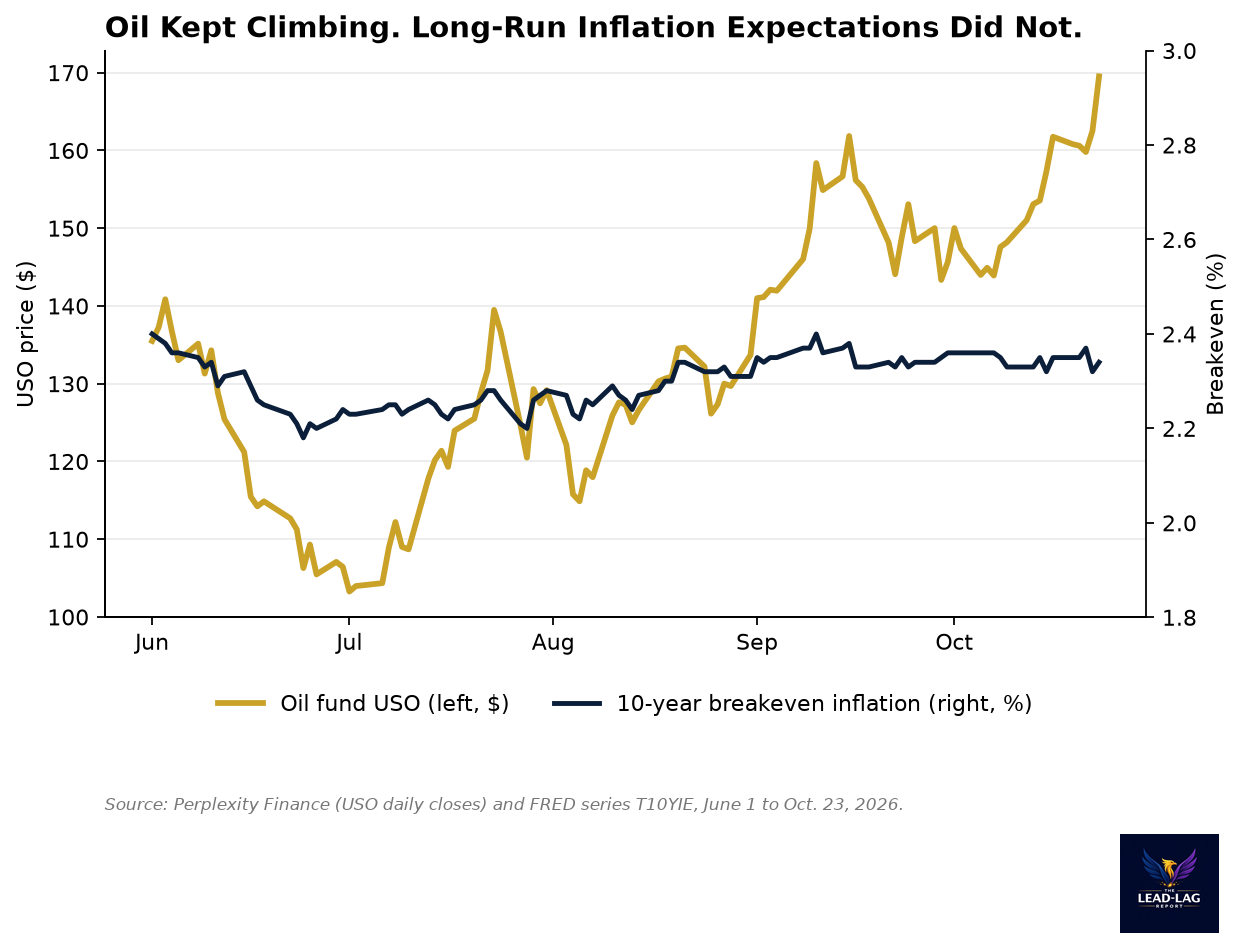
That is the Fed's credibility showing up in prices. The market does not believe the oil shock becomes a permanent inflation problem. It is starting to believe the oil shock becomes a growth problem. If that is right, September's hike already did its job, and a second one at this meeting buys very little extra credibility at a real cost to growth.
The Three Ways Wednesday Can Go
I do not make calls on what any reader should own. I map outcomes, because the reaction will matter more than the decision.
- A hawkish hold. This is the consensus. The statement keeps the language that further increases are likely, and Warsh points to December. The 2-year probably stays well above the target range, and the market keeps the hedge it bought last week. This is the outcome most consistent with the minutes, Waller and Williams.[10][3]
- A second hike now. As Gov.House put it, a move on October 28 "would still be consistent with everything the committee has said."[3] But it would land after a week in which credit spreads widened and stocks fell. A hike into a growth scare is how policy mistakes get named later. I would watch the CCC spread more than the S&P 500 for the verdict.
- A dovish hold. The statement softens the guidance and Warsh leans on the jobs data. The 2-year would likely fall hard, and the long end might steepen as the market prices a Fed that tolerates higher headline inflation. The bond hedge would work again. The question is whether breakevens stay near 2.3% or start to climb.
There are no new projections at this meeting. The next Summary of Economic Projections arrives with the December 8 to 9 meeting.[3] That matters, because it means the press conference carries the whole message. Warsh speaks at 2:30 p.m. ET, half an hour after the 2:00 p.m. statement.[3]
Where The Risk Sits
If you hold a balanced portfolio, the decision matters less than what it does to the two relationships that broke down this year. The first is the stock-bond correlation. Through the summer, long Treasuries fell on the same days stocks fell, which is what an inflation shock does to a 60/40 portfolio. This week they did the opposite.[17] A Fed that hikes again into the oil spike risks pushing bonds back into lockstep with stocks, because it tells the market inflation is still the binding constraint.
The second is the spread between safe and risky credit. Real yields have been the main driver of the move in long rates. On October 22, about 70% of the drop in the 10-year yield came from the real yield rather than from inflation expectations, by my arithmetic on the FRED series.[18][7] Falling real yields and widening junk spreads at the same time is the market pricing slower growth, not lower inflation. That is the setup in which an extra hike does the most damage to the weakest borrowers, and where the CCC spread has already moved the most.[15]
The Calendar Around The Decision
The Fed does not decide in isolation this week. The next morning brings the September personal income and outlays report at 8:30 a.m. ET, which carries the PCE price index the Fed actually targets, along with the first estimate of third-quarter GDP.[3][19] Core PCE rose 3.0% in the 12 months through August.[3] That is above core CPI, and it is a reminder that the Fed's preferred gauge is running hotter than the one most investors watch.
The Bank of Japan meets on October 29 and 30.[20] A Fed that pauses and a Bank of Japan that tightens would push the dollar and the yen in opposite directions at the same moment, and global markets have been carrying a lot of yen-funded risk this year.
Then politics. Reuters noted after the September meeting that this decision falls just before the midterm elections that decide control of Congress.[21] The president has called for cuts and the Fed raised rates anyway.[9] I do not expect the calendar to move the committee. I do expect the market to read any softening in the statement through a political lens, fairly or not.
Why This Is The Real Warsh Test
The first Warsh test came over the summer. The July hold was not unanimous, and the committee then raised rates 12 to 0 in September after a 9 to 3 vote in July.[21] The committee met its own condition and hiked. That was the easy part. Hiking into rising inflation with a strong labor market is what central banks are built to do.
The harder part is now. Inflation is being driven by a supply shock the Fed cannot fix. Hiring has nearly stopped. Credit is widening. And the bond market, which spent the summer selling Treasuries alongside stocks, has started buying them as insurance. A central bank earns credibility by hiking when it is unpopular. It keeps credibility by knowing when the hike it promised can wait.
I think the committee holds this week and keeps December alive. I think the language matters more than the rate. And I think the most important number on Thursday is not GDP or PCE but the high yield spread, because that is where a policy mistake shows up first.
What Would Change My View
- Breakevens break higher. A 10-year breakeven moving toward 2.5% from 2.34% would say the oil shock is becoming an inflation expectations problem, and the case for a faster second hike gets much stronger.[7]
- Core PCE accelerates on Thursday. Core PCE was 3.0% through August. A clear move higher would undercut the idea that the inflation story is mostly energy.[3]
- Credit tightens back. If the high yield spread falls back toward 3.0% from 3.40%, the growth scare was noise and the Fed has more room to hike.[15]
- The 2-year rejoins the target. If the 2-year falls toward 4.00%, the market is pricing the end of the cycle. If it climbs back above 4.8%, it is pricing more than the dots.[6]
The Fed promised one more hike. The market is now asking whether it still needs it. Wednesday tells us which side blinks first.
Few understand this.
— — —
Notes
- [1] FOMC statement, Sept. 16, 2026: 25 basis point hike to 3.75% to 4.00%, 12 to 0 vote: Federal Reserve Board.
- [2] 10-year yield move, record one-day drop since March 2023, oil settlements and AI issuance comments: CNBC, October 22, 2026.
- [3] October FOMC preview: dot distribution, CPI, payrolls, Waller and Williams remarks, Beige Book, meeting and data calendar: Gov.House, Oct. 15, 2026.
- [4] 16 of 18 policymakers expect at least one more hike by end of 2026: Reuters Morning Bid, Sept. 17, 2026.
- [5] Consumer Price Index, September 2026: all items +3.7%, core +2.6%, energy +20.4%, gasoline +34.2%: Bureau of Labor Statistics, Oct. 14, 2026.
- [6] 2-year Treasury yield (DGS2) and federal funds target upper bound (DFEDTARU): FRED.
- [7] 10-year breakeven inflation rate (T10YIE): FRED.
- [8] Research tally for the Oct. 28 meeting: 40 of 41 houses expect a hold: FinChiefs.
- [9] Warsh: inflation "too high and has been for too long"; Trump opposition to the hike: BBC News.
- [10] Minutes of the Sept. 15 to 16, 2026 FOMC meeting: Federal Reserve Board.
- [11] 8 of 18 dot submitters expect at least one additional hike in 2027: J.P. Morgan Asset Management.
- [12] Brent settlement of $116.72 on October 23, highest since April 29, and Adam Turnquist comment: Reuters via Central Oregon Daily, October 23, 2026.
- [13] Brent from under $97 at the start of October; about three of four S&P 500 stocks fell: Associated Press, October 23, 2026.
- [14] Report that the U.S. and Israel are weighing strikes on Iran after the midterms: Briefs, Treasuries rally as stocks sell off and oil jumps.
- [15] ICE BofA US High Yield and CCC option-adjusted spreads (BAMLH0A0HYM2, BAMLH0A3HYC): FRED.
- [16] S&P 500 and Nasdaq 100 moves, Treasury haven status, fading Fed hike bets, spot gold: Bloomberg markets wrap via Swissinfo, October 22, 2026.
- [17] Daily closes and returns for TLT, SPY, HYG, USO, GLD, GDX, SLV and UUP; correlations are my calculations: Perplexity Finance.
- [18] 10-year TIPS real yield (DFII10): FRED.
- [19] Release schedule, GDP and personal income and outlays on October 29: Bureau of Economic Analysis.
- [20] 2026 Monetary Policy Meeting dates, Oct. 29 to 30: Bank of Japan.
- [21] July hold vote 9 to 3; October meeting just before the midterm elections: Reuters, Sept. 17, 2026.