29,000 Jobs. Stocks Up. Bonds Down. One of These Markets Is Wrong.
September payrolls missed by two thirds, July revised to negative 10,000, and stocks rallied while the 10-year still closed higher at 5.28 percent. Stocks and bonds disagreed about the same number.

Today’s Lead-Lag Report post is sponsored by SanJac Alpha
A smarter approach to fixed income investing
SanJac Alpha offers actively managed fixed income ETFs designed to pursue opportunities while also managing risk across today’s fixed income landscape.
The SanJac Alpha Low Duration ETF (SJLD) seeks current income and capital preservation through short-term, high-grade credit markets.
The SanJac Alpha Core Plus Bond ETF (SJCP) seeks to maximize total returns while maintaining a moderate risk profile by providing exposure to a diverse range of Treasury, Agency, and Investment-Grade Bonds, Mortgage-Backed Securities (MBS), mREITs, and Preferred Stocks. Seeks to maximize total return while balancing risk by providing exposure to a broad range of bond products with a bias toward high-grade credits.
Markets change. Volatility is here.
It’s time for active management.
IMPORTANT INFORMATION
SanJac Alpha offers two exchange-traded funds. The funds’ investment objectives, risks, and expenses must be considered carefully before investing. The prospectus contains this and other important information about the investment company. Please read it carefully before investing. A copy of the prospectus can be found by visiting www.sanjacalpha.com or by calling 1-800-617-0004.
Investing involves risk, including loss of principal.
ETFs are subject to additional risks that do not apply to conventional mutual funds, including the risks that the market price of an ETF’s shares may trade at a premium or discount to its net asset value, an active secondary trading market may not develop or be maintained, or trading may be halted by the exchange in which they trade, which may impact an ETF’s ability to sell its shares.
Shares of any ETF are bought and sold at market price (not NAV) and are not individually redeemed from the ETF. Brokerage commissions will reduce returns.
The SanJac Alpha exchange-traded funds are distributed by Quasar Distributors, LLC.
DISCLAIMER – PLEASE READ: This is sponsored advertising content for which Lead-Lag Publishing, LLC has been paid a fee. The information provided in the link is solely the creation of SanJac Alpha. Lead-Lag Publishing, LLC does not guarantee the accuracy or completeness of the information provided in the link or make any representation as to its quality. All statements and expressions provided in the link are the sole opinion of SanJac Alpha, and Lead-Lag Publishing, LLC expressly disclaims any responsibility for action taken in connection with the information provided in the link.
The weakest jobs report of the year arrived Friday, and every market answered it. Their answers did not agree, and the disagreement is the most important thing happening in markets right now.
By Michael A. Gayed, CFA · October 3, 2026
Key Highlights
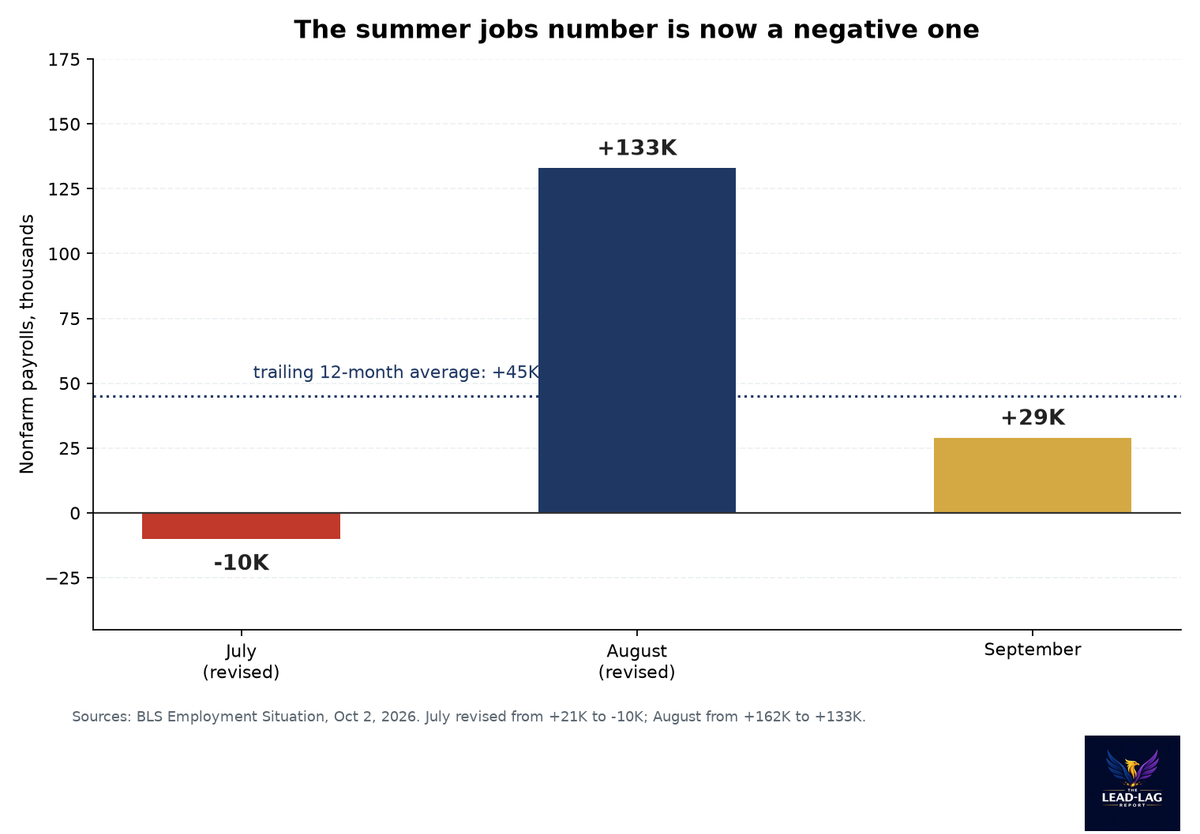
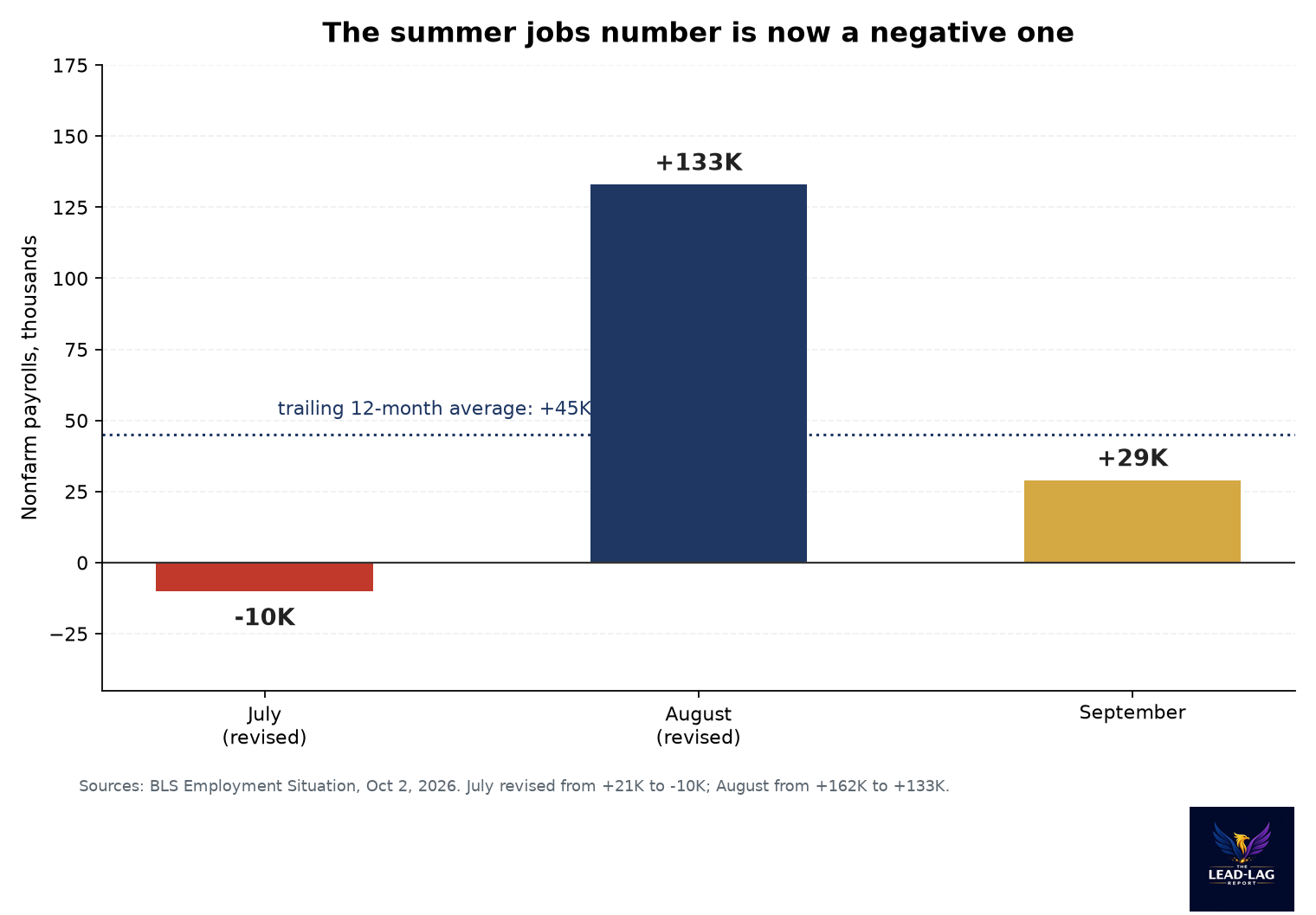
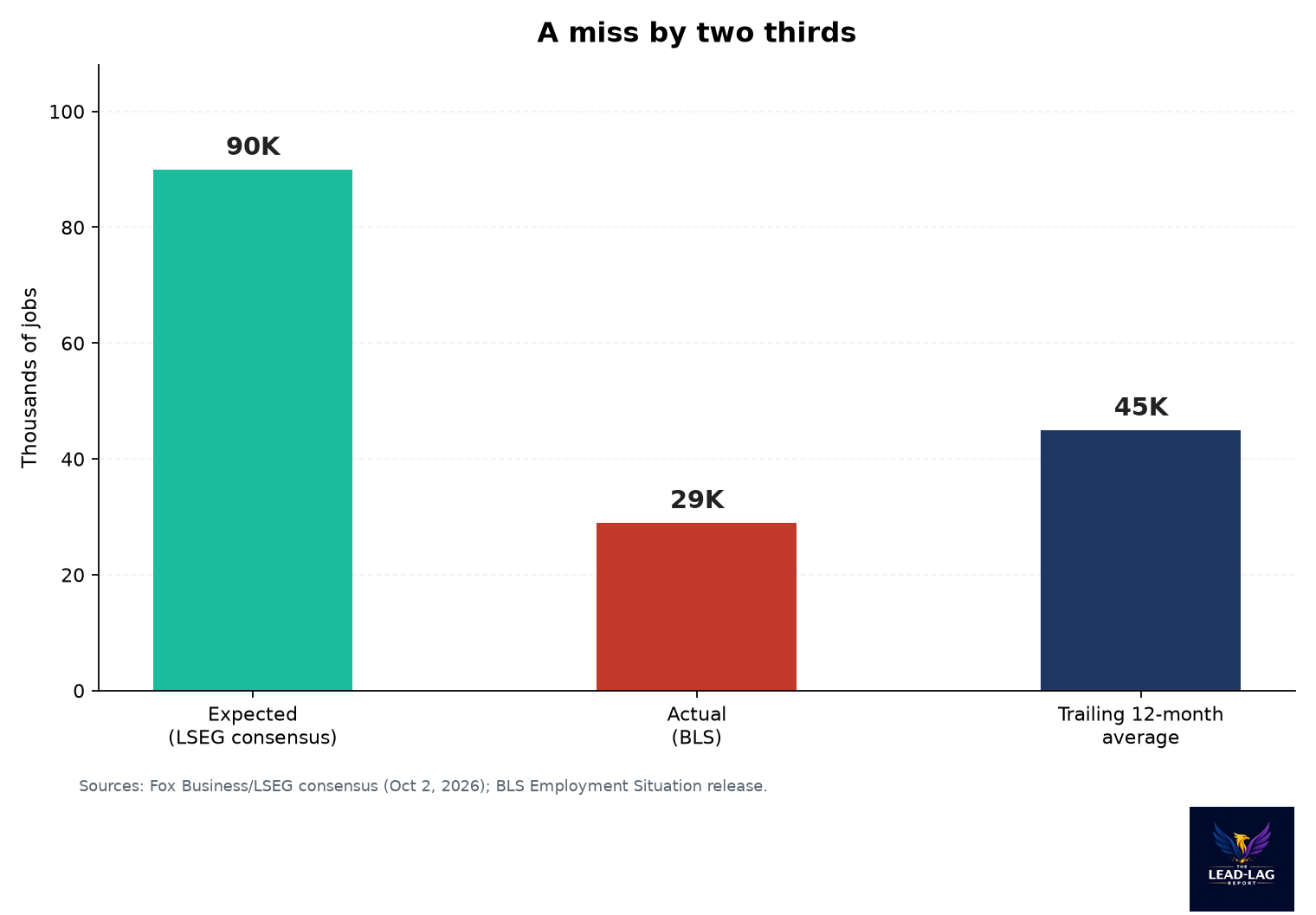
September payrolls rose 29,000 against a 90,000 consensus, and the prior two months lost 60,000 jobs to revision, with July turning negative at -10,000. The trailing 12-month average is 45,000.
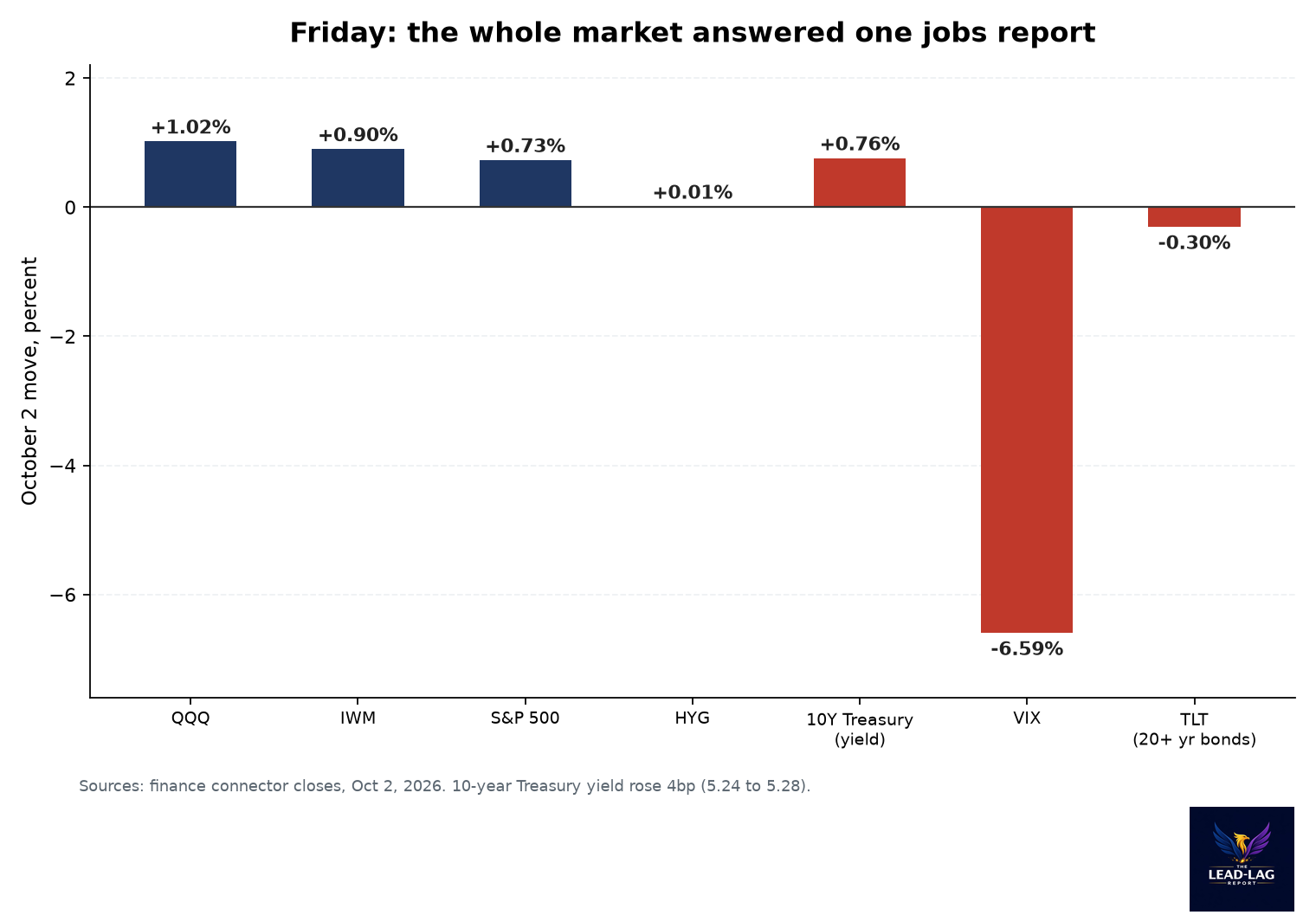
The S&P 500 rose 0.73 percent to 7,722.72 and the VIX fell 6.59 percent to 15.31. The 10-year yield still closed higher at 5.28 percent, and long Treasuries fell. Stocks and bonds disagreed about the same number.
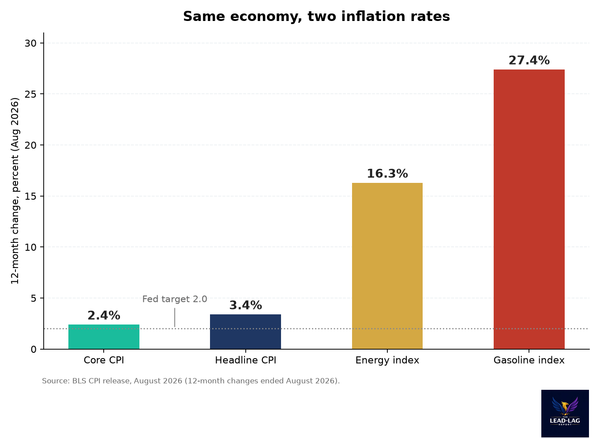
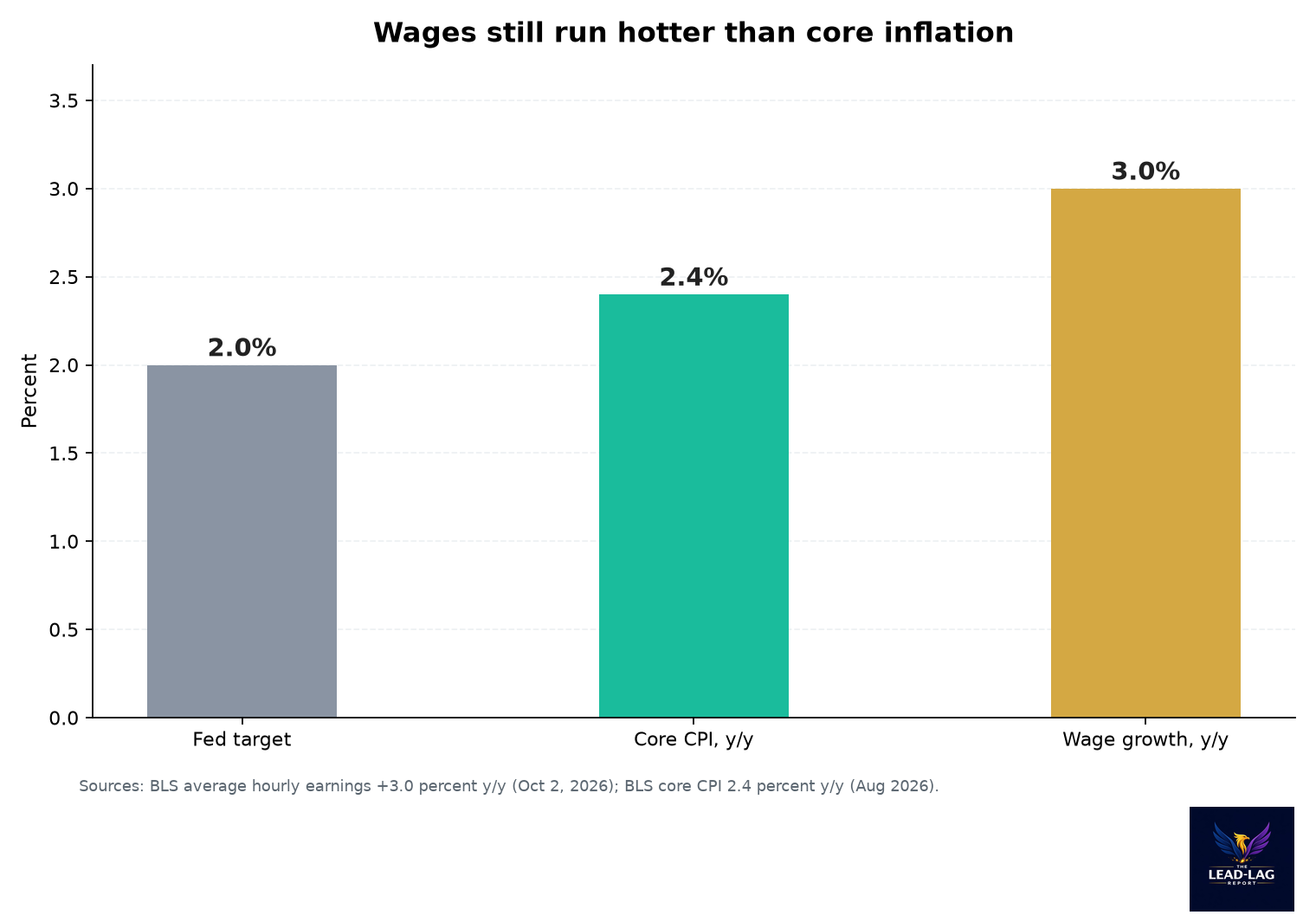
Wages grew 3.0 percent year over year, above core CPI at 2.4 percent, and the unemployment rate sits at 4.2 percent with participation flat at 61.8 percent. The labor market is weakening while the wage number still runs hotter than the core. The Fed's dilemma survived the print intact.
The number, in full
Friday's Employment Situation report was the kind of release that gets revised into the story of a cycle. Nonfarm payrolls rose 29,000 in September against a consensus near 90,000, per the LSEG survey. That is a miss of roughly two thirds, and it lands against a backdrop that was already deteriorating: the trailing 12-month average gain is 45,000, so September came in at a fraction of a trend that had itself slowed.
The revisions did more damage than the headline. July went from +21,000 to -10,000, a month in which the economy shed jobs outright, and August was cut from +162,000 to +133,000. Sixty thousand jobs disappeared from the summer in a single release. This is not a statistical rounding quirk. When a month crosses zero on revision, the question stops being whether growth is slowing and becomes whether employment is contracting at the margin, because the months that surround that negative print were also revised lower.
The internals confirmed the slowdown rather than explaining it away. Health care added 17,000 against a 33,000 average over the prior twelve months, with ambulatory services up 13,000, hospitals up 12,000, and nursing and residential care facilities down 9,000. Construction added 11,000, close to its trend. Manufacturing added 9,000 and remains up 72,000 from its December 2025 low. No single sector explains the miss, and that is precisely the point: the whole pace downshifted, and the revisions say it downshifted earlier than anyone was told.
The labor market's two clocks
The household side of the report tells a subtler story than the payroll count. The unemployment rate ticked up to 4.2 percent, but the BLS notes it has held in a narrow band between 4.1 and 4.3 percent since March. Labor force participation was flat at 61.8 percent. Average hours held at 34.4. This is not an economy shedding workers in a panic. It is an economy that stopped adding them, with the people already employed keeping their jobs and their hours while the entry points quietly close.
That distinction matters for what comes next, because the two clocks run at different speeds. The payroll count is the first clock, and it is running slow enough to force the Fed's attention. Wage growth is the second clock, and it is still fast: average hourly earnings rose 3.0 percent over the past year, a full 0.6 points above core CPI. An economy that stops hiring but keeps paying existing workers more is not a recessionary economy. It is a supply-constrained one, and it is a harder case for rate cuts than the payroll headline suggests.
What every market said, and why they said it
Here is where Friday got genuinely strange. Equities treated the print as a rate-cut ticket. The S&P 500 rose 0.73 percent to 7,722.72, small caps outperformed with IWM up 0.90 percent, and the VIX collapsed 6.59 percent to 15.31, near its lows of the year. The logic is straightforward on its face: a weak employment number hands the Fed a reason to stop, and the market priced the reason before the Fed met.
The bond market did not buy the ticket. The 10-year yield rose to 5.28 percent, up 4 basis points on the day, and long Treasuries fell, with TLT down 0.30 percent. Read that sequence again, slowly: the weakest jobs report of the year could not produce a single day of net strength in long Treasuries. Yields dipped toward 5.15 in the initial minutes, and the dip did not survive the session. When bad data cannot make the bond market rally, the bond market is not pricing the data.
Why the long end does not care
The explanation is the one this report has been building for months, and Friday compressed it into one session. The long end is not trading the policy path. The BIS attributed this year's global long-end climb to term premia driven by fiscal supply, not to rate expectations. A term premium prices the quantity of government debt the market must absorb and the credibility of the fiscal backstop behind it. Neither of those variables moved on Friday morning. The Treasury issuance calendar does not pause for a payroll miss, and the marginal buyer of duration did not wake up caring about one.
This is the mechanism that makes the old playbook dangerous. For most of the last three decades, weak employment data was a buy signal for duration, and by extension a tailwind for every asset priced against duration, from utilities to real estate to gold equities. That transmission worked because the long end traded the Fed. The moment the long end started trading the fiscal calendar instead, the transmission broke, and Friday is the cleanest single-day demonstration available: the data event arrived on schedule, the equity market reacted on script, and the bond market did nothing.
The disagreement is the signal
So one of two markets is mispricing something, and the honest position is that we cannot know which one yet. If the equity rally is right and the labor slide forces the Fed's hand, long Treasuries should be the best-performing asset of the past month. They have not been. Reporting after Friday's print put the odds of an October move lower, per The New York Times, which is the market's cut narrative hardening in real time.
But the Fed that the equity market is pricing is not the Fed that just acted. This is a central bank that raised rates on September 16 for the first time in three years, to a range of 3.75 to 4.00 percent, into an oil shock it cannot print away. Its reaction function includes the wage number, and the wage number cuts against the cut story. A policymaker staring at 29,000 payrolls but 3.0 percent wage growth against 2.4 percent core inflation is staring at a labor market that stopped growing without loosening. Those are the conditions for patience, not for easing.
That leaves the equity market holding the contrarian end of the stick in the meantime. Stocks rallied on weakness in the one data series the Fed watches most, at a 5.28 percent discount rate, with the labor market's slack building underneath the rally. The rally's premise is that rate relief is coming. If October 27-28 delivers patience instead, the premise re-prices at the same 5.28 percent discount rate that has been climbing all year.
The cross-asset tell
The rotation inside the equity market on Friday was as loud as the index moves. Small caps led, with IWM up 0.90 percent against the S&P's 0.73, and the Nasdaq 100 added 1.02 percent. That is an unusual pairing: small caps are the market's most direct exposure to the domestic labor and credit cycle, and they rallied hardest on the weakest labor data of the year. The only reading that reconciles it is that the market was not buying an earnings story, it was buying a rates story. Small caps carry proportionally more floating-rate debt and refinance more often, so a rate-relief trade reaches them first, and the tape traded them as the purest expression of it.
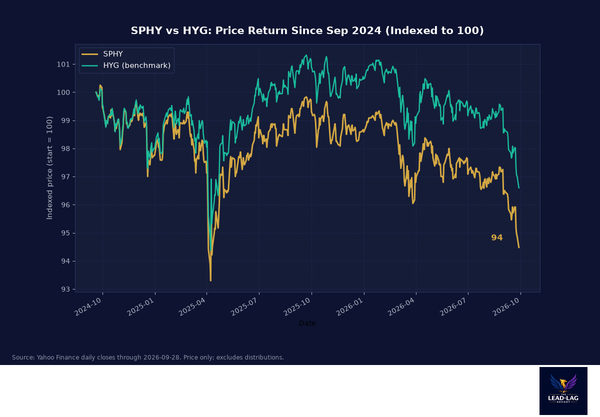
Credit was the dissenting voice inside the risk complex. High yield, which is the part of the bond market that actually reads the labor market, went nowhere: HYG finished flat, up a hundredth of a percent. If the equity market's cut narrative were broadly held, high yield would have outperformed duration on the day, because falling policy rates compress credit spreads first. Instead, high yield investors priced neither the labor weakness nor the cut story, which is consistent with the other thing they can see clearly: a 10-year at 5.28 percent raises every refinancing wall in the credit universe, and no payroll print changes that arithmetic.
Put the three risk markets side by side and Friday's session reads like a poll with contradictory answers. Equities voted for rate relief. Long duration abstained. Credit abstained louder. When the polls disagree this sharply, the resolution is rarely gentle, because whichever way the Fed resolves the October meeting, two of the three markets have to reprice toward the third.
What to watch
Three checkpoints settle it. First, the October 27-28 Fed meeting: the statement and the press conference will reveal whether the payroll miss moved the reaction function or whether the wage number anchors it. Second, the next round of revisions: if September follows July into negative territory, the labor market is not cooling, it is contracting, and the equity rally's premise changes from rate relief to earnings risk. Third, the long end itself, especially through the refunding window: the day bonds fail to rally on bad news is the day you stop owning bonds for the reason you were taught to own them.
The takeaway is not that stocks are wrong or that bonds are wrong. It is that they can no longer be right together the way they used to be. For two decades, bad economic news was good news for a balanced portfolio, because one leg rallied while the other fell. When one number sends equities up and duration down, diversification stops being a portfolio feature and becomes a bet on which market is reading the world correctly. That is a different risk than the one most portfolios were built to hold. Few understand this.
The Lead-Lag Report is provided by Lead-Lag Publishing, LLC. All opinions and views mentioned in this report constitute our judgments as of the date of writing and are subject to change at any time. Information within this material is not intended to be used as a primary basis for investment decisions and should also not be construed as advice meeting the particular investment needs of any individual investor. Trading signals produced by the Lead-Lag Report are independent of other services provided by Lead-Lag Publishing, LLC or its affiliates, and positioning of accounts under their management may differ. Please remember that investing involves risk, including loss of principal, and past performance may not be indicative of future results. Lead-Lag Publishing, LLC, its members, officers, directors and employees expressly disclaim all liability in respect to actions taken based on any or all of the information on this writing.