7% High Yield Exposure For 0.05%: The Cheapest Tool In The Shed
SPHY's 7.10% SEC yield at a 2.89-year duration for five basis points is the honest baseline for junk income.

Today's Lead-Lag Report post is sponsored by Relative Sentiment
The Relative Sentiment Tactical Allocation ETF is a flexible, multi-asset fund that invests across stocks, bonds, commodities, precious metals, and currencies. Its approach is guided by a research-based factor called relative sentiment — which tracks how optimistic or cautious professional investors are compared to individual investors. Studies show professionals tend to have an edge over time, and this ETF seeks to capture that insight by increasing exposure to areas where institutions are more optimistic and reducing exposure where they're more cautious. Relative sentiment often complements trend-following strategies, helping create portfolios that may be more balanced and less prone to sharp swings.
The Fund's investment objectives, risks, charges and expenses must be considered carefully before investing. This and other important information is contained in the Prospectus and SAI, which may be obtained by following the links or by calling +1.215.882.9983. Please read the prospectus carefully before investing.
Investments involve risk. Principal loss is possible.
The Fund is distributed by PINE Distributors LLC.
ETFAC-4976143-11/25
DISCLAIMER – PLEASE READ: This is sponsored advertising content for which Lead-Lag Publishing, LLC has been paid a fee. The information provided in the link is solely the creation of Relative Sentiment. Lead-Lag Publishing, LLC does not guarantee the accuracy or completeness of the information provided in the link or make any representation as to its quality. All statements and expressions provided in the link are the sole opinion of Relative Sentiment. and Lead-Lag Publishing, LLC expressly disclaims any responsibility for action taken in connection with the information provided in the link.
Key Highlights
- Yield: 7.10% 30-day SEC yield per the State Street factsheet, with a 7.38% trailing 12-month indicated yield computed from Yahoo Finance
- Cost: 0.05% gross expense ratio per the factsheet, the cheapest broad high-yield exposure available
- Portfolio: 1,932 holdings tracking the ICE BofA US High Yield Index, option-adjusted duration 2.89 and spread 317.53 bps as of 3/31/2026 per State Street
- Sectors: consumer cyclical 18.01%, communications 15.84%, energy 11.83%, consumer non-cyclical 11.41% per the factsheet
- Risk: 4.2% annualized 1-year price volatility, in line with HYG's 4.3%, computed from daily closes
Every week, we'll profile a high yield investment fund that typically offers an annualized distribution of 6-10% or more. With the S&P 500 yielding less than 2%, many investors find it difficult to achieve the portfolio income necessary to meet their needs and goals. This report is designed to help address those concerns.
Junk Yield Without The Junk Fees
Most of the high yield world's clever packaging, the CEFs, the leveraged funds, the option overlays, exists to transform a ~7% asset class into a double-digit headline. This week I am profiling the opposite product: the cheapest, plainest, most honest way to own the entire below-investment-grade market. The State Street SPDR Portfolio High Yield Bond ETF (SPHY) tracks the ICE BofA US High Yield Index, holds 1,932 bonds, and charges 0.05% per the State Street factsheet. Its 30-day SEC yield is 7.10%.
The Fed hiked to 3.75% to 4.00% on September 16 per Federal Reserve press releases, and short-duration junk is one of the few income sectors where the arithmetic is currently clean: you collect a 7.1% standardized yield, at a 2.89-year duration, in a fund that costs five basis points. The trade-off is that spreads at 317.53 bps per State Street leave very little compensation for a genuine credit event.
Fund Background
SPHY launched June 18, 2012 per the factsheet and manages roughly $12.0 billion. It tracks the ICE BofA US High Yield Index, which holds publicly issued, USD-denominated, below-investment-grade corporate bonds with at least 18 months to maturity, per State Street's fund page. The index is the institutional definition of the US junk market, not a curated subset. That is the point. This is the market itself, in a wrapper that costs 0.05%.
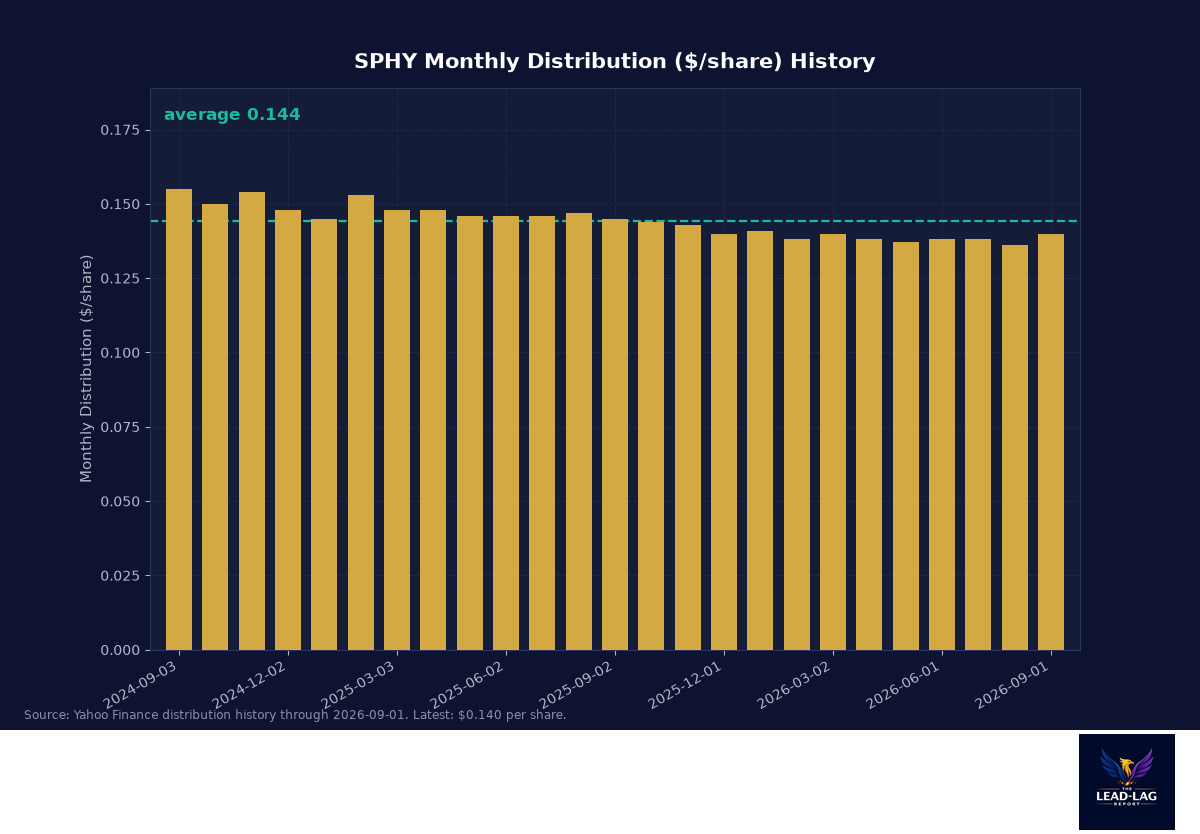
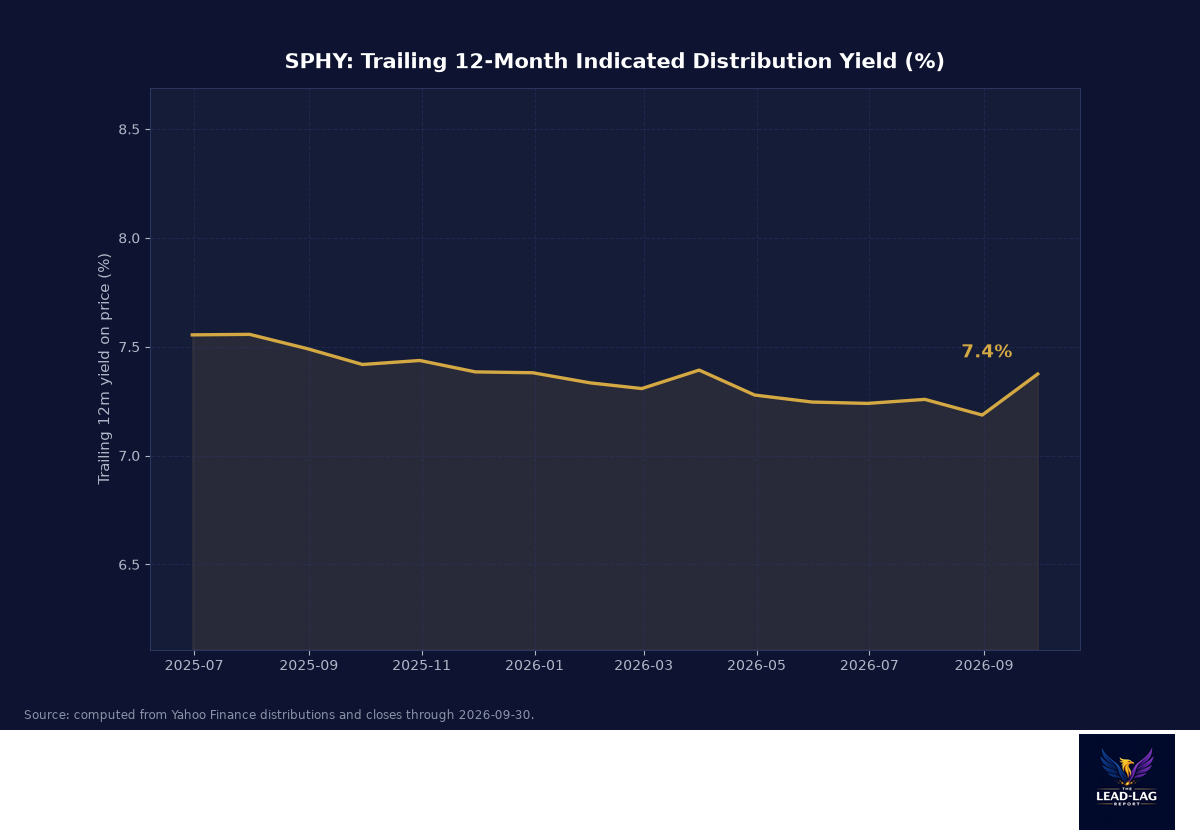
The most recent monthly distribution was $0.14 per share with a September 1 ex-date per Yahoo Finance, and the trailing twelve months summed to $1.673 per share, a 7.38% indicated yield on Friday's $22.68 close, computed from Yahoo Finance data.
A brief note on how this compares to the two heavyweight junk ETFs, HYG and JNK, since advisors always ask. HYG's trailing 12-month distributions computed to a 6.11% yield on the same data set I used for this piece, versus SPHY's 7.38%. Part of that gap is duration and part is the index construction, but the striking part is the cost line: the difference between 0.05% and the older ETFs' fee schedules compounds into real money over a decade of income investing. In a sector where the whole return is the coupon, fees come directly out of the paycheck.
Portfolio Composition
With 1,316 holdings... correction, with 1,932 holdings per the factsheet, idiosyncratic single-name risk is effectively eliminated; this is systematic credit beta. The sector mix per State Street: consumer cyclical 18.01%, communications 15.84%, energy 11.83%, consumer non-cyclical 11.41%, capital goods 10.18%, technology 8.13%. The duration story is the underrated feature: at 2.89 years option-adjusted, this is short-duration credit, so the fund's rates exposure is roughly a third of what the long-bond funds carry. The credit quality story is the standard one: a BB-heavy, B-heavy index with a CCC tail, which is precisely where the 317.53 bps of spread lives.
Historical Performance
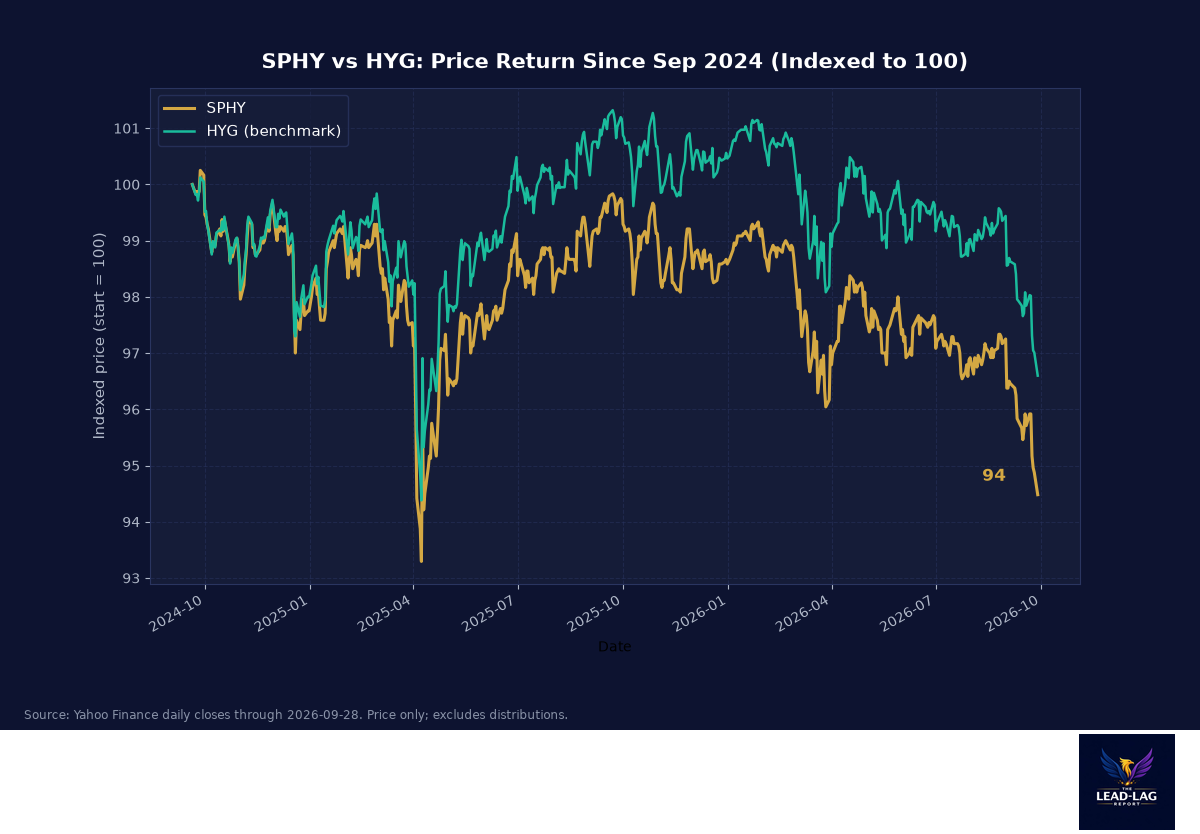
Since September 2024, SPHY computed a +8.8% total return on a -5.5% price return, collecting $3.449 per share of distributions (computed from Yahoo Finance closes and payouts). The negative price leg is mostly rate math, not credit damage: a 2.89-duration bond book marks down when the front end of the curve is being hiked, and coupons rebuild the price over time. Its 4.2% realized volatility matched HYG's 4.3%, confirming this is vanilla asset-class risk with no leverage and no structure tricks.
Volatility Comparison
At 4.2% computed 1-year volatility versus HYG's 4.3%, SPHY is indistinguishable from its category benchmark on risk, as a 0.05% index tracker should be. The number worth internalizing is what that volatility buys you: a 7.10% SEC yield at a 2.89-year duration is a genuinely competitive income-to-risk trade against cash-like alternatives once the Fed has hiked to 3.75% to 4.00%, and unlike cash, the yield reprices upward as short bonds roll over.
Macro Environment
My macro read favors short-duration credit right now, with one large caveat. The September hike to 3.75% to 4.00% (source: Federal Reserve) supports a 7.1% standardized yield on a 2.89-duration book, and short junk historically absorbs hiking cycles far better than long credit, which is what SPHY's modest -5.5% price return since September 2024 actually demonstrates. The caveat is the spread: 317.53 bps per State Street is historically thin compensation for below-investment-grade risk. If the hiking cycle eventually breaks the weakest borrowers, spread widening from this level can erase multiple years of coupon quickly. You are being paid fully for rates. You are being paid thinly for credit.
Distribution Policy
Monthly, floating with the coupon income of the book: $0.14 per share in September per Yahoo Finance, $1.673 over the trailing twelve months, a 7.38% indicated yield at Friday's close, against a 7.10% standardized SEC yield per the factsheet. The near-identity of those two numbers is the quiet headline of this piece: unlike every leveraged and option-based fund I profile, SPHY's distribution is essentially all earned income. As short bonds roll into higher yields, the distribution should drift up, not down.
Advantages
Cost is the differentiator. At 0.05% per the factsheet, you keep essentially all of the market's yield, where a 2%+ CEF expense structure quietly consumes a quarter of it.
Every dollar of the distribution is coupon income, verified by the SEC yield, so there is no return-of-capital illusion to underwrite.
Short duration is a live asset in a hiking cycle: 2.89 years of rate exposure means the book reprices upward quickly, unlike the 8-year leveraged funds whose principal absorbs every hike.
Compare the duration math across this week's batch and the advantage becomes vivid. DSL runs 5.18 years of duration with 24% leverage; DMO runs a leveraged mortgage book at 46% leverage; both carry multiple times SPHY's rate exposure. When the Fed hikes 25 basis points, as it just did, the mark-to-market damage to SPHY's 2.89-duration book is measured in tenths of a percent, a rounding error against a 7.10% standardized yield, while the leveraged funds absorb multiples of that. Duration discipline is invisible in bull markets and priceless in hiking ones.
Disadvantages
The spread cushion is thin. At 317.53 bps per State Street, a normal recessionary widening episode can consume a year of coupon in a quarter.
There is no smart alpha here, no discount snapback, no management edge to underwrite. If the high-yield market does badly, you do badly, minus five basis points.
The headline 7% is smaller than the leveraged products' 12 to 15%, and income-starved investors consistently reach for the bigger number without noticing they took double the volatility to get it. SPHY requires the discipline to prefer the honest yield.
It is also worth naming the behavioral failure mode directly, because I see it constantly. Investors anchor on the biggest yield on the screener, buy the leveraged CEF, then sell it at maximum discount width during the first rate scare, locking in the price damage the leverage created. The unleveraged 7.38% that gets ignored is the yield that actually survives that cycle intact. Boring is a feature when the alternative is a fund that has fallen over 20% on price in twelve months, which three of this week's CEF profiles did.
Conclusion
SPHY is the benchmark, and every high-yield product I profile should ultimately be judged against it: 7.10% of standardized income, five basis points of cost, 2.89 years of duration, no leverage. My verdict: short-term the right core junk holding while the Fed hikes and coupons roll higher, long-term dependent on spreads, which are thin and offer limited credit-event protection. Own it as the honest baseline of an income allocation, and demand that anything fancier earn its complexity premium against this fund before it earns a place in the portfolio.
The Lead-Lag Report is provided by Lead-Lag Publishing, LLC. All opinions and views mentioned in this report constitute our judgments as of the date of writing and are subject to change at any time. Information within this material is not intended to be used as a primary basis for investment decisions and should also not be construed as advice meeting the particular investment needs of any individual investor. Trading signals produced by the Lead-Lag Report are independent of other services provided by Lead-Lag Publishing, LLC or its affiliates, and positioning of accounts under their management may differ. Please remember that investing involves risk, including loss of principal, and past performance may not be indicative of future results. Lead-Lag Publishing, LLC, its members, officers, directors and employees expressly disclaim all liability in respect to actions taken based on any or all of the information on this writing.