The Largest BDC In America Pays 10%. Its Book Value Just Ticked Down
ARCC's $29.5 billion book pays $0.48 a quarter, but core EPS is $0.47 and NAV slipped to $19.59.

Today's Lead-Lag Report post is sponsored by Relative Sentiment
The Relative Sentiment Tactical Allocation ETF is a flexible, multi-asset fund that invests across stocks, bonds, commodities, precious metals, and currencies. Its approach is guided by a research-based factor called relative sentiment — which tracks how optimistic or cautious professional investors are compared to individual investors. Studies show professionals tend to have an edge over time, and this ETF seeks to capture that insight by increasing exposure to areas where institutions are more optimistic and reducing exposure where they're more cautious. Relative sentiment often complements trend-following strategies, helping create portfolios that may be more balanced and less prone to sharp swings.
The Fund's investment objectives, risks, charges and expenses must be considered carefully before investing. This and other important information is contained in the Prospectus and SAI, which may be obtained by following the links or by calling +1.215.882.9983. Please read the prospectus carefully before investing.
Investments involve risk. Principal loss is possible.
The Fund is distributed by PINE Distributors LLC.
ETFAC-4976143-11/25
DISCLAIMER – PLEASE READ: This is sponsored advertising content for which Lead-Lag Publishing, LLC has been paid a fee. The information provided in the link is solely the creation of Relative Sentiment. Lead-Lag Publishing, LLC does not guarantee the accuracy or completeness of the information provided in the link or make any representation as to its quality. All statements and expressions provided in the link are the sole opinion of Relative Sentiment. and Lead-Lag Publishing, LLC expressly disclaims any responsibility for action taken in connection with the information provided in the link.
Key Highlights
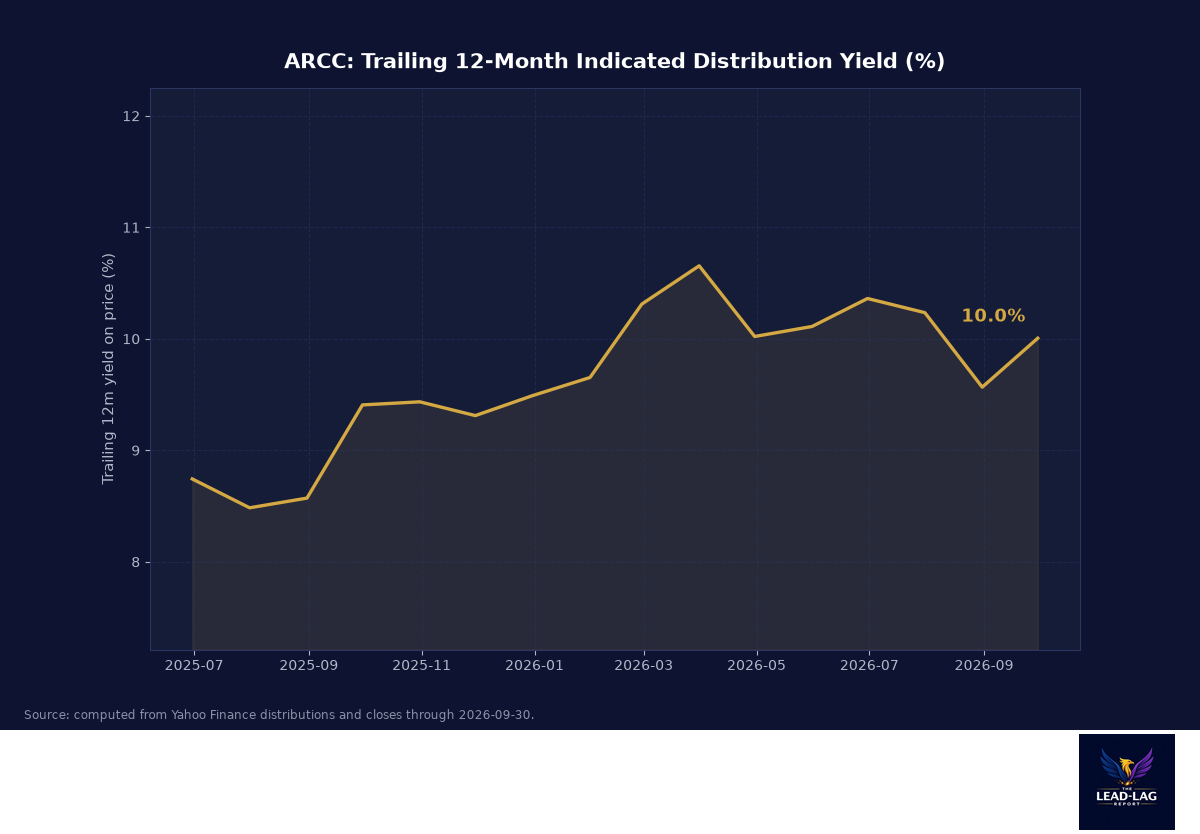
- Yield: 10.01% indicated on price ($1.92 of trailing dividends against a $19.17 close, computed from Yahoo Finance), paid quarterly at $0.48 per share
- Scale: $29.5 billion of portfolio investments at fair value across 607 companies, per the Q1 2026 results
- Coverage: Q1 2026 core EPS of $0.47 against a $0.48 dividend, the second straight quarter earnings landed a penny shy of the payout
- NAV: $19.59 per share at March 31, 2026, down from $19.94 at year-end 2025; the stock at $19.17 trades at a ~2.1% discount to book
- Risk: 19.7% annualized 1-year price volatility vs 13.0% for SPY, computed from daily closes
Every week, we'll profile a high yield investment fund that typically offers an annualized distribution of 6-10% or more. With the S&P 500 yielding less than 2%, many investors find it difficult to achieve the portfolio income necessary to meet their needs and goals. This report is designed to help address those concerns.
When A 10% Check Meets A Shrinking Book
Private credit has been sold as the asset class that replaces the 1% S&P dividend with a 10% check. The largest publicly traded version of that promise is Ares Capital Corporation (ARCC), founded in 2004, now holding $29.5 billion of portfolio investments at fair value across 607 companies per its Q1 2026 results. The stock pays a $0.48 quarterly dividend, good for a 10.01% indicated yield on Friday's $19.17 close.
But the same filing that describes the check also describes the wobble. Book value per share slipped from $19.94 at December 31, 2025 to $19.59 at March 31, 2026. Core EPS of $0.47 came in against a $0.48 dividend. Neither number is a crisis. Both are the early symptoms of a spread-compression cycle that every seasoned BDC analyst knows by heart. The question is whether you are being paid enough for the direction of travel.
Fund Background
ARCC is a business development company, a regulated lender to private middle-market companies. The regulatory frame matters for income investors: as a regulated investment company, a BDC must distribute at least 90% of taxable investment income to shareholders, which is why the cash return exists by law rather than by discretion. That same rule is also why distribution sustainability is a coverage question and nothing else. Regulation cuts both ways: as a BDC it must distribute most investment income, which is why the yield exists, and it must mark its loan book quarterly at fair value, which is why book value moves at all. At March 31, 2026, stockholders' equity stood at $14.07 billion and debt-to-equity at 1.13x, or 1.10x net of available cash per the Q1 2026 results. That leverage is the engine that turns a ~9% underlying yield on first-lien lending into a 10% equity yield, and it is the same leverage that amplifies any credit deterioration.
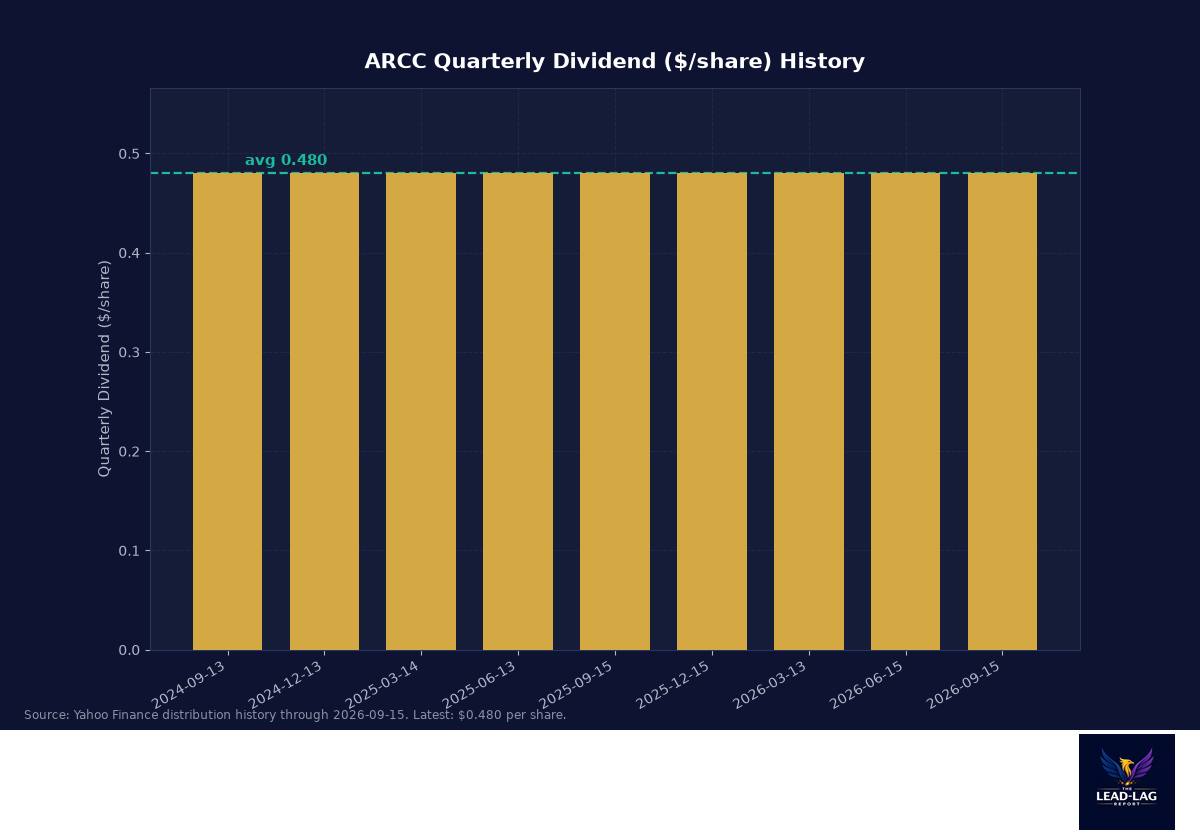
The dividend cadence is quarterly. ARCC declared $0.48 for the second quarter of 2026 and again with its June 30 results for the third quarter, per PR Newswire. Four payments of $0.48 annualize to $1.92 against a $19.17 price.
Portfolio Composition
The book is $29.5 billion at fair value across 607 portfolio companies per the Q1 2026 filing. Ares lends primarily senior secured, first-lien style debt to sponsored middle-market borrowers, which is the highest-quality end of the private credit spectrum, though the specific lien mix shifts quarter to quarter and I will only assert what the filing shows. Two numbers frame the composition honestly: 607 companies is genuine diversification, and 1.13x leverage means every dollar of equity is backed by roughly a dollar of borrowings against those loans.
GAAP EPS of $0.13 for Q1 2026 versus core EPS of $0.47 tells you the fair-value marks were the drag this quarter, not cash earnings. That distinction is the whole game in BDC analysis.
It is worth being explicit about what separates ARCC from the smaller BDCs that populate yield screeners. A $29.5 billion book across 607 companies means the average position is under $50 million against an equity base over $14 billion, so no single borrower can meaningfully dent book value. The diversification is structural, not aspirational, and it shows up in the variance of quarterly core EPS, which has been remarkably tight for the sector.
Historical Performance
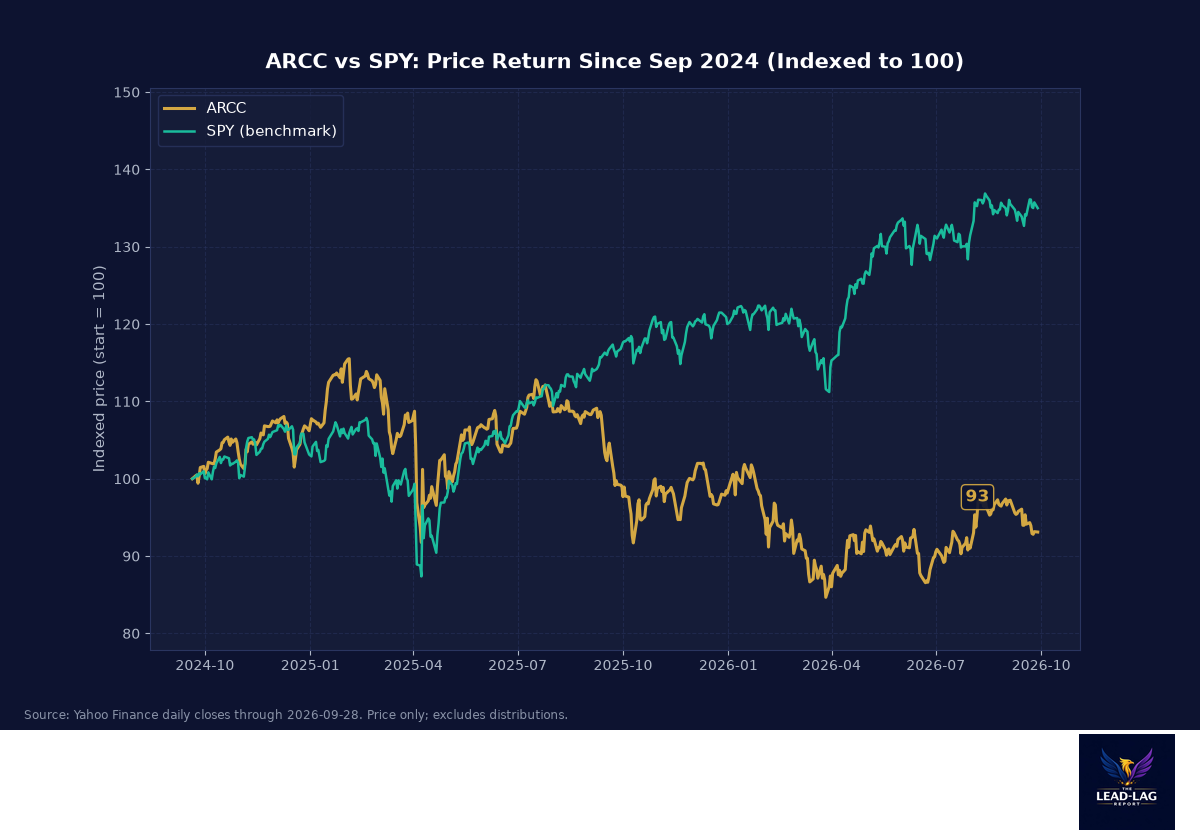
Since September 2024, ARCC's computed total return is +11.7%, composed of a -6.9% price return plus $3.84 of dividends per share (computed from Yahoo Finance closes and distributions). Compare that to SPY's straight-up run over the same window and you see the opportunity cost of holding a lender instead of the market it lends against. The stock sits near $19.17 against $19.59 of March 31 book, roughly a 2.1% discount.
Volatility Comparison
ARCC's 1-year annualized price volatility computes to 19.7% against 13.0% for SPY. A debt instrument should not be 50% more volatile than the S&P 500, but ARCC is. The explanation is that its book is marked, not traded, so the market prices the uncertainty of the marks themselves. When investors distrust private valuations, ARCC's price moves faster than its book. That is precisely what the 2026 tape has been doing to BDCs broadly.
Macro Environment
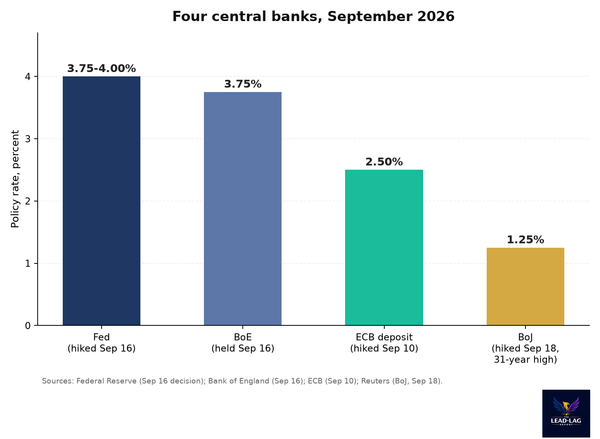
My framework: the Fed hiked to 3.75% to 4.00% on September 16, 2026 (source: Federal Reserve press releases), which mechanically lifts floating-rate loan yields and supports BDC income. That is the bull case and it is real. Against it: a hike at this point in the cycle is also a statement about inflation persistence, higher benchmark rates raise the debt service burden on leveraged middle-market borrowers, and spread compression on new private deals has been the sector's chronic margin squeeze. ARCC's Q1 core EPS of $0.47 versus $0.50 a year earlier is that squeeze, visible one decimal at a time.
The honest summary is that ARCC's 10% is now more rate-supported and less credit-stressed than bears predicted, but the coverage cushion is thin at $0.47 against $0.48. A dividend that consumes 102% of current core earnings is not yet a cut story. It is a no-margin-for-error story.
Distribution Policy
The base dividend is a stable $0.48 quarterly, declared for both Q2 and Q3 2026 per PR Newswire, with supplemental payouts historically added in strong years. Trailing twelve months paid exactly $1.92 per share per Yahoo Finance, a 10.01% yield. Coverage is the number to watch: $0.47 of Q1 core EPS against $0.48 of dividend means the payout is running a hair ahead of earnings, funded by the gap between net investment income timing and declaration dates. Watch whether Q2 results close that gap before extrapolating the supplementals.
Advantages
Scale is the moat. At $29.5 billion across 607 companies, ARCC originates deals smaller BDCs cannot see, and its 1.13x leverage per the Q1 filing sits at the conservative end of the sector.
The senior-secured core of the book means recoveries in a downturn outrank the equity of the borrowers. When credit turns, lien position is everything.
Floating-rate income in a hiking cycle is a tailwind most bond funds would envy. The September Fed hike to 3.75% to 4.00% passes through to loan yields faster than it hurts credit, at least initially.
Disadvantages
Coverage below 100% of core EPS is the number I cannot get past. $0.47 against $0.48 is one bad quarter from a supplementals pause and two from a base dividend conversation.
Book value direction matters more than the dividend. NAV fell from $19.94 to $19.59 in one quarter per the filing. A 10% yield with a 2% NAV decline is an 8% reality.
The stock trades at a 2.1% discount to book but has spent long stretches at premiums; you are not being paid a historic margin of safety to own marked private credit with 19.7% realized volatility.
A valuation nuance that matters at this price: because book value is marked quarterly and the market reprices continuously, the discount itself oscillates with sentiment about private marks generally. When the next credit scare arrives, expect the discount to widen well before any filing confirms deterioration. That is either an entry opportunity or a warning depending on your view of the marks, and it is the one variable no dividend analysis captures.
Conclusion
ARCC remains the quality name in private credit exposure, and 10% from the sector giant is a fair deal, not a great one. The income is rate-supported and the book is senior and diversified, but coverage is a penny short, NAV is drifting down, and the market is charging you nearly full book value for all of it. My verdict: short-term fine while rates rise and spreads behave, long-term dependent on coverage turning back above 100%. Own it as a position-sized lender allocation, not as a bond replacement, and mark Q2's core EPS print as your tripwire.
The Lead-Lag Report is provided by Lead-Lag Publishing, LLC. All opinions and views mentioned in this report constitute our judgments as of the date of writing and are subject to change at any time. Information within this material is not intended to be used as a primary basis for investment decisions and should also not be construed as advice meeting the particular investment needs of any individual investor. Trading signals produced by the Lead-Lag Report are independent of other services provided by Lead-Lag Publishing, LLC or its affiliates, and positioning of accounts under their management may differ. Please remember that investing involves risk, including loss of principal, and past performance may not be indicative of future results. Lead-Lag Publishing, LLC, its members, officers, directors and employees expressly disclaim all liability in respect to actions taken based on any or all of the information on this writing.