Industrial Production Fell 0.4%. The Factory Floor Did Not.
October's industrial production drop was utilities giving back September's weather-driven surge. Manufacturing rose for a second straight month, capacity utilization sits 3 points below its long-run average, and the consumer control group keeps rising.


Complimentary for advisors today: Video Editing

One recording, many clips. Professional editing of one webinar or interview, repurposed into short channel-ready clips with captions and export guidance.
What you receive
- Editing summary
- Recommended clip package
- Draft captions for each clip
- Channel export table
- Brand and style recommendations
- Compliance and review notes
Cost in credits: 3. Turnaround: 5-7 business days. Delivered as: Handled with the Creative Desk. Best for: Advisors with a recording they want to reuse.
It is complimentary for advisors. There is no invoice from us. You earn the credits by showing up: attend a sponsored Lead-Lag Media webinar, meet a fund issuer in a one-on-one introduction, or join one of our advisor dinners.
Prefer to browse first? See all 34 services at advisor.leadlagmedia.com.
Credits carry no cash value and are not payment for services. Drafts are prepared with AI assistance and are for your and your firm’s review before use; they are not investment, legal, tax or compliance advice, and nothing is guaranteed. Services are offered to financial advisors and are not a solicitation to retail investors. Original filming/production is not included.
Industrial Production Fell 0.4%. The Factory Floor Did Not.
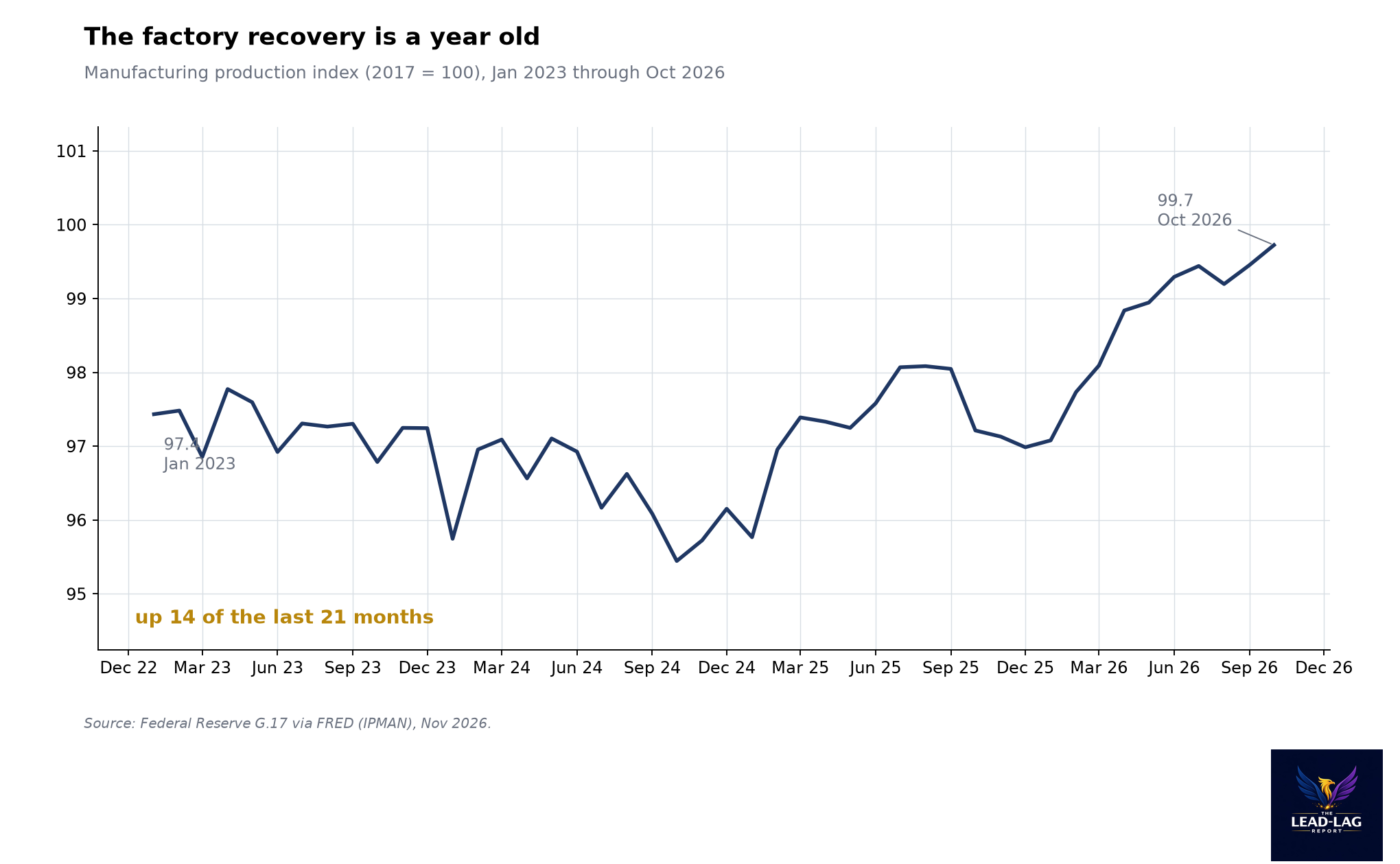
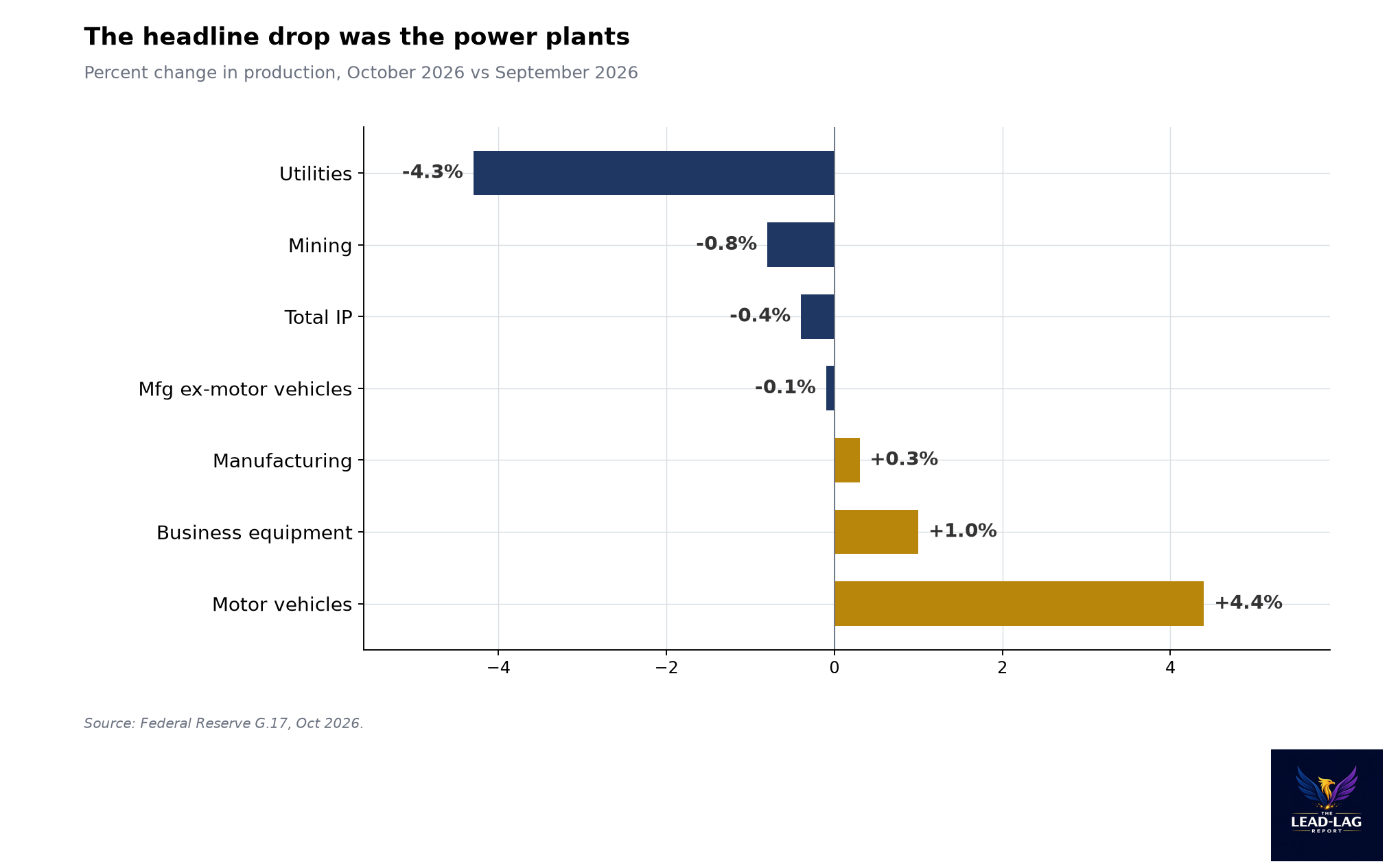
The Federal Reserve's industrial production report for October, released Tuesday, showed total output at factories, mines and utilities down 0.4 percent from September. That headline is the wrong one to remember. Manufacturing output, which makes up about three quarters of the index, rose 0.3 percent for a second straight month. The decline belongs almost entirely to utilities, whose output fell 4.3 percent after a 4.4 percent weather-driven surge in September. Strip the power plants out and the factory recovery is now a year old. [1]
The manufacturing production index reached 99.7 in October, 2.6 percent above its year-earlier level and its highest reading of the year. Manufacturing output has now risen in 14 of the past 21 months, and the October gain beat the roughly 0.2 percent economists expected. [2] [6] A factory sector that spent 2024 flat has quietly put together a steady expansion while the attention went elsewhere. [1]
Where the Drop Came From
The arithmetic of the headline is simple. Utilities are volatile in both directions because the weather is: September's output jumped 4.4 percent on late-summer cooling demand, and October gave it back. Mining fell 0.8 percent. Total industrial production fell 0.4 percent to an index level of 103.4, still 2.1 percent above a year ago. [1] Meanwhile the details inside manufacturing were strong: motor vehicle and parts production rose 4.4 percent, the biggest monthly jump since February 2025, and business equipment output rose 1.0 percent, the most since April. Output of computers and electronic products had its best month in three. Excluding motor vehicles, factory output edged down 0.1 percent, which tells you autos and equipment did the heavy lifting. [1] [6]
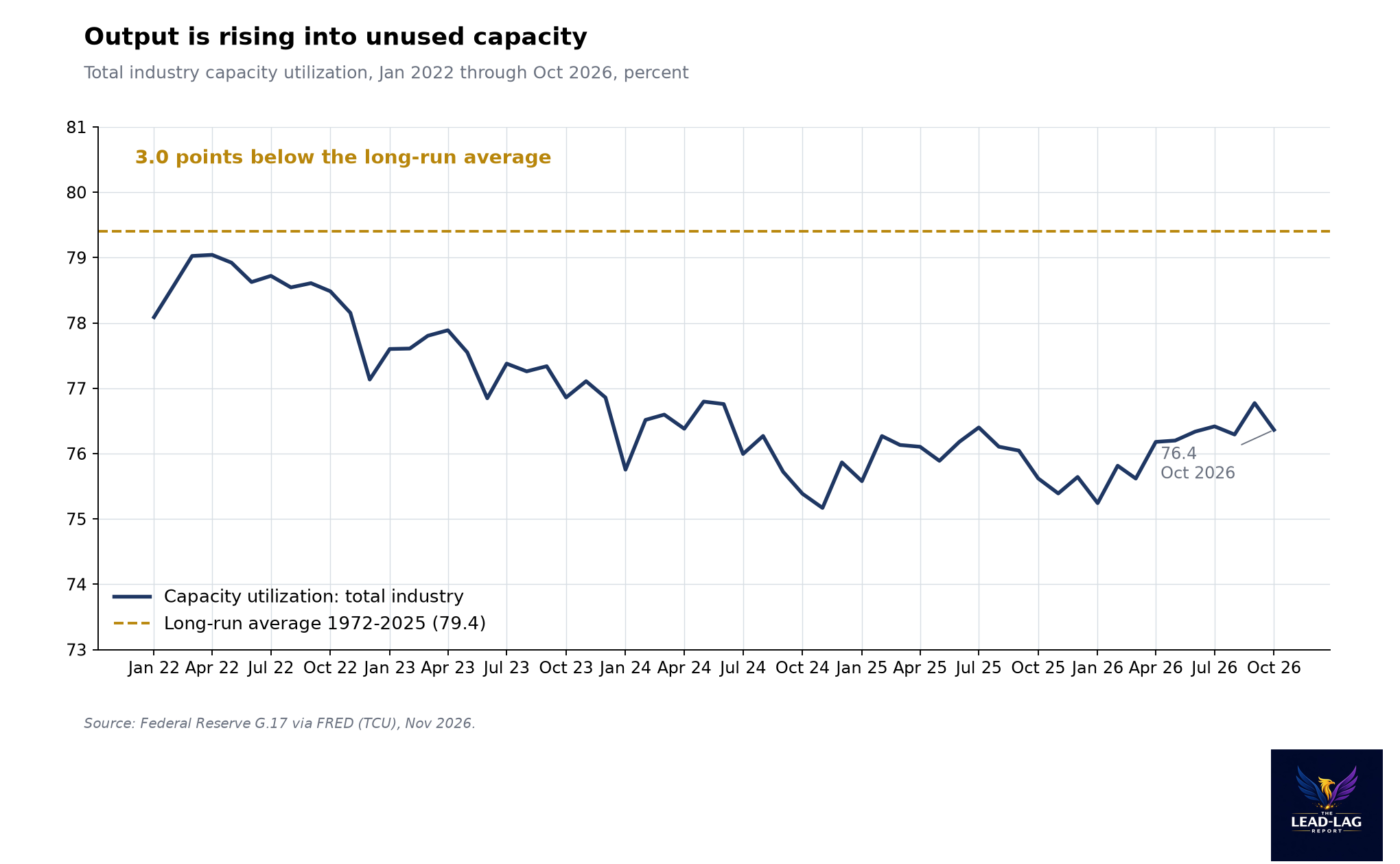
Capacity utilization tells the same story from a different angle. Total industry ran at 76.4 percent of capacity in October, down from 76.8 percent in September and 3.0 percentage points below its long-run average. [1] [3] The factory sector is growing, but from a level of slack that has not been worked off. That combination, rising output with unused capacity, is historically the middle of an expansion rather than the end of one. It is also the one thing that argues against the inflation concern driving the Fed's next decision.
The Consumer Kept Buying
The other report released the same morning explains who is buying what the factories make. Retail and food services sales rose 0.2 percent in October to $748.2 billion, up 6.8 percent from a year earlier, after a 0.8 percent gain in September. The control group that feeds into GDP, which strips out autos, gasoline, building materials and food services, rose a stronger-than-expected 0.6 percent after an upwardly revised 0.5 percent. [4] [5]
The cross-current sits in cars. Motor vehicle and parts dealers saw sales fall 1.6 percent while the factories building those same vehicles raised production 4.4 percent. Some of that is the normal seasonal restocking ahead of the holiday quarter, and some is commercial and fleet demand that never shows up in dealer lots. Either way, production running ahead of retail is inventory building, and inventory only pays off if the consumer shows up. The rest of the retail detail was solid: miscellaneous retailers up 4.7 percent, online up 1.2 percent, health and personal care up 1.5 percent, with the weakness concentrated in furniture, down 2.3 percent, and clothing, down 0.7 percent. [4] [7]
What I Am Watching
Two dates settle this. November industrial production, released December 16, shows whether the October headline drop was purely the utilities giveback or the start of something broader; watch manufacturing excluding motor vehicles, which is the clean signal. And the holiday retail season shows up in the December and January sales reports as the test of whether the auto inventory build was prescient or premature. The base case, after two months of factory gains, a control group running above its third-quarter pace and a consumer still spending, is that October's negative headline was the power plants talking. The factory floor did not get that memo, and it is the part of this economy that makes things.
Notes
- Federal Reserve Board, Industrial Production and Capacity Utilization (G.17), October 2026, released November 17, 2026: total IP -0.4% m/m, index 103.4, +2.1% y/y; manufacturing +0.3%; manufacturing excluding motor vehicles -0.1%; mining -0.8%; utilities -4.3%; motor vehicles and parts +4.4%; capacity utilization 76.4%, 3.0 points below the 1972-2025 average
- FRED, Manufacturing Production Index (IPMAN), Federal Reserve G.17: 99.7 in October 2026, +2.6% y/y; monthly changes show 14 up months out of the last 21
- FRED, Capacity Utilization: Total Industry (TCU), Federal Reserve G.17: 76.4 in October 2026; 1972-2025 average 79.4
- U.S. Census Bureau, Advance Monthly Sales for Retail and Food Services, October 2026 (CB26-181), released November 17, 2026: $748.2 billion, +0.2% m/m, +6.8% y/y; September +0.8%
- Reuters, US retail sales showcase underlying strength despite cost-of-living crunch, November 17, 2026: control group (excluding automobiles, gasoline, building materials and food services) +0.6% after an upwardly revised +0.5% in September; autos and furniture pullback
- Economic Times via Bloomberg, US Factory Output Up 0.3% for Second Straight Month, November 18, 2026: factory output beat the 0.2% Bloomberg median; motor vehicles and parts +4.4%, biggest since February 2025; business equipment +1.0%, most since April; computers and electronic products best in three months
- Trading Economics, US Retail Sales, October 2026 advance: miscellaneous retailers +4.7%, gasoline stations +1.5%, health and personal care +1.5%, online +1.2%, motor vehicles -1.6%, furniture -2.3%, clothing -0.7%
Paid members get the full Weekly Signals, the weekly Leaders and Laggards and every chart behind each call. Start with 7 days free.
The Lead-Lag Report is provided by Lead-Lag Publishing, LLC. All opinions and views mentioned in this report constitute our judgments as of the date of writing and are subject to change at any time. Information within this material is not intended to be used as a primary basis for investment decisions and should also not be construed as advice meeting the particular investment needs of any individual investor. Trading signals produced by the Lead-Lag Report are independent of other services provided by Lead-Lag Publishing, LLC or its affiliates, and positioning of accounts under their management may differ. Please remember that investing involves risk, including loss of principal, and past performance may not be indicative of future results. Lead-Lag Publishing, LLC, its members, officers, directors and employees expressly disclaim all liability in respect to actions taken based on any or all of the information on this writing.