The yen is back near 160. Watch December 18.
The yen is near 160 and the BOJ is expected to hike in December. Why both can be true, and what to watch.

The yen traded near 160 per dollar last week. That is the level where Tokyo has drawn the line before, and on November 9 Japan's Ministry of Finance confirmed it spent a record 15.4 trillion yen defending the currency between July and September. Three months later, the pressure is back.
At the same time, 83% of economists in Bloomberg's latest survey expect the Bank of Japan to raise its policy rate from 1.25% to 1.5% at its December 17 to 18 meeting.
Put those two facts side by side and you have the setup I spent a book trying to explain.
Why a weak yen and a hawkish BOJ can coexist
On paper, a central bank raising rates should support its currency. In practice, the gap still matters more than the direction. This week the two-year Japanese government bond yielded about 1.88%, while the two-year Treasury yielded about 4.85%. The Fed's range is 3.75% to 4.00%. As long as that spread stays wide, borrowing in yen to own higher-yielding assets elsewhere still pays, and the yen stays heavy.
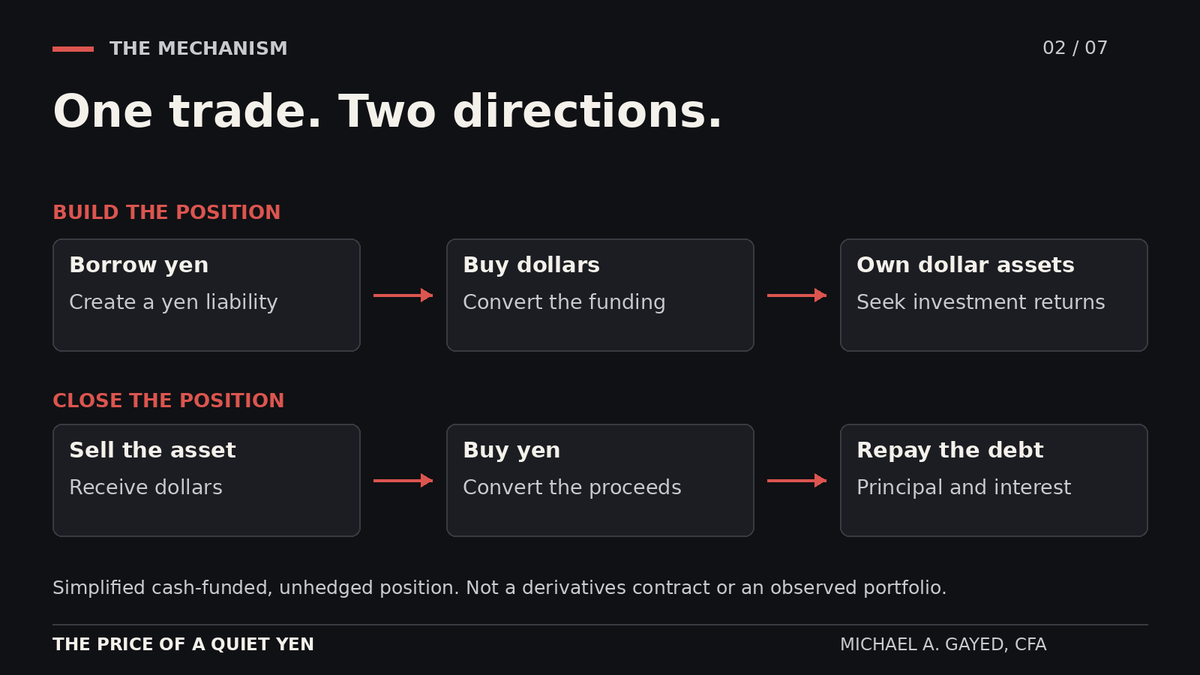
That is the carry trade in its simplest form. Borrow cheap, convert, own something that yields more. It works quietly for long stretches, which is exactly why it gets crowded.
The part people underestimate
A carry position is built in one direction and closed in the other. When the trade is opened, investors sell yen. When it is closed, they have to buy it back, often at the same time and often because they are forced to.
That is why I keep repeating a line from the book: a rate hike is not a liquidation order. Policy changes start the story. Margin calls, volatility limits and funding constraints decide how it ends. The BOJ moving to 1.5% does not by itself unwind anything. A sharp move in the yen that hits leveraged positions at the same moment can.
We saw a version of this in August 2024, and in 2008, and in the autumn of 1998. Each time, the trigger looked modest relative to the reaction. The book walks through each episode from the funding side, because that is where the damage starts.
What I am watching into December
First, the December 17 to 18 meeting itself, and whether the BOJ signals a steady quarterly pace or something faster. Second, the front end of the curve. The spread between Japanese and US two-year yields matters more for the yen than any single headline. Third, intervention. Tokyo has already shown it will spend heavily near 160, and intervention can turn a slow grind into a fast move. Fourth, volatility in currency markets. Carry trades are most dangerous when realized volatility is low and positioning is high, because nobody is sized for a shock.
None of this is a forecast. It is a checklist. The point of studying Japan's history is not to predict the date of the next reversal. It is to recognize the conditions that make one more likely and to know who is forced to sell when it comes.
The book
The Price of a Quiet Yen: Japan's Economic History, the Carry Trade, and the Anatomy of Global Reversals covers how Japan's bubble, its long deflation and decades of near-zero rates turned the yen into the world's funding currency, and what happens when that funding reverses. It ends with a field guide to evidence and four ways the next cycle could unfold.
Kindle: https://www.amazon.com/dp/B0HLYWF9SY
Hardcover: https://www.amazon.com/dp/B0HLZ1YYC6
Read the prologue free: https://www.leadlagreport.com/quiet-yen-free-excerpt/
If you have already read it, an honest Amazon review helps other readers decide whether it is for them.
If you requested the book and never received it, reply and we'll resend it.
Michael A. Gayed, CFA