A Tax-Free 8.5% Monthly Check Built From 76-Cent Bonds And 41% Leverage
Nuveen's NMZ pays an 8.5% tax-free monthly check from investment income, using 41% leverage and a 17-year duration. The income is clean; the structure is the risk.

Today's Lead-Lag Report post is sponsored by Relative Sentiment
The Relative Sentiment Tactical Allocation ETF is a flexible, multi-asset fund that invests across stocks, bonds, commodities, precious metals, and currencies. Its approach is guided by a research-based factor called relative sentiment — which tracks how optimistic or cautious professional investors are compared to individual investors. Studies show professionals tend to have an edge over time, and this ETF seeks to capture that insight by increasing exposure to areas where institutions are more optimistic and reducing exposure where they're more cautious. Relative sentiment often complements trend-following strategies, helping create portfolios that may be more balanced and less prone to sharp swings.
The Fund's investment objectives, risks, charges and expenses must be considered carefully before investing. This and other important information is contained in the Prospectus and SAI, which may be obtained by following the links or by calling +1.215.882.9983. Please read the prospectus carefully before investing.
Investments involve risk. Principal loss is possible.
The Fund is distributed by PINE Distributors LLC.
ETFAC-4976143-11/25
DISCLAIMER – PLEASE READ: This is sponsored advertising content for which Lead-Lag Publishing, LLC has been paid a fee. The information provided in the link is solely the creation of Relative Sentiment. Lead-Lag Publishing, LLC does not guarantee the accuracy or completeness of the information provided in the link or make any representation as to its quality. All statements and expressions provided in the link are the sole opinion of Relative Sentiment. and Lead-Lag Publishing, LLC expressly disclaims any responsibility for action taken in connection with the information provided in the link.
Key Highlights
- Yield: 8.5% tax-free on the $0.066 monthly distribution at the $9.33 close; CEFConnect shows an 11.32% taxable-equivalent yield
- Tax math: at the top 40.8% federal bracket, 8.5% tax-free equals roughly 14.3% taxable-equivalent
- Leverage: 41.39% effective leverage at a 2.96% cost, with leverage-adjusted effective duration of 17.09 years
- Portfolio: average bond price of 76.48% of par, average coupon of roughly 5.7%, effective maturity of 22.29 years
- Watch items: 50.1% of the book not rated by the major agencies, and 18.8% of holdings callable within 12 months
Every week, we'll profile a high yield investment fund that typically offers an annualized distribution of 6-10% or more. With the S&P 500 yielding less than 2%, many investors find it difficult to achieve the portfolio income necessary to meet their needs and goals. This report is designed to help address those concerns.
The Oldest Leverage Trade In The Income Complex
Municipal closed-end funds run the oldest arbitrage in the income investing playbook: borrow short at tax-exempt money market rates, buy long tax-exempt bonds yielding more, and clip the spread. It is simple, it has worked for decades, and it embeds two risks that never go away, duration and leverage, both of which are turned up to maximum in this week's fund. After two days spent on payout credibility in private credit and junk bonds, this is the third variation on the theme: here the income is unambiguous and the balance sheet is the risk.
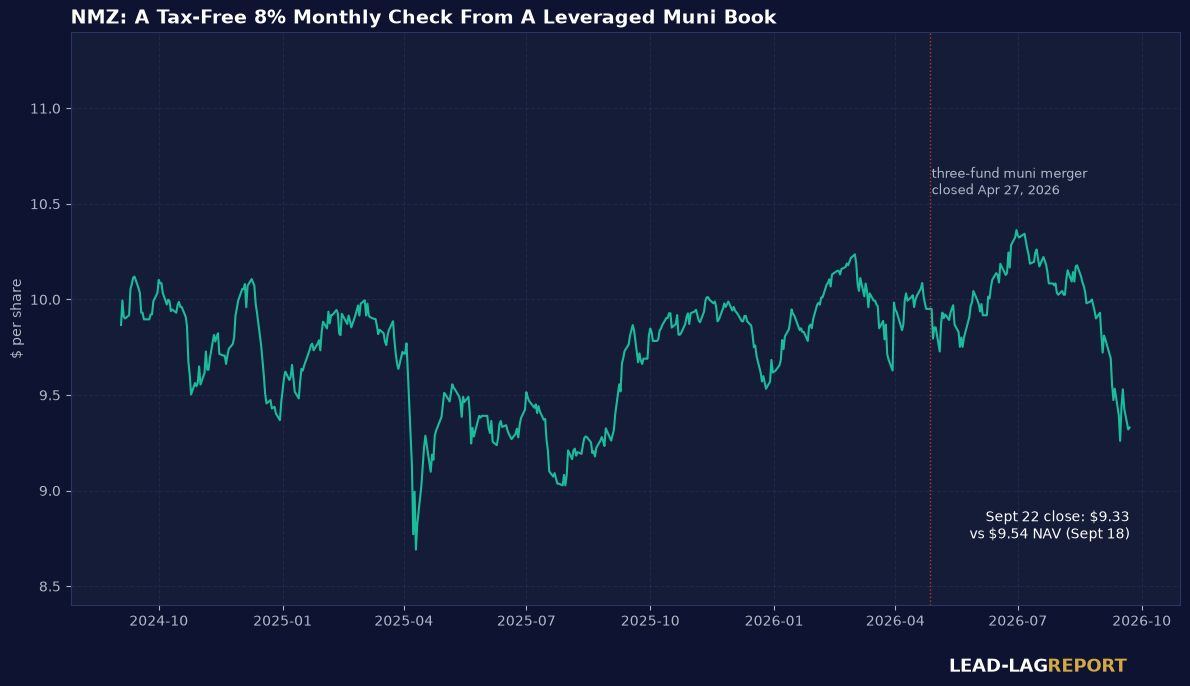
Nuveen Municipal High Income Opportunity Fund (NMZ) pays $0.066 every month, entirely from investment income, an 8.5% tax-free yield at the September 22 close of $9.33. CEFConnect's taxable-equivalent figure of 11.32% translates to roughly 14.3% for investors in the top 40.8% federal bracket. The fund gets there by running 41.39% effective leverage on a bond book priced at 76.48% of par, then it leans into the structure hard: a leverage-adjusted effective duration of 17.09 years. That combination, tax-free income plus true long-duration leverage, is either exactly what a top-bracket investor with a long horizon wants, or a machine built to amplify a rate backup.
Fund Background
NMZ is a closed-end municipal bond fund managed by Nuveen, the largest manager of municipal closed-end funds in the country. Its objective is high current income exempt from regular federal income tax, and it invests primarily in below-investment-grade and unrated municipal obligations, which is where the "high income" in the name comes from. The fund became substantially larger this spring: on April 27, 2026, a tax-free merger absorbed three sibling Nuveen municipal funds, the Missouri, New Jersey, and Pennsylvania Quality Municipal Income funds, scaling NMZ to roughly $2 billion in assets.
The structural facts, from CEFConnect as of September 18 and the fund's own reporting:
- Share price of $9.43 on September 18 ($9.33 at the September 22 close) against a NAV of $9.54, a 1.15% discount
- Effective leverage of 41.39% against regulatory leverage of 22.65%, at a cost of leverage of 2.96%
- Leverage-adjusted effective duration of 17.09 years and effective maturity of 22.29 years
- Average bond price of 76.48% of par, average coupons of roughly 5.7% to 5.8%
- A monthly distribution of $0.066 per share, sourced entirely from investment income
- Fitch affirmed the fund's 2028 AMTPS preferred shares at 'A' on April 28, 2026, citing post-merger effective leverage of 37% and asset coverage of 267%
That Fitch affirmation matters more than it looks. In a leveraged CEF, the preferred shares are the lenders, and asset coverage of 267% means the municipal book covers the preferred stack nearly three times over. The post-merger scale also cuts expense drag per dollar, which is the quiet argument for merger-driven consolidation across the Nuveen muni complex.
Portfolio Composition
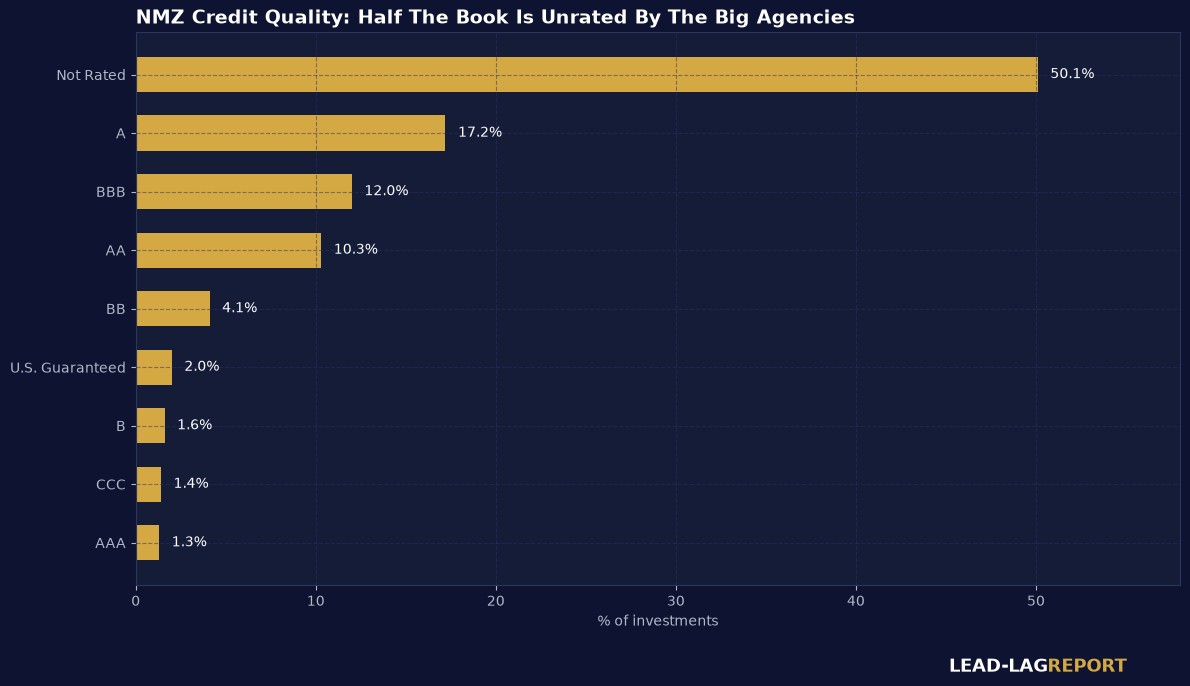
The credit quality table is the honest starting point: 50.1% of investments carry no rating from the major agencies, and the largest rated buckets are single-A at 17.2%, BBB at 12.0%, and double-A at 10.3%. Below-investment-grade rated paper, BB through CCC, totals about 7.1%, and U.S. government guaranteed paper is 2.0%. In the municipal world, "not rated" is not the same signal it is in corporates: small issuers frequently skip agency ratings entirely, and insured and pre-refunded bonds often carry no rating of their own. But it does mean you are relying on Nuveen's internal credit work for half the book, and default history in high yield munis, while far gentler than in corporates, is not zero.
The average bond price of 76.48% of par is the more interesting number. This book was bought at a discount, and a bond bought at 76 cents that matures at par compounds your income with a pull-to-par tailwind, provided the issuer actually pays. The offset is the call exposure: 18.8% of the portfolio is callable within the next 12 months, and discount bonds are exactly the ones issuers refinance first when rates fall. Your upside in a rally is capped by calls while your downside in a selloff is uncapped by anything.
Historical Performance
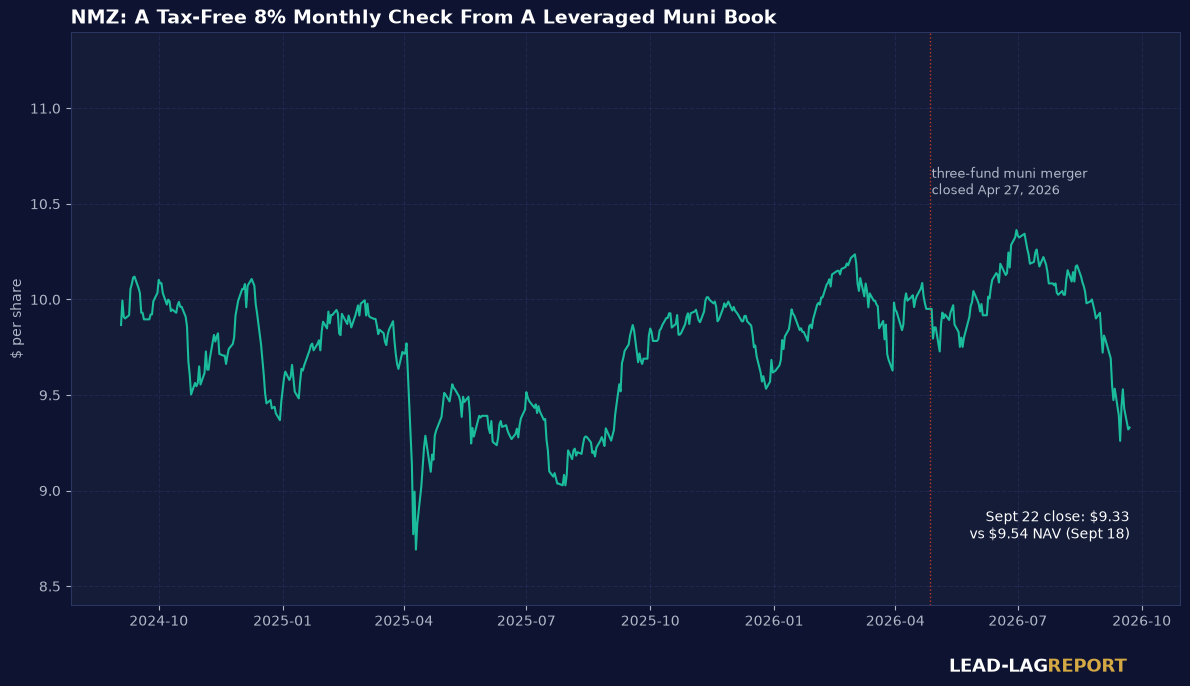
The share price history shows the merger as the visible event: the April 27, 2026 combination produced a step change in the fund's scale, and the price has settled in a tight range since, against a 52-week band of $9.24 to $10.77. Year to date through August 31, the price is up 3.23% while the NAV is up 0.85%, a modest narrowing of the discount. Over the trailing 12 months the NAV total return is 7.83%, which for a leveraged muni fund is the number the distribution has to be judged against.
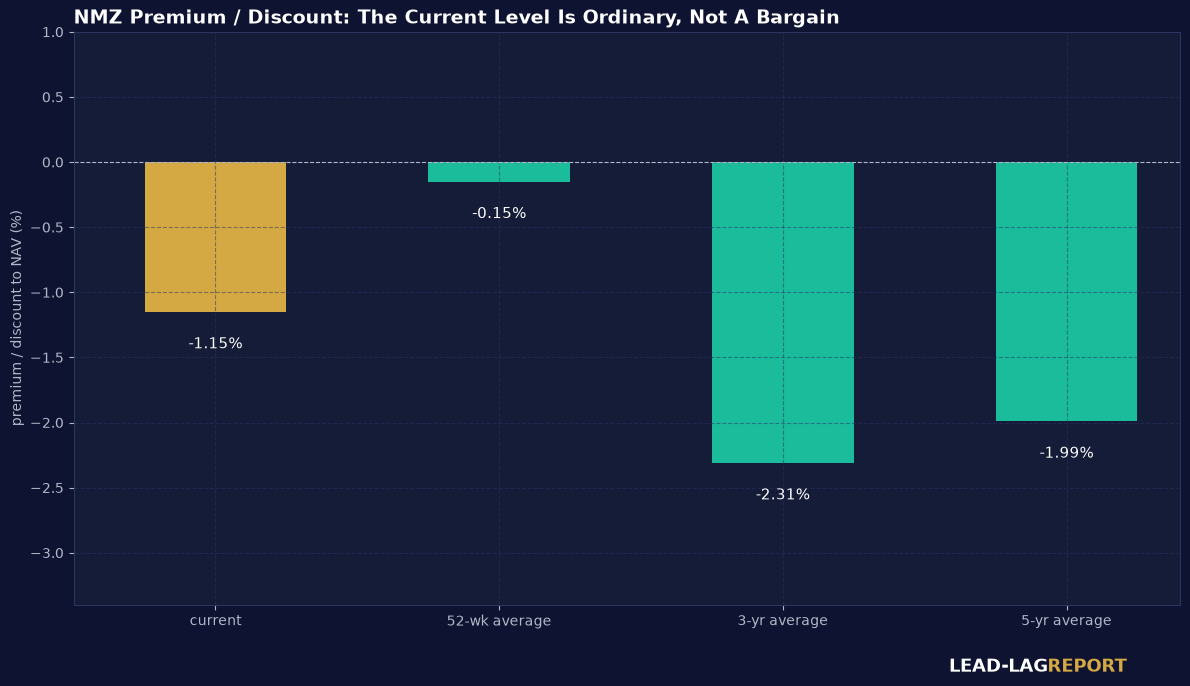
The discount picture is the least exciting part of the story, which is itself informative. At 1.15% below NAV, the fund trades near its 52-week average discount of 0.15%, and it is actually tighter than its 3-year average of 2.31% and its 5-year average of 1.99%. Translation: unlike this week's earlier profiles, you are not being paid a wide discount to own this structure. The market already likes the fund, and the discount offers no cushion worth mentioning.
Volatility Comparison
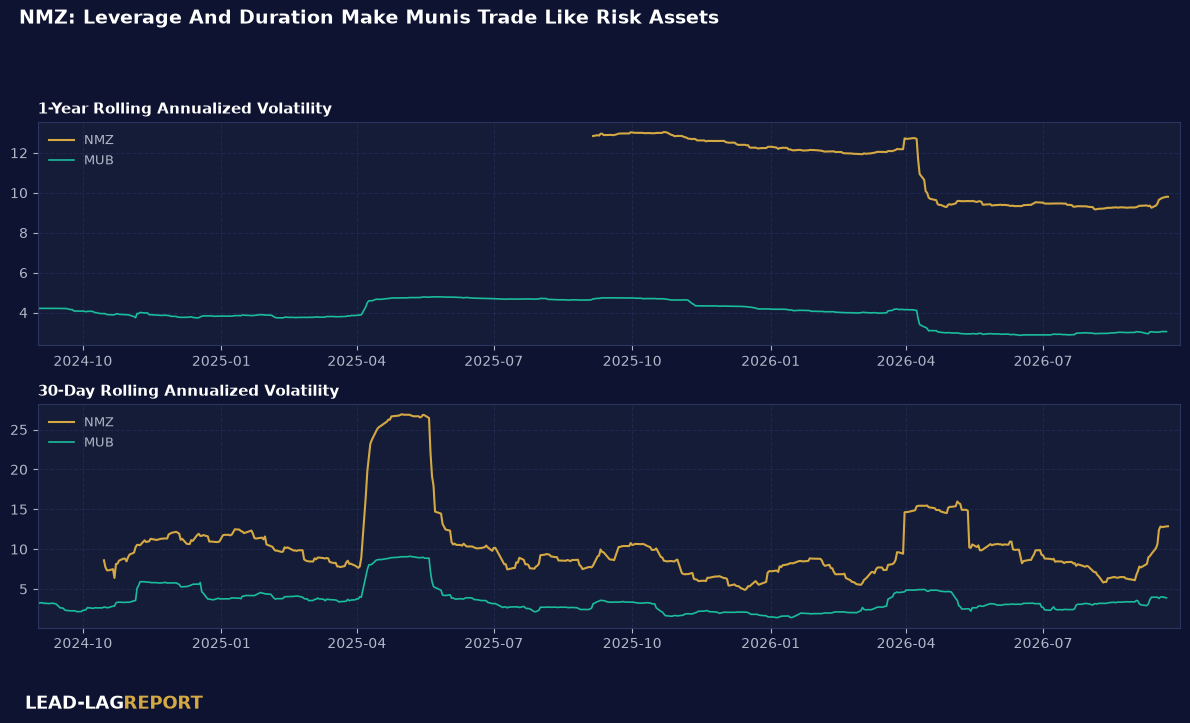
Set against MUB, the investment-grade national muni ETF, NMZ's volatility runs consistently higher, because the fund is MUB plus 41% leverage plus a 17-year duration plus a discount-priced credit book. That is not a defect; it is the design. But it means the drawdown math belongs to the structure: in a rate backup, a fund like this can give back years of tax-free income in months, and the 30-day volatility panel shows exactly how quickly the machine speeds up when rates move.
Macro Environment
The municipal market's tax-free advantage compounds for the highest brackets, and the arithmetic is the entire thesis. An 8.5% tax-free yield equals roughly 11.3% taxable-equivalent at CEFConnect's assumed bracket and about 14.3% at the top 40.8% federal bracket. Few corners of the taxable investment-grade bond market offer anything close to that equivalent yield, which is the standing answer to "why bother with the complexity."
The risks are the mirror image. First, duration: a 17.09-year leverage-adjusted effective duration means each 100 basis point rise in long tax-exempt rates roughly translates to a double-digit percentage NAV hit, before the leverage effects compound. Second, the leverage cost is floating: the preferred stack rolls at short tax-exempt rates, and a 2.96% current cost is the spread engine, so a spike in short rates compresses the very income that funds the distribution. Third, the credit book is half unrated and bought at 76 cents on the dollar, which is where muni defaults, when they happen, actually live. The candid assessment: this structure is attractive for long-horizon top-bracket investors who can hold through rate cycles, and inappropriate for anyone who would be forced to sell into a drawdown.
Distribution Policy
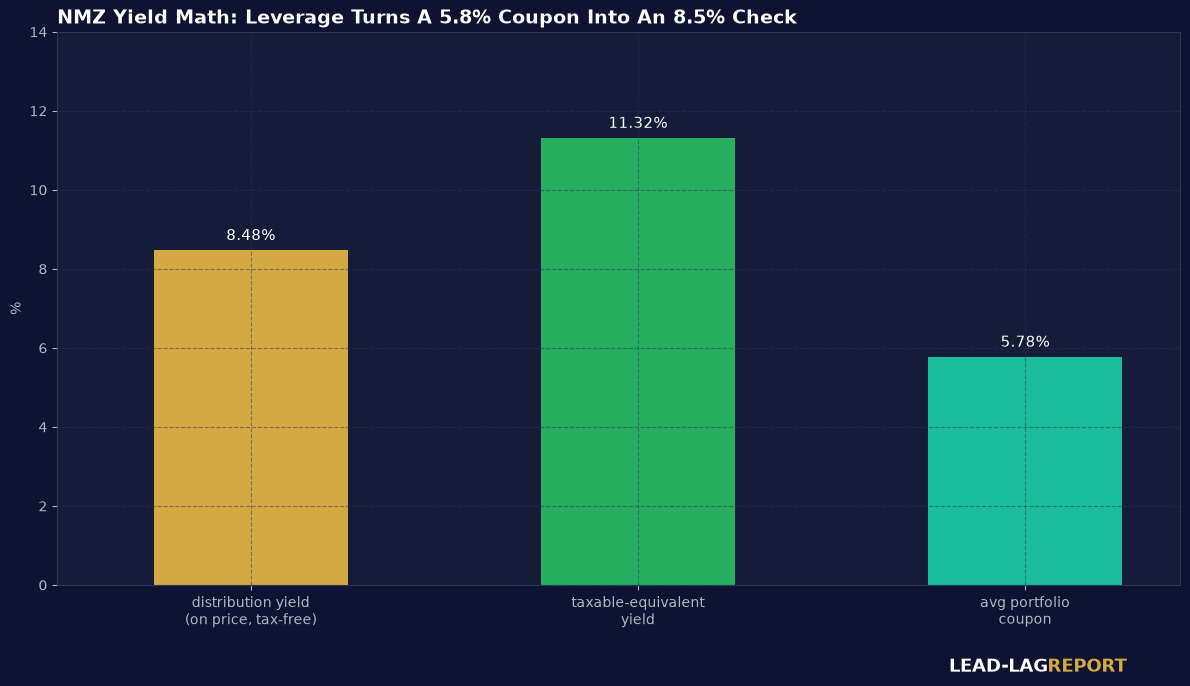
The fund pays a level monthly distribution of $0.066 per share, $0.792 annualized, and unlike this week's other profiles, every dollar of it is sourced from net investment income, with no return-of-capital component. That distinction is worth pausing on after two columns about ROC-funded payouts: this is the clean kind of distribution, income earned by the portfolio's spread between its after-leverage yield and its 2.96% cost of funds.
The sustainability question therefore reduces to spread math rather than payout philosophy. The portfolio's average coupon of roughly 5.7% against an average price of 76.48% of par implies a current yield on the book of roughly 7.5% before leverage, and the leverage earns the spread between that yield and its 2.96% cost. The distribution is not being supplemented with return of capital, but its cushion moves with that spread: a sustained rise in short tax-exempt rates would compress it over time. Watch the coverage figures in the fund's annual and semiannual reports as the tripwire.
Advantages
The income is genuinely tax-free and genuinely earned. An 8.5% federal-tax-free yield, roughly 14.3% taxable-equivalent at the top bracket, produced entirely from investment income with no return-of-capital component, is the cleanest payout structure in the high yield complex.
The bond book was bought at a discount. An average price of 76.48% of par builds pull-to-par appreciation into the total return, cushioning credit losses in a way par-priced books cannot match.
The structure is bigger and better covered than it used to be. The April merger scaled the fund to roughly $2 billion, cutting fixed costs per dollar managed, and Fitch's 'A' affirmation of the preferreds with 267% asset coverage documents a well-protected leverage stack.
Disadvantages
The duration is extreme. A 17.09-year leverage-adjusted effective duration makes this one of the most rate-sensitive instruments an income investor can buy, and a single 100 basis point move in long tax-exempt yields can erase more than a year of distributions.
Half the book is unrated. A 50.1% not-rated share means the credit work rests on Nuveen's internal analysis, and the discount-priced issuers in this fund are exactly the segment where municipal credit risk, while historically low, is concentrated.
You are not being paid to take the structure risk. The 1.15% discount is tighter than the 3-year and 5-year averages, so unlike a deeply discounted CEF, there is no margin of safety in the wrapper on top of the bonds.
The call exposure caps the upside. With 18.8% of holdings callable within 12 months, a rally in tax-exempt rates gets partially taken away by issuers refinancing exactly the discount bonds that would have rallied hardest.
Conclusion
NMZ is the full-expression version of the leveraged muni trade: maximum tax-free income, maximum duration, and a distribution that is honestly earned rather than partially returned. The fund's 7.83% one-year NAV total return shows the machine working as designed over the past year, and the 8.5% tax-free check is among the cleanest income streams at this yield level anywhere.
Short-term, the income looks durable: the spread between the book's current yield and the 2.96% leverage cost remains comfortably positive, and the distribution is fully covered by investment income. Long-term, this is a leveraged bet on the level of long tax-exempt rates, and the 17-year duration will dominate total returns in any sustained rate move. Top-bracket investors with decade-plus horizons and the discipline never to sell into a drawdown are being paid appropriately. Everyone else should buy MUB, sleep well, and let someone else run the machine.
The Lead-Lag Report is provided by Lead-Lag Publishing, LLC. All opinions and views mentioned in this report constitute our judgments as of the date of writing and are subject to change at any time. Information within this material is not intended to be used as a primary basis for investment decisions and should also not be construed as advice meeting the particular investment needs of any individual investor. Trading signals produced by the Lead-Lag Report are independent of other services provided by Lead-Lag Publishing, LLC or its affiliates, and positioning of accounts under their management may differ. Please remember that investing involves risk, including loss of principal, and past performance may not be indicative of future results. Lead-Lag Publishing, LLC, its members, officers, directors and employees expressly disclaim all liability in respect to actions taken based on any or all of the information on this writing.