The Delinquency Cycle Already Turned
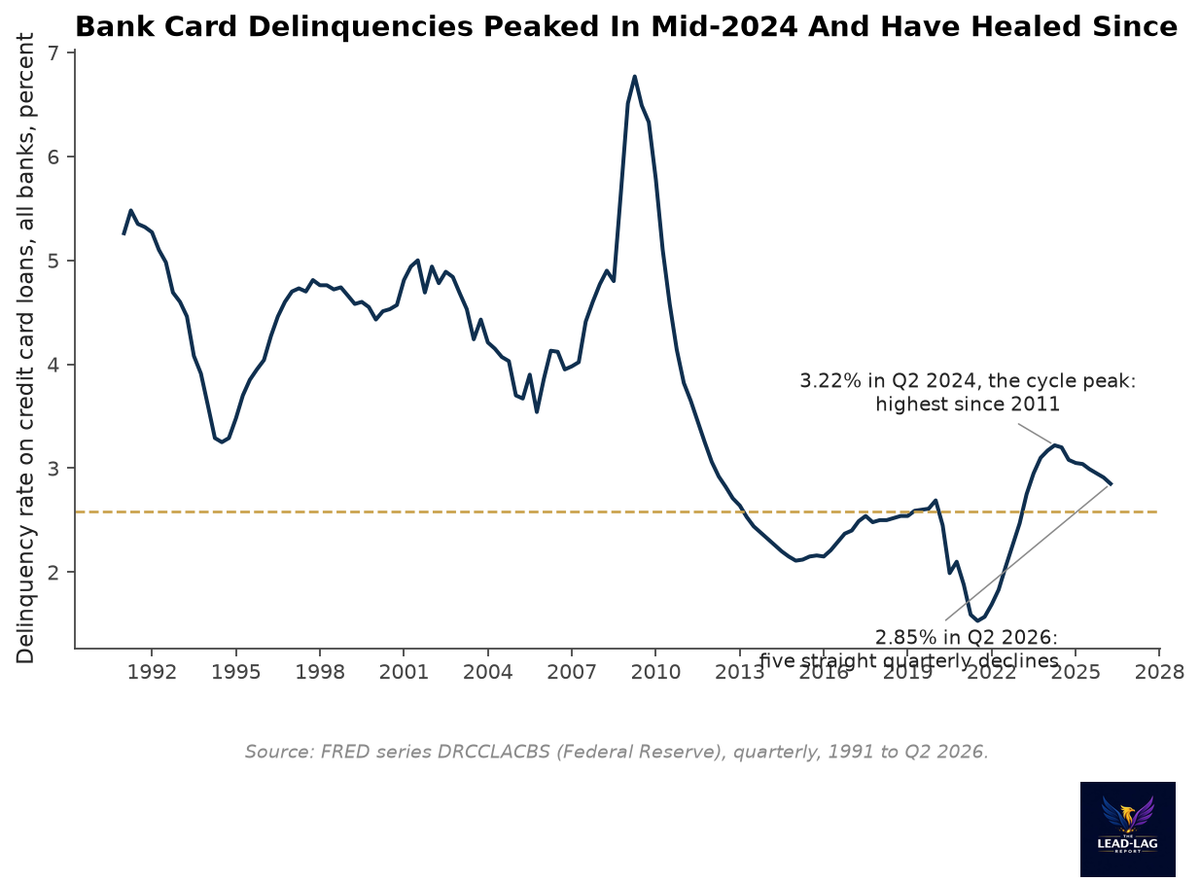
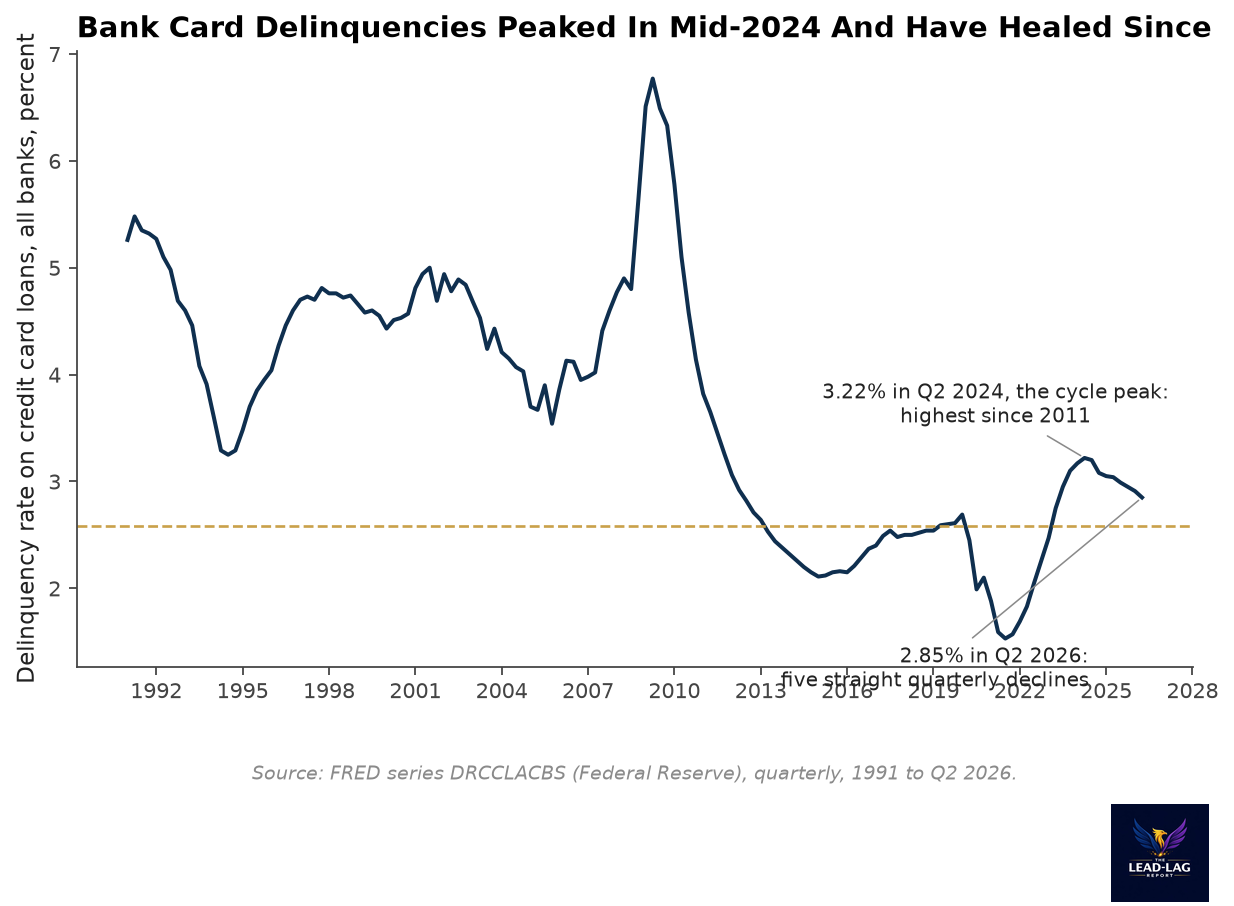
Bank card delinquencies peaked at 3.22% in mid-2024 and have fallen five straight quarters to 2.85%. The consumer crack everyone braced for happened, quietly, and ended while nobody repriced it.

Sponsored by SanJac Alpha
Houston moves more money through private rooms than most states move through their entire wealth-management industry. The energy corridors, the medical center money, the family offices that never advertise — when that much advisory talent sits within Beltway 8, the interesting conversations happen at dinner tables, not webinars.
And the hardest question of 2026 is a bond question: with the Fed re-hiking and cash yields compressing again, where does fixed income actually pay? Duration discipline, credit selectivity, active versus passive core — that's a conversation worth having with the person who manages two actively managed fixed-income ETFs for a living, not a slide deck.
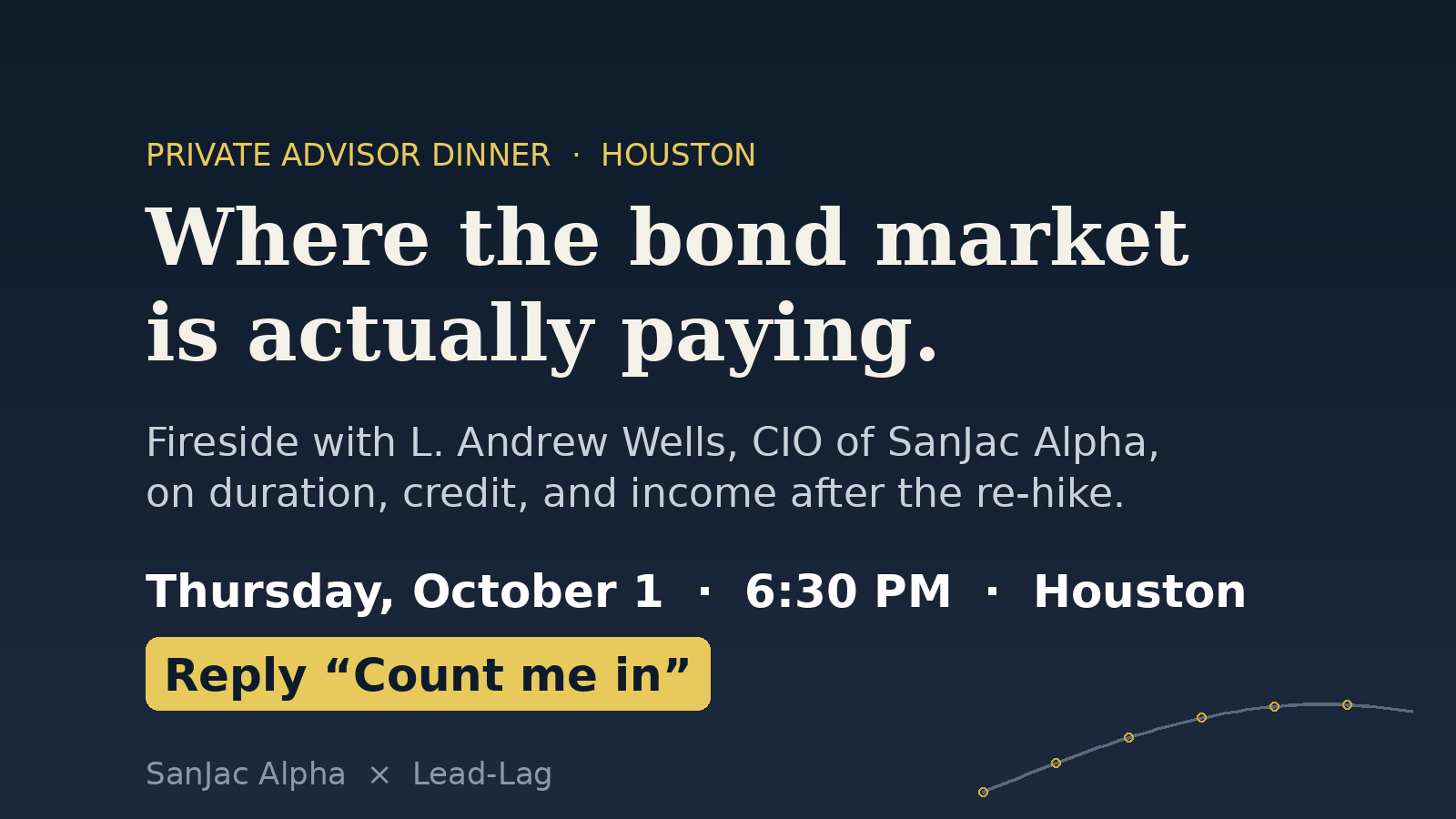
If you're a financial advisor in the Houston area: The Lead-Lag Report is hosting a private dinner in Houston on Thursday, October 1, at 6:30 PM — a fireside with L. Andrew Wells, CIO of SanJac Alpha, on where the bond market is actually paying right now. A room of your peers, no podium, no pitch deck. Seats are limited to 25. Reply “Count me in” and your seat is held.
This is a paid sponsored block. The views expressed are those of the sponsor. Not investment advice.
The Delinquency Cycle Already Turned
Bank card delinquencies peaked at 3.22% in mid-2024, their highest since 2011, and have fallen five consecutive quarters to 2.85%. The consumer crack everyone braced for happened, quietly, and the healing started while nobody repriced it.
MICHAEL A. GAYED, CFA
Key Highlights
- The commercial bank card delinquency rate fell to 2.85% in Q2 2026, a fifth consecutive quarterly decline from the 3.22% cycle peak in Q2 2024.
- Card balances still hit a record $1.263 trillion in Q2 2026, up $54 billion year over year (New York Fed).
- The annualized flow into serious 90+ day card delinquency held at 6.97%, essentially flat versus a year earlier: elevated, but no longer deteriorating.
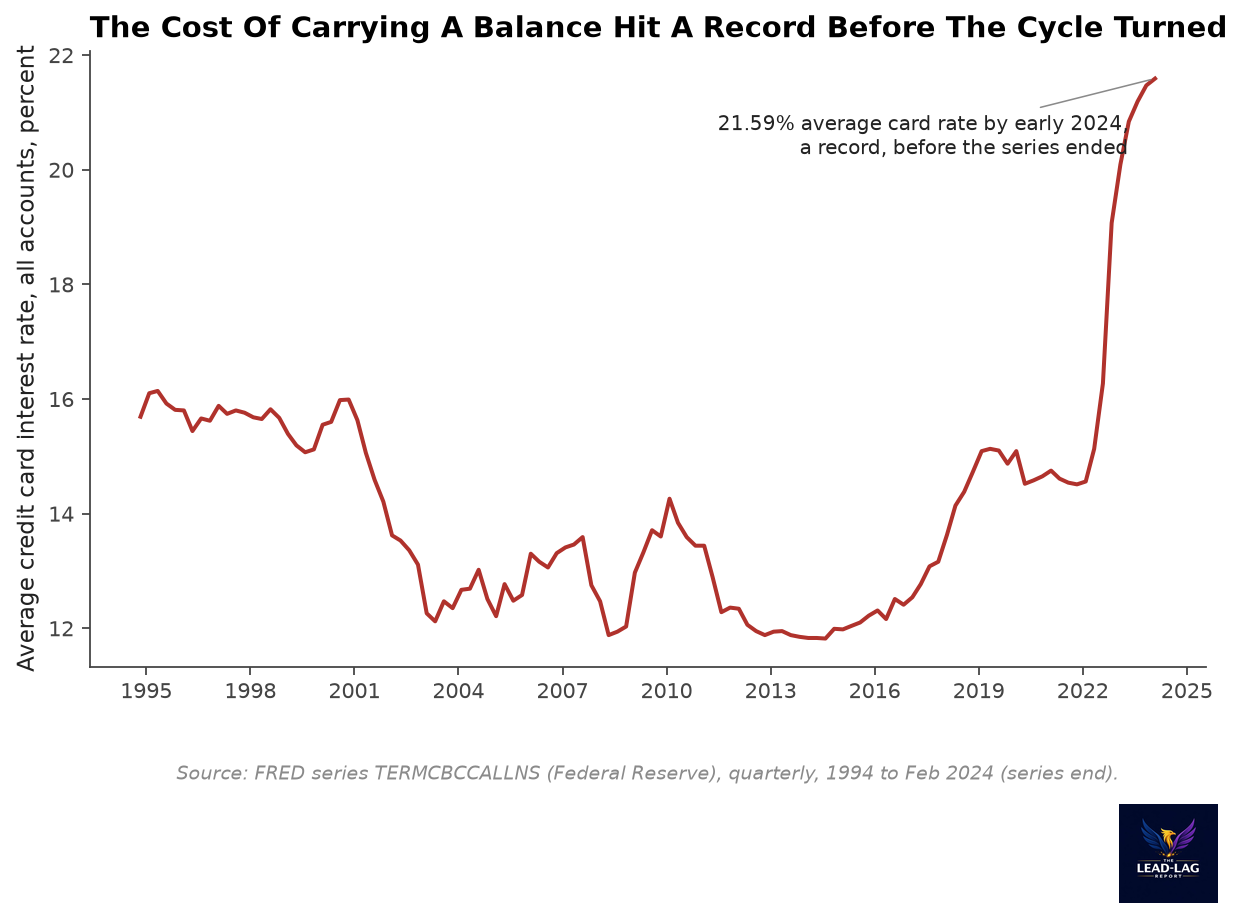
- Average credit card interest rates reached a record 21.59% at the end of the Federal Reserve's series in early 2024, concentrating stress among revolvers.
Somewhere between the regional bank scare and the AI rally, financial commentary settled on a fixed piece of folklore: the American consumer is cracking, financed by credit cards at 21% interest, and the crack is a matter of time. The call was not crazy. Card delinquencies rose for eleven straight quarters through 2023 and 2024 and peaked at 3.22%, the highest since 2011, in the spring of 2024. The problem is what happened next, because almost nobody updated the story. That peak was more than two years ago, and the rate has now fallen five consecutive quarters to 2.85%. The consumer recession everyone braced for arrived, and it ended, quietly, while the consensus kept preparing for it.
The shape of the series matters as much as the level. Commercial bank card delinquencies climbed from a cyclical trough near 2.1% in 2021 to that 3.22% peak in mid-2024, a textbook two-year deterioration that filled conference agendas with K-shaped consumer panels. Then the series rolled over: 3.20 in Q3 2024, 3.08 in Q4, 3.05, 3.04, 2.99, 2.95, and 2.91 by the first quarter of 2026, before reaching 2.85% in the second. Five straight quarterly declines, each one small, each one in the same direction. Delinquency data is the definition of a lagging indicator, which is exactly why it is worth respecting when it turns: by the time it moves, the underlying stress has already peaked and started to drain.
Why did the consensus miss it? Because every ingredient of the fear story stayed in place while the outcome changed. Card interest rates sit at records, 21.59% on average at the end of the Federal Reserve's series in early 2024. Card balances keep making nominal records, $1.263 trillion in Q2 2026 per the New York Fed, up $54 billion year over year. Unemployment spent the period drifting up toward 4.1% without ever breaking. The narrative inputs never improved, and the delinquency rate improved anyway. That is usually how it works: the stress shows up in the marginal borrower while the aggregate is still expanding, and it unwinds the same way, from the bottom of the book upward.
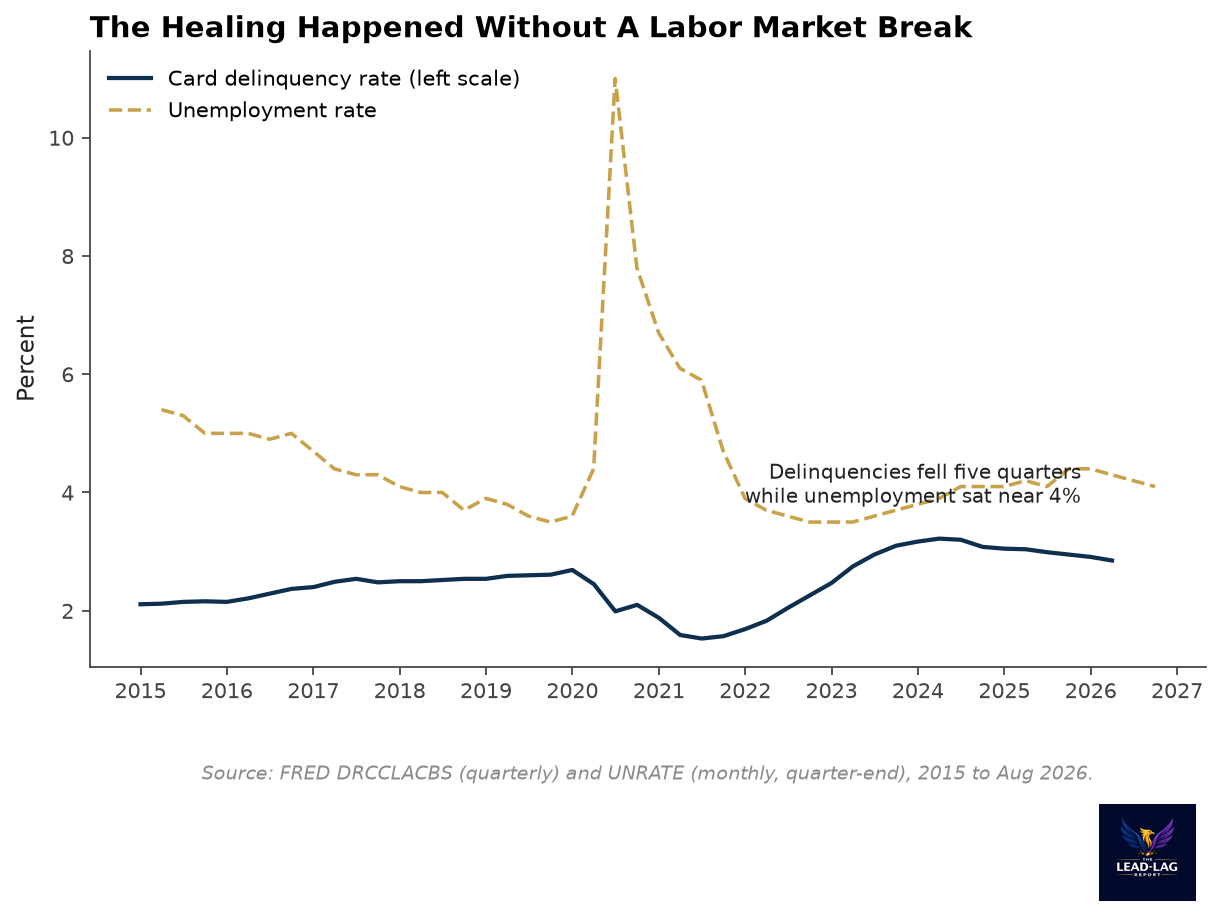
The mechanics of the turn are not mysterious. Banks tightened card standards hard in 2023 and 2024, cutting limits and closing accounts at the riskiest end of the book. A lending book purged of its weakest borrowers is a book whose delinquency rate falls, which is a cleaner way of saying the healing was engineered in part by exclusion. The labor market held: 4.1% unemployment is not a boom, but it is not the income shock that delinquency models assume. And the aggregate household balance sheet never actually cracked: total household debt edged down $13 billion in Q2 2026 to $18.8 trillion, the first quarterly decrease in the current series, with the flow into serious card delinquency flat at 6.97% annualized versus 6.93% a year earlier. Elevated, yes. Deteriorating, no.
The honest case against this piece is real, and I want to state it fully. A 2.85% delinquency rate is still above the 2019 average of 2.59%, so this is healing, not health. The New York Fed's flow measures remain far above pre-pandemic norms, which means the subprime tail is still visibly stressed. Auto loans are not healing the same way: serious auto delinquency ticked up to 3.00% in Q2 2026, up 7 basis points year over year. And a delinquency cycle that ended at 4.1% unemployment would restart quickly at 5%: the series has never fallen far without the labor market intact. The stress trade is not wrong about the fragility of the bottom half of consumers. It is wrong about the timing, and it has been for five quarters.
The positioning implication is about staleness. Consumer-stress positioning, whether expressed through credit-sensitive equities, defensive allocation, or simply the refusal to own anything with a household in the business description, has been priced against a deterioration that stopped in mid-2024. The surprise risk in consumer credit for the next year runs toward resilience, with the specific caveat that the marginal borrower remains one payroll shock from relapse. The 2023 and 2024 vintage of consumer fear was correct about the borrowers and wrong about the aggregate, and the aggregate is what clears in markets. Few understand this.
— — —
Notes
- Delinquency rate on credit card loans, all commercial banks: 2.85% in Q2 2026, 3.22% peak in Q2 2024, 2.59% 2019 average, FRED series DRCCLACBS. Charts 1 and 2 use this series.
- New York Fed Quarterly Report on Household Debt and Credit, Q2 2026 (released August 11, 2026): card balances $1.263 trillion, up $54 billion year over year; flow into 90+ day card delinquency 6.97% annualized versus 6.93% a year earlier; serious auto delinquency 3.00%, up 7 basis points; total household debt $18.8 trillion, down $13 billion on the quarter: New York Fed.
- Unemployment rate 4.1% in August 2026, FRED series UNRATE.
- Average credit card interest rate, all accounts: record 21.59% at the series end in February 2024, FRED series TERMCBCCALLNS.