The Dollar Round-Tripped. Gold Kept Climbing.
The dollar erased its post-jobs dovish repricing. Gold and crude did not. That gap refutes last week's convergence thesis.

Sponsored by Tuttle Capital Management

Every AI narrative of the last two years has been about the model. The next one is about what's standing in its way — and Tuttle Capital has mapped exactly where we believe the constraints are right now.
What We'll Cover
The GPU bottleneck is priced in — its window closed after roughly a 1,200% run and three years of consensus catching up. Here's where the AI bottlenecks are now:
Memory (2023–today): High-Bandwidth Memory is the choke point behind every AI inference call. DRAM exports are up 265% year-on-year at cycle peak. Mid-stage — the supercycle is still running.
Photonics (2025–present): Copper physically cannot move data at the speed 100,000-GPU clusters require. Hyperscalers have reportedly locked up 1.6T transceiver supply through 2028. Early stage — the window is open now.
Space (2025–2035+): Terrestrial power and bandwidth are hitting structural limits — U.S. grid interconnection queues now stretch a median of five years. Blue Origin has filed with the FCC for up to 51,600 satellites; Google has its own space-based compute research underway. Emerging — the enabling layers monetize first.
But what's next? That's what we'll be discussing.
About the Panelists
Matt Tuttle, CEO & Portfolio Manager, Tuttle Capital Management — 44 years as a trader and investor, architect of TCM's fully transparent, actively managed ETF lineup (~$4.5B AUM).
Frances Newton, Chief Investment Officer, Tuttle Wealth Partners — extensive experience analyzing monetary policy and national media commentator (Bloomberg, Fox Business, CBS, Yahoo Finance); policy advisor to the Bank of England.
Dave Pankiw, Partner, CUBIC Advisors — 40 years in the investment business, flat-fee retirement planning specialist, contributor to the Journal of Personal Finance and MarketWatch.com.
Any stock references are provided for informational purposes only and should not be considered personalized investment recommendations. Investors are responsible for conducting their own due diligence and determining whether any investment is appropriate for their individual needs. Investing involves risk and investors must be prepared to bear potential losses, including the loss of principal. Past performance and referenced securities are not indicative of future results, and no guarantee of performance is expressed or implied. This content is sponsored by Tuttle Capital Management. Lead-Lag Media receives compensation for producing and distributing this webinar. All views expressed are those of the panelists and Tuttle Capital Management, LLC (SEC-Registered Investment Adviser; Distributor: Foreside Fund Services, LLC). This is not investment advice.
Key Highlights
- The dollar round-tripped from 99.43 back to 99.81 while gold settled at its highest since June 4. Both cannot be pricing the same Fed.
- Chip weakness broadened rather than resolved: the SOX fell 2.9% on August 10, dragging Arm, Marvell, Micron and the optical names down with it.
- Last week's convergence call is refuted. Crude, gold and the dollar are now trading three different stories into this morning's CPI print.
By Michael A. Gayed, CFA · August 12, 2026
Let me lead with the contradiction, because it is the whole edition. Last week this space argued the market had converged — chips, banks, small caps and blue chips all lifting together on a single Hormuz de-escalation headline — and asked whether that convergence was durable. It was not. Seven sessions later the answer is in, and it is the first thesis in this series I am marking refuted rather than extended. Friday's jobs report handed the market a textbook dovish shock: nonfarm payrolls fell 23,000 against a consensus near +80,000, with May and June revised down a combined 103,000 and the unemployment rate ticking to 4.1% only because 264,000 people left the labor force. The dollar dropped to 99.43 intraday, gold ripped, and September hike odds collapsed. By Tuesday's close the dollar had round-tripped the entire move. Gold did not round-trip. Crude did not round-trip. That is the bifurcation that matters now, and the question into this morning's July CPI print is which of those three assets is telling the truth.
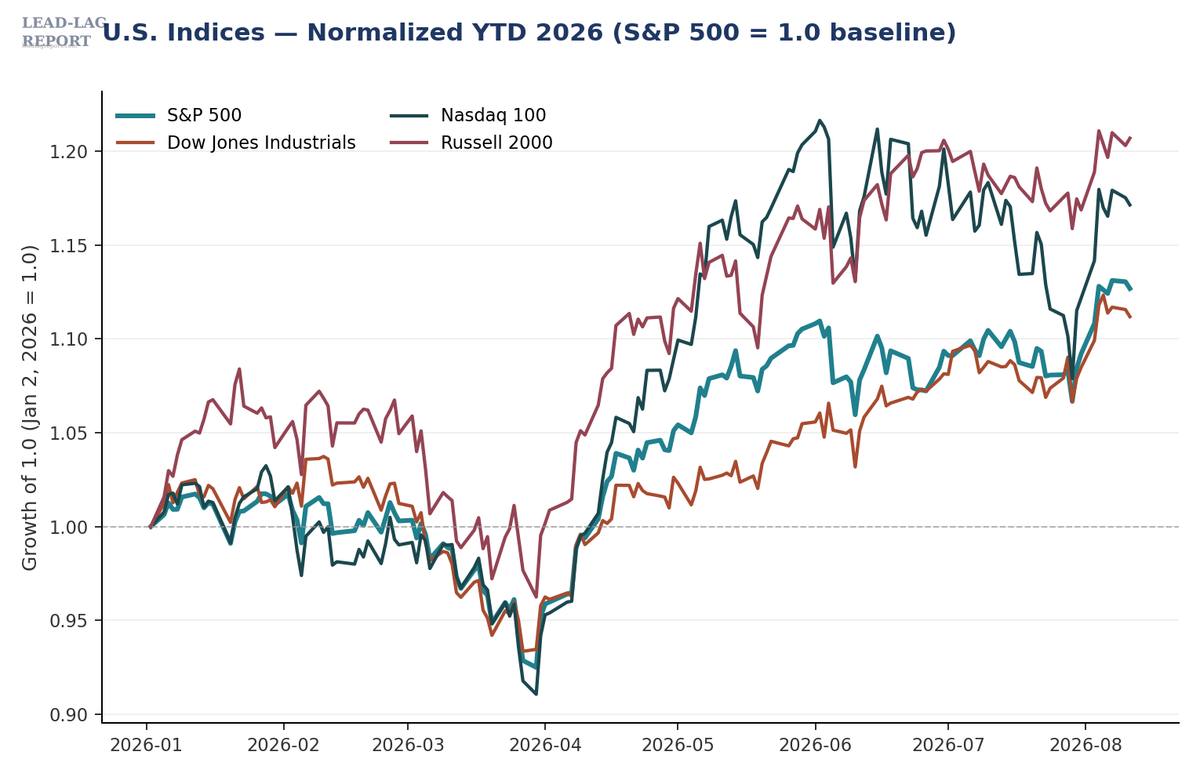
Start with the tape, because the index-level damage is trivial and the damage underneath it is not. The S&P 500 closed Tuesday at 7,728.20, down 0.32% on the day and 0.11% below the prior Tuesday's 7,736.52. The Dow finished at 53,791.85, off 0.34% on the session and 0.54% on the week. The Nasdaq Composite closed 26,445.45, down 0.60%. The Russell 2000 was the lone gainer, closing 3,027.12 against Monday's 3,017.40 — a gain of 0.32% computed off actual closes rather than the rounded prints carried on the wires. Friday's 7,757.64 remains the S&P's record close, leaving Tuesday's finish 29.44 points, or 0.38%, below it. The Dow's own record close of 54,085.88, set August 4, is now roughly 294 points away. Four sessions of drift, no drawdown to speak of, a tape that looks calm from a distance.
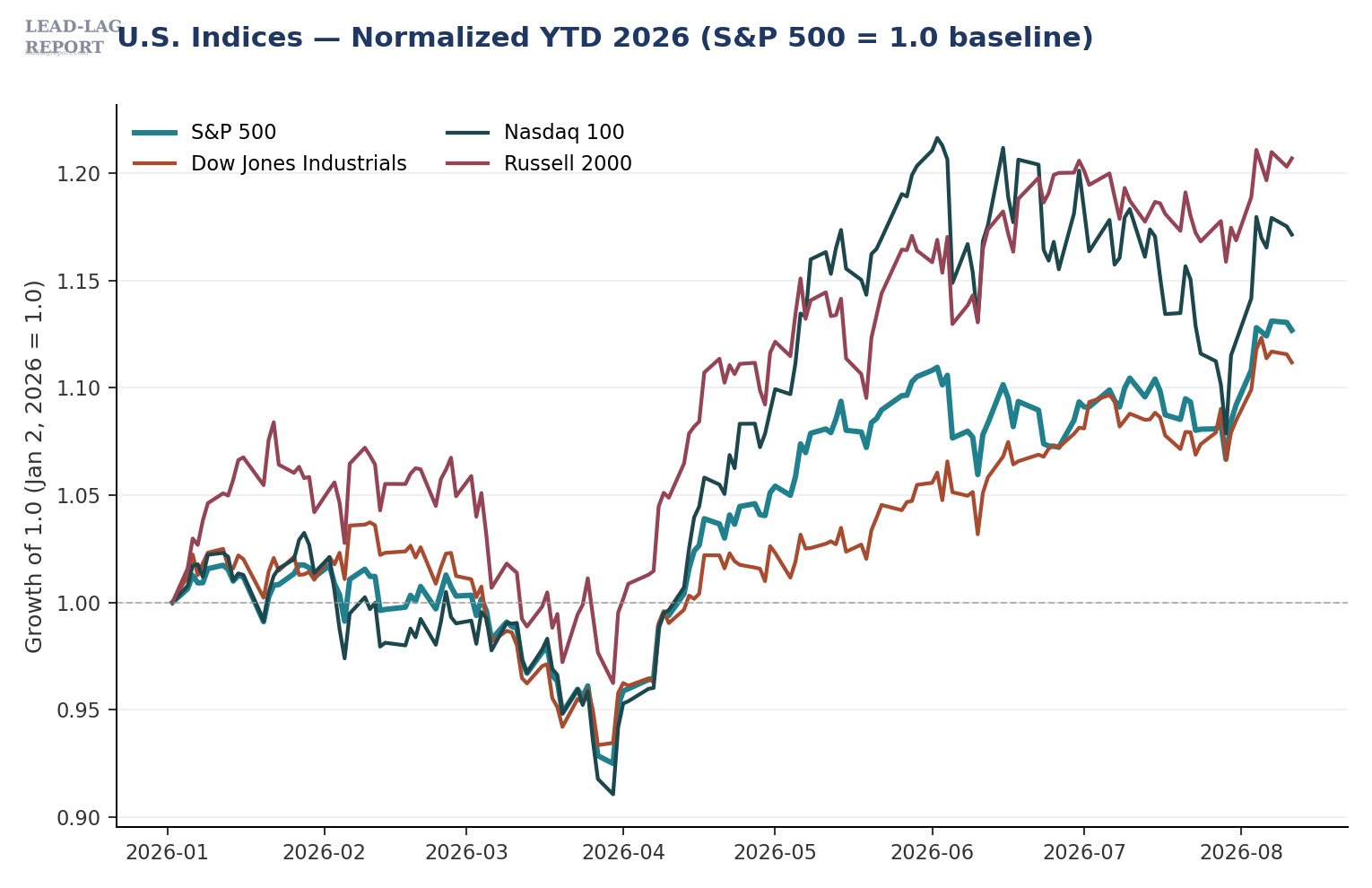
The chip complex is where the damage actually sits, and it has broadened rather than resolved. The PHLX Semiconductor Index fell to 11,993.86 on Monday, August 10 from 12,356.79 — a decline of 2.9% — and the composition matters more than the magnitude. Arm Holdings fell 5.21%, Marvell 4.65%, AMD and Nvidia roughly 2.86% each, Micron 1.89% and Broadcom 1.25%. Optical-communications names were hit harder still, with Coherent down more than 14% and Lumentum more than 8% in the same session. Intel dropped 3% to 4% after announcing a $20 billion equity raise at $95/share, upsized August 11, to fund AI capacity buildout. This is no longer an AMD story. AMD's June-quarter print was a genuine beat — adjusted EPS of $1.66 against $1.62 consensus, revenue of $11.54 billion against $11.28 billion expected, data-center revenue of $6.7 billion up 107% year over year — and the stock closed down 7% on August 5, having been off as much as 10% intraday. A week later the de-rating has reached names with no AMD exposure at all. In my view that is the most important fact in this edition: the market is not repricing a company, it is repricing the terminal multiple on the AI capital-expenditure cycle.
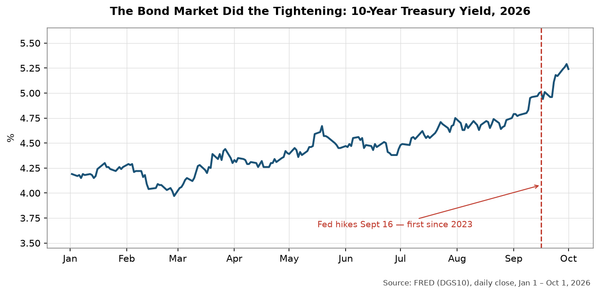
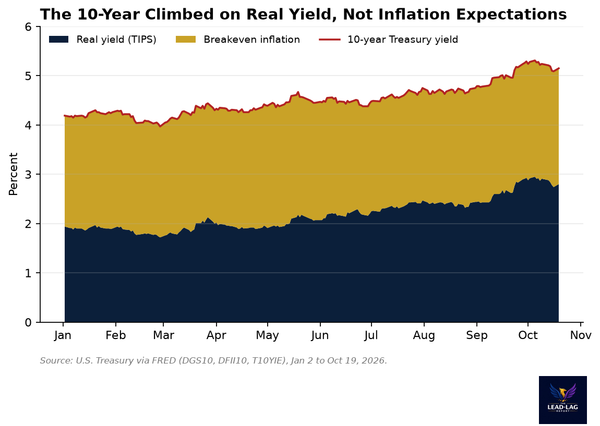
Rates are the transmission mechanism, and they moved the wrong way for equities. The two-year Treasury closed Tuesday at 4.22%, the ten-year at 4.70% and the thirty-year at 5.24%, putting 2s10s at 48 basis points and 2s30s at 102 — both verified against YCharts for the August 11 close, and the 2s10s reading is five basis points steeper than the 43 this space cited on August 4. Two-year yields fell on the jobs data; long yields did not follow, because crude did what crude does to breakevens. Odds of a September hike, priced immediately after the August 7 payrolls release, sit in a 40% to 44% band across CME FedWatch and Kalshi against roughly 50% to 58% before the print — quote that as a range, because the aggregators disagree and the pricing is now five days stale. The July 28–29 FOMC held at 3.50%–3.75% on a 9-3 vote, with Hammack, Kashkari and Logan dissenting in favor of an immediate hike, and all three doubled down publicly on July 31. Underneath the index, the rotation held: energy gained 4.63% Tuesday against technology's 1.10% decline, real estate down 1.23%, utilities down 1.11%. Berkshire Hathaway's first full quarter under Greg Abel showed operating earnings up 16% to $12.98 billion and roughly $19.8 billion of net equity purchases after fourteen straight quarters of net selling, while CoreWeave, reporting after Tuesday's close, roughly doubled revenue to $2.575 billion from $1.212 billion and widened its net loss to $626 million. Value's year-to-date lead over large-cap growth has widened materially. Those are not the same market, and only one of them is fragile.
(Continued for paid subscribers)
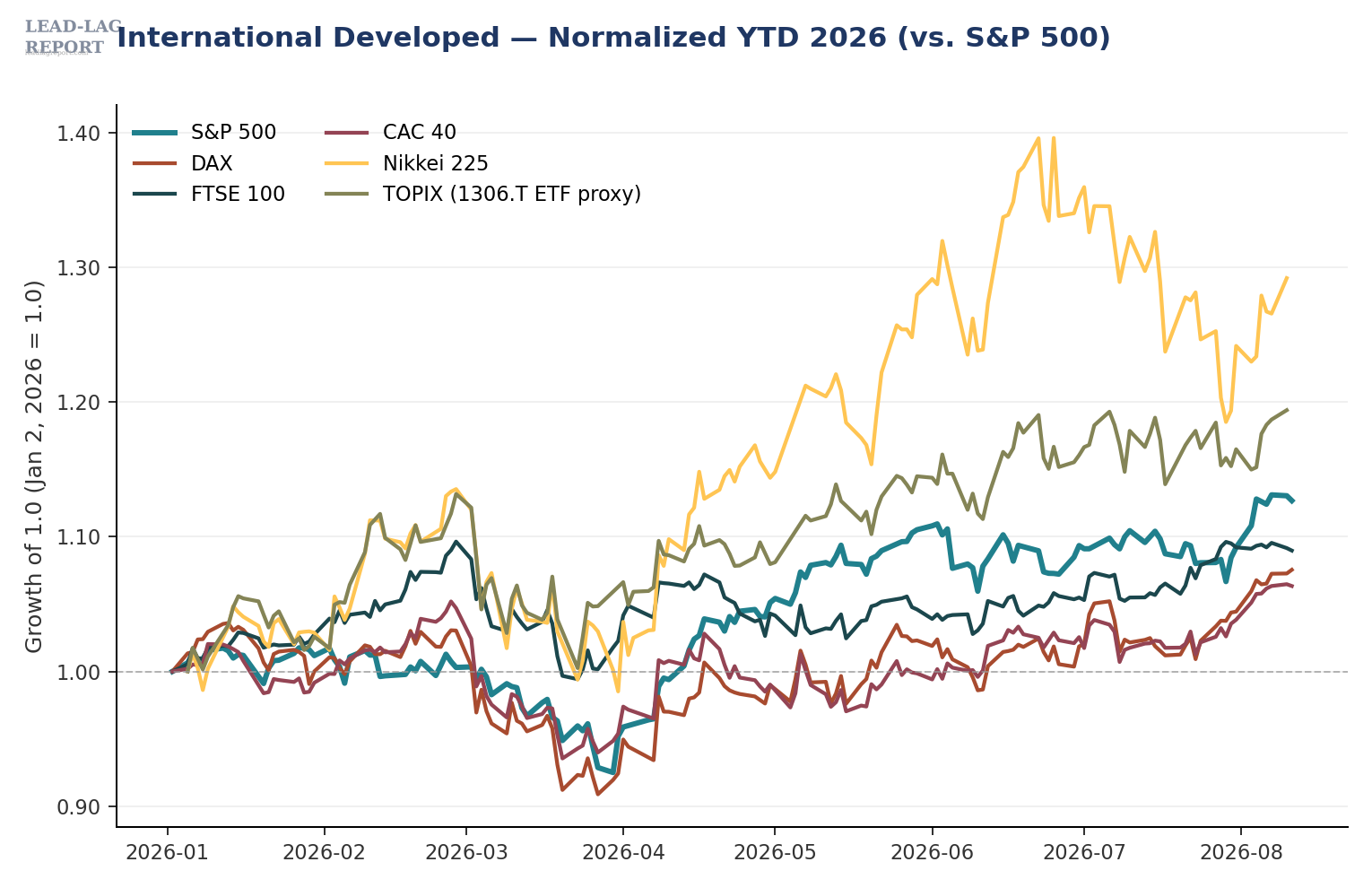
Europe is the cleanest part of the picture and the part nobody is discussing. The DAX closed Tuesday at 26,391.42, up 0.26%. The CAC 40 finished 8,714.94, down 0.13%, a whisker off Monday's record close of 8,726.03. The FTSE 100 closed 10,844.19, down 0.17%, still short of the 10,910.55 all-time closing high set on February 27. Each of those day-moves is anchored to primary exchange close data rather than aggregator estimates, which this week diverged by enough to matter. The German data underneath is genuinely good: final July manufacturing PMI at 52.2, a four-year high, and June factory orders up 3.1% month over month against a 0.3% consensus. France is the counterweight — June industrial production rose just 0.1% month over month and manufacturing output fell 1.1%. A two-speed industrial Europe, with the faster speed in the larger economy.
Policy is where Europe and Japan part company with Washington. The ECB deposit rate sits at 2.25%, and OIS-based pricing on the ECB Watch Tool put roughly 84% odds on a hike to 2.50% at the September 10 meeting as of Tuesday. Eurozone flash HICP for July came in at 2.9% year over year with core at 2.5%, a fifth straight month above target, energy inflation running 10.0% on the Iran conflict. The Bank of England held Bank Rate at 3.75% at its meeting ending July 29, announced July 30, and Andrew Bailey went out of his way to talk down hike speculation; the ten-year gilt closed at 5.01% Tuesday anyway, up from a 4.891% three-week low on August 4. The Bank of Japan holds at 1.00% and Governor Ueda has signaled the BOJ could accelerate the pace of hikes, which puts the September 17–18 meeting live, with the ten-year JGB at 2.804% and the two-year at 1.611% on the Ministry of Finance reference rates for August 7. One caveat worth stating plainly: the Nikkei 225 print of 66,970.22, up 2.08%, is the Monday, August 10 Tokyo session close, and Tokyo was closed Tuesday August 11 for Mountain Day, so this is a stale carry-forward print — not a timezone artifact. Japan's second-quarter GDP does not publish until Monday, August 17.
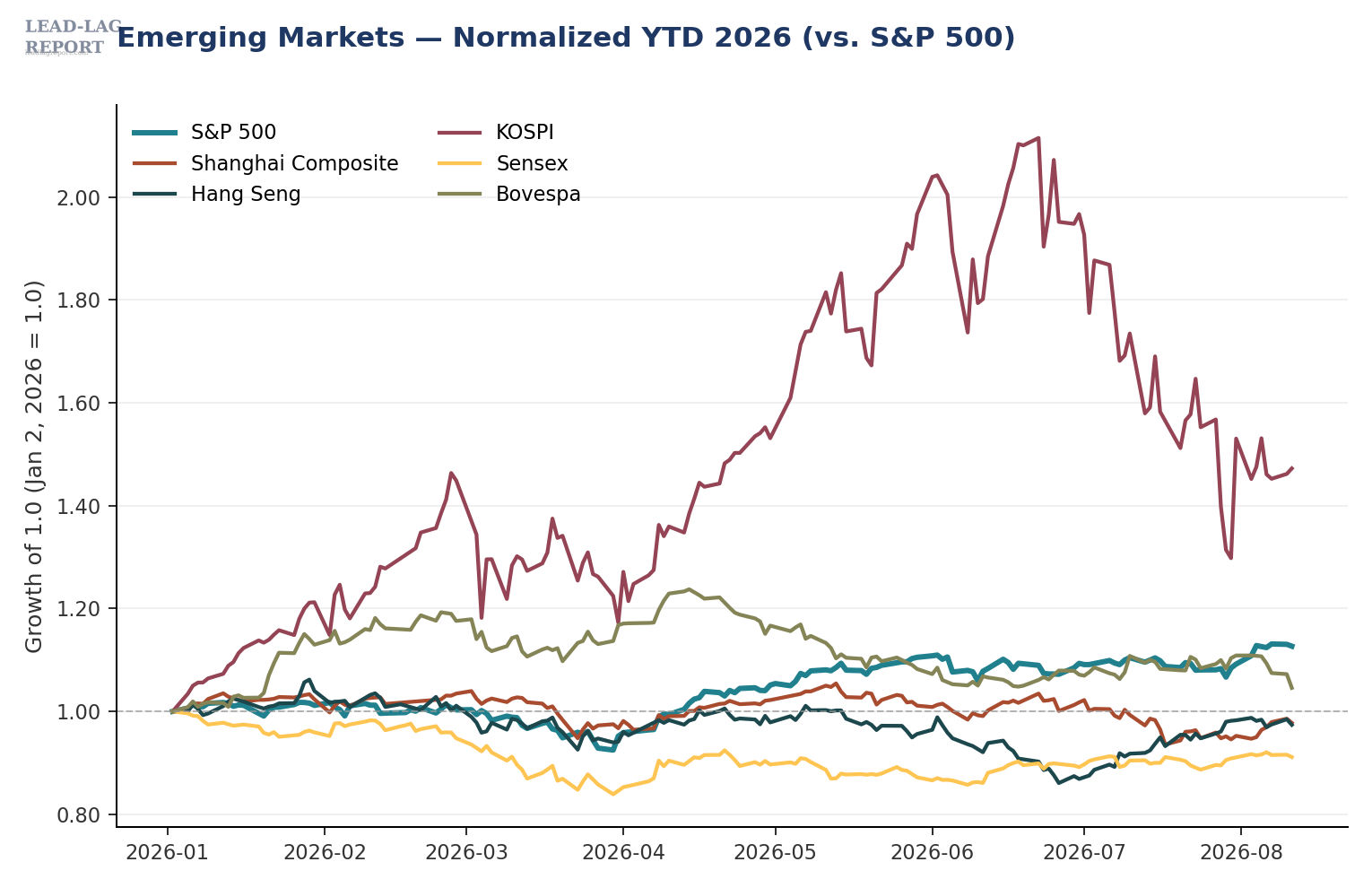
Korea stabilized, and the manner of it matters more than the level. The KOSPI closed Tuesday at 6,345.53, up 0.73%, after opening down almost a percent on Wall Street weakness and reversing on strong semiconductor export data that lifted Samsung Electronics 4.13%. No market-wide circuit breaker has fired since the July 28–29 episode. I am deliberately not attaching an ordinal to that episode's place in the 2026 sequence: the wires disagree between the eighth and the ninth, the Korea Exchange has not published a cumulative count I can verify directly, and August 5's event was a five-minute buy-side sidecar rather than a circuit breaker at all. Different mechanism, different trigger, and conflating the two is how a newsletter earns a correction. What I will say is that Korea is currently the only major Asian market converting U.S. chip weakness into strength rather than sympathy selling.
China and India went the other way. The Shanghai Composite closed 3,934.09, down 0.82%, snapping a five-session run; the Hang Seng fell 1.10% to 25,652.82 with the tech sub-index down 1.93%, both pressured by crude and by fading U.S.-Iran diplomacy. July inflation data released August 9 by the National Bureau of Statistics showed CPI at just 0.5% year over year, a six-month low, with PPI at 3.5% and decelerating from 4.1% — factory-gate reflation fading while the consumer side hovers barely above zero. India's Sensex closed 78,154.25 and the Nifty 50 at 24,471.70, both lower for a second session as crude weighed on financials and realty, with the Reserve Bank of India holding the repo rate at 5.25% on August 5 for a fourth consecutive meeting. Brazil was the week's casualty: the Ibovespa closed 167,874.64 Tuesday, down 2.5% from Monday's 172,179.93 and 5.9% below the prior Tuesday, even as the central bank cut the Selic 25 basis points to 14.00% on August 5 — a fourth consecutive quarter-point cut per the Copom communique. Easing did not help.
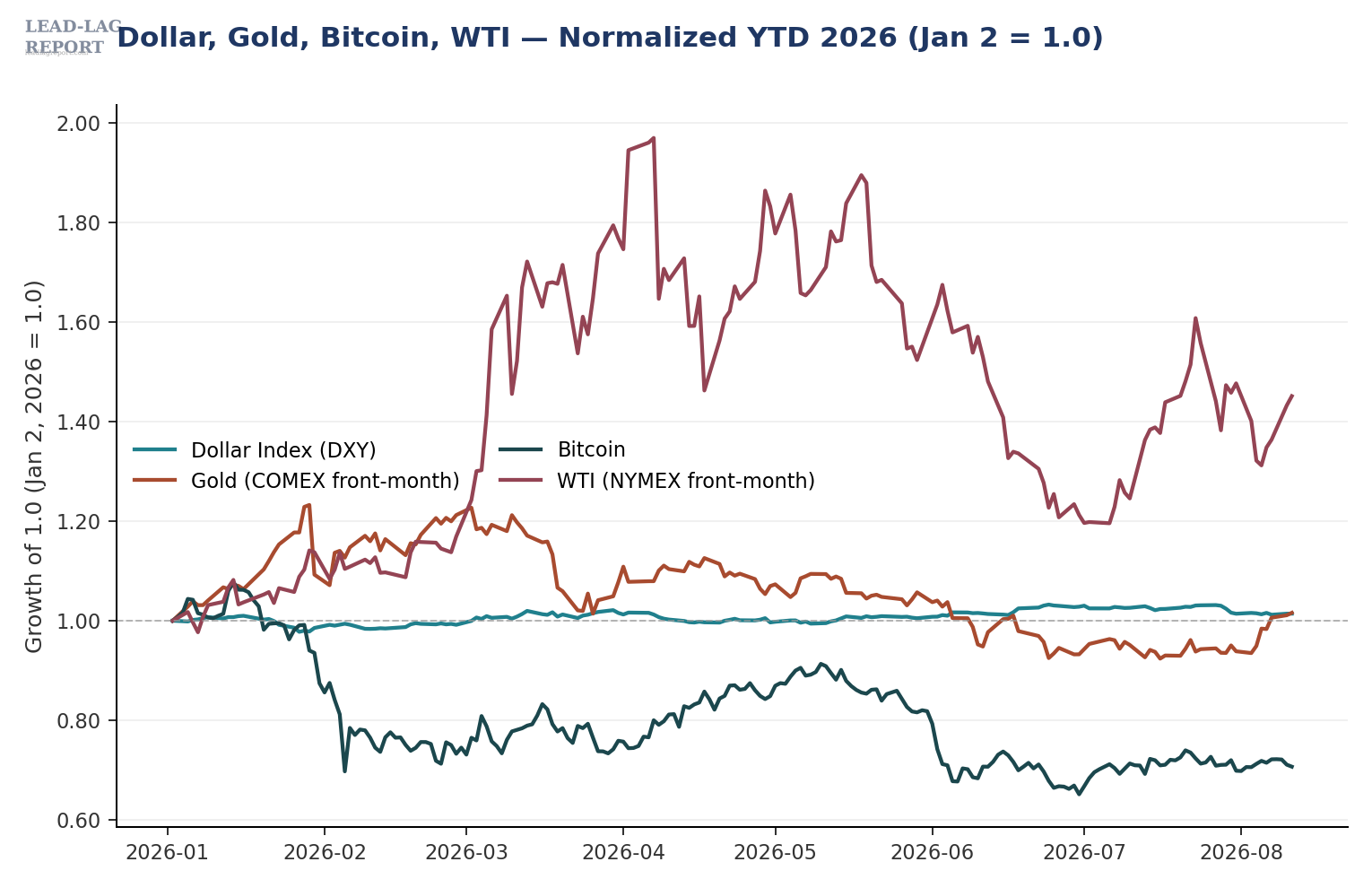
Now the decoupling itself. The ICE dollar index closed Tuesday at 99.81, with the futures-based series marking 99.82 — call it flat on the week and down 1.40% month to date. What that flat number hides is the round trip: 99.43 intraday on Friday, August 7 immediately after the payrolls miss, then a full clawback across the weekend as U.S.-Iran diplomacy soured. The yen went along for the ride, rallying to 157.20 Friday before surrendering all of it to close near 159.2 Tuesday. EUR/USD finished 1.1542 and sterling 1.3507, both rangebound. If the dollar has erased the entire dovish repricing, the assets that rallied on that repricing should have erased theirs too. They did not, and that refusal is the story.
COMEX front-month gold settled at $4,383.00 Tuesday, up 0.49% or $21.20, a third consecutive higher session and a 3.32% three-day run — the highest front-month settlement since June 4, per Morningstar's Dow Jones Data Talk. That is the futures settlement rather than spot, and the distinction matters this week because the post-settlement electronic session marked as high as $4,427.80. Gold is up 8.25% month to date, 1.33% year to date, and still 17.59% below the January 29 record settlement of $5,318.40. Silver ran hotter, up 12.30% on the month. Crude told the same story in a different currency: NYMEX September WTI settled $82.13 Monday, up $3.95 or 5.05%, a fourth consecutive higher session, and finished Tuesday's electronic session at $83.23; ICE October Brent settled $87.90 Monday, up $4.35 or 5.2%, and traded near $88.95 Tuesday after briefly poking above $90. The catalysts were specific — Iran naming a hardline former Revolutionary Guard commander to its top security post, and a reported Iranian missile strike on an ADNOC-linked vessel — on day 165 by our reckoning of the Strait of Hormuz situation. Bitcoin, meanwhile, closed at $63,693.06, off Monday's move above $65,000 and tracking the dollar rather than the metals. The divergence between gold and bitcoin this month is the cleanest evidence I have that the gold bid is geopolitical rather than monetary. The market is missing that distinction, and anyone holding gold as a pure Fed trade is on borrowed time.
What I am watching next week. First, this morning's July CPI at 8:30 — consensus near 3.4% headline and 2.5% core — and specifically whether a soft number pulls the dollar back toward 99.43 or whether gold ignores it the way it ignored the dollar's clawback. Second, Thursday's PPI and Applied Materials' fiscal third-quarter report the same day, the next real read on chip-equipment demand after the SOX break. Third, whether the oil-gold divergence resolves through Hormuz headlines or through the Fed, because the two paths imply opposite equity outcomes. Fourth, the KOSPI's 6,400 resistance as the tell for whether Asian chip sentiment has genuinely bottomed. Fifth, Japan's second-quarter GDP on Monday, August 17. And into September, three central banks with a live hike bias inside three weeks — the ECB on the 10th, the FOMC on the 15th and 16th, the Bank of Japan on the 17th and 18th. If this week taught anything, it is that the cross-asset market has stopped agreeing with itself. I would not expect it to start again on one inflation print.
The Lead-Lag Report is provided by Lead-Lag Publishing, LLC. All opinions and views mentioned in this report constitute our judgments as of the date of writing and are subject to change at any time. Information within this material is not intended to be used as a primary basis for investment decisions and should also not be construed as advice meeting the particular investment needs of any individual investor. Trading signals produced by the Lead-Lag Report are independent of other services provided by Lead-Lag Publishing, LLC or its affiliates, and positioning of accounts under their management may differ. Please remember that investing involves risk, including loss of principal, and past performance may not be indicative of future results. Lead-Lag Publishing, LLC, its members, officers, directors and employees expressly disclaim all liability in respect to actions taken based on any or all of the information on this writing.