Three Greens and a Warning
Three of four intermarket signals favor risk-on positioning this week. Lumber/Gold remains the lone defensive holdout.

Today’s Lead-Lag Report post is sponsored by Columbia Threadneedle
What if you could target only the strongest performers in an index?
Columbia Research Enhanced Core ETF (RECS) leverages the firm's quantitative research by investing in the highest-rated stocks from the Russell 1000. The result is an ETF with reduced drag and enhanced return potential at an attractive price point.
Potential benefits of RECS:
- Aims to optimize core equity exposure
- Sector-neutral to the Russell 1000
- Competitive expense ratio of 15 basis points1
1 Net and gross expense ratio. The fund's expense ratio is from the most recent prospectus.
Investors should carefully consider the investment objectives, risks, charges and expenses of the Fund before investing. To obtain a prospectus containing this and other important information, please visit the Columbia Threadneedle ETF page to view or download a prospectus. Read the prospectus carefully before investing.
Investing involves risks, including the risk of loss of principal. Market risk may affect a single issuer, sector of the economy, industry or the market as a whole. The fund is passively managed and seeks to track the performance of an index. There is no guarantee that the index and, correspondingly, the fund will achieve positive returns. Risk exists that the index provider may not follow its methodology for index construction. Errors may result in a negative fund performance. The fund’s net asset value will generally decline when the market value of its targeted index declines. The fund concentrates its investments in issuers of one or more particular industries to the same extent as the underlying index. Investments in a narrowly focused sector may exhibit higher volatility than investments with a broader focus. Investments selected using quantitative methods may perform differently from the market as a whole and may not enable the fund to achieve its objective. Investment in larger companies may involve certain risks associated with their larger size and may be less able to respond quickly to new competitive challenges than smaller competitors. Investments in mid-cap companies often involve greater risks than investments in larger companies and may have less predictable earnings and be less liquid than the securities of larger firms. Growth securities, at times, may not perform as well as value securities or the stock market in general and may be out of favor with investors. Value securities may be unprofitable if the market fails to recognize their intrinsic worth or the portfolio manager misgauges that worth. Although the fund’s shares are listed on an exchange, there can be no assurance that an active, liquid or otherwise orderly trading market for shares will be established or maintained. The Fund may have portfolio turnover, which may cause an adverse cost impact. There may be additional portfolio turnover risk as active market trading of the fund’s shares may cause more frequent creation or redemption activities that could, in certain circumstances, increase the number of portfolio transactions as well as tracking error to the Index, and high levels of transactions increase brokerage and other transaction costs and may result in increased taxable capital gains.
ETF shares are bought and sold at market price (not NAV) and are not individually redeemable. Investors buy and sell shares on a secondary market. Shares may trade at a premium or discount to the NAV. Only market makers or “authorized participants” may trade directly with the Fund(s), typically in blocks of 50,000 shares.
Shares are not FDIC insured, may lose value, and have no bank guarantee.
For broker/dealer or institutional use only.
Columbia Management Investment Advisers, LLC serves as the investment manager to the ETFs. The ETFs are distributed by ALPS Distributors, Inc., which is not affiliated with Columbia Management Investment Advisers, LLC, Columbia Management Investment Distributors, Inc. or its parent company Ameriprise Financial, Inc. Columbia Management Investment Distributors, Inc., LLC (Member FINRA | SIPC) is a marketing agent for the ETFs. Columbia Threadneedle Investments is the global brand name of the Columbia and Threadneedle group of companies.
DISCLAIMER – PLEASE READ: This is sponsored advertising content for which Lead-Lag Publishing, LLC has been paid a fee. The information provided in the link is solely the creation of Columbia Threadneedle. Lead-Lag Publishing, LLC does not guarantee the accuracy or completeness of the information provided in the link or make any representation as to its quality. All statements and expressions provided in the link are the sole opinion of Columbia Threadneedle and Lead-Lag Publishing, LLC expressly disclaims any responsibility for action taken in connection with the information provided in the link.
Three Greens and a Warning
Three of four signals favor risk-on positioning. The Lumber/Gold signal is the lone holdout, continuing to flag a defensive undertone beneath the surface.
Week Ending August 21, 2026
By Michael A. Gayed, CFA
SIGNAL SUMMARY
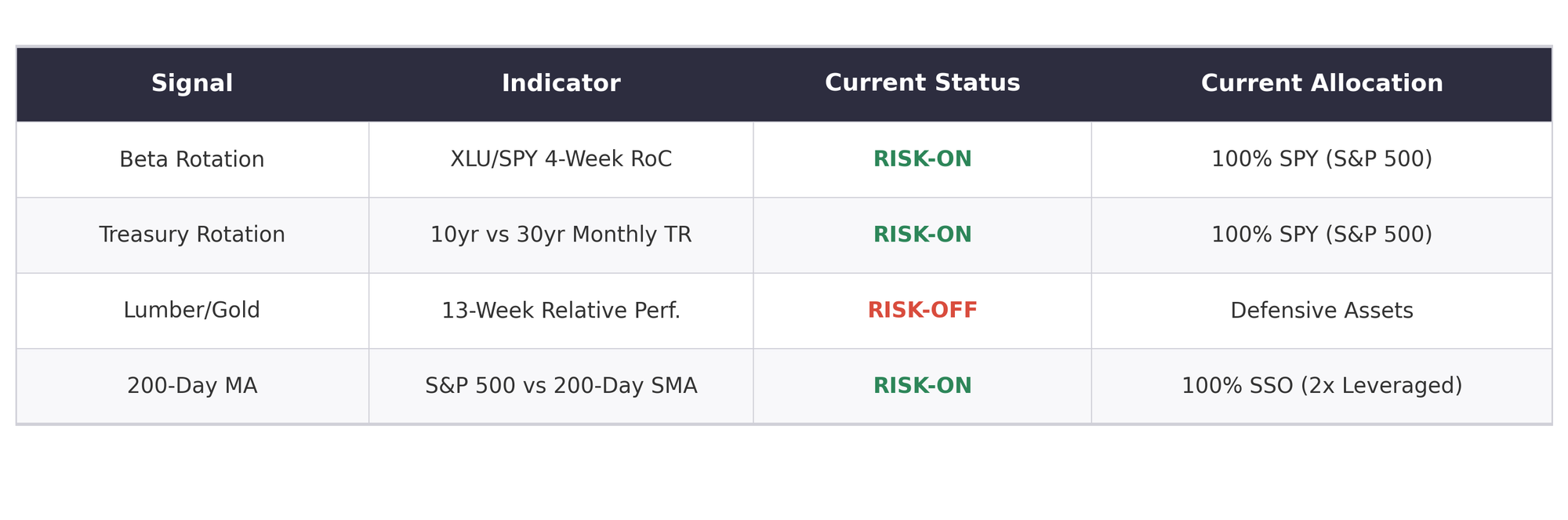
COMPOSITE: TILT RISK-ON (+46 on a -100/+100 conviction-weighted scale)
3-of-4 RISK-ON · 1-of-4 RISK-OFF
Lone-holdout alert: Lumber/Gold is the only defensive signal against three risk-on readings. Single dissenting signals often resolve toward the majority — but historically also flag the earliest leg of a broader rotation. Worth watching whether it converges or the others follow it lower.
Key Takeaways:
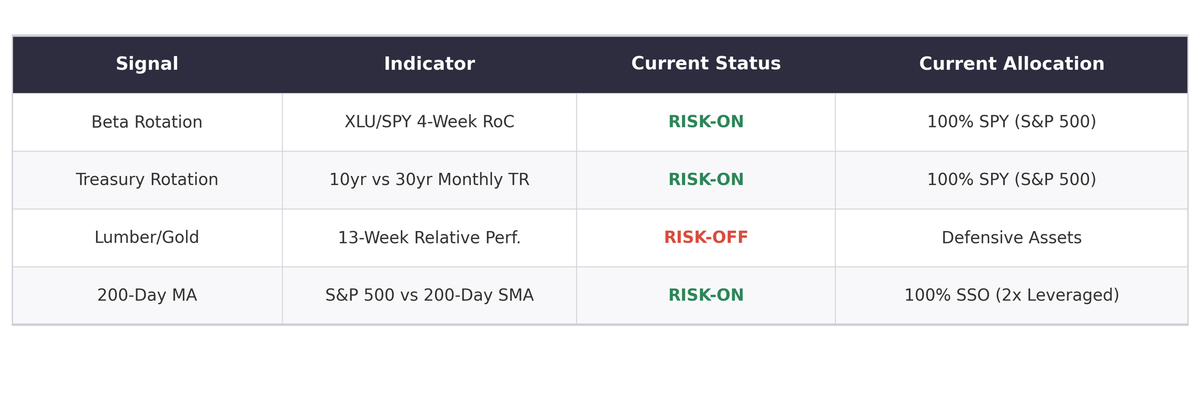
- Signal 1 (Beta Rotation) remains Risk-On with the XLU/SPY 4-week RoC at -10.84%. The S&P 500 continues to outperform Utilities, signaling that risk appetite still favors broad equity over defensive sectors. The allocation remains 100% SPY.
- Signal 2 (Treasury Rotation) is RISK-ON on the latest July 2026 month-end reading. TLT returned -4.83% in July versus IEF at -1.71%. Long-duration bonds underperformed intermediate maturities by more than three percentage points, a classic risk-appetite indicator. The current allocation tilts toward SPY (S&P 500).
- Signal 3 (Lumber/Gold) is RISK-OFF on the latest 13-week relative-performance reading. Lumber's 13-week return of -1.96% lags gold's 2.07%. All seven sub-strategies are rotated to defensive positioning as gold leadership signals risk aversion.
- The S&P 500 at 7,657.2 sits +8.2% above its 200-day SMA of 7,075.44. Signal 4 remains Risk-On, with the allocation set to SSO (2x leveraged S&P 500). Trend remains intact even after Thursday’s broad equity selloff.
MARKET COMMENTARY
The framework reads 3-1 Risk-On this week. Three of the four intermarket indicators favor offensive positioning, with the Lumber/Gold signal the lone defensive holdout on the latest 13-week reading. The S&P 500 closed at 7,657.2 on August 21, 2026, with the index sitting +8.2% above its 200-day moving average of 7,075.44. Trend, beta rotation, and lumber/gold remain aligned with risk, but the long-duration Treasury bid suggests pockets of caution beneath the surface.
The week ending August 21, 2026 closed with the S&P 500 at 7,657.2. The index continues to sit above its 200-day moving average, keeping the trend structure intact that has framed the year to date. Beneath the headline price action, broad equity continues to lead defensive sectors, and intermediate Treasuries outperformed long bonds, a risk-appetite signature. Earnings season has wound down with broadly stable forward guidance, and macro data continues to trace a soft-landing path, but valuations, positioning, and concentration risk all argue for tactical respect of the framework's defensive readings.
At 7,657.2, the index sits +8.2% above its 200-day SMA of 7,075.44. That spread is comfortable enough to keep Signal 4 on the offensive 2x leveraged allocation. The technical setup remains constructive in the aggregate — price above a rising 200-day — but the divergence between the trend signal and the defensive signals is the kind of split that historically precedes either a pause in the trend or a stronger rotation into defense.
The Beta Rotation signal is RISK-ON with the XLU/SPY 4-week Rate of Change at -10.84%. Utilities continue to underperform the broad market over the trailing four weeks, with the negative RoC reflecting persistent flows out of defensive equity sectors. The framework’s allocation stays on SPY.
The Treasury Rotation signal is RISK-ON on the latest July 2026 month-end reading. TLT returned -4.83% in July versus IEF at -1.71%, with the intermediate maturity outperforming long-duration by 3.1 percentage points — a strong risk-appetite signature. The signal will hold this July reading through the end of August.
The Lumber/Gold signal is RISK-OFF on the latest 13-week reading. Lumber's 13-week return of -1.96% lags gold's 2.07%. All seven Lumber/Gold sub-strategies are rotated to defensive positioning. Gold leadership versus lumber over a 13-week window is one of the more robust early-warning indicators in the framework.
The 3-1 Risk-On reading sits in the middle of the framework’s distribution. Mixed readings often precede broader pivots in either direction — either the defensive signals reconverge to risk-on, or the risk-on signals follow defense lower. The current setup demands tactical respect: maintain offensive allocations where signals call for them, recognize defensive allocations where they apply, and treat the disagreement among indicators as meaningful. The risks worth watching are a flip of the Treasury Rotation signal back to defensive, a flip of the Beta Rotation signal, equity selloffs that compress the cushion above the 200-day, or a flip of the Lumber/Gold spread back to gold-favored.