When the Bond Market Dies, So Does Capitalism
Federal interest just passed defense. Debt-to-GDP exceeded the WWII peak in peacetime. The foreign buyer base is disassembling. And a democratic socialist just took NYC. These are not separate stories. They are the same story, upstream and downstream.

This Lead-Lag Report post is sponsored by Columbia Threadneedle
What if you could target only the strongest performers in an index?
Columbia Research Enhanced Core ETF (RECS) leverages the firm's quantitative research by investing in the highest-rated stocks from the Russell 1000. The result is an ETF with reduced drag and enhanced return potential at an attractive price point.
Potential benefits of RECS:
- Aims to optimize core equity exposure
- Sector-neutral to the Russell 1000
- Competitive expense ratio of 15 basis points1
1 Net and gross expense ratio. The fund's expense ratio is from the most recent prospectus.
Investors should carefully consider the investment objectives, risks, charges and expenses of the Fund before investing. To obtain a prospectus containing this and other important information, please visit columbiathreadneedleus.com/etf to view or download a prospectus. Read the prospectus carefully before investing.
Investing involves risks, including the risk of loss of principal. Market risk may affect a single issuer, sector of the economy, industry or the market as a whole. The fund is passively managed and seeks to track the performance of an index. There is no guarantee that the index and, correspondingly, the fund will achieve positive returns. Risk exists that the index provider may not follow its methodology for index construction. Errors may result in a negative fund performance. The fund's net asset value will generally decline when the market value of its targeted index declines. The fund concentrates its investments in issuers of one or more particular industries to the same extent as the underlying index. Investments in a narrowly focused sector may exhibit higher volatility than investments with a broader focus. Investments selected using quantitative methods may perform differently from the market as a whole and may not enable the fund to achieve its objective. Investment in larger companies may involve certain risks associated with their larger size and may be less able to respond quickly to new competitive challenges than smaller competitors. Investments in mid-cap companies often involve greater risks that investments in larger companies and may have less predictable earning and be less liquid than the securities in larger firms. Growth securities, at times, may not perform as well as value securities or the stock market in general and may be out of favor with investors. Value securities may be unprofitable if the market fails to recognize their intrinsic worth or the portfolio manager misgauged that worth. Although the fund's shares are listed on an exchange, there can be no assurance that an active, liquid or otherwise orderly trading market for shares will be established or maintained. The Fund may have portfolio turnover, which may cause an adverse cost impact. There may be additional portfolio turnover risk as active market trading of the fund's shares may cause more frequent creation or redemption activities that could, in certain circumstances, increase the number of portfolio transactions as well as tracking error to the Index and high levels of transactions increase brokerage and other transaction costs and may result in increased taxable capital gains.
ETF shares are bought and sold at market price (not NAV) and are not individually redeemable. Investors buy and sell shares on a secondary market. Shares may trade at a premium or discount to the NAV. Only market makers or "authorized participants" may trade directly with the Fund(s), typically in blocks of 50,000 shares.
Shares are not FDIC insured, may lose value, and have no bank guarantee.
For broker/dealer or institutional use only.
The ETFs are distributed by ALPS Distributors, Inc. Columbia Management Investment Advisers, LLC serves as the investment manager. Columbia Threadneedle Investments is the global brand name of the Columbia and Threadneedle group of companies.
DISCLAIMER – PLEASE READ: This is sponsored advertising content for which Lead-Lag Publishing, LLC has been paid a fee. The information provided in the link is solely the creation of Columbia Threadneedle. Lead-Lag Publishing, LLC does not guarantee the accuracy or completeness of the information provided in the link or make any representation as to its quality. All statements and expressions provided in the link are the sole opinion of Columbia Threadneedle and Lead-Lag Publishing, LLC expressly disclaims any responsibility for action taken in connection with the information provided in the link.
The Only Institution That Ever Disciplined the State Is the One We Are Now Killing
Key Highlights
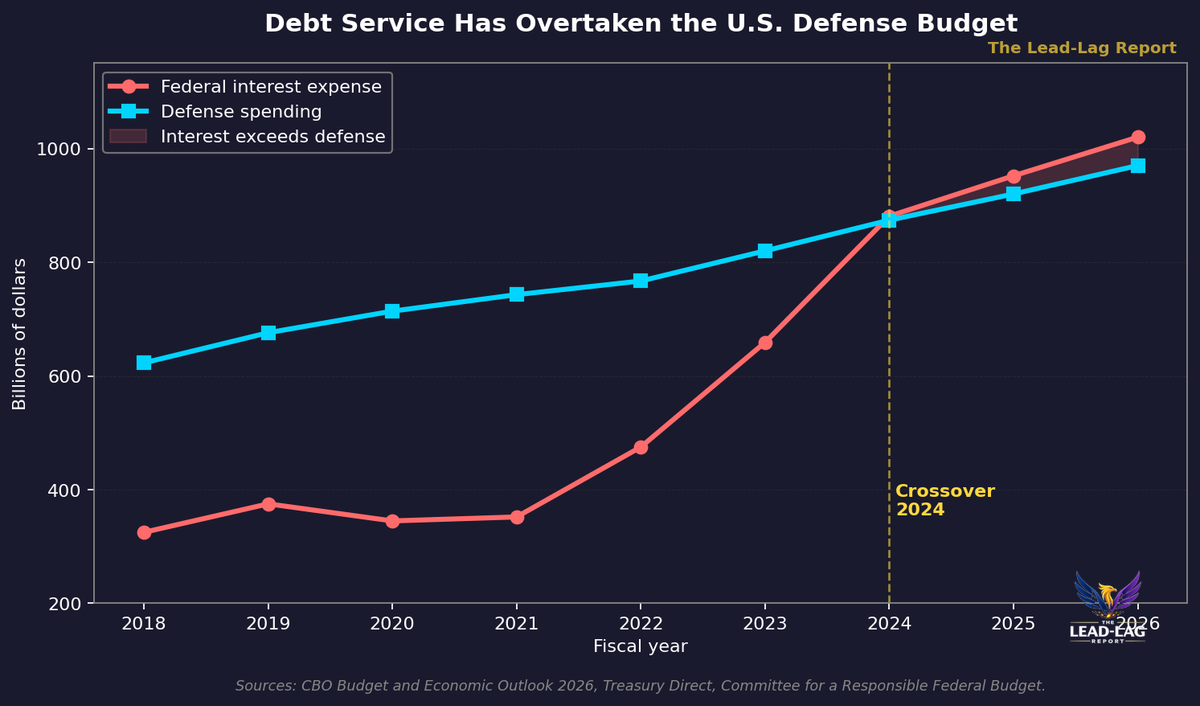
- Federal interest expense crossed the entire defense budget in 2024 and continues climbing. In FY2026 gross interest is projected near $1.02 trillion versus defense outlays near $970 billion.
- U.S. debt-to-GDP passed 122 percent in Q1 2026, exceeding the 106 percent WWII peak, in peacetime.
- Foreign holders of U.S. Treasuries have collapsed from 34 percent of marketable debt in 2013 to 23 percent in 2026, even as nominal holdings rose from $5.6T to $8.9T. Supply outran the price-sensitive buyer base.
- The MOVE Index remains structurally elevated with a 64 percent spike in February-March 2026, indicating chronic Treasury volatility, not a passing episode.
- Zohran Mamdani was inaugurated the 112th mayor of New York City in January 2026 on an explicit democratic-socialist platform. This is not a local anomaly. It is a leading indicator.
The Signal Everyone Is Reading Wrong
Every functioning capitalist economy since Adam Smith has rested on a single, boring institution: a sovereign bond market that disciplines the state. When politicians overspend, yields rise. When yields rise, borrowing costs rise. When borrowing costs rise, the state either raises taxes, cuts spending, or lets inflation eat the debt. Every one of those responses is politically painful, which is exactly the point. The bond market is the veto on fiscal irresponsibility that voters cannot cast at the ballot box.
That veto is dying. And the political consequences of its death are already visible.
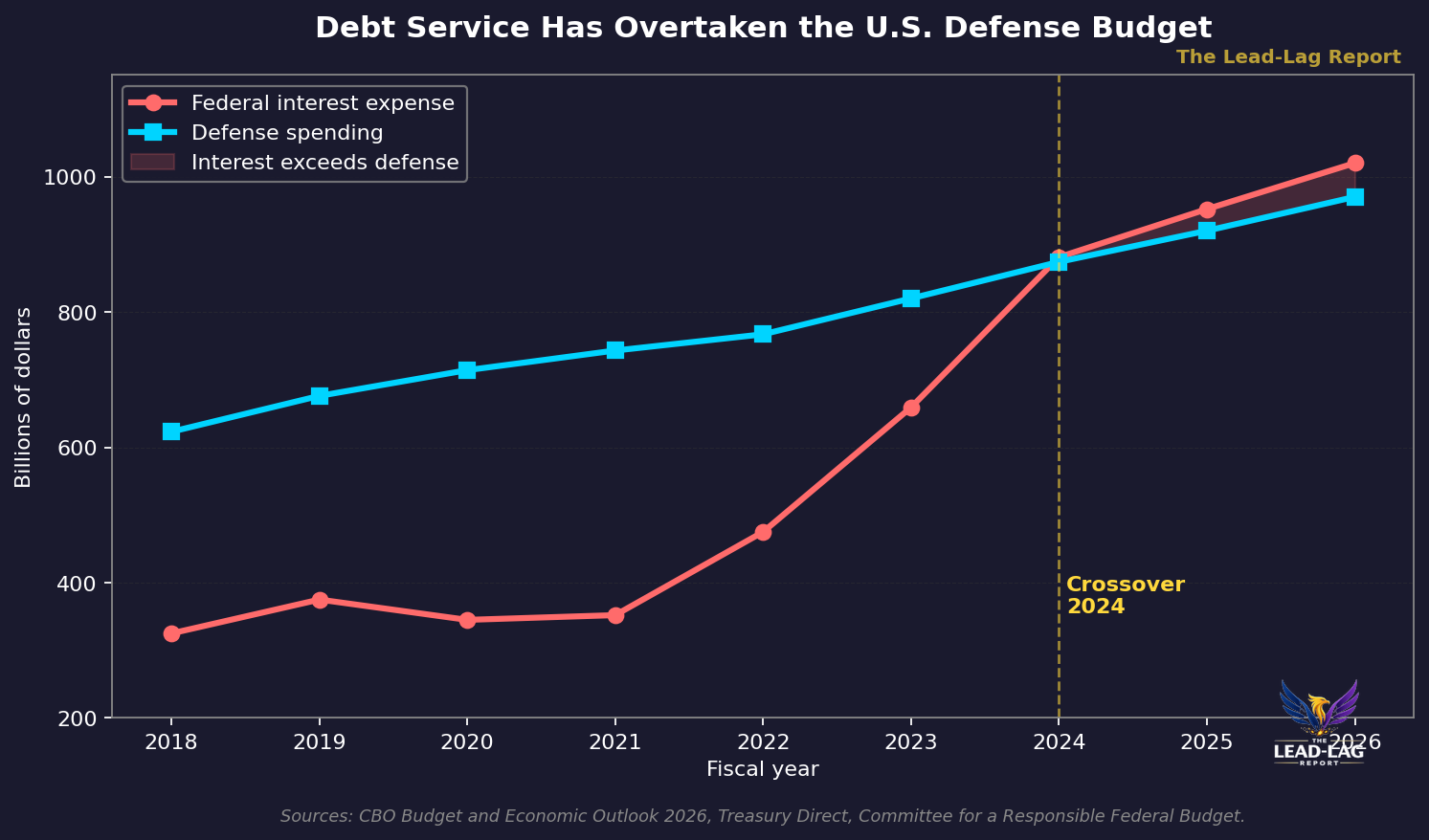
Federal interest expense crossed the entire U.S. defense budget in 2024 and has continued climbing. In FY2026, gross interest on the national debt is projected to run near $1.02 trillion, compared to defense outlays near $970 billion[1]. This is not a wartime economy. Interest is the single fastest-growing line item in the federal budget, growing faster than Medicare, faster than Social Security, faster than any discretionary program.
The relevant question is not whether this is sustainable in some abstract mathematical sense. The relevant question is what happens when it stops being sustainable politically. And the answer is already being written, in real time, in the political discourse of the United States and the composition of its electorate.
What the Data Actually Shows
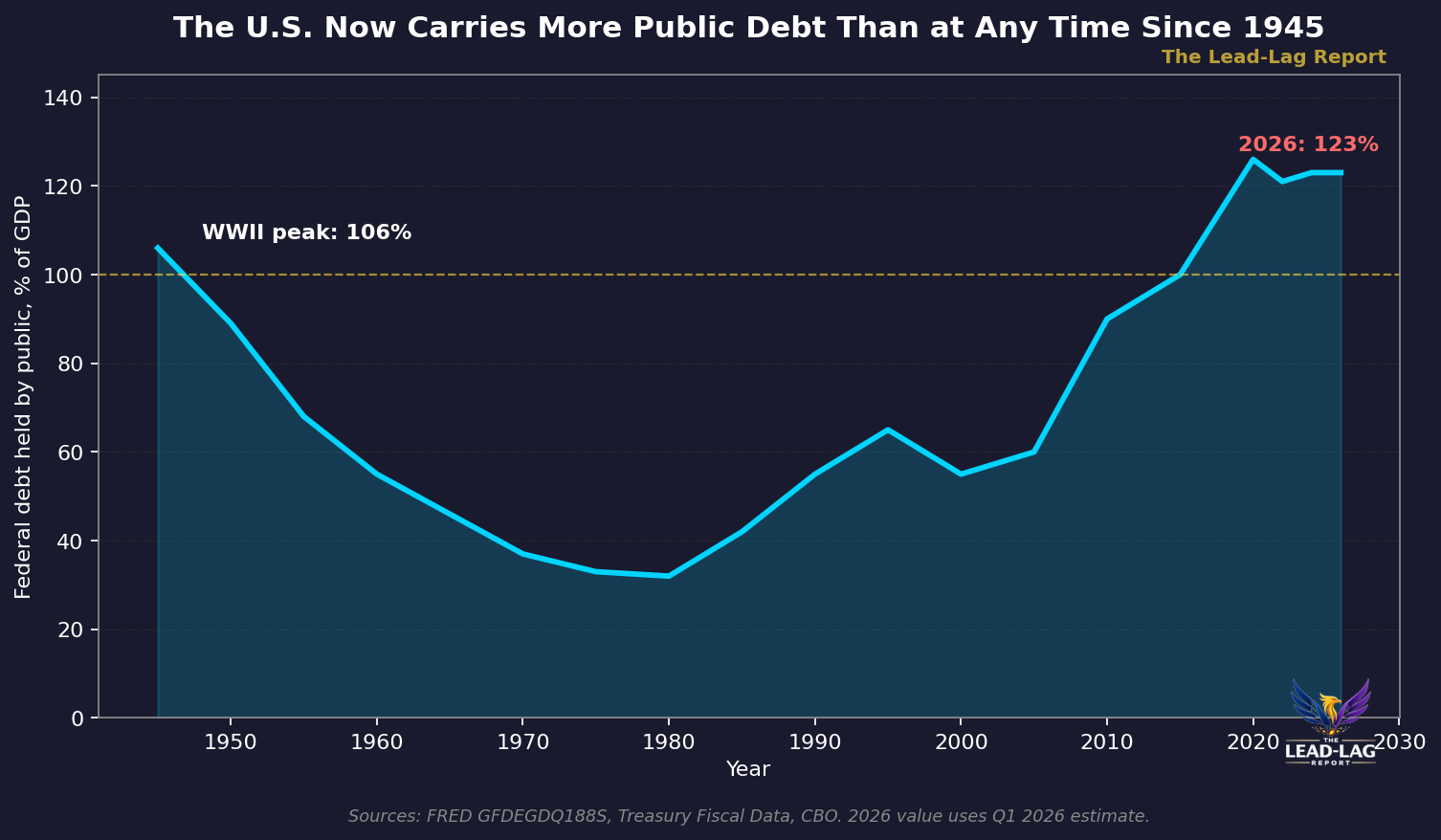
U.S. federal debt held by the public passed 122 percent of GDP in the first quarter of 2026, and total federal debt exceeded 122.6 percent, per the St. Louis Fed[2]. This is higher than the World War II peak of roughly 106 percent, reached at a moment when the United States had just financed the largest military mobilization in human history and was in the process of demobilizing.
The distinction matters. In 1946, debt-to-GDP was declining rapidly because the war had ended and the productive economy was expanding. In 2026, debt-to-GDP is rising because deficits are running at $1.9 trillion, and are projected by the Congressional Budget Office to remain at or above 5 percent of GDP for the next decade even under baseline assumptions of continuous economic expansion and 4.2 percent unemployment[3]. We are running war-scale deficits at the top of the business cycle.
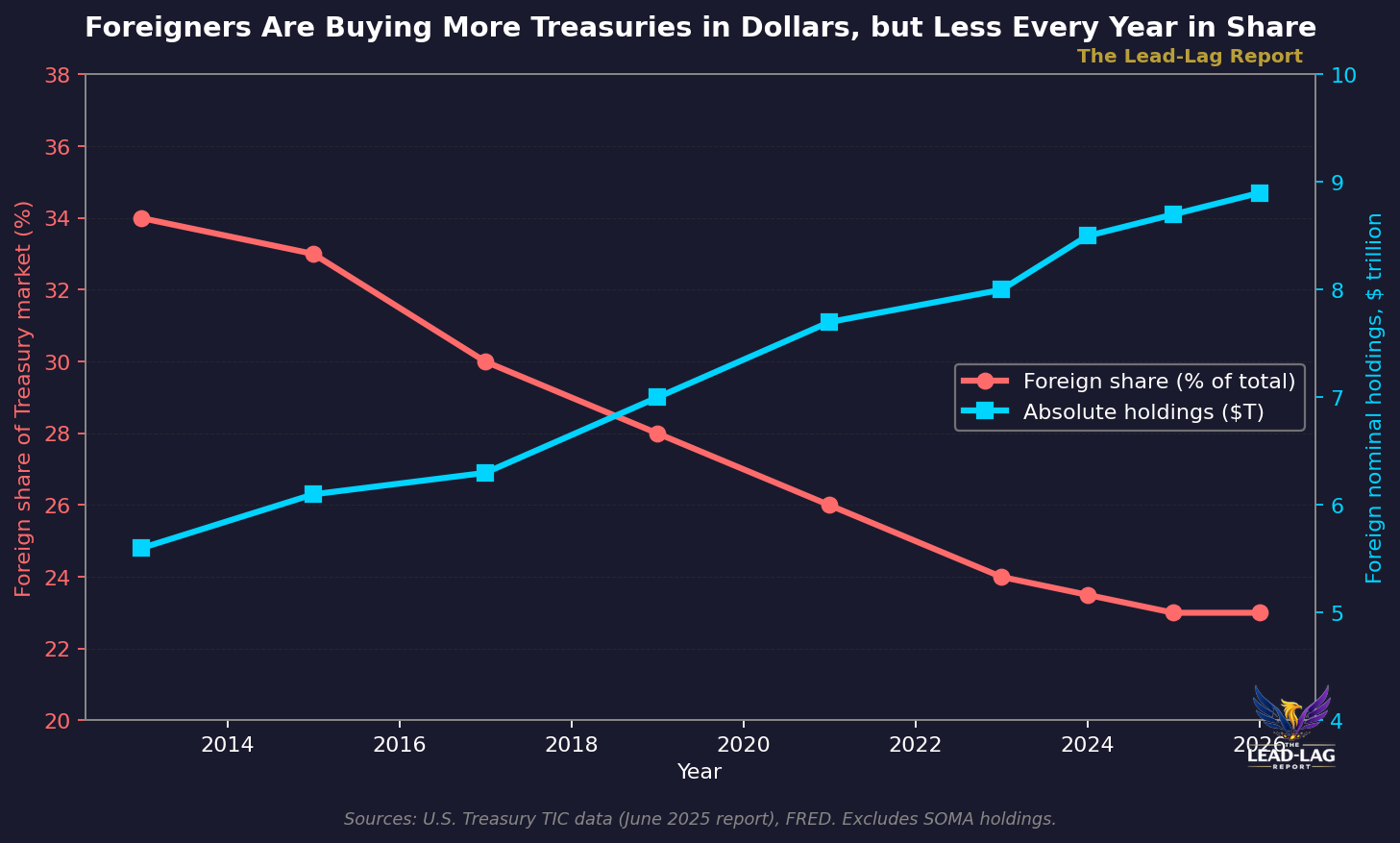
The structural buyer base for those Treasuries has meanwhile been quietly disassembling. Foreign holdings of U.S. Treasury securities as a share of total marketable debt have fallen from roughly 34 percent in 2013 to approximately 23 percent in 2026[4]. In nominal dollars, foreign holdings rose from about $5.6 trillion to $8.9 trillion. But the debt they were funding rose faster. Supply overwhelmed the marginal price-sensitive buyer.
Who took the other side? Domestic price-insensitive buyers. The Federal Reserve, which absorbed several trillion in quantitative easing purchases before beginning to unwind. Money-market funds and banks under regulatory mandates to hold Treasuries as high-quality liquid assets. They buy because they are structurally required to, not because they are performing genuine credit and duration analysis.
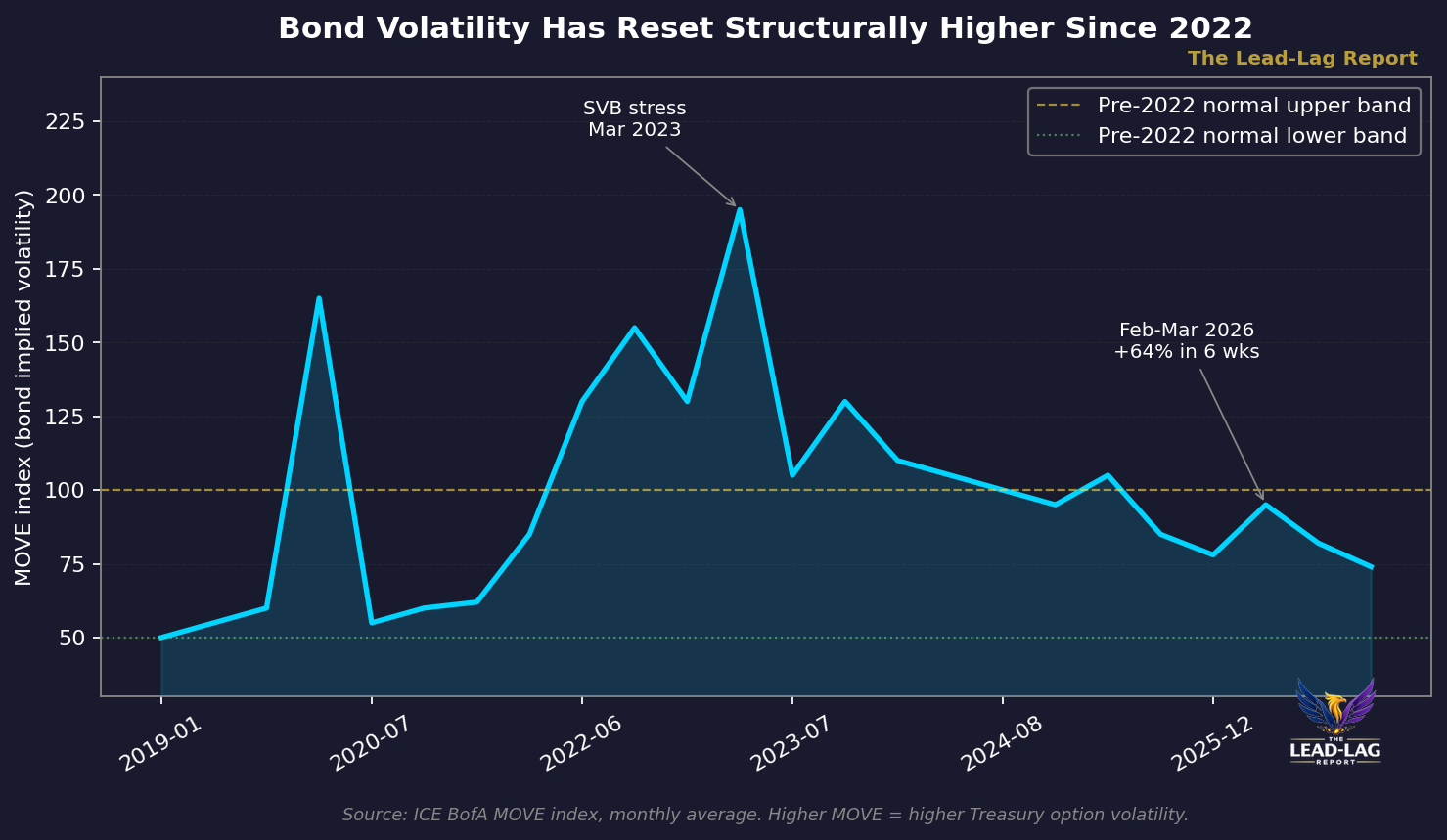
The Merrill Lynch MOVE Index, the fixed-income equivalent of the VIX, reads 74.18 as of July 29, 2026, off its recent spike near 95 during the February-March 2026 dislocation[5]. But 74 is still meaningfully above the pre-2022 average of 55. The regime has shifted. Rates volatility is now a structural feature of the U.S. Treasury market, not an episodic phenomenon around specific Federal Reserve meetings. That is what a bond market looks like when the marginal buyer has changed, and when the market is no longer confident that the fiscal path is stable.
What this means, in plain English, is that the price signaling function of the U.S. Treasury market has degraded. That process, if it continues, does not end in a crash. It ends in the Federal Reserve becoming the buyer of last resort at every long-end auction. At which point the yield curve is a policy variable, not a market signal.
What Communism Actually Signals
In January of this year, Zohran Mamdani was sworn in as the 112th mayor of New York City after running an explicit democratic-socialist platform. Rent freezes. Fare-free buses. Universal childcare. City-owned grocery stores in each borough. At his one-hundred-day address, he described his approach as "pothole politics," a 2026 version of what he called sewer socialism[6].
It would be easy to dismiss this as a local phenomenon in one deep-blue city. It is not. It is a leading indicator. Every major shift in a country's economic ideology has been preceded by a period in which the population concluded that the existing system was rigged, that ordinary work no longer produced ordinary prosperity, and that the traditional guardrails, whether courts, legislatures, or markets, had ceased to constrain a governing class perceived to be acting in its own interest.
The bond market has historically been the most powerful of those guardrails because it acted quietly and continuously. When the U.K. government tried to pass an unfunded tax cut in September 2022, the gilt market blew up in forty-eight hours and forced the government to reverse itself and, ultimately, resign. That is what a functioning bond market does. It prices in political consequence before political consequence arrives. When it stops doing that, the political system searches for a new source of discipline. That new source, historically, has been the crowd.
It is not a coincidence that the political discourse in this country has moved measurably to the left in the same window during which the bond market has lost its power to constrain the fiscal deficit. Voters do not read TIC data. They read grocery prices, rent increases, and the perceived fairness of the game. When a bond market stops disciplining a fiscal deficit, that deficit ultimately manifests as inflation, asset-price inflation, or currency debasement. Each of those, in turn, transfers wealth from wage earners to asset holders. And when that transfer has gone on long enough, the political system that permitted it loses legitimacy.
Be Careful What You Wish For
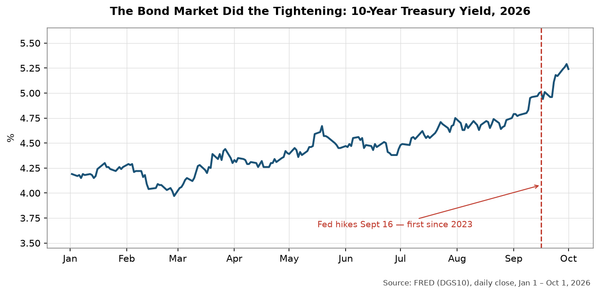
The financial press has spent the past two years cheering every downtick in the 10-year yield as if lower rates were unambiguously good. They are not. Yields at 4.5 percent with 3.4 percent core PCE inflation and $1.9 trillion deficits are already artificially low. What would signal a genuinely healthy bond market is not lower yields. It is higher yields, driven by the return of price-sensitive marginal buyers demanding a real risk premium.
The opposite scenario, the one being cheered, is yields being pushed lower by a combination of Fed rate cuts, forward guidance, and if necessary, yield-curve control. That path preserves nominal asset prices in the short run. It also completes the transition of the Treasury market from a price-discovery mechanism into a fiscal-policy tool. Once complete, the bond market is dead in every functional sense. It still exists as a venue. It just no longer performs its function.
At that point, capitalism as understood since Adam Smith no longer has a functioning capital allocator. Capital flows to whichever borrower the state prefers, at whichever rate the state sets. That is not a slippery slope argument. That is the definition of a command economy with a stock exchange on top of it, which is what China has run for the past twenty years. It is not by accident that the same publications that dismissed the possibility of Zohran Mamdani's election are now producing thoughtful essays on whether the U.S. economy needs "strategic capital allocation." That is the language of the transition.
The Trade Nobody Wants to Make
There is a specific asymmetry in the current bond market that few investors are positioned for. The consensus trade is duration extension on the belief that the Fed will cut rates and long-end yields will fall in sympathy. That trade works if inflation cooperates, if issuance moderates, and if foreign demand stabilizes. Three assumptions, each of which the data is quietly rejecting.
The contrarian trade is not a bearish duration bet in the ordinary sense. It is a bet on convexity. Long volatility in rates, expressed through payer swaptions or long-dated OTM puts on Treasury futures, is priced for a world in which the MOVE index reverts to its pre-2022 range. It should not. The structural buyer base has changed. The issuance profile has changed. The Fed's reaction function has changed. Rates volatility pricing has not fully caught up to any of those changes.
The other underappreciated position is gold. Not as an inflation hedge in the ordinary sense, but as a hedge against the failure of the bond market to price sovereign risk. Central banks around the world have been the marginal buyer of gold since 2022. That is not a retail phenomenon. That is professional money that has looked at foreign holdings of Treasuries, drawn the trend line forward, and decided to diversify. The retail investor, still holding a 60/40 portfolio with the 40 in nominal Treasuries, is on the other side of that trade whether he knows it or not.
Falsification
Every macro thesis needs a specific observable that would invalidate it. For this one, the falsification condition is straightforward. If foreign holdings of U.S. Treasuries as a share of total marketable debt rise back above 30 percent within the next three years, without a corresponding collapse in the total, the marginal-buyer thesis is wrong. If the MOVE index sustains below 60 for four consecutive quarters, the structural volatility thesis is wrong. If federal interest expense as a share of federal receipts falls back below 15 percent, the crowding-out thesis is wrong.
None of those observables are currently trending in the direction that would invalidate the thesis. Every one is trending in the direction that confirms it.
What This Means for Investors
- The 60/40 portfolio's 40 percent nominal-Treasury allocation is not a hedge in this regime. It is a levered bet on a bond market that no longer functions as a shock absorber. A more defensible construction rotates a portion into TIPS, into gold, and into rates volatility.
- Sponsors and issuers of long-duration fixed-income products face a structural headwind. Duration risk is asymmetrically distributed toward yields staying higher for longer than the forward curve implies. Products marketed on yield stability have model risk that is not fully priced.
- Emerging-market sovereign spreads, historically wide over U.S. Treasuries, may compress not because EM improved, but because the U.S. deteriorated. That is not a bullish EM signal. It is a bearish U.S. signal that shows up on someone else's spread chart first.
- The equity market's price-to-earnings multiple is anchored, in every academic framework, to the risk-free rate. If the risk-free rate is no longer risk-free, that multiple is anchored to nothing. That does not mean equities crash. It means the ground beneath equity valuations has become unstable in a way that the VIX does not measure.
The Takeaway
Capitalism does not die in a moment. It dies gradually, in the way that a body dies when the heart stops beating. The bond market is the heart. The interest expense is the pulse. The foreign holder is the marginal supplier of oxygen. The MOVE index is the electrocardiogram.
Every reading is pointing in the same direction, and the political system is responding, as political systems always have when the bond market can no longer be trusted to discipline the fiscal authority, by searching for alternatives that have historically not ended well. The rise of democratic socialism in the largest American city is a symptom, not a cause. The cause is upstream, on the CBO's website, in a spreadsheet.
Be very careful what you wish for in markets. The lower-yield environment being cheered is the transition, not the destination. The destination, absent an intervention that no one in Washington is prepared to make, is a bond market that no longer functions as a bond market, and an economy that no longer functions as capitalism. What replaces it will be called many things. But it will not be what it says on the door.
Few understand this.
Notes
[1] Committee for a Responsible Federal Budget analysis of Treasury Direct outlays; CBO Budget and Economic Outlook 2026-2036; Fortune reporting (March 2026) placing FY2026 gross interest expense near $1 trillion. https://www.cbo.gov/publication/62105
[2] Federal Reserve Bank of St. Louis, GFDEGDQ188S series; Q1 2026 reading of 122.6 percent published Jun 2026. https://fred.stlouisfed.org/series/GFDEGDQ188S
[3] CBO baseline February 2026: FY2026 deficit projected at $1.9 trillion, unemployment at 4.2 percent per BLS June 2026 release. https://www.cbo.gov/publication/62105
[4] U.S. Treasury International Capital (TIC) data, June 2026 report covering positions as of June 30, 2025; 2026 estimates based on monthly TIC updates through May 2026. Excludes System Open Market Account holdings. https://ticdata.treasury.gov/Publish/shlptab2.html
[5] ICE BofA MOVE Index, monthly average via Reuters and TradingView. Reading of 74.18 on July 29, 2026. Structural range shift documented by TheTradable.com March 2026 analysis. https://www.reuters.com/markets/quote/.MOVE/
[6] City & State New York, "100 days in, Mamdani embraces democratic socialism," April 13, 2026. Additional reporting from CNN and ABC News confirming inauguration date of January 2026. https://www.cityandstateny.com/politics/2026/04/100-days-mamdani-embraces-democratic-socialism/412789/
The Lead-Lag Report is provided by Lead-Lag Publishing, LLC. All opinions and views mentioned in this report constitute our judgments as of the date of writing and are subject to change at any time. Information within this material is not intended to be used as a primary basis for investment decisions and should also not be construed as advice meeting the particular investment needs of any individual investor. Trading signals produced by the Lead-Lag Report are independent of other services provided by Lead-Lag Publishing, LLC or its affiliates, and positioning of accounts under their management may differ. Please remember that investing involves risk, including loss of principal, and past performance may not be indicative of future results. Lead-Lag Publishing, LLC, its members, officers, directors and employees expressly disclaim all liability in respect to actions taken based on any or all of the information on this writing.