A 12.4% Yield The IRS Cannot Touch, With A 13-Year Duration Attached
Nuveen's AMT-free muni fund pays 7.14% tax-free, which is worth roughly 12.4% pre-tax to a top-bracket investor, but 41% leverage and a 13.2-year duration made it lose 23% in 2022

Today’s Lead-Lag Report post is sponsored by Manifesting Algorithm

111,000+ people paid over $1,000 for the recording of one closed-door lecture on how the wealthy manifest what they want. Right now it's free — the full audio plus the new 500-page manuscript.
“Your Wish Is Your Command” was recorded at a private event in the Swiss Alps. Kevin Trudeau’s premise: the Law of Attraction fails because your brain broadcasts on the wrong frequency — and the fix is learnable. Full audio + the rewritten 500-page e-book, free.
DISCLAIMER – PLEASE READ: This is sponsored advertising content for which Lead-Lag Publishing, LLC is being paid a fee. The information provided is solely the creation of Manifesting Algorithm. Lead-Lag Publishing, LLC does not guarantee the accuracy or completeness of the information provided or make any representation as to its quality. All statements and expressions provided are the sole opinion of Manifesting Algorithm and Lead-Lag Publishing, LLC expressly disclaims any responsibility for action taken in connection with the information provided.
KEY HIGHLIGHTS
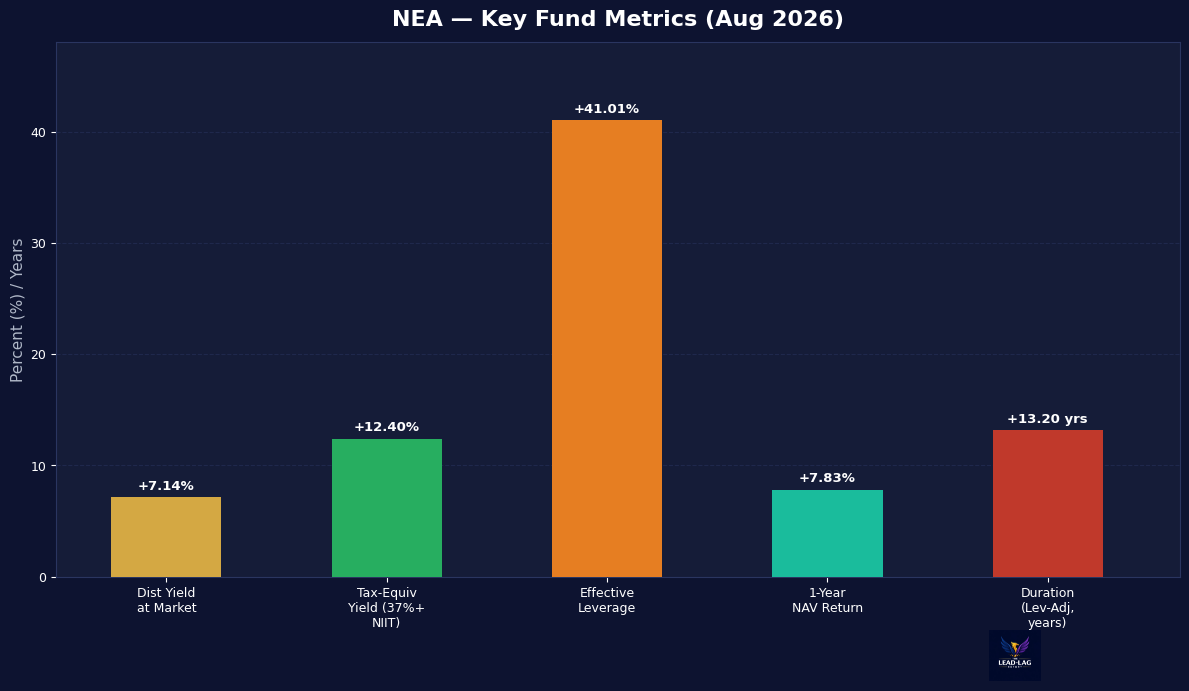
Yield: 7.14% at market | Taxable-equivalent: ~12.4% (top bracket, 37% + 3.8% NIIT)
Tax advantage: Federal income tax exempt + AMT-exempt -- core reason to own NEA over a taxable bond fund
Valuation: +1.16% premium vs -0.81% 52-week average -- currently slightly expensive; range -4.22% to +1.40%
Duration risk: 13.20-year leverage-adjusted duration -- very sensitive to rate moves; -23.3% in 2022
AUM: $5.83B total exposure | 41% effective leverage | ~47% of distribution estimated as return of capital
Every week, we'll profile a high yield investment fund that typically offers an annualized distribution of 6-10% or more. With the S&P 500 yielding less than 2%, many investors find it difficult to achieve the portfolio income necessary to meet their needs and goals. This report is designed to help address those concerns.

Income investors spend most of their time arguing about yield and almost none about what they keep. That is backwards. A taxable 9% coupon in a top-bracket brokerage account nets out below 6% once federal tax and the net investment income surtax are applied. A tax-exempt 7% keeps all of it, and closing that gap requires no extra credit risk and no manager skill, only attention to the tax code.
That is the entire reason leveraged municipal closed-end funds exist. The bonds are investment grade, default experience is historically minimal, and the coupon escapes federal tax. What the structure adds is leverage, and what leverage adds is duration. A muni CEF is not a credit bet. It is an interest rate bet with a tax subsidy stapled to the front.
The largest and most liquid expression of that trade is the Nuveen AMT-Free Quality Municipal Income Fund (NEA). The fund runs $5.83 billion in total investment exposure across 1,072 municipal positions and distributes $0.0680 per share monthly, a 7.14% yield at the current $11.37 price, free of federal income tax and free of the alternative minimum tax. For a 37% bracket investor paying the 3.8% surtax, that is a taxable-equivalent yield of roughly 12.4%, and no taxable investment grade fund in this series comes close. That number is the bull case. It is also the only part of the story that is unambiguously good, because the fund trades at a premium rather than the usual muni CEF discount, carries a 13.20-year leverage-adjusted duration, and funds roughly 47% of its distribution with estimated return of capital against negative $0.8250 in average undistributed net investment income.
Fund Background
Structure. NEA is a closed-end fund listed on the NYSE and managed by Nuveen, the largest manager in the municipal closed-end space, running this strategy since the fund's November 2002 inception. Nearly twenty-four years of history covers the financial crisis, the taper tantrum, the March 2020 muni liquidity seizure, and the 2022 rate shock. Nothing about how this fund behaves under stress is a mystery.
Mandate. The portfolio holds investment grade municipal bonds under an explicit AMT-free constraint, so individual holders need not worry about private activity bond income triggering alternative minimum tax. Holdings number 1,072 at an average maturity of 19.14 years and an average coupon of 5.18%, per [CEFConnect](https://www.cefconnect.com/fund/NEA).
Leverage. Effective leverage sits at 41.01%, financed at an average 3.18%. The fund borrows roughly $1.83 billion against a $3.44 billion common asset base. The spread between the 5.18% coupon and the 3.18% borrowing cost is what manufactures a 7% payout out of a 4% asset class.
Pricing. NEA trades at $11.37 against a net asset value of $11.36, a 1.16% premium. The 52-week average is a 0.81% discount and the range ran from a 4.22% discount to a 1.40% premium, per [Nuveen's fund page](https://www.nuveen.com/en-us/closed-end-funds/nea-nuveen-amt-free-quality-municipal-income-fund). Buyers today sit at the expensive end of a one-year range.
Portfolio Composition
Sector exposure is led by health care at 21.3%, tax obligation limited at 20.3%, transportation at 14.4%, and utilities at 12.3%, per Nuveen's [second quarter fact sheet](https://documents.nuveen.com/Documents/Nuveen/Viewer.aspx?uniqueId=3b907f74-2bc5-46fd-b667-a78396fb9d37&download=1). That is a revenue-bond-heavy book rather than a general obligation book. Health care munis are hospital system debt, and hospital credit is genuinely cyclical, sensitive to reimbursement policy, labor costs, and patient volumes. It is both the largest and the most credit-exposed sleeve in the fund. Tax obligation limited bonds are backed by dedicated revenue streams such as sales taxes rather than a full faith and credit pledge, transportation covers toll roads, airports, and transit, and utilities are water, sewer, and municipal power, historically the most stable corner of the market.
The honest read on 1,072 holdings is that credit selection barely matters. No single issuer moves the needle, and return is driven almost entirely by the level and shape of the municipal yield curve. That is a feature if you want a clean rate expression and a limitation if you hoped to be paid for manager skill.
What matters is the 19.14-year average maturity combined with 41% leverage, which produces the 13.20-year leverage-adjusted effective duration. That is the most important number in this report. It says a 100 basis point move in municipal yields should move net asset value roughly 13%, in either direction.

Performance Analysis
The record splits cleanly into rate regimes. From 2019 through 2021, with yields low and falling, NEA delivered price returns of 22.42%, 10.09%, and 8.17% against NAV returns of 12.17%, 7.39%, and 3.57%. Leverage plus long duration in a falling rate environment is a wonderful thing, and the price outperformance reflects discounts narrowing as buyers chased tax-free income.
Then 2022 happened. Price fell 23.30% and net asset value fell 18.01% as the Fed hiked at the fastest pace in four decades. Nothing went wrong with the credit. A 13-year duration met a 400 basis point tightening cycle and leverage did what leverage does. That is not a tail scenario. It is what this structure does when the rate call goes wrong.
The recovery since has come from valuation, not assets. In 2023 net asset value returned 8.21% while price managed 0.73%. In 2024 price rose 9.50% against 0.28% on NAV, and in 2025 price rose 11.30% against 2.45%. Across those two years price gained roughly 21% while the portfolio produced under 3%. That is discount compression, and it is why the fund now trades at a premium.
Year to date in 2026, price is up 0.98% and net asset value is flat. The valuation tailwind has run out of room. There is no discount left to close.


Macro Environment
Everything about the forward return here reduces to the path of long rates.
In a rate-cutting scenario, NEA is one of the more attractive vehicles available anywhere. A 100 basis point decline in muni yields against a 13.20-year duration implies roughly 13% of net asset value appreciation on top of a 7.14% tax-free distribution, with the fund's 3.18% borrowing cost falling at the same time and widening the leverage spread. High-teens total return is achievable, which is why muni CEFs get bid aggressively whenever the market smells easing.
In a rate-hold scenario the outcome is mediocre. Investors collect the distribution, the leverage spread stays put, net asset value drifts sideways, and the 1.16% premium is more likely to compress toward the negative 0.81% average than to expand.
In a rising rate scenario this is a bad place to be. Credit quality would be irrelevant, duration would drive the loss, leverage would multiply it, the premium would flip to a wide discount, and borrowing costs would climb into it. A 15% to 20% drawdown is not a stretch.
One risk specific to munis rarely gets priced: the exemption is only valuable while tax rates stay high. Any serious move toward lower top marginal rates or repeal of the surtax compresses the advantage that justifies owning this over a taxable alternative.
Distribution Policy
NEA pays $0.0680 per share monthly, annualizing to $0.816, which is 7.14% on the $11.37 price and 7.18% on the $11.36 net asset value. Monthly cadence is a real advantage for anyone living on portfolio income.
The coverage picture is the problem. Nuveen's reporting shows an average earnings to distribution ratio of 59.53%, average undistributed net investment income of negative $0.8250 per share, and roughly 47% of the distribution estimated as return of capital. The portfolio is earning about 60 cents of every dollar it pays, the shortfall has accumulated into a negative UNII balance, and close to half of what arrives in the account is capital coming back.
To be fair, return of capital in a muni fund is less alarming than in an equity fund. Some of it reflects amortization of premium bonds, an accounting artifact rather than value erosion, and it defers tax by reducing basis. But 59.53% coverage against a negative UNII balance is more than a quirk. It is a distribution running ahead of what the assets generate.
Treat the 7.14% as a payout rate, not an earnings rate. Nuveen has historically adjusted muni CEF distributions rather than defending them indefinitely, so underwrite this position assuming the payout can come down, because on these figures it eventually may.

Advantages
The tax-equivalent yield is the argument and it is close to unbeatable in its lane. A 7.14% federally exempt distribution is worth roughly 12.4% pre-tax in the 37% bracket with the 3.8% surtax, and producing 12.4% on taxable investment grade paper is not possible without credit risk munis do not require. The AMT-free construction removes the one wrinkle that spoils the exemption for high earners.
Credit quality and diversification are genuine strengths. This is an investment grade book of 1,072 positions at a 5.18% average coupon, and municipal default experience is historically a fraction of comparably rated corporate debt. Whatever goes wrong here is unlikely to be credit.
Scale matters more than investors assume in munis. At $5.83 billion in total exposure, NEA is among the largest municipal closed-end funds in existence, which supports liquidity and gives Nuveen new issue allocations and block pricing a smaller fund cannot match, at a reasonable 0.99% expense ratio on common shares.
The rate setup is potentially excellent. If easing continues, a 13.20-year duration levered 41% into falling yields is close to the highest-torque tax-free instrument available, and the fund's own borrowing cost falls alongside, lifting earned income while net asset value appreciates.
Disadvantages
The duration is the dominant risk and it is severe. A 13.20-year leverage-adjusted duration means a 1% move in muni yields is roughly a 13% move in net asset value, and 2022 demonstrated it with a 23.30% price decline. Anyone buying for a tax-free 7% is buying the volatility of a long-duration bet, not a savings vehicle, and credit quality offers no protection because rate risk and credit risk are different things.
The valuation offers no cushion. At a 1.16% premium against a 0.81% average discount, buyers are paying above net asset value in a category where discounts are the norm and where the 52-week range bottomed at a 4.22% discount. The 2024 and 2025 price gains of 9.50% and 11.30% came against NAV returns of 0.28% and 2.45%, so the recent return was valuation rather than assets. That well is dry, and mean reversion now works against the buyer.
Distribution coverage is weak. A 59.53% earnings to distribution ratio, negative $0.8250 average UNII, and roughly 47% of distributions estimated as return of capital together say the payout exceeds earned income, which raises the probability of a cut if the leverage spread narrows.
The cost of that leverage is not trivial either. Effective leverage of 41.01% at a 3.18% financing cost pushes the all-in expense ratio to 2.88% including interest, and if short rates stay elevated while long muni yields do not fall, the spread compresses from both ends.
Finally, the tax advantage exists only in a taxable account. Holding NEA in an IRA converts a tax-free 7.14% into an ordinary 7.14% and discards the reason the fund exists, leaving a leveraged long-duration bond fund charging 2.88% all-in. Account placement is not a detail here. It is the thesis.
Final Thoughts
NEA is a well-run vehicle built for one specific job, offered at a slightly worse than average price right after the easy money in it has been made.
The case for owning it is narrow and strong. If you are in the top federal bracket, hold it in a taxable account, and want tax-free monthly income from investment grade credit, a 7.14% distribution worth roughly 12.4% pre-tax is hard to replicate. Nuveen is the right manager, the diversification is real, the AMT-free structure closes the loophole that matters, and if the Fed keeps cutting, a 13.20-year duration levered 41% is exactly where an income investor wants to be.
The case for restraint is equally clear. The premium leaves no valuation cushion, the 2024 and 2025 gains were discount compression rather than portfolio performance, coverage at 59.53% with negative UNII means the distribution runs ahead of earnings, and the duration behind the bull case works with equal force in reverse. A repeat of 2022 costs more than three years of distributions.
So this is a position sized to a rate view, not a core income holding. If your base case is meaningfully lower yields over the next year or two, NEA is one of the better ways to express it and the tax treatment makes it better still. If you are agnostic on rates and simply want the yield, wait for the premium to give way to a discount closer to the 4.22% low. And if it is going in a retirement account, do not buy it at all. The 12.4% is real, but only for the investor eligible to collect it.
The Lead-Lag Report is provided by Lead-Lag Publishing, LLC. All opinions and views mentioned in this report constitute our judgments as of the date of writing and are subject to change at any time. Information within this material is not intended to be used as a primary basis for investment decisions and should also not be construed as advice meeting the particular investment needs of any individual investor. Trading signals produced by the Lead-Lag Report are independent of other services provided by Lead-Lag Publishing, LLC or its affiliates, and positioning of accounts under their management may differ. Please remember that investing involves risk, including loss of principal, and past performance may not be indicative of future results. Lead-Lag Publishing, LLC, its members, officers, directors and employees expressly disclaim all liability in respect to actions taken based on any or all of the information on this writing.