The Allocation No One Talks About, and Why Today's WASDE Just Made It Impossible to Ignore
Agriculture ETFs are 0.01 percent of all ETF AUM. Yesterday's WASDE cut US wheat stocks 22 percent YoY. Live today at 2 PM ET with Jake Hanley of Teucrium. CFP CE credit included.

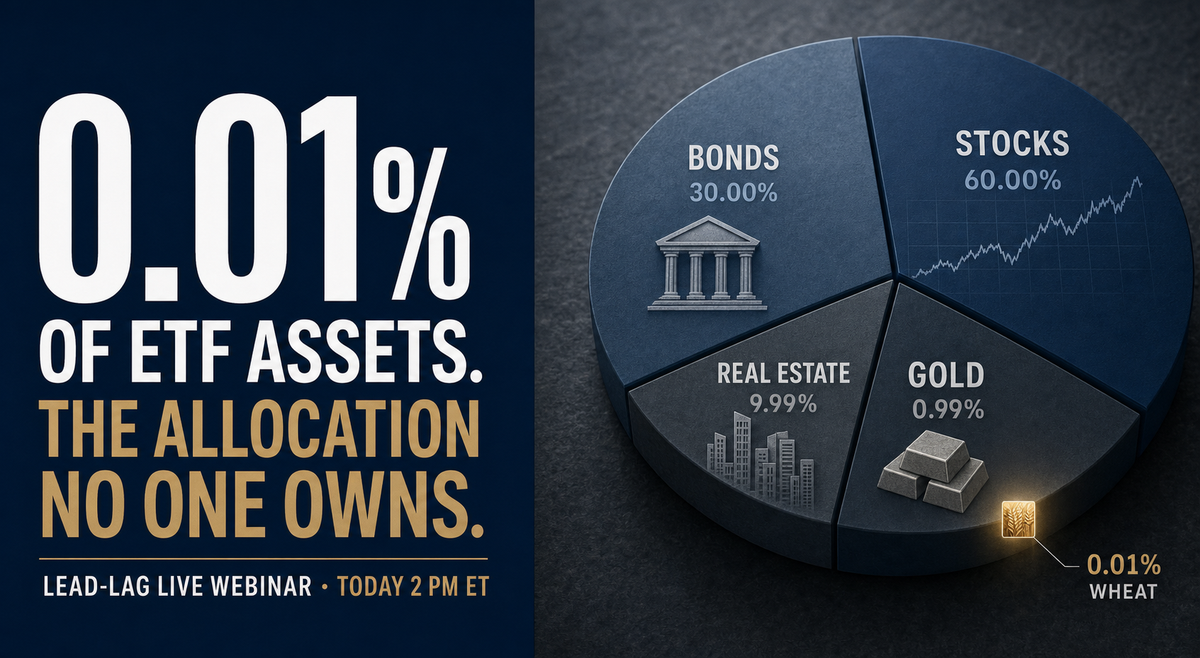
Live today at 2 PM ET. Register here to join the Lead-Lag Live webinar.
There is an asset class sitting inside the ETF universe that almost no professional allocator holds. Not because it's controversial. Not because it's expensive. Because nobody talks about it.
Agriculture.
Agriculture ETFs account for roughly 0.01 percent of all ETF assets under management. Not one percent. One one-hundredth of one percent. In a world where every advisor is looking for uncorrelated return streams, for something that behaves differently than the S&P 500, for something that responds to real-world supply and demand rather than Fed policy, the answer has been in front of us the entire time and almost nobody has been paying attention.
Yesterday's WASDE report from the USDA gave us a reason to start.
What just changed in wheat
The August 12 World Agricultural Supply and Demand Estimates report cut US wheat ending stocks for the 2026/27 marketing year to 717 million bushels. That is a 22 percent year-over-year decline. Production was revised down 5 million bushels, with Hard Red Winter and Durum both taking cuts. The season-average farm price moved up 20 cents to $6.20 per bushel.
On the global side, USDA cut Russia and Ukraine wheat exports by roughly 300,000 metric tons combined. The stated reason: ongoing conflict in the Sea of Azov and Black Sea corridor. Those two countries move about 30 percent of world wheat trade between them. When their export logistics get disrupted, US and EU producers become the marginal supplier. And EU and UK production also just got trimmed on grain-fill heat damage.
This is exactly the kind of setup where an agriculture allocation earns its keep in a portfolio. A tightening supply picture. A geopolitical wildcard. A commodity that trades independently of what the Nasdaq does tomorrow.
Why advisors haven't been in this space
Three reasons, and none of them hold up to scrutiny anymore.
First, most advisors were taught that commodity exposure means either a futures account or a fund-of-funds structure with layers of fees. The modern agriculture ETF sidesteps both. It's a listed vehicle. It trades like any other ETF on your platform. Your custodian handles it. Your reporting handles it. Your fee schedule handles it.
Second, there's a belief that commodities are too volatile to allocate to responsibly. The data doesn't support that when you look at agriculture specifically. Grains, softs, and livestock do not move in lockstep with each other or with equities. That's the entire point. Volatility is not risk if it's not correlated to what you already own.
Third, advisors who have looked at the space have often looked at broad commodity ETFs, seen the energy weight, decided they don't want the energy exposure, and walked away. That is a category error. Agriculture ETFs exist. They isolate the exposure. You can size the sleeve precisely.
What today's webinar covers
Jake Hanley, Managing Director and Senior Portfolio Strategist at Teucrium, is walking through:
The mechanics of futures-based agriculture ETFs , how they are structured, why they behave differently than equity ETFs, and what to know about K-1s versus 1099s.
The current state of grain fundamentals , wheat, corn, soybeans , with yesterday's WASDE data as the anchor.
What allocators are actually doing right now , sizing, sleeve construction, and how a small dedicated agriculture position changes the correlation profile of a traditional 60/40.
And the piece most people miss , what to say to a client who asks why you're adding agriculture to their portfolio in 2026. The narrative matters. The narrative is currently very good.
Details
Date: Today, Thursday August 13, 2026
Time: 2:00 PM ET
Format: 45 minutes with Jake Hanley, followed by live Q&A
Continuing Education: 1 hour CFP CE approved (Investment Planning category). Attendance is captured automatically from Zoom's participant report. Certificates go out within 5 business days.
Registration
There are three ways to register. Use whichever you prefer , all three route to the same event.
1. Zoom registration page: us06web.zoom.us/webinar/register/WN_21rGpEjWQy-CcQp9tCysKw
2. Click here: Register for the Lead-Lag Live webinar
Register , Free CFP CE Credit Included
If you've been telling clients that alternatives are a legitimate part of a modern portfolio but you haven't given them a real answer on what those alternatives look like beyond hedge funds and private credit , this hour will change that.
Agriculture is the alternative allocation nobody's crowded into. Today's WASDE just made it much harder to keep ignoring.
See you at 2.
Michael A. Gayed, CFA
Publisher, The Lead-Lag Report
Founder, Lead-Lag Media
Sponsor
This webinar is sponsored by Teucrium. Teucrium is an ETF issuer specializing in futures-based commodity products, including agriculture, natural resources, and digital-asset strategies. This is not investment advice. Please consult your own advisor before making any allocation decisions. Teucrium disclosures and prospectus information are available at teucrium.com.